Modular Data Center

Modular Data Center Architecture Analysis

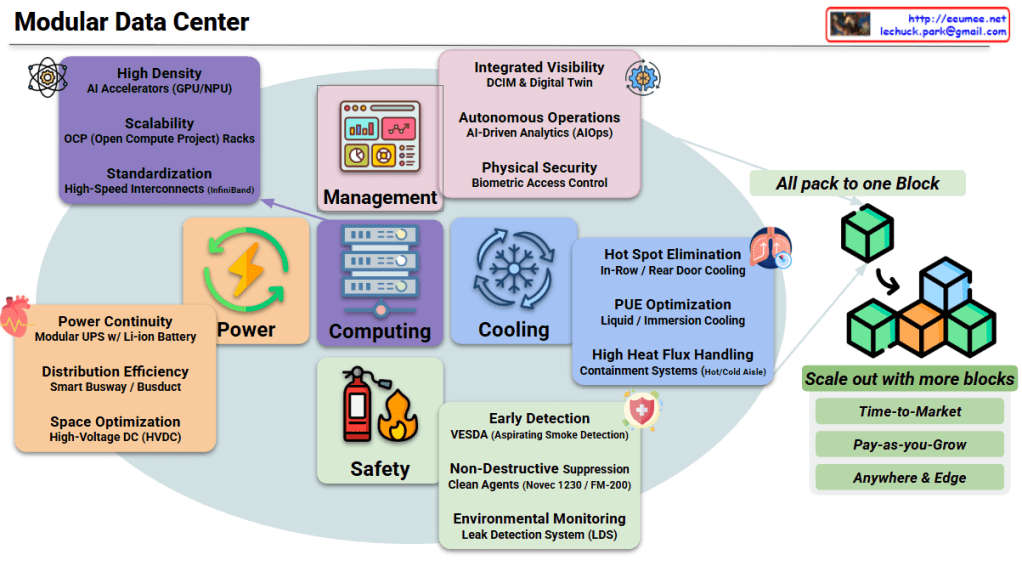
This image illustrates a comprehensive Modular Data Center architecture designed specifically for modern AI/ML workloads, showcasing integrated systems and their key capabilities.

Core Components

1. Management Layer

  • Integrated Visibility: DCIM & Digital Twin for real-time monitoring
  • Autonomous Operations: AI-Driven Analytics (AIOps) for predictive maintenance
  • Physical Security: Biometric Access Control for enhanced protection

2. Computing Infrastructure

  • High Density AI Accelerators: GPU/NPU optimized for AI workloads
  • Scalability: OCP (Open Compute Project) Racks for standardized deployment
  • Standardization: High-Speed Interconnects (InfiniBand) for low-latency communication

3. Power Systems

  • Power Continuity: Modular UPS with Li-ion Battery for reliable uptime
  • Distribution Efficiency: Smart Busway/Busduct for optimized power delivery
  • Space Optimization: High-Voltage DC (HVDC) for reduced footprint

4. Cooling Solutions

  • Hot Spot Elimination: In-Row/Rear Door Cooling for targeted heat removal
  • PUE Optimization: Liquid/Immersion Cooling for maximum efficiency
  • High Heat Flux Handling: Containment Systems (Hot/Cold Aisle) for AI density

5. Safety & Environmental

  • Early Detection: VESDA (Very Early Smoke Detection Apparatus)
  • Non-Destructive Suppression: Clean Agents (Novec 1230/FM-200)
  • Environmental Monitoring: Leak Detection System (LDS)

Why Modular DC is Critical for AI Data Centers

Speed & Agility

Traditional data centers take 18-24 months to build, but AI demands are exploding NOW. Modular DCs deploy in 3-6 months, allowing organizations to capture market opportunities and respond to rapidly evolving AI compute requirements without lengthy construction cycles.

AI-Specific Thermal Challenges

AI workloads generate 3-5x more heat per rack (30-100kW) compared to traditional servers (5-10kW). Modular designs integrate advanced liquid cooling and containment systems from day one, purpose-built to handle GPU/NPU thermal density that would overwhelm conventional infrastructure.

Elastic Scalability

AI projects often start experimental but can scale exponentially. The “pay-as-you-grow” model lets organizations deploy one block initially, then add capacity incrementally as models grow—avoiding massive upfront capital while maintaining consistent architecture and avoiding stranded capacity.

Edge AI Deployment

AI inference increasingly happens at the edge for latency-sensitive applications (autonomous vehicles, smart manufacturing). Modular DCs’ compact, self-contained design enables AI deployment anywhere—from remote locations to urban centers—with full data center capabilities in a standardized package.

Operational Efficiency

AI workloads demand maximum PUE efficiency to manage operational costs. Modular DCs achieve PUE of 1.1-1.3 through integrated cooling optimization, HVDC power distribution, and AI-driven management—versus 1.5-2.0 in traditional facilities—critical when GPU clusters consume megawatts.

Key Advantages

📦 “All pack to one Block” – Complete infrastructure in pre-integrated modules 🧩 “Scale out with more blocks” – Linear, predictable expansion without redesign

  • ⏱️ Time-to-Market: 4-6x faster deployment vs traditional builds
  • 💰 Pay-as-you-Grow: CapEx aligned with revenue/demand curves
  • 🌍 Anywhere & Edge: Containerized deployment for any location

Summary

Modular Data Centers are essential for AI infrastructure because they deliver pre-integrated, high-density compute, power, and cooling blocks that deploy 4-6x faster than traditional builds, enabling organizations to rapidly scale GPU clusters from prototype to production while maintaining optimal PUE efficiency and avoiding massive upfront capital investment in uncertain AI workload trajectories.

The modular approach specifically addresses AI’s unique challenges: extreme thermal density (30-100kW/rack), explosive demand growth, edge deployment requirements, and the need for liquid cooling integration—all packaged in standardized blocks that can be deployed anywhere in months rather than years.

This architecture transforms data center infrastructure from a multi-year construction project into an agile, scalable platform that matches the speed of AI innovation, allowing organizations to compete in the AI economy without betting the company on fixed infrastructure that may be obsolete before completion.


#ModularDataCenter #AIInfrastructure #DataCenterDesign #EdgeComputing #LiquidCooling #GPUComputing #HyperscaleAI #DataCenterModernization #AIWorkloads #GreenDataCenter #DCInfrastructure #SmartDataCenter #PUEOptimization #AIops #DigitalTwin #EdgeAI #DataCenterInnovation #CloudInfrastructure #EnterpriseAI #SustainableTech

With Claude

Basic LLM Workflow

Basic LLM Workflow Interpretation

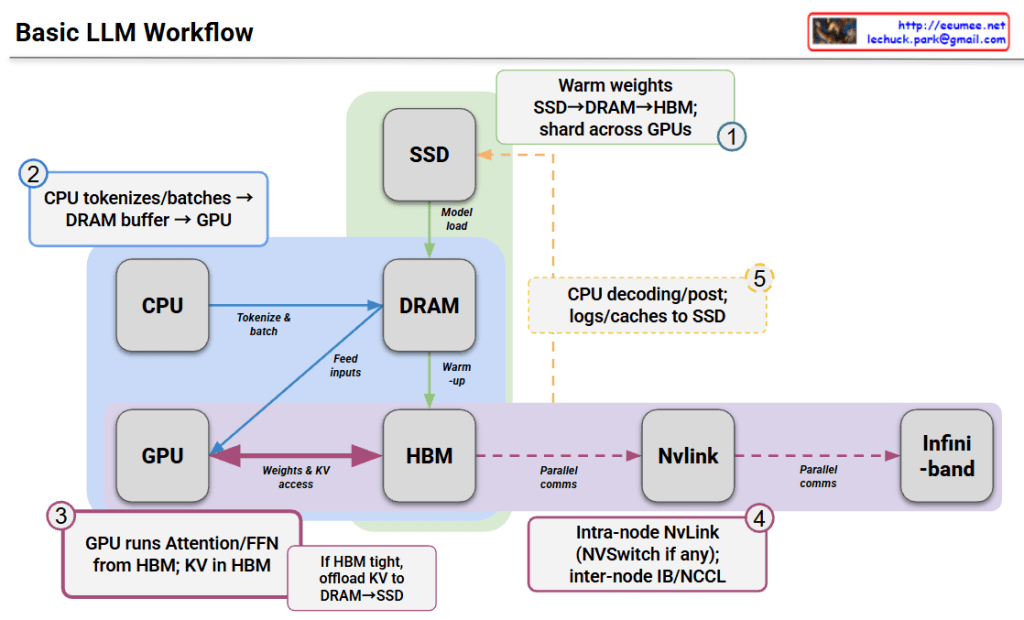
This diagram illustrates how data flows through various hardware components during the inference process of a Large Language Model (LLM).

Step-by-Step Breakdown

① Initialization Phase (Warm weights)

  • Model weights are loaded from SSD → DRAM → HBM (High Bandwidth Memory)
  • Weights are distributed and shared across multiple GPUs

② Input Processing (CPU tokenizes/batches)

  • CPU tokenizes input text and processes batches
  • Data is transferred through DRAM buffer to GPU

③ GPU Inference Execution

  • GPU performs Attention and FFN (Feed-Forward Network) computations from HBM
  • KV cache (Key-Value cache) is stored in HBM
  • If HBM is tight, KV cache can be offloaded to DRAM or SSD

④ Distributed Communication (NvLink/Infiniband)

  • Intra-node: High-speed communication between GPUs via NvLink (with NVSwitch if available)
  • Inter-node: Parallel communication through InfiniBand or NCCL

⑤ Post-processing (CPU decoding/post)

  • CPU decodes generated tokens and performs post-processing
  • Logs and caches are saved to SSD

Key Characteristics

This architecture leverages a memory hierarchy to efficiently execute large-scale models:

  • SSD: Long-term storage (slowest, largest capacity)
  • DRAM: Intermediate buffer
  • HBM: GPU-dedicated high-speed memory (fastest, limited capacity)

When model size exceeds GPU memory, strategies include distributing across multiple GPUs or offloading data to higher-level memory tiers.


Summary

This diagram shows how LLMs process data through a memory hierarchy (SSD→DRAM→HBM) across CPU and GPU components. The workflow involves loading model weights, tokenizing inputs on CPU, running inference on GPU with HBM, and using distributed communication (NvLink/InfiniBand) for multi-GPU setups. Memory management strategies like KV cache offloading enable efficient execution of large models that exceed single GPU capacity.

#LLM #DeepLearning #GPUComputing #MachineLearning #AIInfrastructure #NeuralNetworks #DistributedComputing #HPC #ModelOptimization #AIArchitecture #NvLink #Transformer #MLOps #AIEngineering #ComputerArchitecture

With Claude

Optimize LLM

LLM Optimization: Integration of Traditional Methods and New Paradigms

Core Message

LLM (Transformer) optimization requires more than just traditional optimization methodologies – new perspectives must be added.


1. Traditional Optimization Methodology (Left Side)

SW (Software) Optimization

  • Data Optimization
    • Structure: Data structure design
    • Copy: Data movement optimization
  • Logics Optimization
    • Algorithm: Efficient algorithm selection
    • Profiling: Performance analysis and bottleneck identification

Characteristics: Deterministic, logical approach

HW (Hardware) Optimization

  • Functions & Speed (B/W): Function and speed/bandwidth optimization
  • Fit For HW: Optimization for existing hardware
  • New HW implementation: New hardware design and implementation

Characteristics: Physical performance improvement focus


2. New Perspectives Required for LLM (Right Side)

SW Aspect: Human-Centric Probabilistic Approach

  • Human Language View / Human’s View
    • Human language understanding methods
    • Human thinking perspective
  • Human Learning
    • Mimicking human learning processes

Key Point: Statistical and Probabilistic Methodology

  • Different from traditional deterministic optimization
  • Language patterns, probability distributions, and context understanding are crucial

HW Aspect: Massive Parallel Processing

  • Massive Simple Parallel
    • Parallel processing of large-scale simple computations
    • Hardware architecture capable of parallel processing (GPU/TPU) is essential

Key Point: Efficient parallel processing of large-scale matrix operations


3. Integrated Perspective

LLM Optimization = Traditional Optimization + New Paradigm

DomainTraditional MethodLLM Additional Elements
SWAlgorithm, data structure optimization+ Probabilistic/statistical approach (human language/learning perspective)
HWFunction/speed optimization+ Massive parallel processing architecture

Conclusion

For effective LLM optimization:

  1. Traditional optimization techniques (data, algorithms, hardware) as foundation
  2. Probabilistic approach reflecting human language and learning methods
  3. Hardware perspective supporting massive parallel processing

These three elements must be organically combined – this is the core message of the diagram.


Summary

LLM optimization requires integrating traditional deterministic SW/HW optimization with new paradigms: probabilistic/statistical approaches that mirror human language understanding and learning, plus hardware architectures designed for massive parallel processing. This represents a fundamental shift from conventional optimization, where human-centric probabilistic thinking and large-scale parallelism are not optional but essential dimensions.


#LLMOptimization #TransformerArchitecture #MachineLearningOptimization #ParallelProcessing #ProbabilisticAI #HumanLanguageView #GPUComputing #DeepLearningHardware #StatisticalML #AIInfrastructure #ModelOptimization #ScalableAI #NeuralNetworkOptimization #AIPerformance #ComputationalEfficiency

New For AI

Analysis of “New For AI” Diagram

This image, titled “New For AI,” systematically organizes the essential components required for building AI systems.

Structure Overview

Top Section: Fundamental Technical Requirements for AI (Two Pillars)

Left Domain – Computing Axis (Turquoise)

  1. Massive Data
    • Processing vast amounts of data that form the foundation for AI training and operations
  2. Immense Computing
    • Powerful computational capacity to process data and run AI models

Right Domain – Infrastructure Axis (Light Blue)

3. Enormous Energy
Large-scale power supply to drive AI computing

  1. High-Density Cooling
    • Effective heat removal from high-performance computing operations

Central Link 🔗

Meaning of the Chain Link Icon:

  • For AI to achieve its performance, Computing (Data/Chips) and Infrastructure (Power/Cooling) don’t simply exist in parallel
  • They must be tightly integrated and optimized to work together
  • Symbolizes the interdependent relationship where strengthening only one side cannot unlock the full system’s potential

Bottom Section: Implementation Technologies (Stability & Optimization)

Learning & Inference/Reasoning (Learning and Inference Optimization)

Technologies to enhance AI model performance and efficiency:

  • Evals/Golden Set: Model evaluation and benchmarking
  • Safety Guardrails, RLHF-DPO: Safety assurance and human feedback-based learning
  • FlashAttention: Memory-efficient attention mechanism
  • Quant(INT8/FP8): Computational optimization through model quantization
  • Speculative/MTP Decoding: Inference speed enhancement techniques

Massive Parallel Computing (Large-Scale Parallel Computing)

Hardware and network technologies enabling massive computation:

  • GB200/GB300 NVL72: NVIDIA’s latest GPU systems
  • HBM: High Bandwidth Memory
  • InfiniBand, NVlink: Ultra-high-speed interconnect technologies
  • AI factory: AI-dedicated data centers
  • TPU, MI3xx, NPU, DPU: Various AI-specialized chips
  • PIM, CxL, UvLink: Memory-compute integration and next-gen interfaces
  • Silicon Photonics, UEC: Optical communication technologies

More Energy, Energy Efficiency (Energy Supply and Efficiency)

Technologies for stable and efficient power supply:

  • Smart Grid: Intelligent power grid
  • SMR: Small Modular Reactor (stable large-scale power source)
  • Renewable Energy: Renewable energy integration
  • ESS: Energy Storage System (power stabilization)
  • 800V HVDC: High-voltage direct current transmission (loss minimization)
  • Direct DC Supply: Direct DC supply (eliminating conversion losses)
  • Power Forecasting: AI-based power demand prediction and optimization

High Heat Exchange & PUE (Heat Exchange and Power Efficiency)

Securing cooling system efficiency and stability:

  • Liquid Cooling: Liquid cooling (higher efficiency than air cooling)
  • CDU: Coolant Distribution Unit
  • D2C: Direct-to-Chip cooling
  • Immersing: Immersion cooling (complete liquid immersion)
  • 100% Free Cooling: Utilizing external air (energy saving)
  • AI-Driven Cooling Optimization: AI-based cooling optimization
  • PUE Improvement: Power Usage Effectiveness (overall power efficiency metric)

Key Message

This diagram emphasizes that for successful AI implementation:

  1. Technical Foundation: Both Data/Chips (Computing) and Power/Cooling (Infrastructure) are necessary
  2. Tight Integration: These two axes are not separate but must be firmly connected like a chain and optimized simultaneously
  3. Implementation Technologies: Specific advanced technologies for stability and optimization in each domain must provide support

The central link particularly visualizes the interdependent relationship where “increasing computing power requires strengthening energy and cooling in tandem, and computing performance cannot be realized without infrastructure support.”


Summary

AI systems require two inseparable pillars: Computing (Data/Chips) and Infrastructure (Power/Cooling), which must be tightly integrated and optimized together like links in a chain. Each pillar is supported by advanced technologies spanning from AI model optimization (FlashAttention, Quantization) to next-gen hardware (GB200, TPU) and sustainable infrastructure (SMR, Liquid Cooling, AI-driven optimization). The key insight is that scaling AI performance demands simultaneous advancement across all layers—more computing power is meaningless without proportional energy supply and cooling capacity.


#AI #AIInfrastructure #AIComputing #DataCenter #AIChips #EnergyEfficiency #LiquidCooling #MachineLearning #AIOptimization #HighPerformanceComputing #HPC #GPUComputing #AIFactory #GreenAI #SustainableAI #AIHardware #DeepLearning #AIEnergy #DataCenterCooling #AITechnology #FutureOfAI #AIStack #MLOps #AIScale #ComputeInfrastructure

With Claude

“Tightly Fused” in AI DC

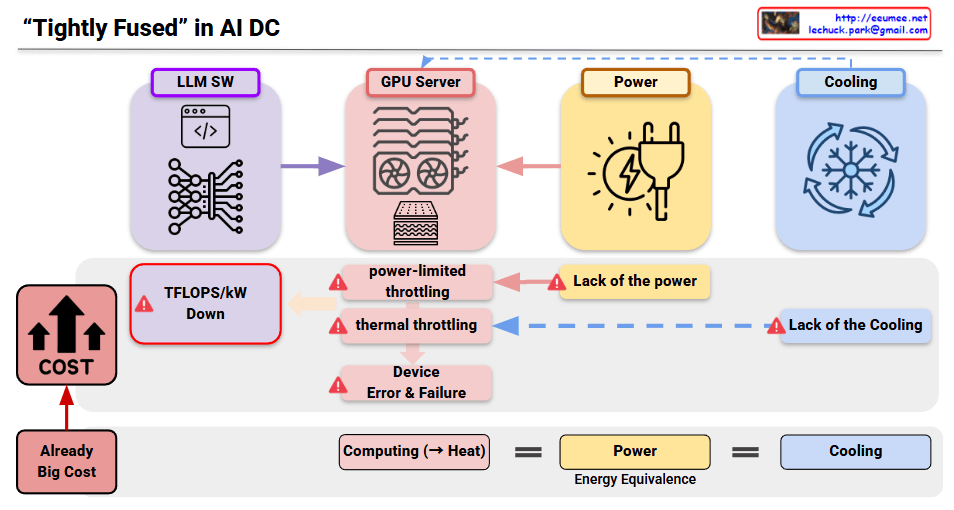
This diagram illustrates a “Tightly Fused” AI datacenter architecture showing the interdependencies between system components and their failure points.

System Components

  • LLM SW: Large Language Model Software
  • GPU Server: Computing infrastructure with cooling fans
  • Power: Electrical power supply system
  • Cooling: Thermal management system

Critical Issues

1. Power Constraints

  • Lack of power leads to power-limited throttling in GPU servers
  • Results in decreased TFLOPS/kW (computational efficiency per watt)

2. Cooling Limitations

  • Insufficient cooling causes thermal throttling
  • Increases risk of device errors and failures

3. Cost Escalation

  • Already high baseline costs
  • System bottlenecks drive costs even higher

Core Principle

The bottom equation demonstrates the fundamental relationship: Computing (→ Heat) = Power = Cooling

This shows that computational workload generates heat, requiring equivalent power supply and cooling capacity to maintain optimal performance.

Summary

This diagram highlights how AI datacenters require perfect balance between computing, power, and cooling systems – any bottleneck in one area cascades into performance degradation and cost increases across the entire infrastructure.

#AIDatacenter #MLInfrastructure #GPUComputing #DataCenterDesign #AIInfrastructure #ThermalManagement #PowerEfficiency #ScalableAI #HPC #CloudInfrastructure #AIHardware #SystemArchitecture

With Claude