Predictive/Proactive/Reactive

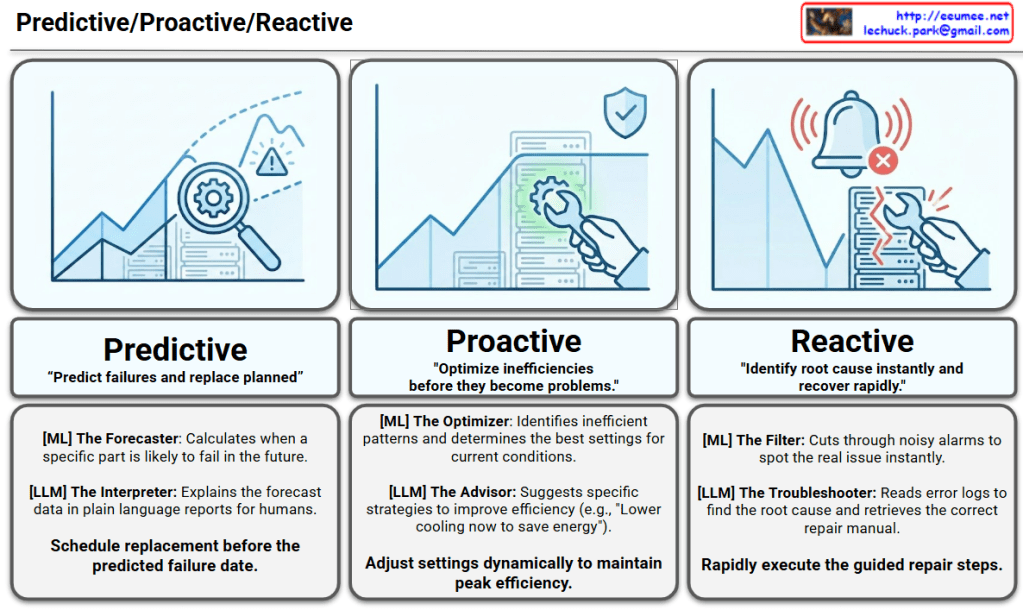
The infographic visualizes how AI technologies (Machine Learning and Large Language Models) are applied across Predictive, Proactive, and Reactive stages of facility management.


1. Predictive Stage

This is the most advanced stage, anticipating future issues before they occur.

  • Core Goal: “Predict failures and replace planned.”
  • Icon Interpretation: A magnifying glass is used to examine a future point on a rising graph, identifying potential risks (peaks and warnings) ahead of time.
  • Role of AI:
    • [ML] The Forecaster: Analyzes historical data to calculate precisely when a specific component is likely to fail in the future.
    • [LLM] The Interpreter: Translates complex forecast data and probabilities into plain language reports that are easy for human operators to understand.
  • Key Activity: Scheduling parts replacement and maintenance windows well before the predicted failure date.

2. Proactive Stage

This stage focuses on optimizing current conditions to prevent problems from developing.

  • Core Goal: “Optimize inefficiencies before they become problems.”
  • Icon Interpretation: On a stable graph, a wrench is shown gently fine-tuning the system for optimization, protected by a shield icon representing preventative measures.
  • Role of AI:
    • [ML] The Optimizer: Identifies inefficient operational patterns and determines the optimal configurations for current environmental conditions.
    • [LLM] The Advisor: Suggests specific, actionable strategies to improve efficiency (e.g., “Lower cooling now to save energy”).
  • Key Activity: Dynamically adjusting system settings in real-time to maintain peak efficiency.

3. Reactive Stage

This stage deals with responding rapidly and accurately to incidents that have already occurred.

  • Core Goal: “Identify root cause instantly and recover rapidly.”
  • Icon Interpretation: A sharp drop in the graph accompanied by emergency alarms, showing an urgent repair being performed on a broken server rack.
  • Role of AI:
    • [ML] The Filter: Cuts through the noise of massive alarm volumes to instantly isolate the true, critical issue.
    • [LLM] The Troubleshooter: Reads and analyzes complex error logs to determine the root cause and retrieves the correct Standard Operating Procedure (SOP) or manual.
  • Key Activity: Rapidly executing the guided repair steps provided by the system.

Summary

  • The image illustrates the evolution of data center operations from traditional Reactive responses to intelligent Proactive optimization and Predictive maintenance.
  • It clearly delineates the roles of AI, where Machine Learning (ML) handles data analysis and forecasting, while Large Language Models (LLMs) interpret these insights and provide actionable guidance.
  • Ultimately, this integrated AI approach aims to maximize uptime, enhance energy efficiency, and accelerate incident recovery in critical infrastructure.

#DataCenter #AIOps #PredictiveMaintenance #SmartInfrastructure #ArtificialIntelligence #MachineLearning #LLM #FacilityManagement #ITOps

with Gemini

Network for AI

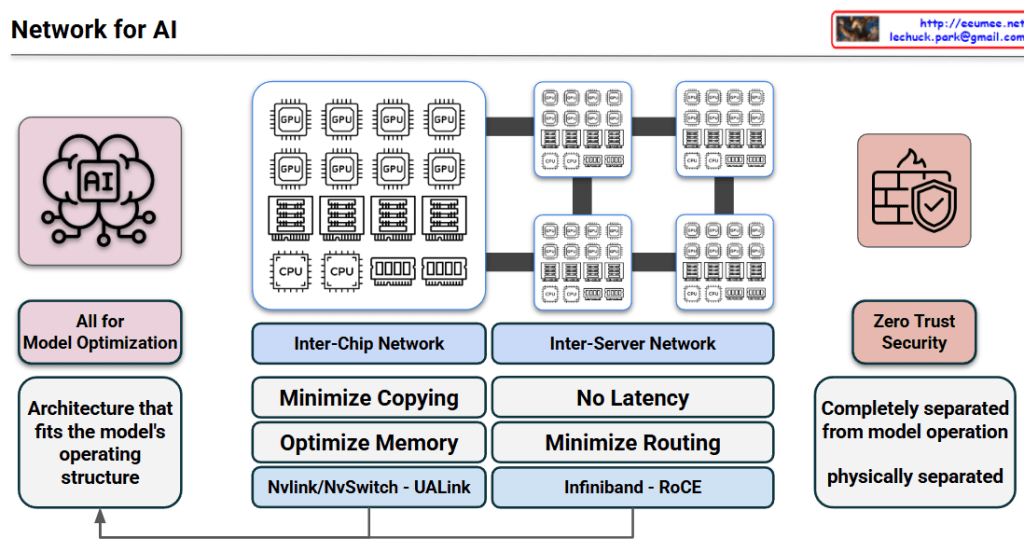
1. Core Philosophy: All for Model Optimization

The primary goal is to create an “Architecture that fits the model’s operating structure.” Unlike traditional general-purpose data centers, AI infrastructure is specialized to handle the massive data throughput and synchronized computations required by LLMs (Large Language Models).

2. Hierarchical Network Design

The architecture is divided into two critical layers to handle different levels of data exchange:

A. Inter-Chip Network (Scale-Up)

This layer focuses on the communication between individual GPUs/Accelerators within a single server or node.

  • Key Goals: Minimize data copying and optimize memory utilization (Shared Memory/Memory Pooling).
  • Technologies: * NVLink / NVSwitch: NVIDIA’s proprietary high-speed interconnect.
  • UALink (Ultra Accelerator Link): The new open standard designed for scale-up AI clusters.

B. Inter-Server Network (Scale-Out)

This layer connects multiple server nodes to form a massive AI cluster.

  • Key Goals: Achieve “No Latency” (Ultra-low latency) and minimize routing overhead to prevent bottlenecks during collective communications (e.g., All-Reduce).
  • Technologies: * InfiniBand: A lossless, high-bandwidth fabric preferred for its low CPU overhead.
  • RoCE (RDMA over Converged Ethernet): High-speed Ethernet that allows direct memory access between servers.

3. Zero Trust Security & Physical Separation

A unique aspect of this architecture is the treatment of security.

  • Operational Isolation: The security and management plane is completely separated from the model operation plane.
  • Performance Integrity: By being physically separated, security protocols (like firewalls or encryption inspection) do not introduce latency into the high-speed compute fabric where the model runs. This ensures that a “Zero Trust” posture does not degrade training or inference speed.

4. Architectural Feedback Loop

The arrow at the bottom indicates a feedback loop: the performance metrics and requirements of the inter-chip and inter-server networks directly inform the ongoing optimization of the overall architecture. This ensures the platform evolves alongside advancing AI model structures.


The architecture prioritizes model-centric optimization, ensuring infrastructure is purpose-built to match the specific operating requirements of large-scale AI workloads.

It employs a dual-tier network strategy using Inter-chip (NVLink/UALink) for memory efficiency and Inter-server (InfiniBand/RoCE) for ultra-low latency cluster scaling.

Zero Trust security is integrated through complete physical separation from the compute fabric, allowing for robust protection without causing any performance bottlenecks.

#AIDC #ArtificialIntelligence #GPU #Networking #NVLink #UALink #InfiniBand #RoCEv2 #ZeroTrust #DataCenterArchitecture #MachineLearningOps #ScaleOut

Mixture-of-Experts (MoE) DeepSeek-v3

Image Interpretation: DeepSeek-v3 Mixture-of-Experts (MoE)

This image outlines the key technologies and performance efficiency of the DeepSeek-v3 model, which utilizes the Mixture-of-Experts (MoE) architecture. It is divided into the architecture diagram/cost table on the left and four key technical features on the right.

1. DeepSeekMoE Architecture (Left Diagram)

The diagram illustrates how the model processes data:

  • Separation of Experts: Unlike traditional MoEs, it distinguishes between Shared Experts (Green) and Routed Experts (Blue).
    • Shared Experts: Always active to handle common knowledge.
    • Routed Experts: Selectively activated by the Router to handle specific, specialized features.
  • Workflow: When an input (ut) arrives, the Router selects the top-$K$ experts (Top-Kr). The system processes the input through both shared and selected routed experts in parallel and combines the results.

2. Four Key Technical Features (Right Panel)

This section explains how DeepSeek-v3 overcomes the limitations of existing MoE models:

  • Load Balancing without Auxiliary Loss:
    • Problem: Standard MoEs often use “auxiliary loss” to balance expert usage, which can degrade performance.
    • Solution: It uses learnable bias terms in the router to ensure balance. This bias only affects “dispatching” (where data goes) and not the actual “weights” (calculation values), preserving model quality.
  • Shared Expert Design:
    • Concept: Keeping one or a few experts always active for general tasks allows the routed experts to focus purely on complex, specialized tasks.
    • Benefit: Reduces redundancy and improves the capacity utilization of experts.
  • Hardware-Aware Dual-Pipe Parallelism:
    • Efficiency: It fully overlaps All-to-All communication with computation, minimizing idle time.
    • Optimization: “Node-local expert routing” is used to minimize slow data transfers between different nodes.
  • FP8 Mixed-Precision Training:
    • Speed & Cost: Utilizes the tensor cores of modern GPUs (Hopper/Blackwell) for full FP8 (8-bit floating point) training. This drastically lowers both training and inference costs.

3. Cost Efficiency Comparison (Table 2)

The comparison highlights the massive efficiency gain over dense models:

  • DeepSeek-V3 MoE (671B parameters): Despite having the largest parameter count, its training cost is extremely low at 250 GFLOPS/Token.
  • LLaMa-405B Dense (405B parameters): Although smaller in size, it requires ~10x higher cost (2448 GFLOPS/Token) compared to DeepSeek-v3.
  • Conclusion: DeepSeek-v3 achieves “high performance at low cost” by massively scaling the model size (671B) while keeping the actual computation equivalent to a much smaller model.

Summary

  1. Hybrid Structure: DeepSeek-v3 separates “Shared Experts” for general knowledge and “Routed Experts” for specialized tasks to maximize efficiency.
  2. Optimized Training: It achieves high speed and balance using “Load Balancing without Auxiliary Loss” and “FP8 Mixed-Precision Training.”
  3. Extreme Efficiency: Despite a massive 671B parameter size, it offers roughly 10x lower training costs per token compared to similar dense models (like LLaMa-405B).

#DeepSeek #AI #MachineLearning #MoE #MixtureOfExperts #LLM #DeepLearning #TechTrends #ArtificialIntelligence #ModelArchitecture

With Gemini

AI Data Center: Critical Bottlenecks and Technological Solutions


AI Data Center: Critical Bottlenecks and Technological Solutions

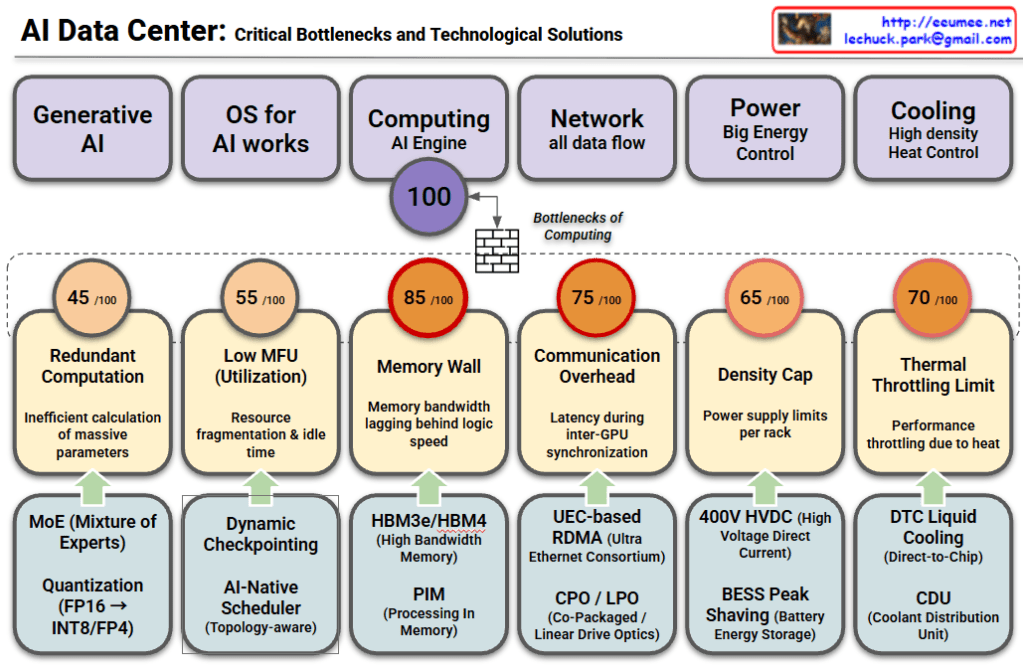
This chart analyzes the major challenges facing modern AI Data Centers across six key domains. It outlines the [Domain] → [Bottleneck/Problem] → [Solution] flow, indicating the severity of each bottleneck with a score out of 100.

1. Generative AI

  • Bottleneck (45/100): Redundant Computation
    • Inefficiencies occur when calculating massive parameters for large models.
  • Solutions:
    • MoE (Mixture of Experts): Uses only relevant sub-models (experts) for specific tasks to reduce computation.
    • Quantization (FP16 → INT8/FP4): Reduces data precision to speed up processing and save memory.

2. OS for AI Works

  • Bottleneck (55/100): Low MFU (Model Flops Utilization)
    • Issues with resource fragmentation and idle time result in underutilization of hardware.
  • Solutions:
    • Dynamic Checkpointing: Efficiently saves model states during training.
    • AI-Native Scheduler: Optimizes task distribution based on network topology.

3. Computing / AI Engine (Most Critical)

  • Bottleneck (85/100): Memory Wall
    • Marked as the most severe bottleneck, where memory bandwidth cannot keep up with the speed of logic processors.
  • Solutions:
    • HBM3e/HBM4: Next-generation High Bandwidth Memory.
    • PIM (Processing In Memory): Performs calculations directly within memory to reduce data movement.

4. Network

  • Bottleneck (75/100): Communication Overhead
    • Latency issues arise during synchronization between multiple GPUs.
  • Solutions:
    • UEC-based RDMA: Ultra Ethernet Consortium standards for faster direct memory access.
    • CPO / LPO: Advanced optics (Co-Packaged/Linear Drive) to improve data transmission efficiency.

5. Power

  • Bottleneck (65/100): Density Cap
    • Physical limits on how much power can be supplied per server rack.
  • Solutions:
    • 400V HVDC: High Voltage Direct Current for efficient power delivery.
    • BESS Peak Shaving: Using Battery Energy Storage Systems to manage peak power loads.

6. Cooling

  • Bottleneck (70/100): Thermal Throttling Limit
    • Performance drops (throttling) caused by excessive heat in high-density racks.
  • Solutions:
    • DTC Liquid Cooling: Direct-to-Chip liquid cooling technologies.
    • CDU: Coolant Distribution Units for effective heat management.

Summary

  1. The “Memory Wall” (85/100) is identified as the most critical bottleneck in AI Data Centers, meaning memory bandwidth is the primary constraint on performance.
  2. To overcome these limits, the industry is adopting advanced hardware like HBM and Liquid Cooling, alongside software optimizations like MoE and Quantization.
  3. Scaling AI infrastructure requires a holistic approach that addresses computing, networking, power efficiency, and thermal management simultaneously.

#AIDataCenter #ArtificialIntelligence #MemoryWall #HBM #LiquidCooling #GenerativeAI #TechTrends #AIInfrastructure #Semiconductor #CloudComputing

With Gemini

Programming … AI

This image contrasts traditional programming, where developers must explicitly code rules and logic (shown with a flowchart and a thoughtful programmer), with AI, where neural networks automatically learn patterns from large amounts of data (depicted with a network diagram and a smiling programmer). It illustrates the paradigm shift from manually defining rules to machines learning patterns autonomously from data.

#AI #MachineLearning #Programming #ArtificialIntelligence #AIvsTraditionalProgramming

AI goes exponentially with ..

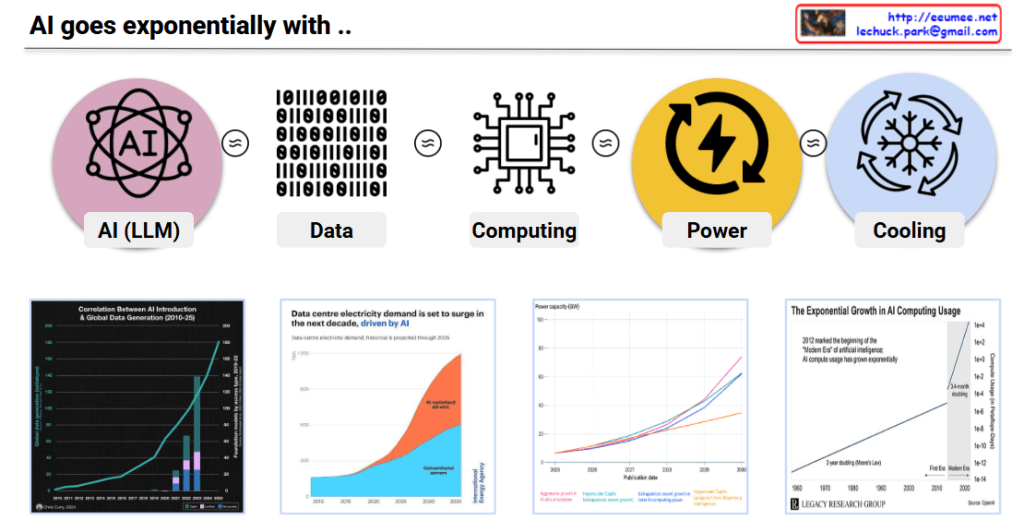
This infographic illustrates how AI’s exponential growth triggers a cascading exponential expansion across all interconnected domains.

Core Concept: Exponential Chain Reaction

Top Process Chain: AI’s exponential growth creates proportionally exponential demands at each stage:

  • AI (LLM)DataComputingPowerCooling

The “≈” symbol indicates that each element grows exponentially in proportion to the others. When AI doubles, the required data, computing, power, and cooling all scale proportionally.

Evidence of Exponential Growth Across Domains

1. AI Networking & Global Data Generation (Top Left)

  • Exponential increase beginning in the 2010s
  • Vertical surge post-2020

2. Data Center Electricity Demand (Center Left)

  • Sharp increase projected between 2026-2030
  • Orange (AI workloads) overwhelms blue (traditional workloads)
  • AI is the primary driver of total power demand growth

3. Power Production Capacity (Center Right)

  • 2005-2030 trends across various energy sources
  • Power generation must scale alongside AI demand

4. AI Computing Usage (Right)

  • Most dramatic exponential growth
  • Modern AI era begins in 2012
  • Doubling every 6 months (extremely rapid exponential growth)
  • Over 300,000x increase since 2012
  • Three exponential growth phases shown (1e+0, 1e+2, 1e+4, 1e+6)

Key Message

This infographic demonstrates that AI development is not an isolated phenomenon but triggers exponential evolution across the entire ecosystem:

  • As AI models advance → Data requirements grow exponentially
  • As data increases → Computing power needs scale exponentially
  • As computing expands → Power consumption rises exponentially
  • As power consumption grows → Cooling systems must expand exponentially

All elements are tightly interconnected, creating a ‘cascading exponential effect’ where exponential growth in one domain simultaneously triggers exponential development and demand across all other domains.


#ArtificialIntelligence #ExponentialGrowth #AIInfrastructure #DataCenters #ComputingPower #EnergyDemand #TechScaling #AIRevolution #DigitalTransformation #Sustainability #TechInfrastructure #MachineLearning #LLM #DataScience #FutureOfAI #TechTrends #TechnologyEvolution

With Claude