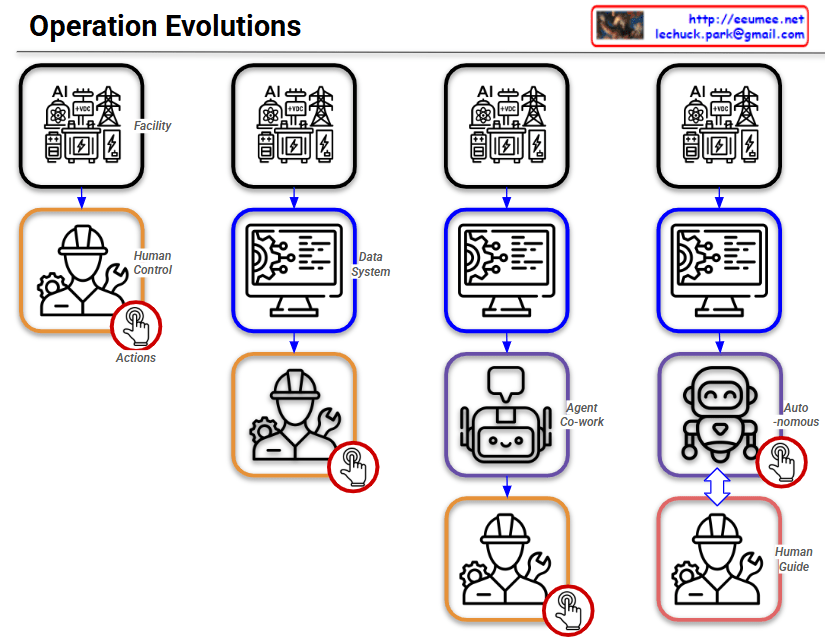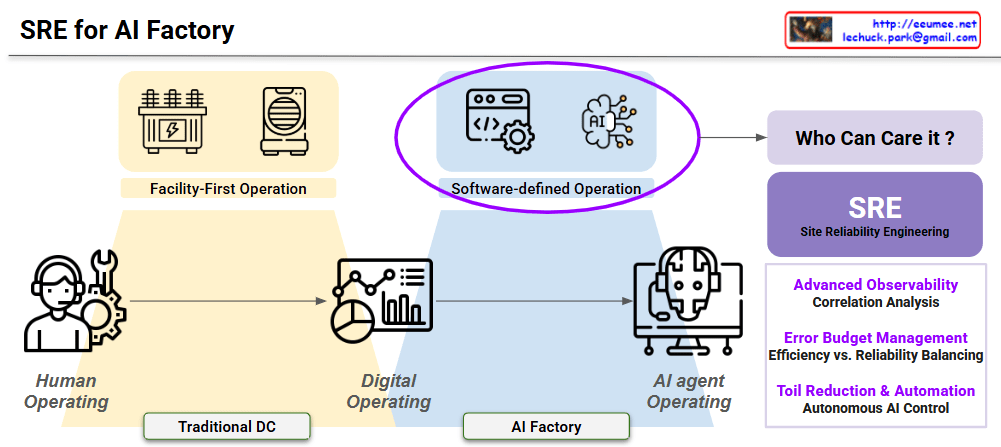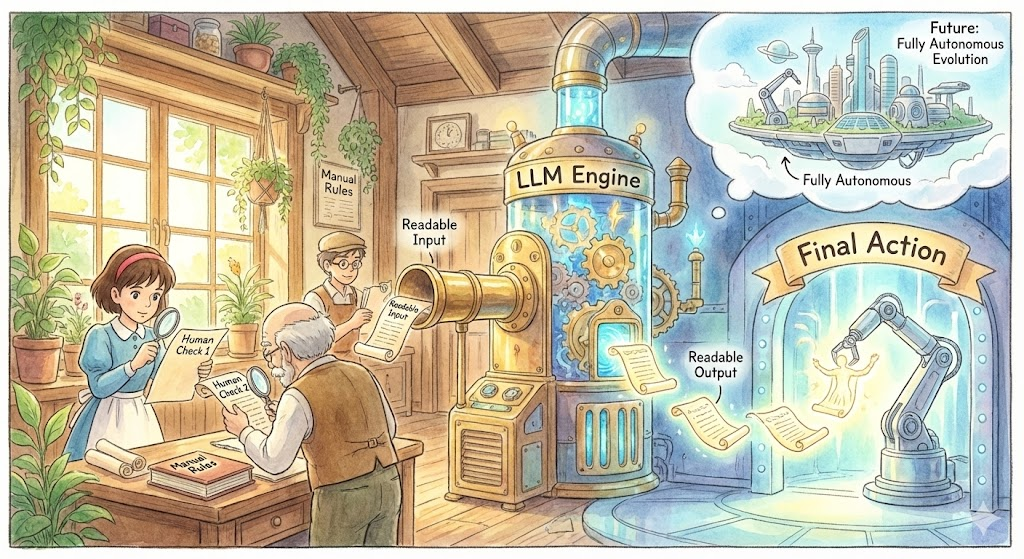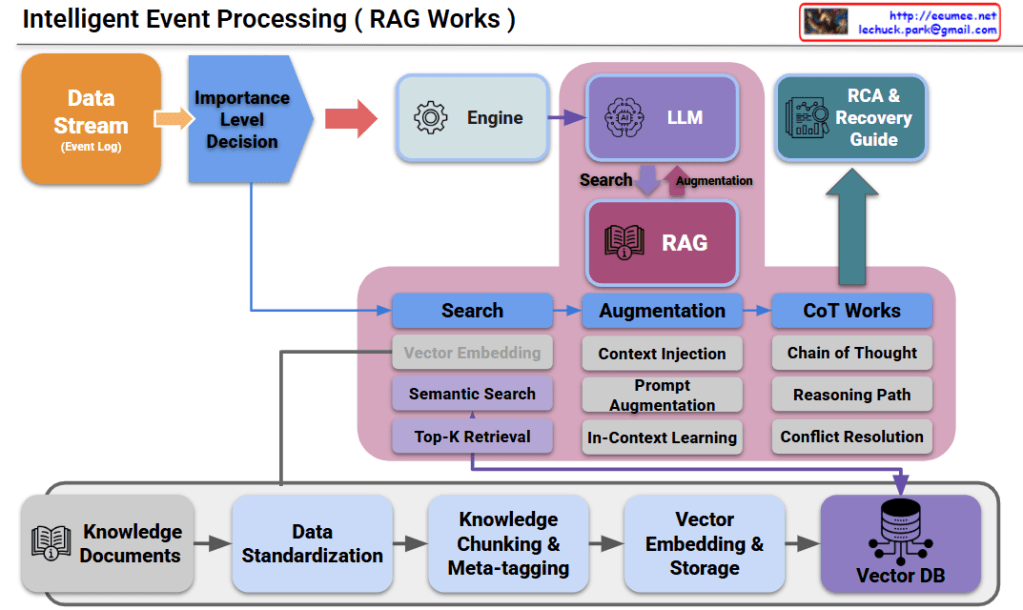
To the full Automation

This visual emphasizes the critical role of high-quality data as the engine driving the transition from human-led reactions to fully autonomous operations. This roadmap illustrates how increasing data resolution directly enhances detection and automated actions.


Comprehensive Analysis of the Updated Roadmap

1. The Standard Operational Loop

The top flow describes the current state of industrial maintenance:

  • Facility (Normal): The baseline state where everything functions correctly.
  • Operation (Changes) & Data: Any deviation in operation produces data metrics.
  • Monitoring & Analysis: The system observes these metrics to identify anomalies.
  • Reaction: Currently, a human operator (the worker icon) must intervene to bring the system “Back to the normal”.

2. The Data Engine

The most significant addition is the emphasized Data block and its impact on the automation cycle:

  • Quality and Resolution: The diagram highlights that “More Data, Quality, Resolution” are the foundation.
  • Optimization Path: This high-quality data feeds directly into the “Detection” layer and the final “100% Automation” goal, stating that better data leads to “Better Detection & Action”.

3. Evolution of Detection Layers

Detection matures through three distinct levels, all governed by specific thresholds:

  • 1 Dimension: Basic monitoring of single variables.
  • Correlation & Statistics: Analyzing relationships between different data points.
  • AI Analysis with AI/ML: Utilizing advanced machine learning for complex pattern recognition.

4. The Goal: 100% Automation

The final stage replaces human “Reaction” with autonomous “Action”:

  • LLM Integration: Large Language Models are utilized to bridge the gap from “Easy Detection” to complex “Automation”.
  • The Vision: The process culminates in 100% Automation, where a robotic system handles the recovery loop independently.
  • The Philosophy: It concludes with the defining quote: “It’s a dream, but it is the direction we are headed”.

Summary

  • The roadmap evolves from human intervention (Reaction) to autonomous execution (Action) powered by AI and LLMs.
  • High-resolution data quality is identified as the core driver that enables more accurate detection and reliable automated outcomes.
  • The ultimate objective is a self-correcting system that returns to a “Normal” state without manual effort.

#HyperAutomation #DataQuality #IndustrialAI #SmartManufacturing #LLM #DigitalTwin #AutonomousOperations #AIOp

With Gemini

Predictive/Proactive/Reactive

The infographic visualizes how AI technologies (Machine Learning and Large Language Models) are applied across Predictive, Proactive, and Reactive stages of facility management.


1. Predictive Stage

This is the most advanced stage, anticipating future issues before they occur.

  • Core Goal: “Predict failures and replace planned.”
  • Icon Interpretation: A magnifying glass is used to examine a future point on a rising graph, identifying potential risks (peaks and warnings) ahead of time.
  • Role of AI:
    • [ML] The Forecaster: Analyzes historical data to calculate precisely when a specific component is likely to fail in the future.
    • [LLM] The Interpreter: Translates complex forecast data and probabilities into plain language reports that are easy for human operators to understand.
  • Key Activity: Scheduling parts replacement and maintenance windows well before the predicted failure date.

2. Proactive Stage

This stage focuses on optimizing current conditions to prevent problems from developing.

  • Core Goal: “Optimize inefficiencies before they become problems.”
  • Icon Interpretation: On a stable graph, a wrench is shown gently fine-tuning the system for optimization, protected by a shield icon representing preventative measures.
  • Role of AI:
    • [ML] The Optimizer: Identifies inefficient operational patterns and determines the optimal configurations for current environmental conditions.
    • [LLM] The Advisor: Suggests specific, actionable strategies to improve efficiency (e.g., “Lower cooling now to save energy”).
  • Key Activity: Dynamically adjusting system settings in real-time to maintain peak efficiency.

3. Reactive Stage

This stage deals with responding rapidly and accurately to incidents that have already occurred.

  • Core Goal: “Identify root cause instantly and recover rapidly.”
  • Icon Interpretation: A sharp drop in the graph accompanied by emergency alarms, showing an urgent repair being performed on a broken server rack.
  • Role of AI:
    • [ML] The Filter: Cuts through the noise of massive alarm volumes to instantly isolate the true, critical issue.
    • [LLM] The Troubleshooter: Reads and analyzes complex error logs to determine the root cause and retrieves the correct Standard Operating Procedure (SOP) or manual.
  • Key Activity: Rapidly executing the guided repair steps provided by the system.

Summary

  • The image illustrates the evolution of data center operations from traditional Reactive responses to intelligent Proactive optimization and Predictive maintenance.
  • It clearly delineates the roles of AI, where Machine Learning (ML) handles data analysis and forecasting, while Large Language Models (LLMs) interpret these insights and provide actionable guidance.
  • Ultimately, this integrated AI approach aims to maximize uptime, enhance energy efficiency, and accelerate incident recovery in critical infrastructure.

#DataCenter #AIOps #PredictiveMaintenance #SmartInfrastructure #ArtificialIntelligence #MachineLearning #LLM #FacilityManagement #ITOps

with Gemini

Numeric Data Processing


Architecture Overview

The diagram illustrates a tiered approach to Numeric Data Processing, moving from simple monitoring to advanced predictive analytics:

  • 1-D Processing (Real-time Detection): This layer focuses on individual metrics. It emphasizes high-resolution data acquisition with precise time-stamping to ensure data quality. It uses immediate threshold detection to recognize critical changes as they happen.
  • Static Processing (Statistical & ML Analysis): This stage introduces historical context. It applies statistical functions (like averages and deviations) to identify trends and uses Machine Learning (ML) models to detect anomalies that simple thresholds might miss.
  • n-D Processing (Correlative Intelligence): This is the most sophisticated layer. It groups multiple metrics to find correlations, creating “New Numeric Data” (synthetic metrics). By analyzing the relationship between different data points, it can identify complex root causes in highly interleaved systems.

Summary

  1. The framework transitions from reactive 1-D monitoring to proactive n-D correlation, enhancing the depth of system observability.
  2. It integrates statistical functions and machine learning to filter noise and identify true anomalies based on historical patterns rather than just fixed limits.
  3. The ultimate goal is to achieve high-fidelity data processing that enables automated severity detection and complex pattern recognition across multi-dimensional datasets.

#DataProcessing #AIOps #MachineLearning #Observability #Telemetry #SystemArchitecture #AnomalyDetection #DigitalTwin #DataCenterOps #InfrastructureMonitoring

With Gemini

AI Operation : All Connected

AI Operation: All Connected – Image Analysis

This diagram explains the operational paradigm shift in AI Data Centers (AI DC).

Top Section: New Challenges

AI DC Characteristics:

  • Paradigm shift: Fundamental change in operations for the AI era
  • High Cost: Massive investment required for GPUs, infrastructure, etc.
  • High Risk: Greater impact during outages and increased complexity

Five Core Components of AI DC (left→right):

  1. Software: AI models, application development
  2. Computing: GPUs, servers, and computational resources
  3. Network: Data transmission and communication infrastructure
  4. Power: High-density power supply and management (highlighted in orange)
  5. Cooling: Heat management and cooling systems

→ These five elements are interconnected through the “All Connected Metric”

Bottom Section: Integrated Operations Solution

Core Concept:

📦 Tightly Fused Rubik’s Cube

  • The five core components (Software, Computing, Network, Power, Cooling) are intricately intertwined like a Rubik’s cube
  • Changes or issues in one element affect all other elements due to tight coupling

🎯 All Connected Data-Driven Operations

  • Data-driven integrated operations: Collecting and analyzing data from all connected elements
  • “For AI, With AI”: Operating the data center itself using AI technology for AI workloads

Continuous Stability & Optimization

  • Ensuring continuous stability
  • Real-time monitoring and optimization

Key Message

AI data centers have five core components—Software, Computing, Network, Power, and Cooling—that are tightly fused together. To effectively manage this complex system, a data-centric approach that integrates and analyzes data from all components is essential, enabling continuous stability and optimization.


Summary

AI data centers are characterized by tightly coupled components (software, computing, network, power, cooling) that create high complexity, cost, and risk. This interconnected system requires data-driven operations that leverage AI to monitor and optimize all elements simultaneously. The goal is achieving continuous stability and optimization through integrated, real-time management of all connected metrics.

#AIDataCenter #DataDrivenOps #AIInfrastructure #DataCenterOptimization #TightlyFused #AIOperations #HybridInfrastructure #IntelligentOps #AIforAI #DataCenterManagement #MLOps #AIOps #PowerManagement #CoolingOptimization #NetworkInfrastructure