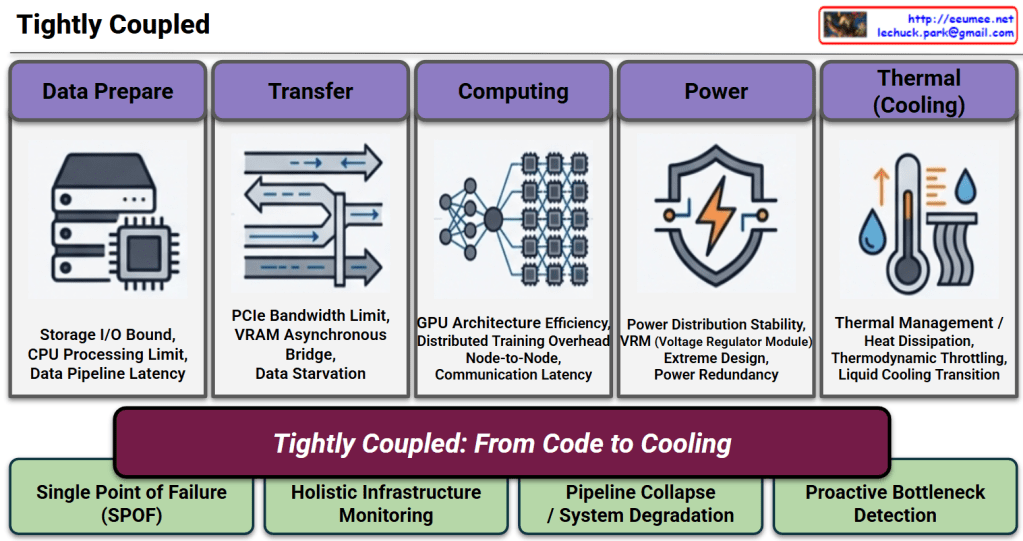
AI DC Power Risk with BESS


Technical Analysis: The Impact of AI Loads on Weak Grids

1. The Problem: A Threat to Grid Stability

Large-scale AI loads combined with “Weak Grids” (where the Short Circuit Ratio, or SCR, is less than 3) significantly threaten power grid stability.

  • AI Workload Characteristics: These loads are defined by sudden “Step Power Changes” and “Pulse-type Profiles” rather than steady consumption.
  • Sensitivity: NERC (2025) warns that the decrease in voltage-sensitive loads and the rise of periodic workloads are major drivers of grid instability.

2. The Vicious Cycle of Instability

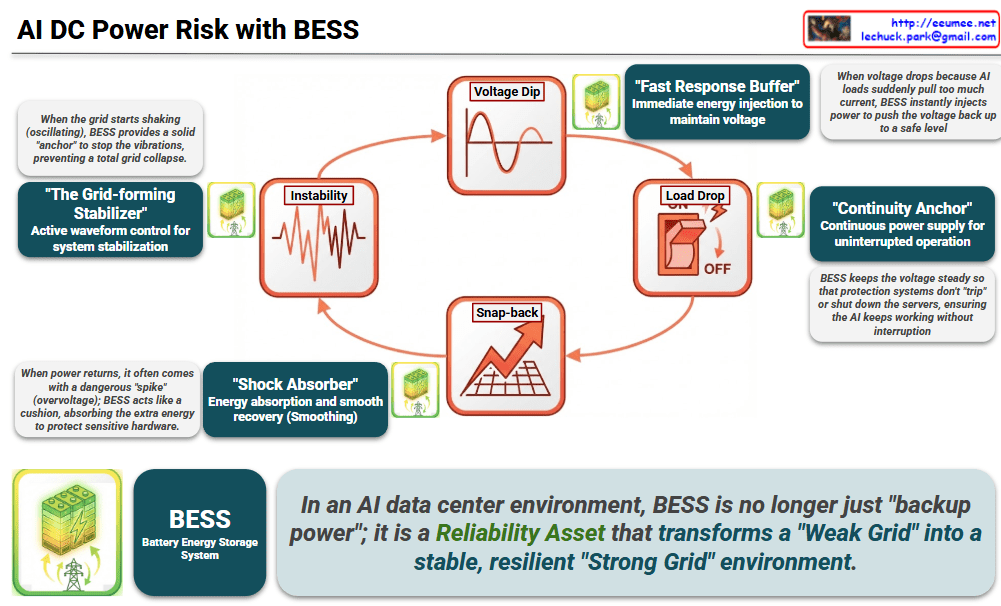
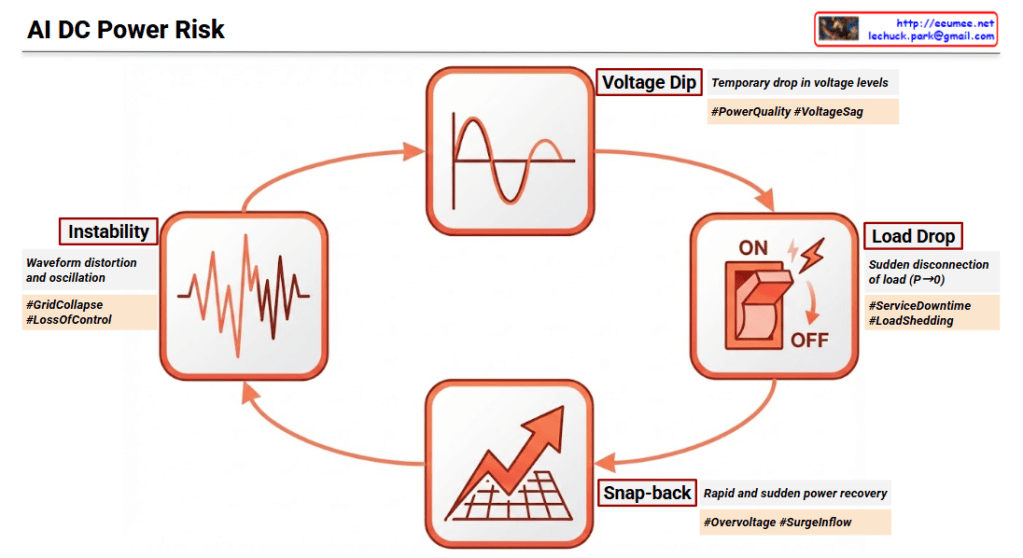
The images illustrate a four-stage downward spiral triggered by the interaction between AI hardware and a fragile power infrastructure:

  • Voltage Dip: As AI loads suddenly spike, the grid’s high impedance causes a temporary but sharp drop in voltage levels. This degrades #PowerQuality and causes #VoltageSag.
  • Load Drop: When voltage falls too low, protection systems trigger a sudden disconnection of the load ($P \rightarrow 0$). This leads to #ServiceDowntime and massive #LoadShedding.
  • Snap-back: As the grid tries to recover or the load re-engages, there is a rapid and sudden power surge. This creates dangerous #Overvoltage and #SurgeInflow.
  • Instability: The repetition of these fluctuations leads to waveform distortion and oscillation. Eventually, this causes #GridCollapse and a total #LossOfControl.

3. The Solution: BESS as a Reliability Asset

The final analysis reveals that a Battery Energy Storage System (BESS) acts as the critical circuit breaker for this vicious cycle.

  • Fast Response Buffer: BESS provides immediate energy injection the moment a dip is detected, maintaining voltage levels.
  • Continuity Anchor: By holding the voltage steady, it prevents protection systems from “tripping,” ensuring uninterrupted operation for AI servers.
  • Shock Absorber: During power recovery, BESS absorbs excess energy to “smooth” the transition and protect sensitive hardware from spikes.
  • The Grid-forming Stabilizer: It uses active waveform control to stop oscillations, providing the “virtual inertia” needed to prevent total grid collapse.

Summary

  1. AI Load Dynamics: The erratic “pulse” nature of AI power consumption acts as a physical shock to weak grids, necessitating a new layer of protection.
  2. Beyond Backup Power: In this context, BESS is redefined as a Reliability Asset that transforms a “Weak Grid” into a resilient “Strong Grid” environment.
  3. Operational Continuity: By filling gaps, absorbing shocks, and anchoring the grid, BESS ensures that AI data centers remain operational even during severe transient events.

#BESS #GridStability #AIDataCenter #PowerQuality #WeakGrid #EnergyStorage #NERC2025 #VoltageSag #VirtualInertia #TechInfrastructure

with Gemini

AI DC Power Risk


Technical Analysis: AI Load & Weak Grid Interaction

The integration of massive AI workloads into a Weak Grid (SCR:Short Circuit Ratio < 3) creates a high-risk environment where electrical Transients can escalate into systemic failures.

1. Voltage Dip (Transient Voltage Sag)

  • Mechanism: AI workloads are characterized by Step Power Changes and Pulse-type Profiles. When these massive loads activate simultaneously, they cause an immediate Transient Voltage Sag in a weak grid due to high impedance.
  • Impact: This compromises Power Quality, leading to potential malfunctions in voltage-sensitive AI hardware.

2. Load Drop (Transient Load Rejection)

  • Mechanism: If the voltage sag exceeds safety thresholds, protection systems trigger Load Rejection, causing the power consumption to plummet to zero (P -> 0).
  • Impact: This results in Service Downtime and creates a massive power imbalance in the grid, often referred to as Load Shedding.

3. Snap-back (Transient Recovery & Inrush)

  • Mechanism: As the grid attempts to recover or the load is re-engaged, it creates a Transient Recovery Voltage (TRV).
  • Impact: This phase often sees Overvoltage (Overshoot) and a massive Surge Inflow (Inrush Current), which places extreme electrical stress on power components and can damage sensitive circuitry.

4. Instability (Dynamic & Harmonic Oscillation)

  • Mechanism: The repetition of sags and surges leads to Dynamic Oscillation. The control systems of power converters may lose synchronization with the grid frequency.
  • Impact: The result is severe Waveform Distortion, Loss of Control, and eventually a total Grid Collapse (Blackout).

Key Insight (NERC 2025 Warning)

The North American Electric Reliability Corporation (NERC) warns that the reduction of voltage-sensitive loads and the rise of periodic, pulse-like AI workloads are primary drivers of modern grid instability.


Summary

  1. AI Load Dynamics: Rapid step-load changes in AI data centers act as a “shock” to weak grids, triggering a self-reinforcing cycle of electrical failure.
  2. Transient Progression: The cycle moves from a Voltage Sag to a Load Trip, followed by a damaging Power Surge, eventually leading to non-damped Oscillations.
  3. Strategic Necessity: To break this cycle, data centers must implement advanced solutions like Grid-forming Inverters or Fast-acting BESS to provide synthetic inertia and voltage support.

#PowerTransients #WeakGrid #AIDataCenter #GridStability #NERC2025 #VoltageSag #LoadShedding #ElectricalEngineering #AIInfrastructure #SmartGrid #PowerQuality

With Gemini

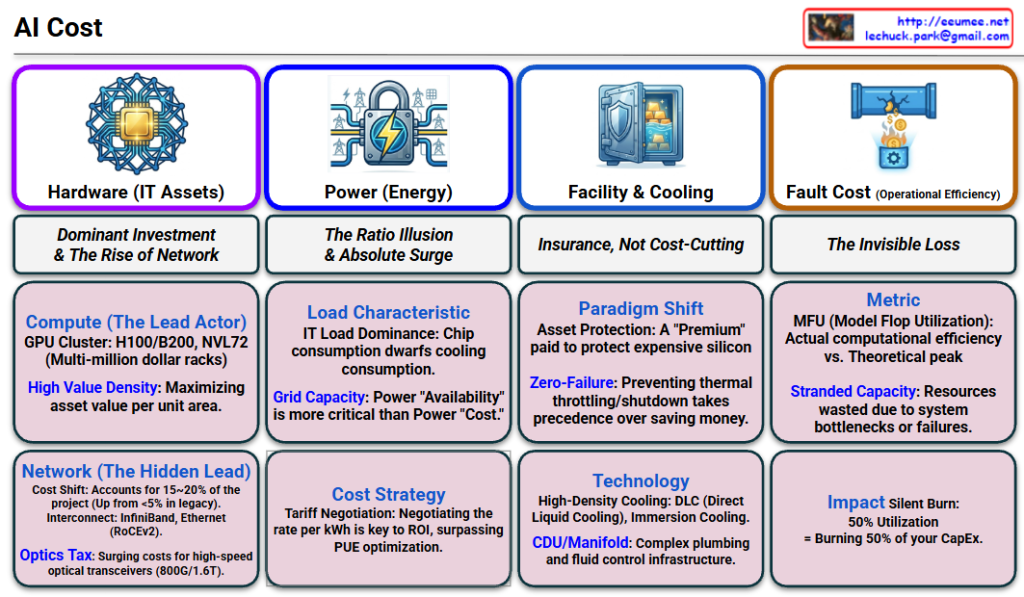
AI Cost


Strategic Analysis of the AI Cost Chart

1. Hardware (IT Assets): “The Investment Core”

  • Icon: A chip embedded in a complex network web.
  • Key Message: The absolute dominant force, consuming ~70% of the total budget.
  • Details:
    • Compute (The Lead): Features GPU clusters (H100/B200, NVL72). These are not just servers; they represent “High Value Density.”
    • Network (The Hidden Lead): No longer just cabling. The cost of Interconnects (InfiniBand/RoCEv2) and Optics (800G/1.6T) has surged to 15~20%, acting as the critical nervous system of the cluster.

2. Power (Energy): “The Capacity War”

  • Icon: An electric grid secured by a heavy lock (representing capacity security).
  • Key Message: A “Ratio Illusion.” While the percentage (~20%) seems stable due to the skyrocketing hardware costs, the absolute electricity bill has exploded.
  • Details:
    • Load Characteristic: The IT Load (Chip power) dwarfs the cooling load.
    • Strategy: The battle is not just about Efficiency (PUE), but about Availability (Grid Capacity) and Tariff Negotiation.

3. Facility & Cooling: “The Insurance Policy”

  • Icon: A vault holding gold bars (Asset Protection).
  • Key Message: Accounting for ~10% of CapEx, this is not an area for cost-cutting, but for “Premium Insurance.”
  • Details:
    • Paradigm Shift: The facility exists to protect the multi-million dollar “Silicon Assets.”
    • Technology: Zero-Failure is the goal. High-density technologies like DLC (Direct Liquid Cooling) and Immersion Cooling are mandatory to prevent thermal throttling.

4. Fault Cost (Operational Efficiency): “The Invisible Loss”

  • Icon: A broken pipe leaking coins (burning money).
  • Key Message: A “Hidden Cost” that determines the actual success or failure of the business.
  • Details:
    • Metric: The core KPI is MFU (Model Flop Utilization).
    • Impact: Any bottleneck (network stall, storage wait) results in “Stranded Capacity.” If utilization drops to 50%, you are effectively engaging in a “Silent Burn” of 50% of your massive CapEx investment.

💡 Architect’s Note

This chart perfectly illustrates “Why we need an AI DC Operating System.”

“Pillars 1, 2, and 3 (Hardware, Power, Facility) represent the massive capital burned during CONSTRUCTION.

Pillar 4 (Fault Cost) is the battleground for OPERATION.”

Your Operating System is the solution designed to plug the leak in Pillar 4, ensuring that the astronomical investments in Pillars 1, 2, and 3 translate into actual computational value.


Summary

The AI Data Center is a “High-Value Density Asset” where Hardware dominates CapEx (~70%), Power dominates OpEx dynamics, and Facility acts as Insurance. However, the Operational System (OS) is the critical differentiator that prevents Fault Cost—the silent killer of ROI—by maximizing MFU.

#AIDataCenter #AIInfrastructure #GPUUnitEconomics #MFU #FaultCost #DataCenterOS #LiquidCooling #CapExStrategy #TechArchitecture

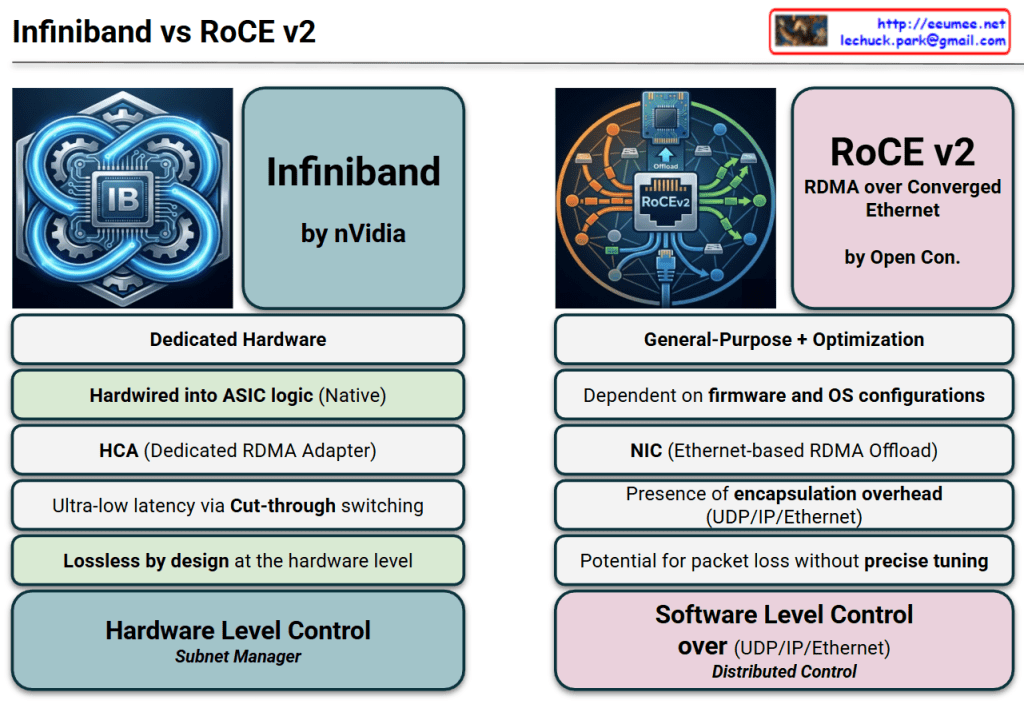
Infiniband vs RoCE v2

This image provides a technical comparison between InfiniBand and RoCE v2 (RDMA over Converged Ethernet), the two dominant networking protocols used in modern AI data centers and High-Performance Computing (HPC) environments.


1. Architectural Philosophy

  • InfiniBand (Dedicated Hardware): Designed from the ground up specifically for high-throughput, low-latency communication. It is a proprietary ecosystem largely driven by NVIDIA (Mellanox).
  • RoCE v2 (General-Purpose + Optimization): An evolution of standard Ethernet designed to bring RDMA (Remote Direct Memory Access) capabilities to traditional network infrastructures. It is backed by the Open Consortium.

2. Hardware vs. Software Logic

  • Hardwired ASIC (InfiniBand): The protocol logic is baked directly into the silicon. This “Native” approach ensures consistent performance with minimal jitter.
  • Firmware & OS Dependent (RoCE v2): Relies more heavily on the NIC’s firmware and operating system configurations, making it more flexible but potentially more complex to stabilize.

3. Data Transfer Efficiency

  • Ultra-low Latency (InfiniBand): Utilizes Cut-through switching, where the switch starts forwarding the packet as soon as the destination address is read, without waiting for the full packet to arrive.
  • Encapsulation Overhead (RoCE v2): Because it runs on Ethernet, it must wrap RDMA data in UDP/IP/Ethernet headers. This adds “overhead” (extra data bits) and processing time compared to the leaner InfiniBand frames.

4. Reliability and Loss Management

  • Lossless by Design (InfiniBand): It uses a credit-based flow control mechanism at the hardware level, ensuring that a sender never transmits data unless the receiver has room to buffer it. This guarantees zero packet loss.
  • Tuning-Dependent (RoCE v2): Ethernet is natively “lossy.” To make RoCE v2 work effectively, the network must be “Converged” using complex features like PFC (Priority Flow Control) and ECN (Explicit Congestion Notification). Without precise tuning, performance can collapse during congestion.

5. Network Management

  • Subnet Manager (InfiniBand): Uses a centralized “Subnet Manager” to discover the topology and manage routing, which simplifies the management of massive GPU clusters.
  • Distributed Control (RoCE v2): Functions like a traditional IP network where routing and control are distributed across the switches and routers.

Comparison Summary

FeatureInfiniBandRoCE v2
Primary DriverPerformance & StabilityCost-effectiveness & Compatibility
ComplexityPlug-and-play (within IB ecosystem)Requires expert-level network tuning
LatencyAbsolute LowestLow (but higher than IB)
ScalabilityHigh (specifically for AI/HPC)High (standard Ethernet scalability)

Design & Logic: InfiniBand is a dedicated, hardware-native solution for ultra-low latency, whereas RoCE v2 adapts general-purpose Ethernet for RDMA through software-defined optimization and firmware.

Efficiency & Reliability: InfiniBand is “lossless by design” with minimal overhead via cut-through switching, while RoCE v2 incurs encapsulation overhead and requires precise network tuning to prevent packet loss.

Control & Management: InfiniBand utilizes centralized hardware-level management (Subnet Manager) for peak stability, while RoCE v2 relies on distributed software-level control over standard UDP/IP/Ethernet stacks.

#InfiniBand #RoCEv2 #RDMA #AIDataCenter #NetworkingArchitecture #NVIDIA #HighPerformanceComputing #GPUCluster #DataCenterDesign #Ethernet #AITraining

Redfish for AI DC

This image illustrates the pivotal role of the Redfish API (developed by DMTF) as the standardized management backbone for modern AI Data Centers (AI DC). As AI workloads demand unprecedented levels of power and cooling, Redfish moves beyond traditional server management to provide a unified framework for the entire infrastructure stack.


1. Management & Security Framework (Left Column)

  • Unified Multi-Vendor Management:
    • Acts as a single, standardized API to manage diverse hardware from different vendors (NVIDIA, AMD, Intel, etc.).
    • It reduces operational complexity by replacing fragmented, vendor-specific IPMI or OEM extensions with a consistent interface.
  • Modern Security Framework:
    • Designed for multi-tenant AI environments where security is paramount.
    • Supports robust protocols like session-based authentication, X.509 certificates, and RBAC (Role-Based Access Control) to ensure only authorized entities can modify critical infrastructure.
  • Precision Telemetry:
    • Provides high-granularity, real-time data collection for voltage, current, and temperature.
    • This serves as the foundation for energy efficiency optimization and fine-tuning performance based on real-time hardware health.

2. Infrastructure & Hardware Control (Right Column)

  • Compute / Accelerators:
    • Enables per-GPU instance power capping, allowing operators to limit power consumption at a granular level.
    • Monitors the health of high-speed interconnects like NVLink and PCIe switches, and simplifies firmware lifecycle management across the cluster.
  • Liquid Cooling:
    • As AI chips run hotter, Redfish integrates with CDU (Cooling Distribution Unit) systems to monitor pump RPM and loop pressure.
    • It includes critical safety features like leak detection sensors and integrated event handling to prevent hardware damage.
  • Power Infrastructure:
    • Extends management to the rack level, including Smart PDU outlet metering and OCP (Open Compute Project) Power Shelf load balancing.
    • Facilitates advanced efficiency analytics to drive down PUE (Power Usage Effectiveness).

Summary

For an AI DC Optimization Architect, Redfish is the essential “language” that enables Software-Defined Infrastructure. By moving away from manual, siloed hardware management and toward this API-driven approach, data centers can achieve the extreme automation required to shift OPEX structures predominantly toward electricity costs rather than labor.

#AIDataCenter #RedfishAPI #DMTF #DataCenterInfrastructure #GPUComputing #LiquidCooling #SustainableIT #SmartPDU #OCP #InfrastructureAutomation #TechArchitecture #EnergyEfficiency


With Gemini

AI GPU Cost

AI GPU Service Cost Proof

This image outlines a framework for justifying the cost of AI GPU services (such as cloud or bare-metal leasing) by strictly proving performance quality. The core theme is “Transparency with Metrics,” demonstrating Stability and Efficiency through data rather than empty promises.

Here is a breakdown of the four key quadrants:

1. Clock Speed Consistency (Top Left)

  • Metric: Stable SM (Streaming Multiprocessor) Clock.
  • Meaning: This tracks the operating frequency of the GPU’s core compute units over time.
  • Significance: The graph should ideally be a flat line. Fluctuations indicate “clock jitter,” which leads to unpredictable training times and inconsistent performance. A stable clock proves the power delivery is clean and the workload is steady.

2. Zero Throttling Events (Top Right)

  • Metric: Count of ‘SW Power Cap’ and ‘Thermal Slowdown’ events.
  • Meaning: It verifies whether the GPU had to forcibly lower its performance (throttle) due to overheating or hitting power limits.
  • Significance: The goal is Zero (0). Any positive number means the infrastructure failed to support the GPU’s maximum potential, wasting the customer’s money and time.

3. Thermal Headroom (Bottom Left)

  • Metric: Temperature Margin (vs. $T_{limit}$).
    • (Note: The text box in the image incorrectly repeats “Streaming Multiprocessor Clock Changes,” likely a copy-paste error, but the gauge clearly indicates Temperature).
  • Meaning: It displays the gap between the current operating temperature and the GPU’s thermal limit.
  • Significance: Operating with a safe margin (headroom) prevents thermal throttling and ensures hardware longevity during long-running AI workloads.

4. Power Draw vs TDP (Bottom Right)

  • Metric: Max Power Utilization vs. Thermal Design Power (TDP).
    • (Note: The text box here also appears to be a copy-paste error from the top right, but the gauge represents Power/Watts).
  • Meaning: It measures how close the actual power consumption is to the GPU’s rated maximum (TDP).
  • Significance: If the power draw is consistently close to the TDP (e.g., 700W), it proves the GPU is being fully utilized. If it’s low despite a heavy workload, it suggests a bottleneck elsewhere (network, CPU, or power delivery issues).

Summary

  1. Objective: To validate service fees by providing transparent, data-driven proof of infrastructure quality.
  2. Key Metrics: Focuses on maintaining Stable Clocks, ensuring Zero Throttling, securing Thermal Headroom, and maximizing Power Utilization.
  3. Value: It acts as a technical SLA (Service Level Agreement), assuring users that the environment allows the GPUs to perform at 100% capacity without degradation.

#AIDataCenter #GPUOptimization #ServiceLevelAgreement #CloudInfrastructure #Nvidia #HighPerformanceComputing #DataCenterOps #GreenComputing #TechTransparency #AIInfrastructure

With Gemini

Ready For AI DC


Ready for AI DC

This slide illustrates the “Preparation and Operation Strategy for AI Data Centers (AI DC).”

In the era of Generative AI and Large Language Models (LLM), it outlines the drastic changes data centers face and proposes a specific three-stage operation strategy (Digitization, Solutions, Operations) to address them.

1. Left Side: AI “Extreme” Changes

Core Theme: AI Data Center for Generative AI & LLM

  • High Cost, High Risk:
    • Establishing and operating AI DCs involves immense costs due to expensive infrastructure like GPU servers.
    • It entails high power consumption and system complexity, leading to significant risks in case of failure.
  • New Techs for AI:
    • Unlike traditional centers, new power and cooling technologies (e.g., high-density racks, immersion cooling) and high-performance computing architectures are essential.

2. Right Side: AI Operation Strategy

Three solutions to overcome the “High Cost, High Risk, and New Tech” environment.

A. Digitization (Securing Data)

  • High Precision, High Resolution: Collecting precise, high-resolution operational data (e.g., second-level power usage, chip-level temperature) rather than rough averages.
  • Computing-Power-Cooling All-Relative Data: Securing integrated data to analyze the tight correlations between IT load (computing), power, and cooling systems.

B. Solutions (Adopting Tools)

  • “Living” Digital Twin: Building a digital twin linked in real-time to the actual data center for dynamic simulation and monitoring, going beyond static 3D modeling.
  • LLM AI Agent: Introducing LLM-based AI agents to assist or automate complex data center management tasks.

C. Operations (Innovating Processes)

  • Integration for Multi/Edge(s): Establishing a unified management system that covers not only centralized centers but also distributed multi-cloud and edge locations.
  • DevOps for the Fast: Applying agile DevOps methodologies to development and operations to adapt quickly to the rapidly changing AI infrastructure.

💡 Summary & Key Takeaways

The slide suggests that traditional operating methods are unsustainable due to the costs and risks associated with AI workloads.

Success in the AI era requires precisely integrating IT and facility data (Digitization), utilizing advanced technologies like Digital Twins and AI Agents (Solutions), and adopting fast, integrated processes (Operations).


#AIDataCenter #AIDC #GenerativeAI #LLM #DataCenterStrategy #DigitalTwin #DevOps #AIInfrastructure #TechTrends #SmartOperations #EnergyEfficiency #EdgeComputing #AIInnovation

With Gemini