Energy Storage & Backup Power


Energy Storage & Backup Power Comparison

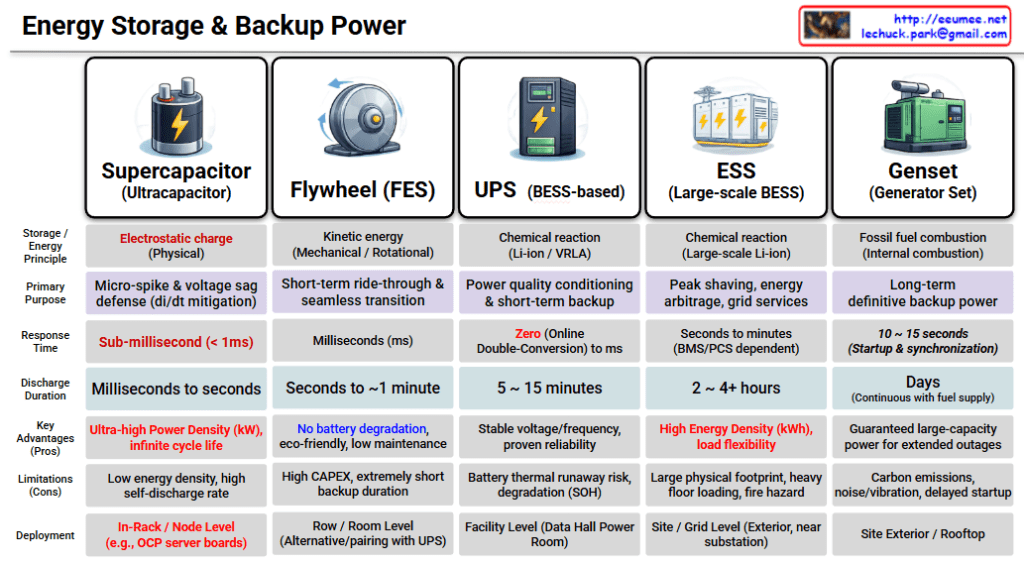
This infographic provides a comprehensive overview of energy storage and backup power technologies used in mission-critical infrastructures like data centers. As you move from left to right, the response time increases, but the backup duration also significantly extends.

1. Supercapacitor (Ultracapacitor)

  • Energy Principle: Electrostatic charge (Physical)
  • Primary Purpose: Micro-spike & voltage sag defense (di/dt mitigation)
  • Response Time: Sub-millisecond (< 1ms)
  • Discharge Duration: Milliseconds to seconds
  • Key Advantages: Ultra-high Power Density (kW), infinite cycle life
  • Limitations: Low energy density, high self-discharge rate
  • Deployment: In-Rack / Node Level (e.g., OCP server boards)

2. Flywheel (FES – Flywheel Energy Storage)

  • Energy Principle: Kinetic energy (Mechanical / Rotational)
  • Primary Purpose: Short-term ride-through & seamless transition
  • Response Time: Milliseconds (ms)
  • Discharge Duration: Seconds to ~1 minute
  • Key Advantages: No battery degradation, eco-friendly, low maintenance
  • Limitations: High CAPEX, extremely short backup duration
  • Deployment: Row / Room Level (Used as an alternative or paired with UPS)

3. UPS (BESS-based)

  • Energy Principle: Chemical reaction (Li-ion / VRLA)
  • Primary Purpose: Power quality conditioning & short-term backup
  • Response Time: Zero (Online Double-Conversion) to ms
  • Discharge Duration: 5 ~ 15 minutes
  • Key Advantages: Stable voltage/frequency, proven reliability
  • Limitations: Battery thermal runaway risk, degradation (SOH – State of Health)
  • Deployment: Facility Level (Data Hall Power Room)

4. ESS (Large-scale BESS)

  • Energy Principle: Chemical reaction (Large-scale Li-ion)
  • Primary Purpose: Peak shaving, energy arbitrage, grid services
  • Response Time: Seconds to minutes (BMS/PCS dependent)
  • Discharge Duration: 2 ~ 4+ hours
  • Key Advantages: High Energy Density (kWh), load flexibility
  • Limitations: Large physical footprint, heavy floor loading, fire hazard
  • Deployment: Site / Grid Level (Exterior, near substation)

5. Genset (Generator Set)

  • Energy Principle: Fossil fuel combustion (Internal combustion)
  • Primary Purpose: Long-term definitive backup power
  • Response Time: 10 ~ 15 seconds (Startup & synchronization)
  • Discharge Duration: Days (Continuous with fuel supply)
  • Key Advantages: Guaranteed large-capacity power for extended outages
  • Limitations: Carbon emissions, noise/vibration, delayed startup
  • Deployment: Site Exterior / Rooftop

Summary of the Spectrum

The hierarchy demonstrates a “Layered Defense” strategy for power reliability:

  • Immediate (ms): Supercapacitors and Flywheels handle transient spikes and sags.
  • Short-term (mins): UPS systems bridge the gap until secondary power kicks in.
  • Long-term (hours/days): ESS manages energy efficiency, while Gensets provide the final safety net for prolonged outages.

#EnergyStorage #BackupPower #DataCenter #UPS #BESS #Flywheel #Supercapacitor #Genset #EnergyEfficiency #PowerReliability #ElectricalEngineering #SmartGrid #EnergyManagement #TechInfographic #Infrastructure

With Gemini

AI DC Power Risk


Technical Analysis: AI Load & Weak Grid Interaction

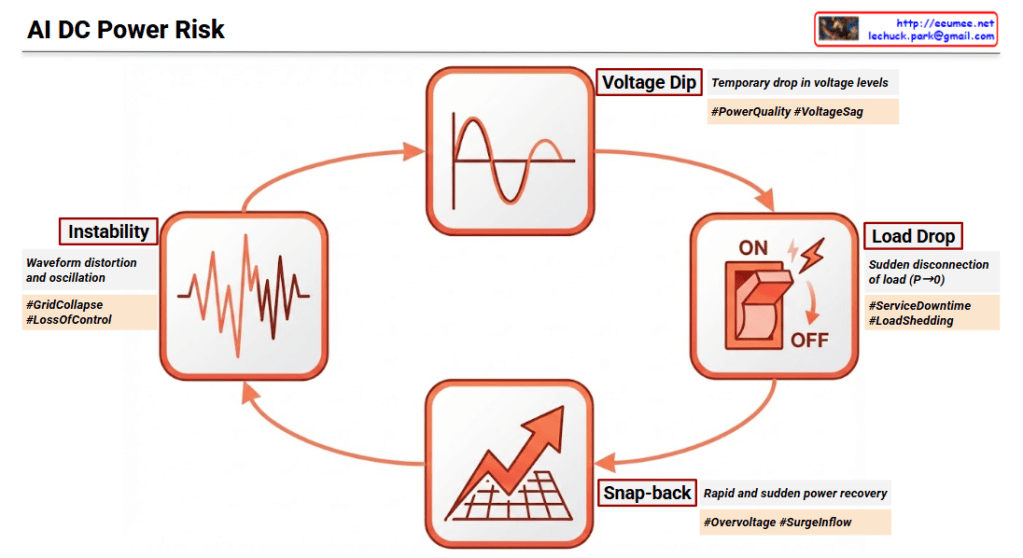
The integration of massive AI workloads into a Weak Grid (SCR:Short Circuit Ratio < 3) creates a high-risk environment where electrical Transients can escalate into systemic failures.

1. Voltage Dip (Transient Voltage Sag)

  • Mechanism: AI workloads are characterized by Step Power Changes and Pulse-type Profiles. When these massive loads activate simultaneously, they cause an immediate Transient Voltage Sag in a weak grid due to high impedance.
  • Impact: This compromises Power Quality, leading to potential malfunctions in voltage-sensitive AI hardware.

2. Load Drop (Transient Load Rejection)

  • Mechanism: If the voltage sag exceeds safety thresholds, protection systems trigger Load Rejection, causing the power consumption to plummet to zero (P -> 0).
  • Impact: This results in Service Downtime and creates a massive power imbalance in the grid, often referred to as Load Shedding.

3. Snap-back (Transient Recovery & Inrush)

  • Mechanism: As the grid attempts to recover or the load is re-engaged, it creates a Transient Recovery Voltage (TRV).
  • Impact: This phase often sees Overvoltage (Overshoot) and a massive Surge Inflow (Inrush Current), which places extreme electrical stress on power components and can damage sensitive circuitry.

4. Instability (Dynamic & Harmonic Oscillation)

  • Mechanism: The repetition of sags and surges leads to Dynamic Oscillation. The control systems of power converters may lose synchronization with the grid frequency.
  • Impact: The result is severe Waveform Distortion, Loss of Control, and eventually a total Grid Collapse (Blackout).

Key Insight (NERC 2025 Warning)

The North American Electric Reliability Corporation (NERC) warns that the reduction of voltage-sensitive loads and the rise of periodic, pulse-like AI workloads are primary drivers of modern grid instability.


Summary

  1. AI Load Dynamics: Rapid step-load changes in AI data centers act as a “shock” to weak grids, triggering a self-reinforcing cycle of electrical failure.
  2. Transient Progression: The cycle moves from a Voltage Sag to a Load Trip, followed by a damaging Power Surge, eventually leading to non-damped Oscillations.
  3. Strategic Necessity: To break this cycle, data centers must implement advanced solutions like Grid-forming Inverters or Fast-acting BESS to provide synthetic inertia and voltage support.

#PowerTransients #WeakGrid #AIDataCenter #GridStability #NERC2025 #VoltageSag #LoadShedding #ElectricalEngineering #AIInfrastructure #SmartGrid #PowerQuality

With Gemini