Energy Storage & Backup Power


Energy Storage & Backup Power Comparison

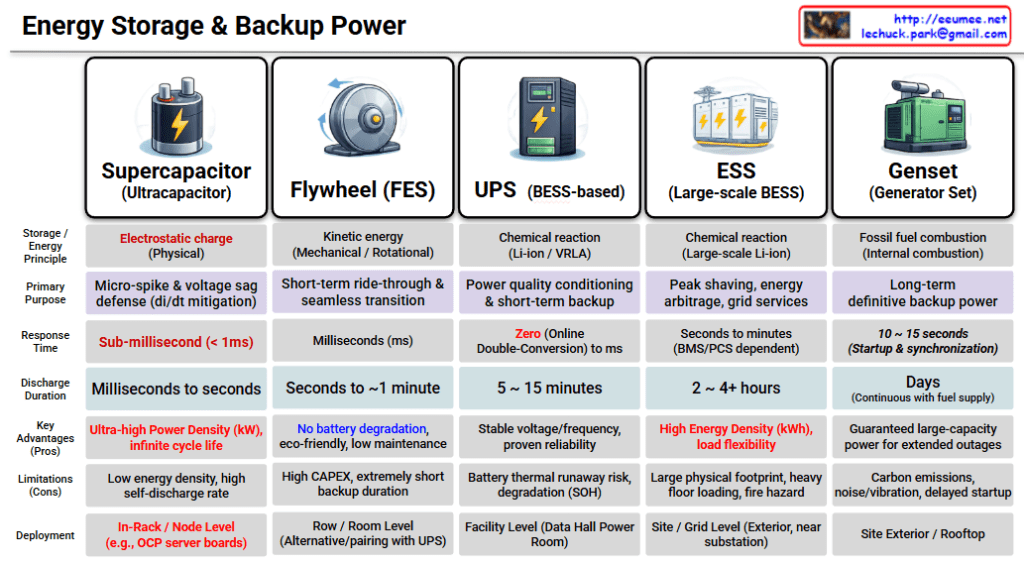
This infographic provides a comprehensive overview of energy storage and backup power technologies used in mission-critical infrastructures like data centers. As you move from left to right, the response time increases, but the backup duration also significantly extends.

1. Supercapacitor (Ultracapacitor)

  • Energy Principle: Electrostatic charge (Physical)
  • Primary Purpose: Micro-spike & voltage sag defense (di/dt mitigation)
  • Response Time: Sub-millisecond (< 1ms)
  • Discharge Duration: Milliseconds to seconds
  • Key Advantages: Ultra-high Power Density (kW), infinite cycle life
  • Limitations: Low energy density, high self-discharge rate
  • Deployment: In-Rack / Node Level (e.g., OCP server boards)

2. Flywheel (FES – Flywheel Energy Storage)

  • Energy Principle: Kinetic energy (Mechanical / Rotational)
  • Primary Purpose: Short-term ride-through & seamless transition
  • Response Time: Milliseconds (ms)
  • Discharge Duration: Seconds to ~1 minute
  • Key Advantages: No battery degradation, eco-friendly, low maintenance
  • Limitations: High CAPEX, extremely short backup duration
  • Deployment: Row / Room Level (Used as an alternative or paired with UPS)

3. UPS (BESS-based)

  • Energy Principle: Chemical reaction (Li-ion / VRLA)
  • Primary Purpose: Power quality conditioning & short-term backup
  • Response Time: Zero (Online Double-Conversion) to ms
  • Discharge Duration: 5 ~ 15 minutes
  • Key Advantages: Stable voltage/frequency, proven reliability
  • Limitations: Battery thermal runaway risk, degradation (SOH – State of Health)
  • Deployment: Facility Level (Data Hall Power Room)

4. ESS (Large-scale BESS)

  • Energy Principle: Chemical reaction (Large-scale Li-ion)
  • Primary Purpose: Peak shaving, energy arbitrage, grid services
  • Response Time: Seconds to minutes (BMS/PCS dependent)
  • Discharge Duration: 2 ~ 4+ hours
  • Key Advantages: High Energy Density (kWh), load flexibility
  • Limitations: Large physical footprint, heavy floor loading, fire hazard
  • Deployment: Site / Grid Level (Exterior, near substation)

5. Genset (Generator Set)

  • Energy Principle: Fossil fuel combustion (Internal combustion)
  • Primary Purpose: Long-term definitive backup power
  • Response Time: 10 ~ 15 seconds (Startup & synchronization)
  • Discharge Duration: Days (Continuous with fuel supply)
  • Key Advantages: Guaranteed large-capacity power for extended outages
  • Limitations: Carbon emissions, noise/vibration, delayed startup
  • Deployment: Site Exterior / Rooftop

Summary of the Spectrum

The hierarchy demonstrates a “Layered Defense” strategy for power reliability:

  • Immediate (ms): Supercapacitors and Flywheels handle transient spikes and sags.
  • Short-term (mins): UPS systems bridge the gap until secondary power kicks in.
  • Long-term (hours/days): ESS manages energy efficiency, while Gensets provide the final safety net for prolonged outages.

#EnergyStorage #BackupPower #DataCenter #UPS #BESS #Flywheel #Supercapacitor #Genset #EnergyEfficiency #PowerReliability #ElectricalEngineering #SmartGrid #EnergyManagement #TechInfographic #Infrastructure

With Gemini
AI DC Power Risk with BESS


Technical Analysis: The Impact of AI Loads on Weak Grids

1. The Problem: A Threat to Grid Stability

Large-scale AI loads combined with “Weak Grids” (where the Short Circuit Ratio, or SCR, is less than 3) significantly threaten power grid stability.

  • AI Workload Characteristics: These loads are defined by sudden “Step Power Changes” and “Pulse-type Profiles” rather than steady consumption.
  • Sensitivity: NERC (2025) warns that the decrease in voltage-sensitive loads and the rise of periodic workloads are major drivers of grid instability.

2. The Vicious Cycle of Instability

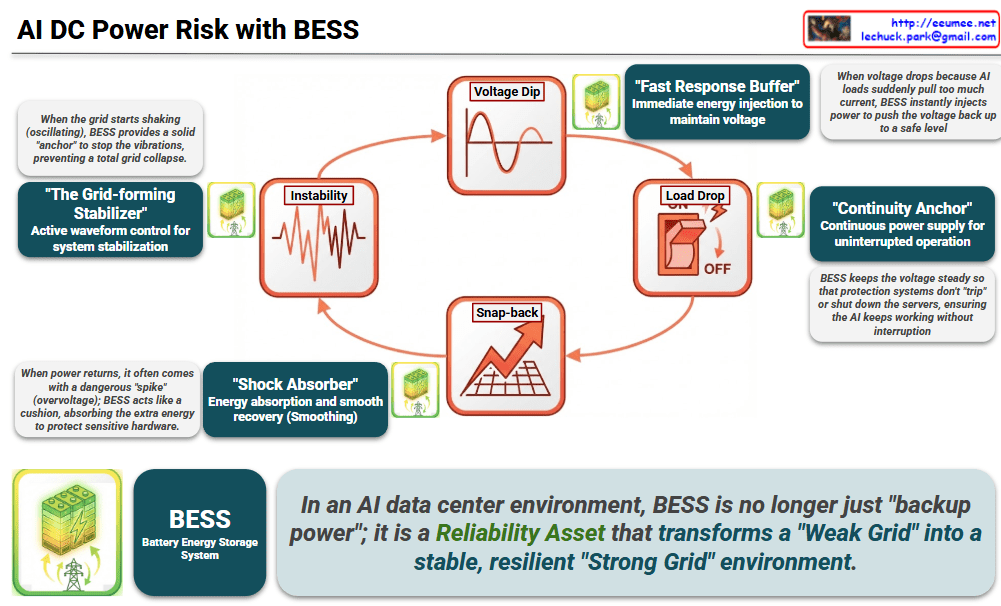
The images illustrate a four-stage downward spiral triggered by the interaction between AI hardware and a fragile power infrastructure:

  • Voltage Dip: As AI loads suddenly spike, the grid’s high impedance causes a temporary but sharp drop in voltage levels. This degrades #PowerQuality and causes #VoltageSag.
  • Load Drop: When voltage falls too low, protection systems trigger a sudden disconnection of the load ($P \rightarrow 0$). This leads to #ServiceDowntime and massive #LoadShedding.
  • Snap-back: As the grid tries to recover or the load re-engages, there is a rapid and sudden power surge. This creates dangerous #Overvoltage and #SurgeInflow.
  • Instability: The repetition of these fluctuations leads to waveform distortion and oscillation. Eventually, this causes #GridCollapse and a total #LossOfControl.

3. The Solution: BESS as a Reliability Asset

The final analysis reveals that a Battery Energy Storage System (BESS) acts as the critical circuit breaker for this vicious cycle.

  • Fast Response Buffer: BESS provides immediate energy injection the moment a dip is detected, maintaining voltage levels.
  • Continuity Anchor: By holding the voltage steady, it prevents protection systems from “tripping,” ensuring uninterrupted operation for AI servers.
  • Shock Absorber: During power recovery, BESS absorbs excess energy to “smooth” the transition and protect sensitive hardware from spikes.
  • The Grid-forming Stabilizer: It uses active waveform control to stop oscillations, providing the “virtual inertia” needed to prevent total grid collapse.

Summary

  1. AI Load Dynamics: The erratic “pulse” nature of AI power consumption acts as a physical shock to weak grids, necessitating a new layer of protection.
  2. Beyond Backup Power: In this context, BESS is redefined as a Reliability Asset that transforms a “Weak Grid” into a resilient “Strong Grid” environment.
  3. Operational Continuity: By filling gaps, absorbing shocks, and anchoring the grid, BESS ensures that AI data centers remain operational even during severe transient events.

#BESS #GridStability #AIDataCenter #PowerQuality #WeakGrid #EnergyStorage #NERC2025 #VoltageSag #VirtualInertia #TechInfrastructure

with Gemini

UPS & ESS


UPS vs. ESS & Key Safety Technologies

This image illustrates the structural differences between UPS (Uninterruptible Power System) and ESS (Energy Storage System), emphasizing the advanced safety technologies required for ESS due to its “High Power, High Risk” nature.

1. Left Side: System Comparison (UPS vs. ESS)

This section contrasts the purpose and scale of the two systems, highlighting why ESS requires stricter safety measures.

  • UPS (Traditional System)
    • Purpose: Bridges the power gap for a short duration (10–30 mins) until the backup generator starts (Generator Wake-Up Time).
    • Scale: Relatively low capacity (25–500 kWh) and output (100 kW – N MW).
  • ESS (High-Capacity System)
    • Purpose: Stores energy for long durations (4+ hours) for active grid management, such as Peak Shaving.
    • Scale: Handles massive power (~100+ MW) and capacity (~400+ MWh).
    • Risk Factor: Labeled as “High Power, High Risk,” indicating that the sheer energy density makes it significantly more hazardous than UPS.

2. Right Side: 4 Key Safety Technologies for ESS

Since standard UPS technologies (indicated in gray text) are insufficient for ESS, the image outlines four critical technological upgrades (indicated in bold text).

① Battery Management System (BMS)

  • (From) Simple voltage monitoring and cut-off.
  • [To] Active Balancing & Precise State Estimation: Requires algorithms that actively balance cell voltages and accurately calculate SOC (State of Charge) and SOH (State of Health).

② Thermal Management System

  • (From) Simple air cooling or fans.
  • [To] Forced Air (HVAC) / Liquid Cooling: Due to high heat generation, robust air conditioning (HVAC) or direct Liquid Cooling systems are necessary.

③ Fire Detection & Suppression

  • (From) Detecting smoke after a fire starts.
  • [To] Off-gas Detection & Dedicated Suppression: Detects Off-gas (released before thermal runaway) to prevent fires early, using specialized suppressants like Clean Agents or Water Mist.

④ Physical/Structural Safety

  • (From) Standard metal enclosures.
  • [To] Explosion-proof & Venting Design: Enclosures must withstand explosions and safely vent gases.
  • [To] Fire Propagation Prevention: Includes fire barriers and BPU (Battery Protective Units) to stop fire from spreading between modules.

Summary

  • Scale: ESS handles significantly higher power and capacity (>400 MWh) compared to UPS, serving long-term grid needs rather than short-term backup.
  • Risk: Due to the “High Power, High Risk” nature of ESS, standard safety measures used in UPS are insufficient.
  • Solution: Advanced technologies—such as Liquid Cooling, Off-gas Detection, and Active Balancing BMS—are mandatory to ensure safety and prevent thermal runaway.

#ESS #UPS #BatterySafety #BMS #ThermalManagement #EnergyStorage #FireSafety #Engineering #TechTrends #OffGasDetection

WIth Gemini