Sag & Swell

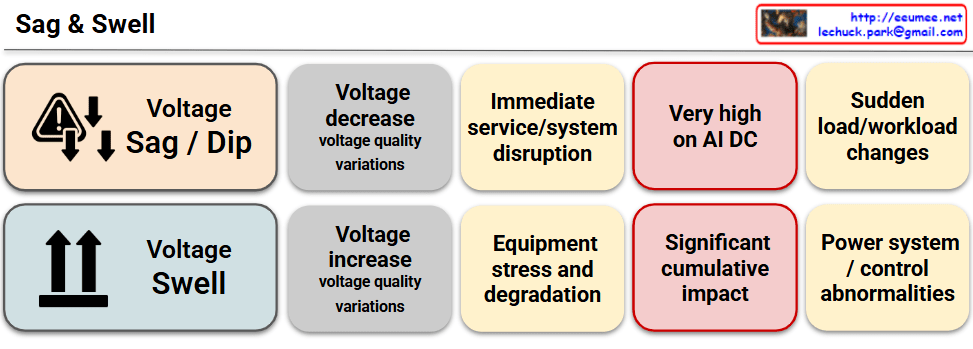
The image provides a clear, side-by-side comparison of two major power quality issues: Voltage Sag (or Dip) and Voltage Swell. It looks like a great summary graphic prepared for your tech blog at eeumee.net, particularly because it sharply highlights how these electrical phenomena specifically impact AI Data Centers (AI DC).

1. Voltage Sag / Dip

  • Definition: A sudden, momentary decrease in voltage.
  • System Impact: It causes immediate service and system disruption. If the voltage drops too low, servers can suddenly power off or reboot.
  • AI DC Relevance: Noted as “Very high on AI DC.” The risk and frequency are elevated in AI environments.
  • Root Cause: This is primarily driven by sudden load or workload changes. When thousands of GPUs simultaneously spin up for intensive AI training or inference tasks, they draw massive amounts of current in an instant, causing the voltage to dip.

2. Voltage Swell

  • Definition: A sudden, momentary increase in voltage.
  • System Impact: Unlike a sag, a swell might not cause an immediate outage, but it forces overvoltage through the components, leading to equipment stress and degradation.
  • AI DC Relevance: It carries a significant cumulative impact. The hardware damage builds up over time, eventually leading to premature component failure.
  • Root Cause: Typically triggered by power system or control abnormalities, or when a massive electrical load is suddenly dropped from the grid.

💡 Core Insight

This slide captures why power dynamics in AI Data Centers are vastly different from traditional IT environments. The extreme, dynamic power fluctuations inherent to AI workloads make rigorous power quality monitoring (via DCIM) and the implementation of highly responsive, advanced power architectures—such as Battery Energy Storage Systems (BESS)—absolutely critical to maintaining uptime and protecting expensive hardware.

#AIDataCenter #PowerQuality #VoltageSag #VoltageSwell #DataCenterInfrastructure #TechBlog #GPUWorkloads #ServerCooling

With Gemini
AI DC Power Risk with BESS


Technical Analysis: The Impact of AI Loads on Weak Grids

1. The Problem: A Threat to Grid Stability

Large-scale AI loads combined with “Weak Grids” (where the Short Circuit Ratio, or SCR, is less than 3) significantly threaten power grid stability.

  • AI Workload Characteristics: These loads are defined by sudden “Step Power Changes” and “Pulse-type Profiles” rather than steady consumption.
  • Sensitivity: NERC (2025) warns that the decrease in voltage-sensitive loads and the rise of periodic workloads are major drivers of grid instability.

2. The Vicious Cycle of Instability

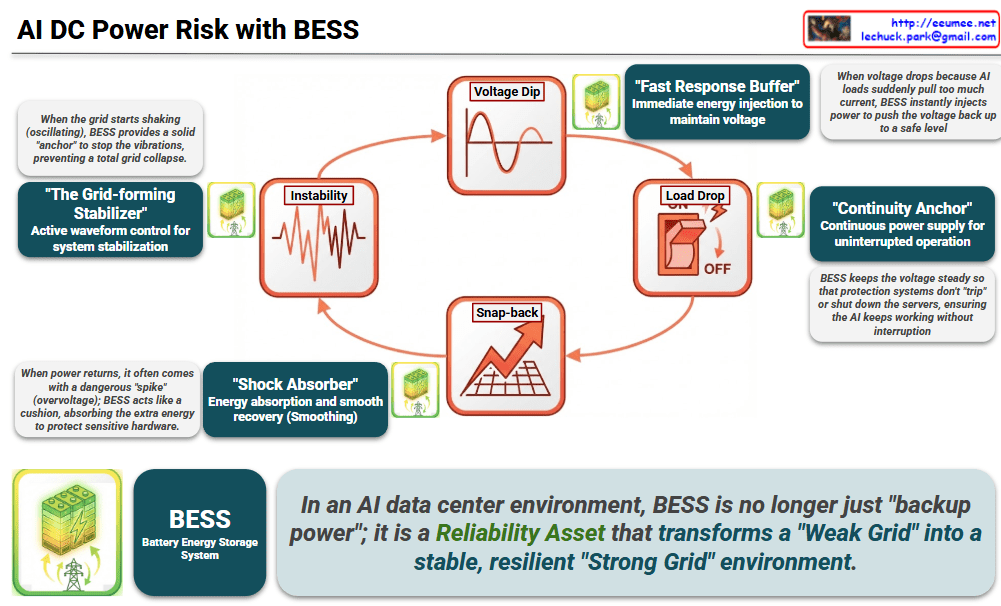
The images illustrate a four-stage downward spiral triggered by the interaction between AI hardware and a fragile power infrastructure:

  • Voltage Dip: As AI loads suddenly spike, the grid’s high impedance causes a temporary but sharp drop in voltage levels. This degrades #PowerQuality and causes #VoltageSag.
  • Load Drop: When voltage falls too low, protection systems trigger a sudden disconnection of the load ($P \rightarrow 0$). This leads to #ServiceDowntime and massive #LoadShedding.
  • Snap-back: As the grid tries to recover or the load re-engages, there is a rapid and sudden power surge. This creates dangerous #Overvoltage and #SurgeInflow.
  • Instability: The repetition of these fluctuations leads to waveform distortion and oscillation. Eventually, this causes #GridCollapse and a total #LossOfControl.

3. The Solution: BESS as a Reliability Asset

The final analysis reveals that a Battery Energy Storage System (BESS) acts as the critical circuit breaker for this vicious cycle.

  • Fast Response Buffer: BESS provides immediate energy injection the moment a dip is detected, maintaining voltage levels.
  • Continuity Anchor: By holding the voltage steady, it prevents protection systems from “tripping,” ensuring uninterrupted operation for AI servers.
  • Shock Absorber: During power recovery, BESS absorbs excess energy to “smooth” the transition and protect sensitive hardware from spikes.
  • The Grid-forming Stabilizer: It uses active waveform control to stop oscillations, providing the “virtual inertia” needed to prevent total grid collapse.

Summary

  1. AI Load Dynamics: The erratic “pulse” nature of AI power consumption acts as a physical shock to weak grids, necessitating a new layer of protection.
  2. Beyond Backup Power: In this context, BESS is redefined as a Reliability Asset that transforms a “Weak Grid” into a resilient “Strong Grid” environment.
  3. Operational Continuity: By filling gaps, absorbing shocks, and anchoring the grid, BESS ensures that AI data centers remain operational even during severe transient events.

#BESS #GridStability #AIDataCenter #PowerQuality #WeakGrid #EnergyStorage #NERC2025 #VoltageSag #VirtualInertia #TechInfrastructure

with Gemini

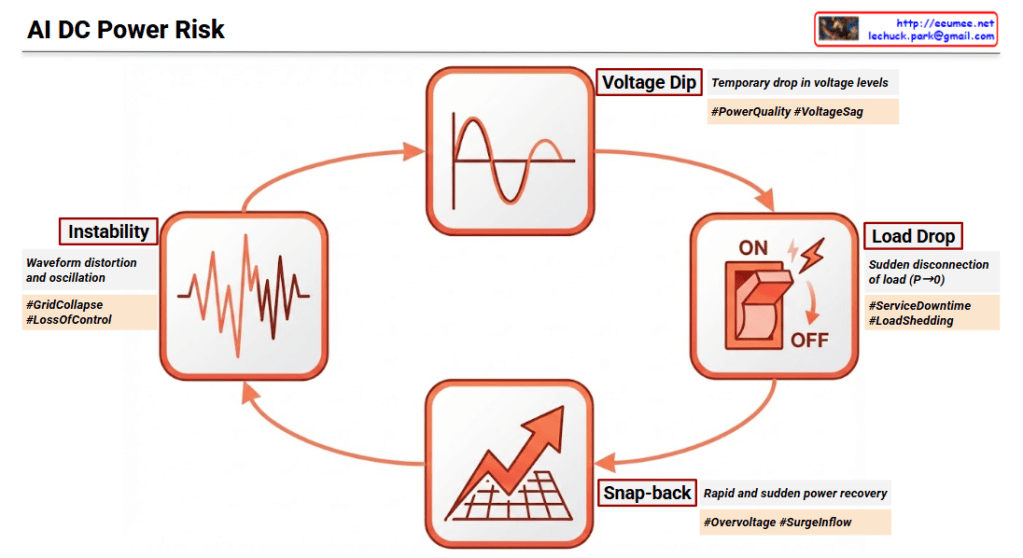
AI DC Power Risk


Technical Analysis: AI Load & Weak Grid Interaction

The integration of massive AI workloads into a Weak Grid (SCR:Short Circuit Ratio < 3) creates a high-risk environment where electrical Transients can escalate into systemic failures.

1. Voltage Dip (Transient Voltage Sag)

  • Mechanism: AI workloads are characterized by Step Power Changes and Pulse-type Profiles. When these massive loads activate simultaneously, they cause an immediate Transient Voltage Sag in a weak grid due to high impedance.
  • Impact: This compromises Power Quality, leading to potential malfunctions in voltage-sensitive AI hardware.

2. Load Drop (Transient Load Rejection)

  • Mechanism: If the voltage sag exceeds safety thresholds, protection systems trigger Load Rejection, causing the power consumption to plummet to zero (P -> 0).
  • Impact: This results in Service Downtime and creates a massive power imbalance in the grid, often referred to as Load Shedding.

3. Snap-back (Transient Recovery & Inrush)

  • Mechanism: As the grid attempts to recover or the load is re-engaged, it creates a Transient Recovery Voltage (TRV).
  • Impact: This phase often sees Overvoltage (Overshoot) and a massive Surge Inflow (Inrush Current), which places extreme electrical stress on power components and can damage sensitive circuitry.

4. Instability (Dynamic & Harmonic Oscillation)

  • Mechanism: The repetition of sags and surges leads to Dynamic Oscillation. The control systems of power converters may lose synchronization with the grid frequency.
  • Impact: The result is severe Waveform Distortion, Loss of Control, and eventually a total Grid Collapse (Blackout).

Key Insight (NERC 2025 Warning)

The North American Electric Reliability Corporation (NERC) warns that the reduction of voltage-sensitive loads and the rise of periodic, pulse-like AI workloads are primary drivers of modern grid instability.


Summary

  1. AI Load Dynamics: Rapid step-load changes in AI data centers act as a “shock” to weak grids, triggering a self-reinforcing cycle of electrical failure.
  2. Transient Progression: The cycle moves from a Voltage Sag to a Load Trip, followed by a damaging Power Surge, eventually leading to non-damped Oscillations.
  3. Strategic Necessity: To break this cycle, data centers must implement advanced solutions like Grid-forming Inverters or Fast-acting BESS to provide synthetic inertia and voltage support.

#PowerTransients #WeakGrid #AIDataCenter #GridStability #NERC2025 #VoltageSag #LoadShedding #ElectricalEngineering #AIInfrastructure #SmartGrid #PowerQuality

With Gemini