Road to the Automation

Diagram Description: The Paradigm Shift to Autonomous Operations

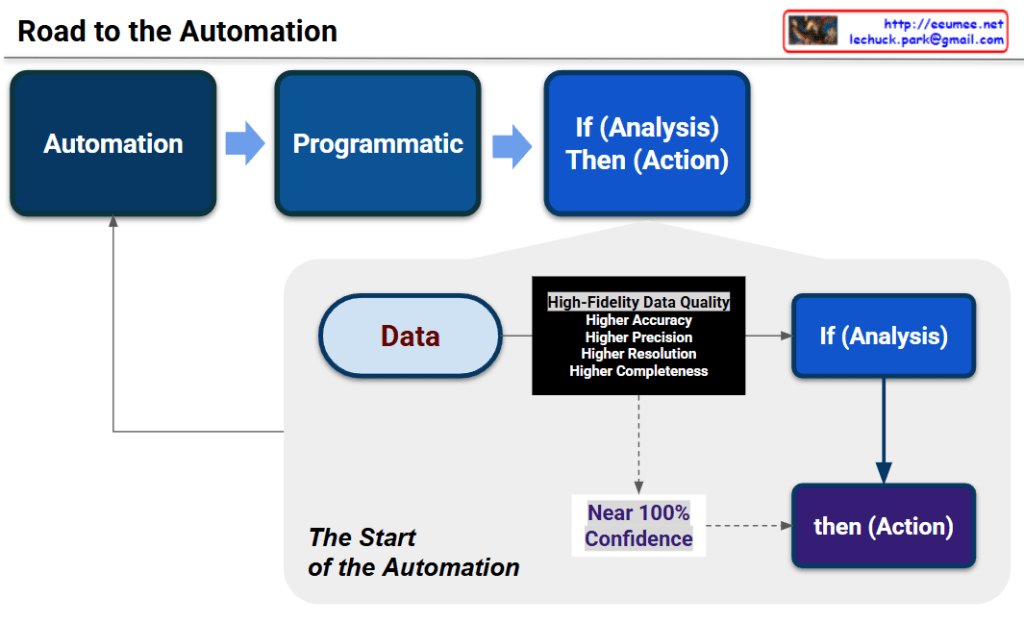
This infographic, titled “Road to the Automation,” visually explains the evolution from traditional, rule-based automation to a highly reliable, data-driven autonomous architecture.

  • The Traditional Approach (Top Flow):The upper section outlines the conventional path of automation. It transitions from a general “Automation” state to a “Programmatic” structure, ultimately relying on a standard, predefined logic: “If (Analysis) Then (Action).” This represents a system that reacts based on statically programmed rules.
  • The Start of True Automation (Bottom Flow):The core philosophy of the diagram lies in the lower, shaded area labeled “The Start of the Automation.” It asserts that true autonomous operation does not start with logic, but with “Data.”
    • The Quality Gate: The raw data must meet a strict standard of “High-Fidelity Data Quality,” which is defined by a comprehensive, four-pillar framework: Higher Accuracy, Higher Precision, Higher Resolution, and Higher Completeness.
    • Generating Systemic Trust: As the high-fidelity data feeds into the “If (Analysis)” phase, it concurrently establishes “Near 100% Confidence.”
    • Triggering Safe Action: This near-perfect confidence level is the critical catalyst. It provides the necessary systemic trust to safely execute the “then (Action).” This implies that a system can only act autonomously and safely when the underlying data quality eliminates uncertainty.
  • The Continuous Loop:Finally, an arrow points from the bottom automated framework back to the initial “Automation” block, illustrating a feedback loop. It shows that high-quality, confidence-backed autonomous actions are what continuously elevate and refine the entire automation ecosystem.

#AIOps #DataQuality #AutonomousSystems #InfrastructureAutomation #HighFidelityData #DataDriven #TechVisualization
The Architecture for AI-Driven Autonomous

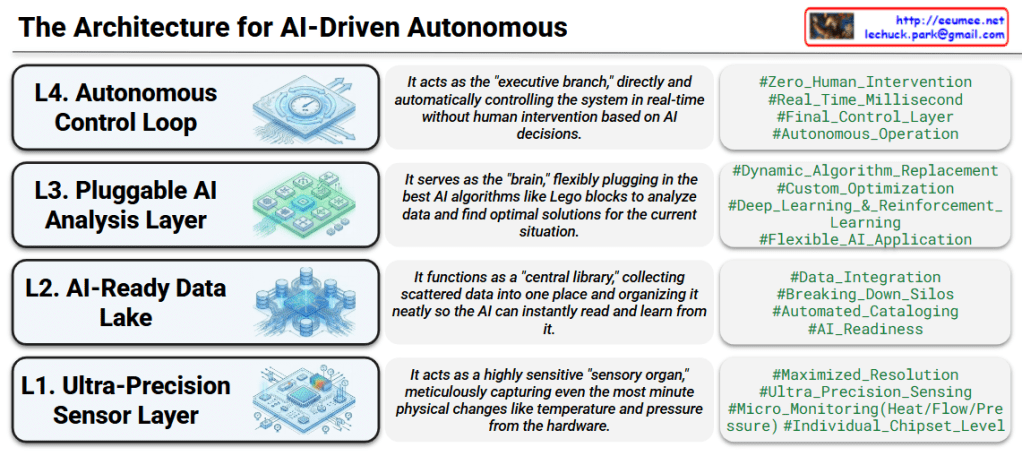
This slide effectively illustrates a complete, four-tier architecture required to build a fully autonomous AI system. Let’s walk through the framework from the foundation (data collection) to the top (autonomous execution):

  • L1. Ultra-Precision Sensor Layer (The “Sensory Organ”)This foundational layer is all about high-resolution data capture. Acting as the system’s highly sensitive sensory organs, it meticulously monitors minute physical changes—such as heat, flow, and pressure—right down to the individual chipset level.
  • L2. AI-Ready Data Lake (The “Central Library”)Once the data is captured, it flows into this layer to be consolidated. It breaks down data silos by collecting scattered facility data into one centralized library. It then automatically catalogs this information so that the AI can instantly access, read, and learn from it.
  • L3. Pluggable AI Analysis Layer (The “Brain”)This is where the cognitive processing happens. Acting as the brain of the system, it analyzes the organized data to find optimal solutions. Its “pluggable” nature means you can dynamically swap in the best AI algorithms—like Deep Learning or Reinforcement Learning—just like snapping Lego blocks together to fit the specific situation.
  • L4. Autonomous Control Loop (The “Executive Branch”)Finally, the insights from the brain are turned into action here. This layer operates in real-time (down to the millisecond) to send control signals back to the system. It executes decisions entirely on its own, achieving true autonomous operation with zero human intervention.

Summary

This architecture demonstrates a seamless, end-to-end operational flow: it starts by sensing microscopic hardware changes (L1), structures that raw data for immediate AI consumption (L2), applies dynamic and flexible algorithms to make smart decisions (L3), and ultimately executes those decisions autonomously in real-time (L4). It is a perfect blueprint for achieving a fully uncrewed, intelligent infrastructure.

#AIArchitecture #AutonomousSystems #EdgeComputing #DataLake #AIOps #SmartInfrastructure #MachineLearning #Automation

With Gemini