New Era of Digitals

This image presents a diagram titled “New Era of Digitals” that illustrates the evolution of computing paradigms.

Overall Structure:

The diagram shows a progression from left to right, transitioning from being “limited by Humans” to achieving “Everything by Digitals.”

Key Stages:

  1. Human Desire: The process begins with humans’ fundamental need to “wanna know it clearly,” representing our desire for understanding and knowledge.
  2. Rule-Based Era (1000s):
    • Deterministic approach
    • Using Logics and Rules
    • Automation with Specific Rules
    • Record with a human recognizable format
  3. Data-Driven Era:
    • Probabilistic approach (Not 100% But OK)
    • Massive Computing (Energy Resource)
    • Neural network-like structures represented by interconnected nodes

Core Message:

The diagram illustrates how computing has evolved from early systems that relied on human-defined explicit rules and logic to modern data-driven, probabilistic approaches. This represents the shift toward AI and machine learning, where we achieve “Not 100% But OK” results through massive computational resources rather than perfect deterministic rules.

The transition shows how we’ve moved from systems that required everything to be “human recognizable” to systems that can process and understand patterns beyond direct human comprehension, marking the current digital revolution where algorithms and data-driven approaches can handle complexity that exceeds traditional rule-based systems.

With Claude

‘tightly fused’

This illustration visualizes the evolution of data centers, contrasting the traditionally separated components with the modern AI data center where software, compute, network, and crucially, power and cooling systems are ‘tightly fused’ together. It emphasizes how power and advanced cooling are organically intertwined with GPU and memory, directly impacting AI performance and highlighting their inseparable role in meeting the demands of high-performance AI. This tight integration symbolizes a pivotal shift for the modern AI era.

LLM Efficiency with a Cooling

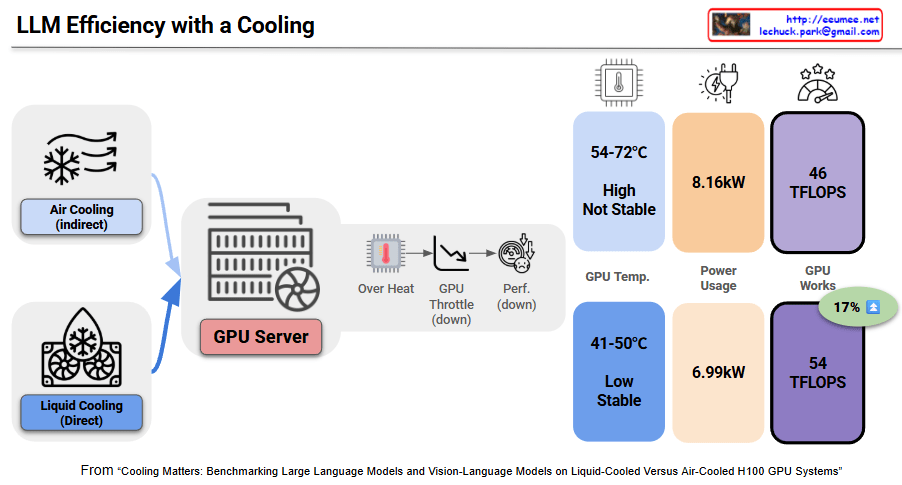
This image demonstrates the critical impact of cooling stability on both LLM performance and energy efficiency in GPU servers through benchmark results.

Cascading Effects of Unstable Cooling

Problems with Unstable Air Cooling:

  • GPU Temperature: 54-72°C (high and unstable)
  • Thermal throttling occurs – where GPUs automatically reduce clock speeds to prevent overheating, leading to significant performance degradation
  • Result: Double penalty of reduced performance + increased power consumption

Energy Efficiency Impact:

  • Power Consumption: 8.16kW (high)
  • Performance: 46 TFLOPS (degraded)
  • Energy Efficiency: 5.6 TFLOPS/kW (poor performance-to-power ratio)

Benefits of Stable Liquid Cooling

Temperature Stability Achievement:

  • GPU Temperature: 41-50°C (low and stable)
  • No thermal throttling → sustained optimal performance

Energy Efficiency Improvement:

  • Power Consumption: 6.99kW (14% reduction)
  • Performance: 54 TFLOPS (17% improvement)
  • Energy Efficiency: 7.7 TFLOPS/kW (38% improvement)

Core Mechanisms: How Cooling Affects Energy Efficiency

  1. Thermal Throttling Prevention: Stable cooling allows GPUs to maintain peak performance continuously
  2. Power Efficiency Optimization: Eliminates inefficient power consumption caused by overheating
  3. Performance Consistency: Unstable cooling can cause GPUs to use 50% of power budget while delivering only 25% performance

Advanced cooling systems can achieve energy savings ranging from 17% to 23% compared to traditional methods. This benchmark paradoxically shows that proper cooling investment dramatically improves overall energy efficiency.

Final Summary

Unstable cooling triggers thermal throttling that simultaneously degrades LLM performance while increasing power consumption, creating a dual efficiency loss. Stable liquid cooling achieves 17% performance gains and 14% power savings simultaneously, improving energy efficiency by 38%. In AI infrastructure, adequate cooling investment is essential for optimizing both performance and energy efficiency.

With Claude

HOPE OF THE NEXT

Hope to jump

This image visualizes humanity’s endless desire for ‘difference’ as the creative force behind ‘newness.’ The organic human brain fuses with the logical AI circuitry, and from their core, a burst of light emerges. This light symbolizes not just the expansion of knowledge, but the very moment of creation, transforming into unknown worlds and novel concepts.

Data Center Operantions

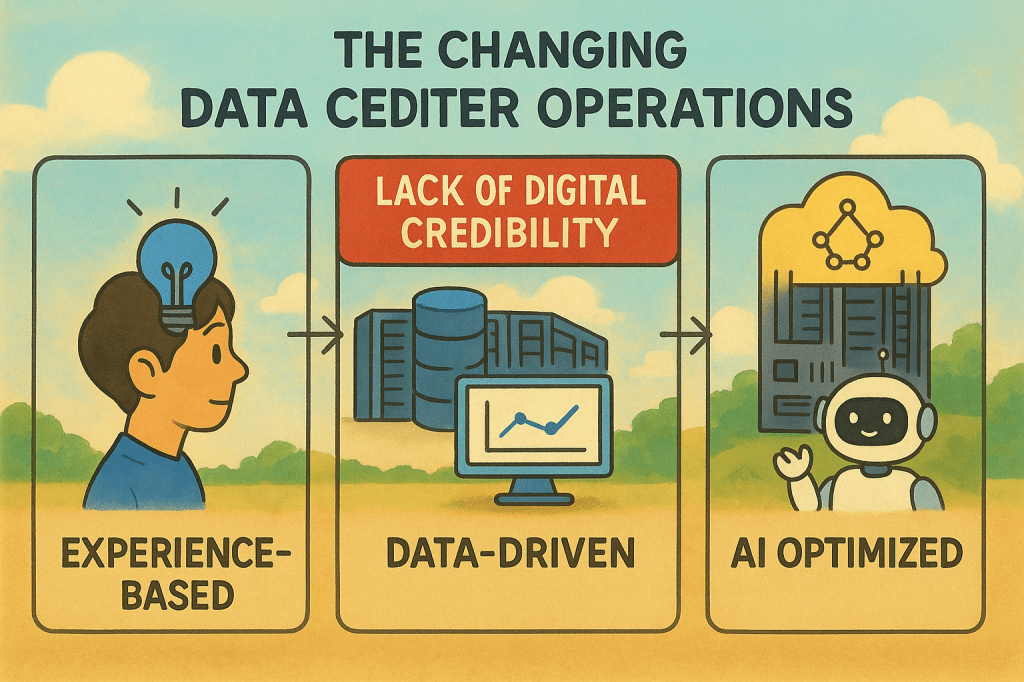
Data center operations are shifting from experience-driven practices toward data-driven and AI-optimized systems.
However, a fundamental challenge persists: the lack of digital credibility.

  • Insufficient data quality: Incomplete monitoring data and unreliable hardware reduce trust.
  • Limited digital expertise of integrators: Many providers focus on traditional design/operations, lacking strong datafication and automation capabilities.
  • Absence of verification frameworks: No standardized process to validate or certify collected data and analytical outputs.

These gaps are amplified by the growing scale and complexity of data centers and the expansion of GPU adoption, making them urgent issues that must be addressed for the next phase of digital operations.

Basic of Reasoning

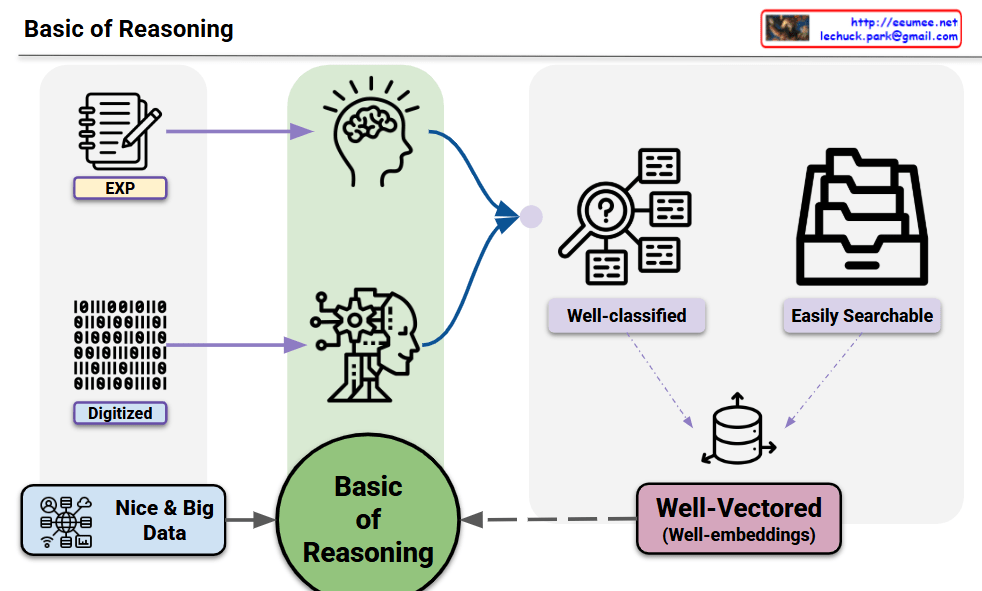
This diagram illustrates that human reasoning and AI reasoning share fundamentally identical structures.

Key Insights:

Common Structure Between Human and AI:

  • Human Experience (EXP) = Digitized Data: Human experiential knowledge and AI’s digital data are essentially the same information in different representations
  • Both rely on high-quality, large-scale data (Nice & Big Data) as their foundation

Shared Processing Pipeline:

  • Both human brain (intuitive thinking) and AI (systematic processing) go through the same Basic of Reasoning process
  • Information gets well-classified and structured to be easily searchable
  • Finally transformed into well-vectorized embeddings for storage

Essential Components for Reasoning:

  1. Quality Data: Whether experience or digital information, sufficient and high-quality data is crucial
  2. Structure: Systematic classification and organization of information
  3. Vectorization: Conversion into searchable and associative formats

Summary: This diagram demonstrates that effective reasoning – whether human or artificial – requires the same fundamental components: quality data and well-structured, vectorized representations. The core insight is that human experiential learning and AI data processing follow identical patterns, both culminating in structured knowledge storage that enables effective reasoning and retrieval.