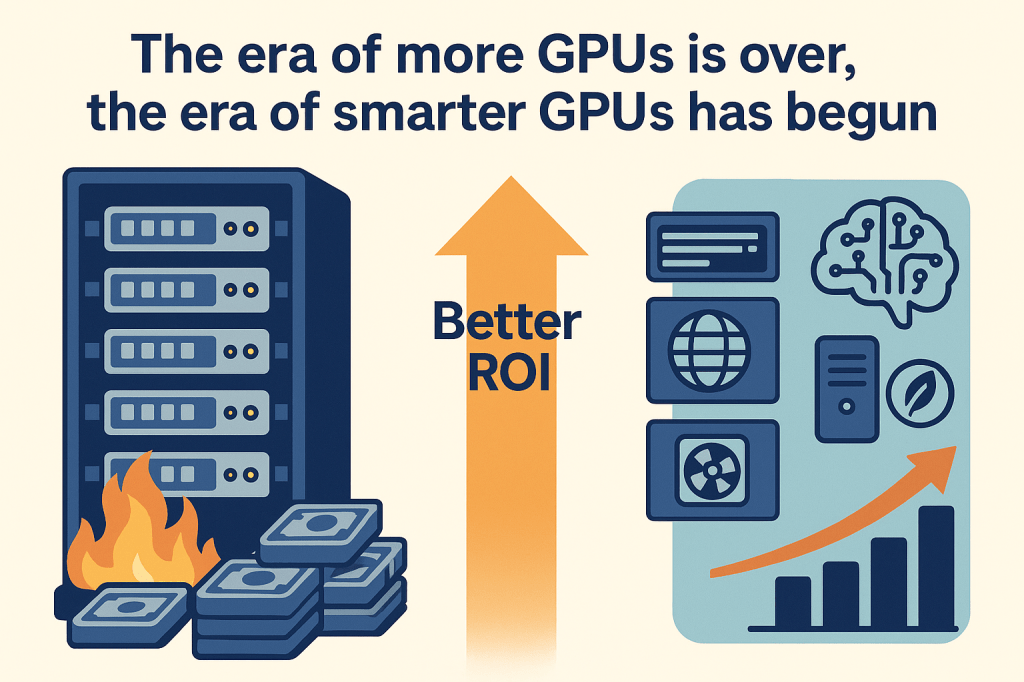
This illustration contrasts an old approach of endlessly adding more GPU servers, burning money for little gain, with a new era where AI-driven optimization of software, network, cooling and power delivers smarter GPUs and a much better ROI.
The Computing for the Fair Human Life.
This illustration contrasts an old approach of endlessly adding more GPU servers, burning money for little gain, with a new era where AI-driven optimization of software, network, cooling and power delivers smarter GPUs and a much better ROI.
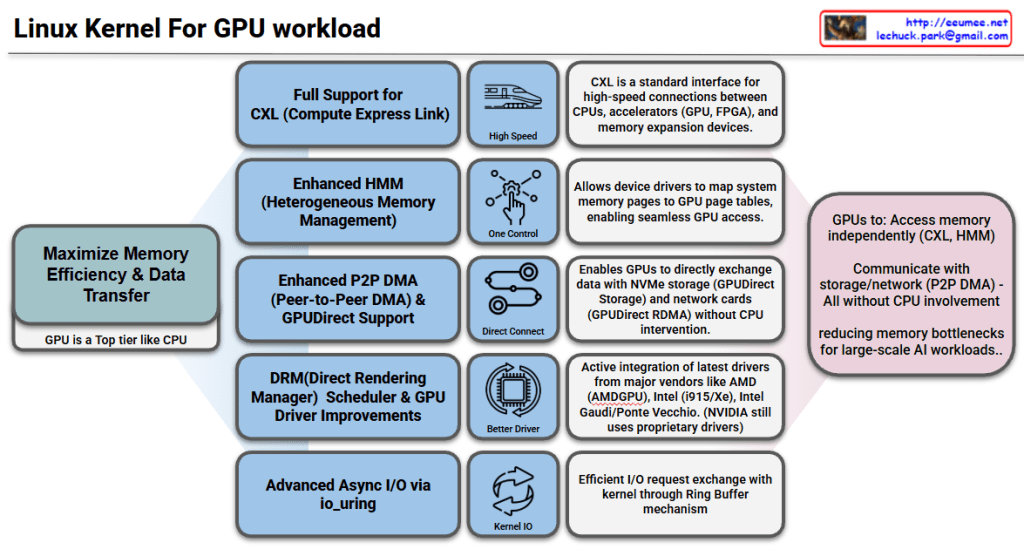
The core objective is to treat GPUs as a top-tier component like CPUs, reducing memory bottlenecks for large-scale AI workloads.
The Linux kernel now enables GPUs to independently access memory (CXL, HMM), storage, and network resources (P2P DMA, GPUDirect) without CPU involvement. Enhanced drivers from AMD, Intel, and improved schedulers optimize GPU workload management. These features collectively eliminate CPU bottlenecks, making the kernel highly efficient for large-scale AI and HPC workloads.
#LinuxKernel #GPU #AI #HPC #CXL #HMM #GPUDirect #P2PDMA #AMDGPU #IntelGPU #MachineLearning #HighPerformanceComputing #DRM #io_uring #HeterogeneousComputing #DataCenter #CloudComputing
With Claude

This image illustrates the dramatic growth in computing performance and data throughput from the Internet era to the AI/LLM era.
1. Internet Era
2. Mobile & Cloud Era
3. AI/LLM (Transformer) Era – “Now Here?” point
The chart demonstrates unprecedented exponential growth in data processing and power consumption driven by AI and Large Language Models. While data center efficiency (PUE) has improved significantly, the sheer scale of computational demands has skyrocketed. This visualization emphasizes the massive infrastructure requirements that modern AI systems necessitate.
#AI #LLM #DataCenter #CloudComputing #MachineLearning #ArtificialIntelligence #BigData #Transformer #DeepLearning #AIInfrastructure #TechTrends #DigitalTransformation #ComputingPower #DataProcessing #EnergyEfficiency
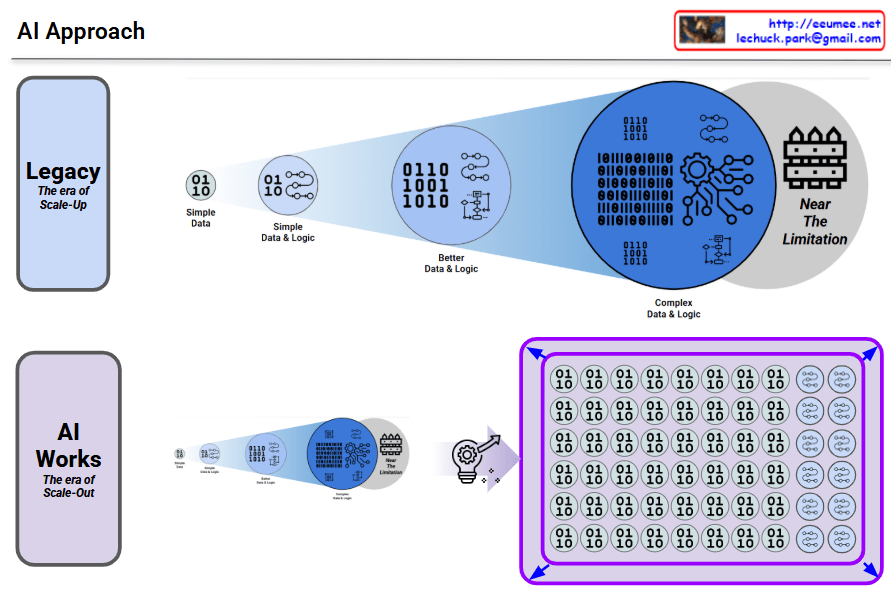
Traditional AI approach showing its limitations:
This approach gradually increases complexity, but no matter how much it improves, it inevitably runs into fundamental scalability limitations.
Modern AI transcending the limitations of the legacy approach through a new paradigm:
No matter how much you improve the legacy approach, there’s a ceiling. AI breaks through that ceiling with a completely different architecture.
#AI #MachineLearning #DeepLearning #NeuralNetworks #ScaleOut #Parallelization #AIRevolution #Paradigmshift #LegacyVsModern #AIArchitecture #TechEvolution #ArtificialIntelligence #ScalableAI #DistributedComputing #AIBreakthrough
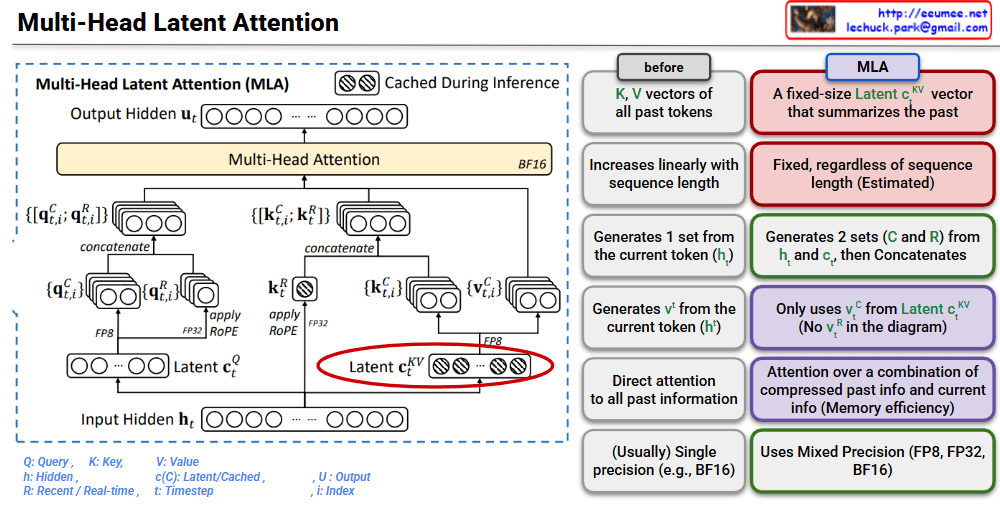
This image is a technical diagram explaining the structure of Multi-Head Latent Attention (MLA).
MLA is a mechanism that improves the memory efficiency of traditional Multi-Head Attention.
Traditional Approach:
MLA:
This architecture is an innovative approach to solve the KV cache memory problem during LLM inference.
MLA replaces the linearly growing KV cache with fixed-size latent vectors, dramatically reducing memory consumption during inference. It combines compressed past information with current token data through an efficient attention mechanism. This innovation enables faster and more memory-efficient LLM inference while maintaining model performance.
#MultiHeadLatentAttention #MLA #TransformerOptimization #LLMInference #KVCache #MemoryEfficiency #AttentionMechanism #DeepLearning #NeuralNetworks #AIArchitecture #ModelCompression #EfficientAI #MachineLearning #NLP #LargeLanguageModels
With Claude

This image contrasts traditional programming, where developers must explicitly code rules and logic (shown with a flowchart and a thoughtful programmer), with AI, where neural networks automatically learn patterns from large amounts of data (depicted with a network diagram and a smiling programmer). It illustrates the paradigm shift from manually defining rules to machines learning patterns autonomously from data.
#AI #MachineLearning #Programming #ArtificialIntelligence #AIvsTraditionalProgramming

This image summarizes four cutting-edge research studies demonstrating the bidirectional optimization relationship between AI LLMs and cooling systems. It proves that physical cooling infrastructure and software workloads are deeply interconnected.
Direction 1: Physical Cooling → AI Performance Impact
Direction 2: AI Software → Cooling Control
[Cooling HW → AI SW Performance]
→ Physical cooling improvements directly enhance AI workload real-time processing capabilities
[AI SW → Cooling HW Control]
→ AI software intelligently controls physical cooling to improve overall system efficiency
[AI SW ↔ Cooling HW Interaction]
→ Complete closed-loop where AI controls physical systems, and results feedback to AI performance
[Cooling HW → AI SW Training Stability]
→ Advanced physical cooling technology secures feasibility of large-scale LLM training
┌─────────────────────────────────────────────────────────┐
│              Physical Cooling Systems                    │
│    (Liquid cooling, Immersion, CRAC, Heat exchangers)   │
└──────────────┬────────────────────────┬─────────────────┘
               ↓                        ↑
        Temp↓ Power↓ Stability↑    AI-based Control
               ↓                   RL/LLM Controllers
┌──────────────┴────────────────────────┴─────────────────┐
│              AI Workloads (LLM/VLM)                      │
│    Performance↑ Throughput↑ Throttling↓ Training Stability↑│
└───────────────────────────────────────────────────────────┘
Better cooling → AI performance improvement → smarter cooling control
→ Energy savings → more AI jobs → advanced cooling optimization
→ Sustainable large-scale AI infrastructure
These studies demonstrate:
These four studies establish that next-generation AI data centers must evolve into integrated ecosystems where physical cooling and software workloads interact in real-time to self-optimize. The bidirectional relationship—where better cooling enables superior AI performance, and AI algorithms intelligently control cooling systems—creates a virtuous cycle that simultaneously achieves enhanced performance, energy efficiency, and sustainable scalability for large-scale AI infrastructure.
#EnergyEfficiency#GreenAI#SustainableAI#DataCenterOptimization#ReinforcementLearning#AIControl#SmartCooling
With Claude

