Computing with supers

From Claude with some prompting
This diagram titled “Computing works with supers” illustrates the structure and operational principles of modern high-performance computing systems. Key features include:

  1. Power Management: The “Making Power” section features a power icon labeled “Super,” indicating the massive power supply required for high-performance computing. This is emphasized by the phrase “Super Energy is required.”
  2. Central Processing Unit (CPU): Responsible for “Making Infra” and “Making Logic,” performing basic computational functions.
  3. Graphics Processing Unit (GPU) and AI: Located below the CPU, the GPU is directly connected to an AI model. The phrase “Delegate work to AI” demonstrates AI’s significant role in handling complex computing tasks.
  4. Heat Management: The diagram shows “Making Super Heat” from the GPU, managed by a “Control It with Cooling” system, highlighting the importance of thermal management.
  5. Integrated Management: The right sidebar groups power, GPU, and cooling systems together, with the caption “Must Manage All connected Supers.” This underscores the interconnectedness of these core elements and the need for integrated management.
  6. System Efficiency: Each major component is labeled “Super,” emphasizing their crucial roles in the high-performance system. This suggests that harmonious management of these elements determines the overall system’s efficiency and performance.
  7. Output: The “Super” human icon at the top right implies that this high-performance system produces exceptional results.

This diagram emphasizes that power management, GPU utilization, heat management, and AI integration are critical in modern high-performance computing. It highlights that efficient integrated management of these elements is key to determining the overall system’s performance and efficiency. Additionally, it suggests the growing importance of AI and automation technologies in effectively managing such complex systems.

DNS Why?

From Claude with some prompting
This image is a network diagram explaining the function and importance of DNS (Domain Name System). The main points are:

  1. WWW service works with DNS on TCP/IP.
  2. DNS is responsible for mapping domains to IP addresses.
  3. All network devices on the Internet can only route to IP addresses.
  4. It’s difficult to include actual service characteristics in IP addresses (only by number).
  5. Domain addresses are easy to use and must be mapped to IP addresses.
  6. On the client side, there’s a DNS Resolver (caching).
  7. On the server side, there’s a DNS server, which includes Authoritative Server, Root Server, and TLD Server. These are managed by IANA.
  8. At the center of the diagram is the key question: “So, how does DNS-IP Mapping work?”

This diagram visually explains the working principle of DNS and its importance in the Internet. It emphasizes the crucial role DNS plays in translating user-friendly domain names into IP addresses that computers can understand.

personalized RAG

from Claude with some prompting
This diagram illustrates a personalized RAG (Retrieval-Augmented Generation) system that allows individuals to use their personal data with various LLM (Large Language Model) implementations. Key aspects include:

  1. User input: Represented by a person icon and notebook on the left, indicating personal data or queries.
  2. On-Premise storage: Contains LLM models that can be managed and run locally by the user.
  3. Cloud integration: An API connects to cloud-based LLM services, represented by icons in the “on cloud” section. These also symbolize different cloud-based LLM models.
  4. Flexible model utilization: The structure enables users to leverage both on-premise and cloud-based LLM models, allowing for combination of different models’ strengths or selection of the most suitable model for specific tasks.
  5. Privacy protection: A “Control a privacy Filter” icon emphasizes the importance of managing privacy filters to prevent inappropriate exposure of sensitive information to LLMs.
  6. Model selection: The “Use proper Foundation models” icon stresses the importance of choosing appropriate base models for different tasks.

This system empowers individual users to safely manage their data while flexibly utilizing various LLM models, both on-premise and cloud-based. It places a strong emphasis on privacy protection, which is crucial in RAG systems dealing with personal data.

The diagram effectively showcases how personal data can be integrated with advanced LLM technologies while maintaining control over privacy and model selection.

Enjoy

By chatGPT

The image depicts a Korean dish called Dak Galbi, consisting of spicy marinated chicken pieces, cabbage, onions, and perilla leaves cooking on a large black iron skillet. The dish is vibrant with red and orange hues from the chili sauce, and steam is rising from the hot skillet, indicating that the food is freshly cooked and sizzling.

AI DICM for AI DC

From Claude with some prompting
This diagram illustrates the structure of an AI DCIM (Data Center Infrastructure Management) system for AI Data Centers (AI DC). Here’s an explanation of the key components and their roles:

  1. EPMS BAS(BMS): Energy and Building Management System, controlling the basic infrastructure of the data center.
  2. DCIM: Data Center Infrastructure Management system, integrated with EPMS/BAS to manage overall data center operations.
  3. AI and Big Data: Linked with DCIM to process large-scale data and perform AI-based analysis and decision-making.
  4. Super Computing: Provides high-performance computing capabilities to support complex AI tasks and large-scale data analysis.
  5. Super Power: Represents the high-performance power supply system necessary for AI DC.
  6. Super Cooling: Signifies the high-efficiency cooling system essential for large-scale computing environments.
  7. AI DCIM for AI DC: Integrates all these elements to create a new management system for AI data centers. This enables greater data processing capacity and faster analysis.

The goal of this system is emphasized by “Faster and more accurate is required!!”, highlighting the need for quicker and more precise operations and analysis in AI DC environments.

This structure enhances traditional DCIM systems with AI and big data technologies, presenting a new paradigm of data center management capable of efficiently managing and optimizing large-scale AI workloads. Through this, AI DCs can operate more intelligently and efficiently, smoothly handling the increasing demands for data processing and complex AI tasks.

The integration of these components aims to create a new facility management system for AI DCs, enabling the processing of larger datasets and faster analysis. This approach represents a significant advancement in data center management, tailored specifically to meet the unique demands of AI-driven infrastructures.

What to do first

From Claude with some prompting
This image outlines a progressive approach to data monitoring and alert systems, starting with simple metrics and evolving to more complex AI-driven solutions. The key steps are:

  1. “Keeping a Temperature”: Basic monitoring of system temperatures.
  2. “Monitoring”: Continuous observation of temperature data.
  3. “Alerts with thresholds”: Simple threshold-based alerts.
  4. More complex metrics: Including 10-minute thresholds, change counts, averages, and derivations.
  5. “More Indicators”: Expanding to additional KPIs and metrics.
  6. “Machine Learning ARIMA/LSTM”: Implementing advanced predictive models.
  7. “Alerts with predictions”: AI-driven predictive alerts.

The central message “EASY FIRST BEFORE THE AI !!” emphasizes starting with simpler methods before advancing to AI solutions.

Importantly, the image also implies that these simpler metrics and indicators established early on will later serve as valuable training data for AI models. This is shown by the arrows connecting all stages to the machine learning component, suggesting that the data collected throughout the process contributes to the AI’s learning and predictive capabilities.

This approach not only allows for a gradual build-up of system complexity but also ensures that when AI is implemented, it has a rich dataset to learn from, enhancing its effectiveness and accuracy.

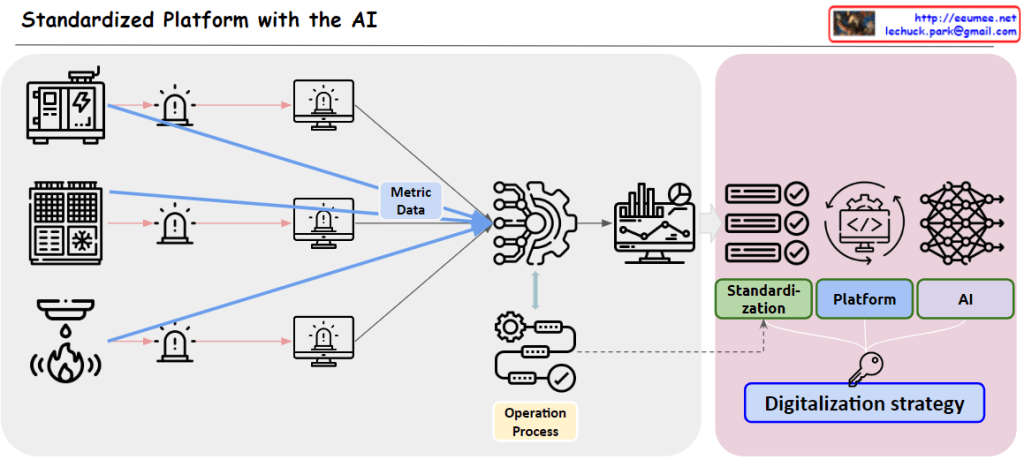
Standardized Platform with the AI

From Claude with some prompting
This image illustrates a “Standardized Platform with the AI”. Here’s a breakdown of the key components and processes:

  1. Left side: Various devices or systems (generator, HVAC system, fire detector, etc.) are shown. Each device is connected to an alarm system and a monitoring screen.
  2. Center: “Metric Data” from these devices is sent to a central gear-shaped icon, representing a data processing system.
  3. Upper right: The processed data is displayed on a dashboard or analytics screen.
  4. Lower right: There’s a section labeled “Operation Process”, indicating management or optimization of operational processes.
  5. Far right: Boxes representing the system’s components:
    • “Standardization”
    • “Platform”
    • “AI”
  6. Bottom: “Digitalization strategy” serves as the foundation for the entire system.

This diagram visualizes a digital transformation strategy that collects data from various systems and devices, processes it using AI on a standardized platform, and uses this to optimize and manage operations.

The flow shows how raw data from different sources is standardized, processed, and utilized to create actionable insights and improve operational efficiency, all underpinned by a comprehensive digitalization strategy.