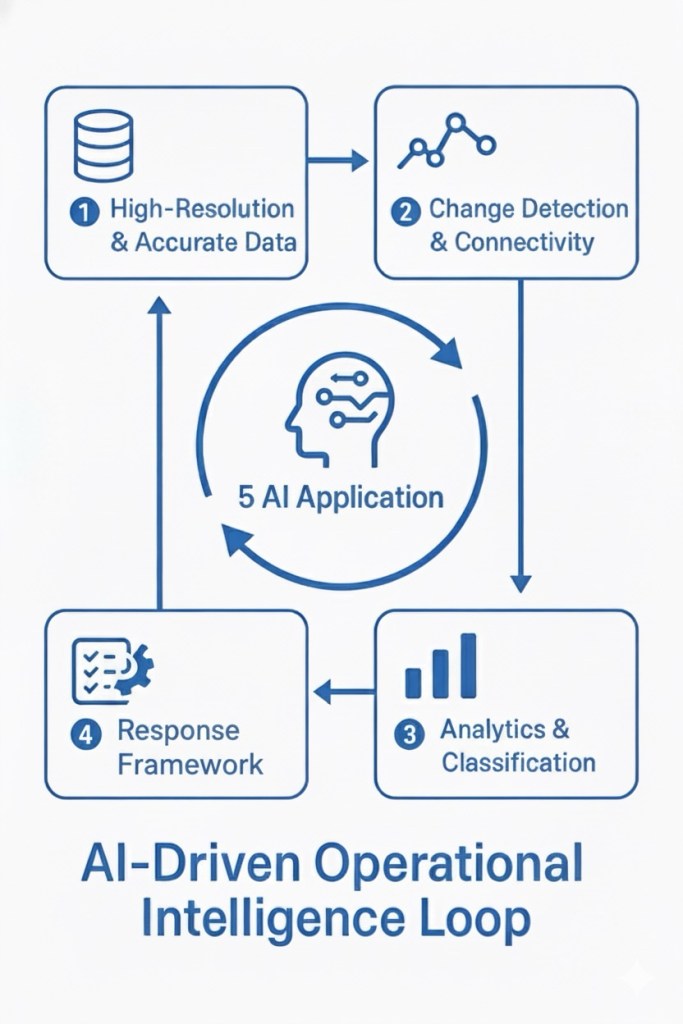
Collect precise, high-frequency sensor data across all systems to ensure reliability and synchronization.
2️⃣ Change Detection & Connectivity
Continuously monitor data variations and correlations to identify anomalies and causal relationships in real time.
3️⃣ Analytics & Classification
Analyze detected changes, classify events by impact and severity, and generate actionable insights for optimization.
4️⃣ Response Framework
Define and execute automated or semi-automated response strategies based on analysis and classification results.
5️⃣ AI Application & Continuous Learning
Use AI to automate steps 2–4, enhance prediction accuracy, and continuously improve operations through feedback and model retraining.
Loop Concept 1 Data → 2 Detection → 3 Analysis → 4 Response → 5 AI → (Feedback & Optimization) Goal: Build a self-optimizing operational ecosystem that integrates data, AI, and automation for smarter, more reliable digital operations.
Big Data Collection: Represented by the binary data (top-left) and the “All Data (Metrics)” block (bottom-left).
Data Quality Verification: The collected data then passes through the checklist icon (top flow) and the “Verification (with Resolution)” step (bottom flow). This aligns with the quality verification step, including ‘resolution/performance’.
3. Change Data Capture (CDC)
Verified data moves to the “Change Only” stage (central pink box).
If there are “No Changes,” it results in “No Actions,” illustrating the CDC (Change Data Capture) concept of processing only altered data.
The magnifying glass icon in the top flow also visualizes this ‘change detection’ role.
State/Numeric Processing: Once changes are detected (after the magnifying glass), the data is split into two types:
State Changes (ON/OFF icon): Represents changes in ‘state values’.
Numeric Changes (graph icon): Represents changes in ‘numeric values’.
Statistical Analysis & Severity Definition:
These changes are fed into the “Analysis” step.
This stage calculates the “Count of Changes” (statistics on the number of changes) and “Numeric change Diff” (amount of numeric change).
The analysis result leads to “Severity Tagging” to define the ‘Severity’ level (e.g., “Critical? Major? Minor?”).
6. Notification & 7. Analysis (Retrieve)
Notification: Once the severity is defined, the “Notification” step (bell/email icon) is triggered to alert personnel.
Analysis (Retrieve):
The notified user then performs the “Retrieve” action.
This final step involves querying both the changed data (CDD results) and the original data (source, indicated by the URL in the top-right) to analyze the cause.
Summary
This workflow begins with collecting and verifying all data, then uses CDC to isolate only the changes. These changes (state or numeric) are analyzed for count and difference to assign a severity level. The process concludes with notification and a retrieval step for root cause analysis.
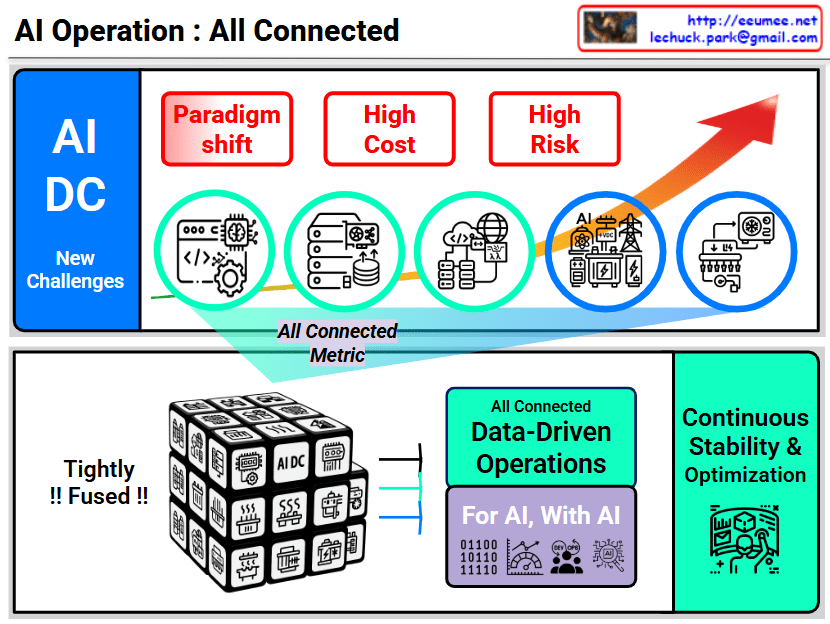
This diagram explains the operational paradigm shift in AI Data Centers (AI DC).
Top Section: New Challenges
AI DC Characteristics:
Paradigm shift: Fundamental change in operations for the AI era
High Cost: Massive investment required for GPUs, infrastructure, etc.
High Risk: Greater impact during outages and increased complexity
Five Core Components of AI DC (left→right):
Software: AI models, application development
Computing: GPUs, servers, and computational resources
Network: Data transmission and communication infrastructure
Power: High-density power supply and management (highlighted in orange)
Cooling: Heat management and cooling systems
→ These five elements are interconnected through the “All Connected Metric”
Bottom Section: Integrated Operations Solution
Core Concept:
📦 Tightly Fused Rubik’s Cube
The five core components (Software, Computing, Network, Power, Cooling) are intricately intertwined like a Rubik’s cube
Changes or issues in one element affect all other elements due to tight coupling
🎯 All Connected Data-Driven Operations
Data-driven integrated operations: Collecting and analyzing data from all connected elements
“For AI, With AI”: Operating the data center itself using AI technology for AI workloads
✅ Continuous Stability & Optimization
Ensuring continuous stability
Real-time monitoring and optimization
Key Message
AI data centers have five core components—Software, Computing, Network, Power, and Cooling—that are tightly fused together. To effectively manage this complex system, a data-centric approach that integrates and analyzes data from all components is essential, enabling continuous stability and optimization.
Summary
AI data centers are characterized by tightly coupled components (software, computing, network, power, cooling) that create high complexity, cost, and risk. This interconnected system requires data-driven operations that leverage AI to monitor and optimize all elements simultaneously. The goal is achieving continuous stability and optimization through integrated, real-time management of all connected metrics.
Maximizes efficiency by reusing the Main Model’s outputs
Two RMSNorms normalize the intermediate outputs from the Main Model
Performs lightweight operations using a single Transformer Block with FP8 Mixed Precision
Generates specialized vectors for future token prediction through Linear Projection and concatenation
Produces candidate tokens with BF16 precision
Key Features
Two-stage processing: The Main Model accurately predicts the next token, while the MTP Module generates additional candidate tokens in advance
Efficiency:
Shares the Embedding Layer with the Main Model to avoid recalculation
Reduces computational load with FP8 Mixed Precision
Uses only a single Transformer Block
Stability: RMSNorm ensures stable processing of outputs that haven’t passed through the Main Model’s deep layers
Summary
MTP architecture accelerates inference by using a lightweight module alongside the main model to speculatively generate multiple future tokens in parallel. It achieves efficiency through shared embeddings, mixed precision operations, and a single transformer block while maintaining stability through normalization layers. This approach significantly reduces latency in large language model generation.
The chart demonstrates unprecedented exponential growth in data processing and power consumption driven by AI and Large Language Models. While data center efficiency (PUE) has improved significantly, the sheer scale of computational demands has skyrocketed. This visualization emphasizes the massive infrastructure requirements that modern AI systems necessitate.




 Lechuck Park