Always Energy

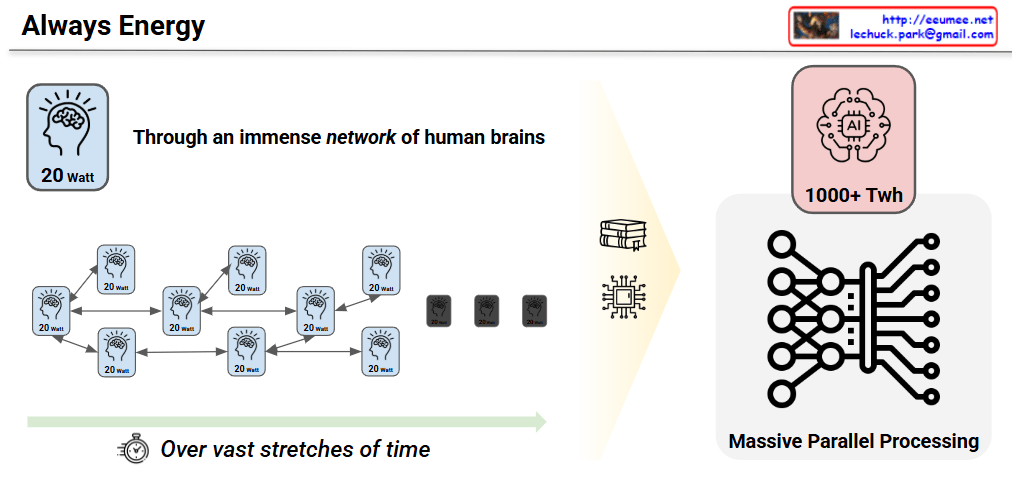
This infographic contrasts the way human knowledge has been accumulated with how modern Artificial Intelligence (AI) operates, focusing on energy consumption and processing structure.

1. Left: The Trajectory of Human Intelligence (Ultra-low Power, Time, and Connection)

  • 20 Watt Icon: Represents the biological limit and astonishing efficiency of a single human brain, consuming only 20W—roughly the energy needed to power a dim lightbulb.
  • Network of Brains: Accompanied by the phrase “Through an immense network of human brains,” the interconnected 20W icons illustrate that while individual intelligence is limited by its biology, a massive web of knowledge was formed through collective intelligence and communication.
  • Timeline: The clock icon, the phrase “Over vast stretches of time,” and the long green arrow stretching to the right emphasize that this knowledge wasn’t built overnight. It was gradually and painstakingly accumulated over the long course of human history.

2. Center: The Transfer of Knowledge (Accumulation and Technology)

  • Inside the large yellow transition arrow, there are icons of books (accumulated knowledge) and a microchip (computing technology).
  • This symbolizes the bridge where humanity’s vast knowledge, built by 20W brains over countless generations, meets modern semiconductor technology and transitions into the realm of machines.

3. Right: The Era of AI (Ultra-high Power and Massive Parallel Processing)

  • 1000+ TWh Icon: Visualizes the astronomical power consumption (over 1000 Terawatt-hours) of global AI and data centers. Placed in stark contrast to the human “20W,” it highlights just how energy-intensive AI technology truly is.
  • Artificial Neural Network Structure: Along with the phrase “Massive Parallel Processing,” it shows a structure where numerous nodes process massive amounts of data simultaneously.
  • While humans processed and passed down information over a “long period,” this illustrates that AI reduces time and achieves unprecedented performance by pouring in “massive power” to compute everything simultaneously (in parallel).

💡 Overall Review

“Humanity built civilization with a mere 20W of energy through time and connection, whereas modern AI operates on massive parallel processing, consuming over 1000+ TWh of immense energy.”

#ArtificialIntelligence #HumanIntelligence #AIvsHuman #CollectiveIntelligence #NeuralNetworks

With Gemini

PI-DLinear(Physics-Informed DLinear)


PI-DLinear (Physics-Informed DLinear)

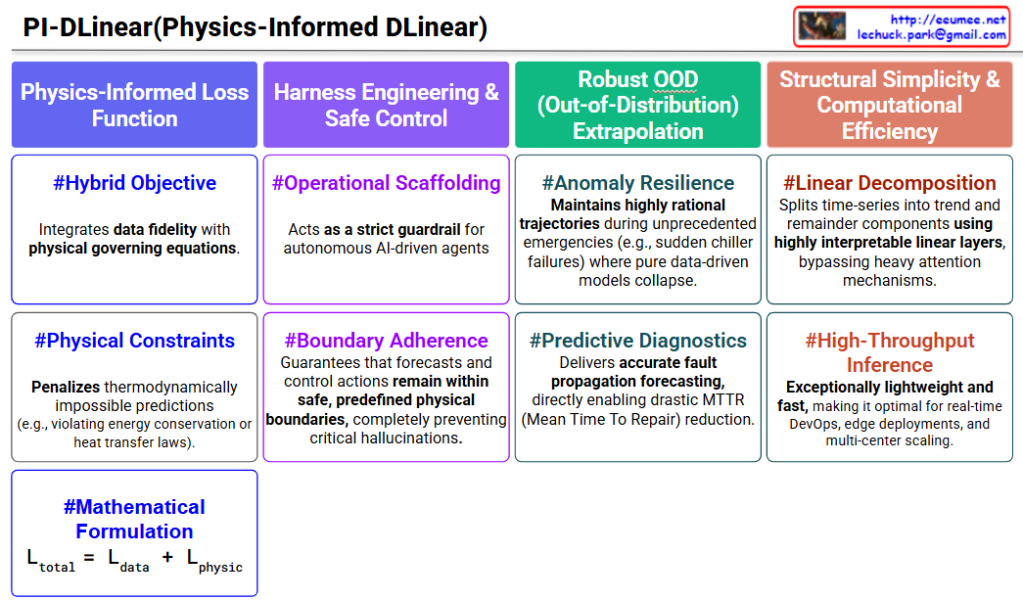
The provided image is a structured infographic slide titled “PI-DLinear (Physics-Informed DLinear).” It visually organizes the model’s core features into four distinct, color-coded columns:

1. Physics-Informed Loss Function (Blue Column)

This section focuses on how physical laws are integrated into the model’s learning process.

  • #Hybrid Objective: It explains that the model integrates data fidelity with physical governing equations.
  • #Physical Constraints: It states that the model penalizes thermodynamically impossible predictions (e.g., violating energy conservation or heat transfer laws).
  • #Mathematical Formulation: It provides the core equation for the loss function: Ltotal = Ldata + Lphysic.

2. Harness Engineering & Safe Control (Purple Column)

This column emphasizes the safety and control aspects for AI operations.

  • #Operational Scaffolding: It describes the model as acting as a strict guardrail for autonomous AI-driven agents.
  • #Boundary Adherence: It guarantees that forecasts and control actions remain within safe, predefined physical boundaries, completely preventing critical hallucinations.

3. Robust OOD (Out-of-Distribution) Extrapolation (Green Column)

This section highlights the model’s reliability during unexpected scenarios.

  • #Anomaly Resilience: It notes that the model maintains highly rational trajectories during unprecedented emergencies (like sudden chiller failures) where pure data-driven models would collapse.
  • #Predictive Diagnostics: It points out that the model delivers accurate fault propagation forecasting, which directly enables a drastic reduction in MTTR (Mean Time To Repair).

4. Structural Simplicity & Computational Efficiency (Red Column)

The final column outlines the architectural benefits of the model.

  • #Linear Decomposition: It explains that the model splits time-series into trend and remainder components using highly interpretable linear layers, bypassing heavy attention mechanisms.
  • #High-Throughput Inference: It emphasizes that the model is exceptionally lightweight and fast, making it optimal for real-time DevOps, edge deployments, and multi-center scaling.

Summary

The infographic effectively presents PI-DLinear as a powerful hybrid model for time-series forecasting. By combining the computational speed and simplicity of linear architectures with the strict mathematical boundaries of physical laws, it creates a highly reliable AI tool. It is specifically designed to handle unexpected anomalies safely and efficiently, making it ideal for critical infrastructure management where AI hallucinations cannot be tolerated.

#PIDLinear #PhysicsInformedAI #TimeSeriesForecasting #AIOps #MachineLearning #SafeAI #PredictiveMaintenance #HarnessEngineering

With Gemini

Why “Definition” Matters More

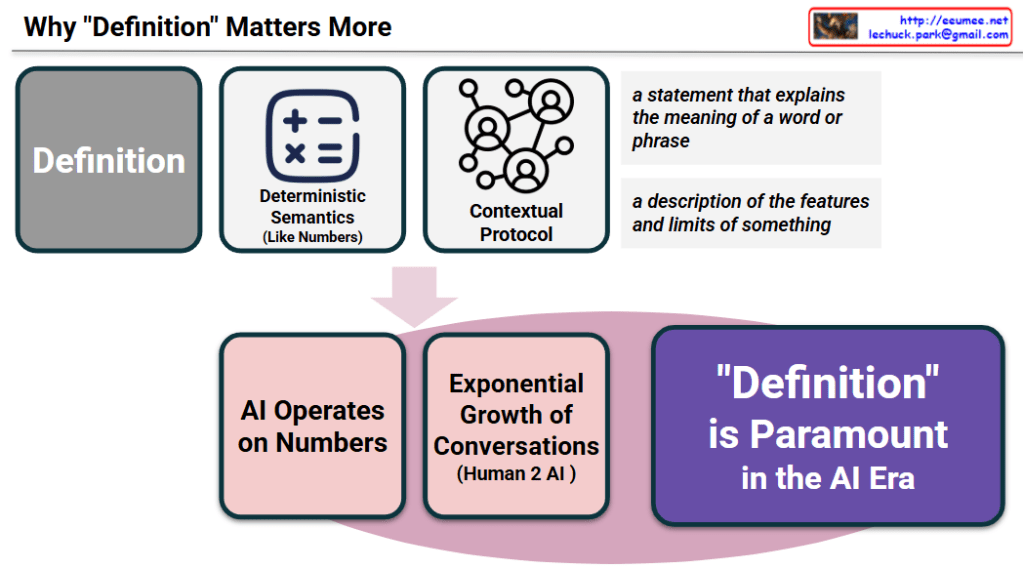
The revised slide visually and professionally conveys the technical philosophy we discussed through a clear visual narrative. Below is a structured breakdown of the slide, organized by its logical flow, which you can use directly as a presentation script or an executive summary.


Slide Overview: The Absolute Value of “Definition” in the AI Era

This slide illustrates why the traditional concept of a “definition” becomes critically important when applied to the new technological landscape of Artificial Intelligence. It follows a three-step logical progression: [The Nature of Concepts ➔ Characteristics of the AI Environment ➔ Final Conclusion].

1. Top Section: The Intrinsic Nature of a “Definition”

The upper half of the slide establishes the role of a “definition” from a system architecture perspective.

  • Deterministic Semantics (Like Numbers): As noted in the dictionary excerpts on the right, a definition explains meanings and boundaries. When applied to AI systems, this must function like mathematical symbols ($+, -, \times, =$). It requires an absolute, unchanging standard—a strict “deterministic semantic” that operates with the exactness of numbers.
  • Contextual Protocol: The network node icon signifies that definitions are no longer just dictionary entries. They act as fundamental “communication protocols” that govern, align, and regulate information exchange across complex networks and multiple AI agents.

2. Bottom-Left Section: The New Paradigm of the AI Environment

Moving through the central arrow, the slide transitions to the unique conditions of the current AI era where these definitions must be applied.

  • AI Operates on Numbers: AI does not comprehend text or context through human intuition; it processes information strictly as vectorized, numerical data.
  • Exponential Growth of Conversations (Human 2 AI): Concurrently, the frequency and volume of interactions—especially between humans and AI, and increasingly among AI agents themselves—are expanding at an explosive, unprecedented rate.

3. Bottom-Right Section: The Core Conclusion

  • “Definition” is Paramount in the AI Era: Ultimately, in an environment where machines process information numerically and the volume of communication is exponentially increasing, even a microscopic conceptual discrepancy can cascade into a catastrophic system failure or hallucination. Therefore, establishing “clear definitions” to structure data and strictly control meaning is the absolute, paramount requirement for maintaining a stable, reliable, and functional AI ecosystem.

Overall Summary

As AI exponentially scales the volume of our daily communications and processes them through rigid, mathematical vectors, linguistic ambiguity becomes the greatest systemic risk. A strictly defined semantic baseline—the “Definition”—is no longer just a linguistic tool, but the most essential engineering protocol required to prevent AI hallucinations and ensure precise, automated operations.

#ArtificialIntelligence #DataArchitecture #DeterministicSemantics #SemanticAnchor #DataGovernance #Definition

With Gemini

Autonomous Facility Operation Optimization Pipeline


Autonomous Facility Operation Optimization Pipeline

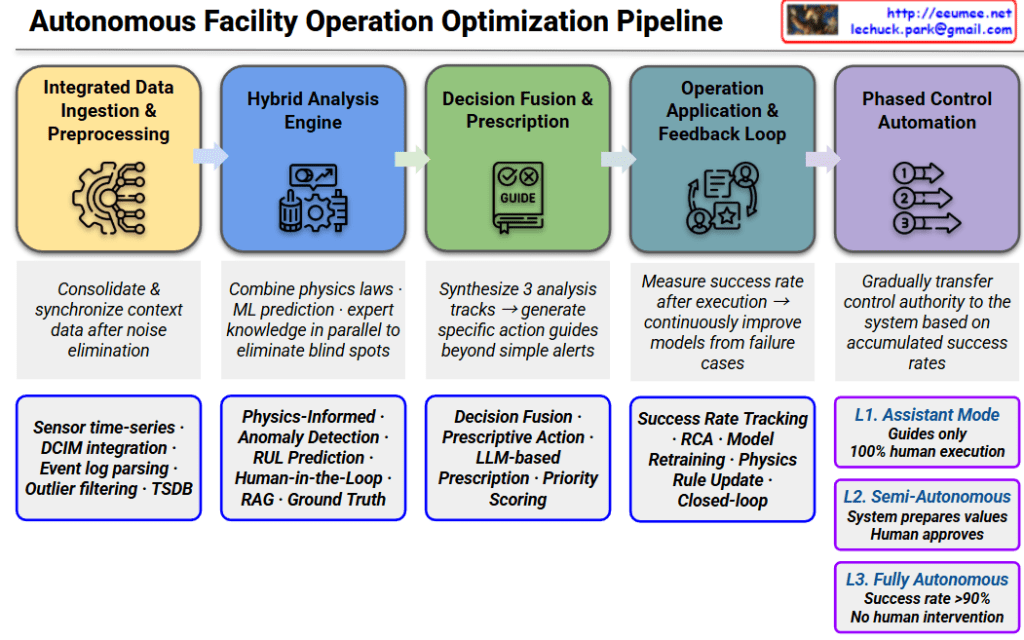
This pipeline represents a sophisticated 5-stage workflow designed to transition facility management from manual oversight to full AI-driven autonomy, ensuring reliability through hybrid modeling.

1. Integrated Data Ingestion & Preprocessing

  • Role: Consolidates diverse data streams into a synchronized, high-fidelity format by eliminating noise.
  • Key Components: Sensor time-series data, DCIM integration, Event log parsing, Outlier filtering, and TSDB (Time Series Database).

2. Hybrid Analysis Engine

  • Role: Eliminates analytical blind spots by running physical laws, machine learning predictions, and expert knowledge in parallel.
  • Key Components: Physics-Informed Machine Learning (PIML), Anomaly Detection, RUL (Remaining Useful Life) Prediction, and RAG-enhanced Ground Truth analysis.

3. Decision Fusion & Prescription

  • Role: Synthesizes multi-track analysis to move beyond simple alerts, generating specific, actionable “prescriptions.”
  • Key Components: Decision Fusion, Prescriptive Action, LLM-based Prescription, and Priority Scoring to rank urgency.

4. Operation Application & Feedback Loop

  • Role: Establishes a closed-loop system that measures success rates post-execution to continuously refine models.
  • Key Components: Success Rate Tracking, RCA (Root Cause Analysis), Model Retraining, and Physics/Rule updates based on real-world performance.

5. Phased Control Automation

  • Role: A risk-mitigated transition of control authority from humans to AI based on accumulated performance data.
  • Automation Levels:
    • L1. Assistant Mode: System provides guides only; 100% human execution.
    • L2. Semi-Autonomous: System prepares optimized values; human provides final approval.
    • L3. Fully Autonomous: System operates without human intervention (triggered when success rate >90%).

Strategic Insight

The hallmark of this architecture is the integration of Physics-Informed ML and LLM-based reasoning. By combining the rigid reliability of physical laws with the adaptive reasoning of Large Language Models, the pipeline solves the “black box” problem of traditional AI, making it suitable for mission-critical infrastructures like AI Data Centers.

#DataCenter #AIOps #AutonomousInfrastructure #PhysicsInformedML #DigitalTwin #LLM #PredictiveMaintenance #DataCenterOptimization #TechVisualization #SmartFacility #EngineeringExcellence

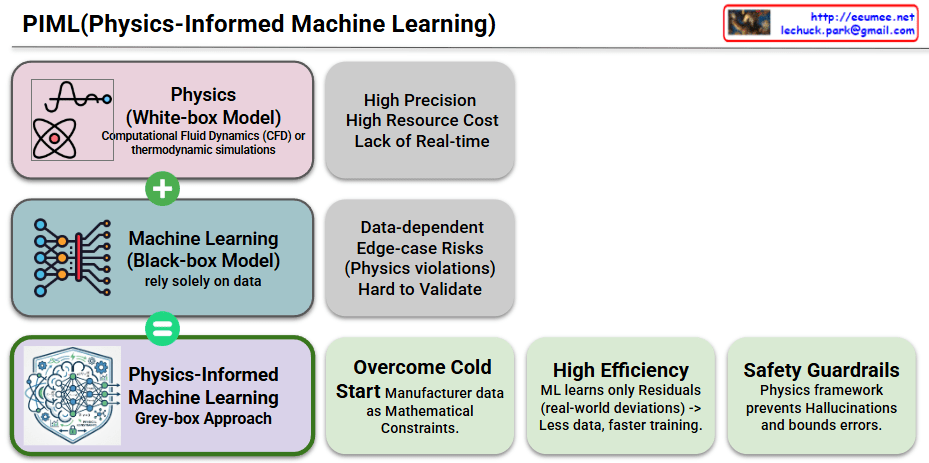
PIML(Physics-Informed Machine Learning)

PIML (Physics-Informed Machine Learning) Explained

This diagram illustrates how PIML (Physics-Informed Machine Learning) combines the strengths of physics-based models and data-driven machine learning to create a more powerful and reliable approach.


1. Top: Physics (White-box Model)

  • Definition: These are models where the underlying principles are fully explained by mathematical equations, such as Computational Fluid Dynamics (CFD) or thermodynamic simulations.
  • Characteristics:
    • High Precision: They are very accurate because they are based on fundamental physical laws.
    • High Resource Cost: They are computationally intensive, requiring significant processing power and time.
    • Lack of Real-time Processing: Complex simulations are difficult to use for real-time prediction or control.

2. Middle: Machine Learning (Black-box Model)

  • Definition: These models rely solely on large amounts of training data to find correlations and make predictions, without using underlying physical principles.
  • Characteristics:
    • Data-dependent: Their performance depends heavily on the quality and quantity of the data they are trained on.
    • Edge-case Risks: In situations not covered by the data (edge cases), they can make illogical predictions that violate physical laws.
    • Hard to Validate: It is difficult to understand their internal workings, making it challenging to verify the reliability of their results.

3. Bottom: Physics-Informed Machine Learning (Grey-box Approach)

  • Definition: This approach integrates the knowledge of physical laws (equations) into a machine learning model as mathematical constraints, combining the best of both worlds.
  • Benefits:
    • Overcome Cold Start Problem: By using existing knowledge like mathematical constraints, PIML can function even when training data is scarce, effectively addressing the initial (“Cold Start”) state.
    • High Efficiency: Instead of learning physics from scratch, the ML model focuses on learning only the residuals (real-world deviations) between the physics-based model and actual data. This makes learning faster and more efficient with less data.
    • Safety Guardrails: The integrated physics framework acts as a set of safety guardrails, providing constraints that prevent the model from making physically impossible predictions (“Hallucinations”) and bounding errors to ensure safety.

#AI #PIML #MachineLearning #Physics #HybridAI #DataScience #ExplainableAI #XAI #ComputationalPhysics #Simulation

with Gemini

Hybrid Analysis for Autonomous Operation (2)

Framework Overview

The image illustrates a “Hybrid Analysis” framework designed to achieve true Autonomous Operation. It outlines five core pillars required to build a reliable, self-driving system for high-stakes environments like AI data centers or power plants. The architecture combines three analytical foundations (purple) with two execution and safety layers (teal).


1. The Analytical Foundation (The Hybrid Triad)

This section forms the “brain” of the autonomous system, blending human expertise, artificial intelligence, and absolute scientific laws.

  • Domain Knowledge (Human Experience):
    • Core: Systematized heuristics, decades of operator know-how, and maintenance manuals.
    • Role: Provides qualitative analysis, establishes preventive maintenance baselines, and handles unstructured exceptions that algorithms might miss.
  • Data-driven ML (Artificial Intelligence):
    • Core: Pattern recognition, anomaly detection, and Predictive Maintenance (PdM).
    • Role: Analyzes massive volumes of multi-dimensional sensor and operational data to find hidden correlations and risks that are imperceptible to human operators.
  • Physics Rule (Engineering Guardrails):
    • Core: Thermodynamic constraints, equations of state, fluid dynamics, and absolute power limits.
    • Role: Acts as the ultimate boundary. It ensures that the operational commands generated by ML models are physically possible and safe, preventing the AI from violating unchanging engineering laws.

2. Execution and Safety Nets

This section translates the insights from the analytical triad into real-world, physical changes while guaranteeing system stability.

  • Control & Actuation (The Hands):
    • Core: IT/OT (Information Technology / Operational Technology) convergence and real-time bi-directional communication.
    • Role: The domain of injecting the optimized setpoints and guidelines directly into the facility’s PLC (Programmable Logic Controller) or DCS (Distributed Control System) to drive physical actuators.
  • Reliability & Governance (The Shield):
    • Core: Data/Model monitoring, Disaster Recovery (DR), and Cyber-Physical Security (CPS).
    • Role: The overarching safety net and pipeline management required to ensure the autonomous operating system runs securely and continuously, 24/7, without interruption.

💡 Key Takeaway

As emphasized by the red text at the bottom, this multi-layered approach is highly critical in environments like data centers or power plants. Relying solely on data-driven ML is too risky for high-density infrastructure; true autonomous stability is only achieved when AI is anchored by human domain expertise and strict physical laws.

#AutonomousOperations #AIOps #HybridAnalysis #PredictiveMaintenance #ITOTConvergence #CyberPhysicalSystems #MissionCritical #TechVisualization #EngineeringInfographic

With Gemini

Hybrid Analysis for Autonomous Operation (1)


Hybrid Analysis for Autonomous Operation (1)

This framework illustrates a holistic approach to autonomous systems, integrating human expertise, physical laws, and AI to ensure safe and efficient real-world execution.

1. Five Core Modules (Top Layer)

  • Domain Knowledge: Codifies decades of operator expertise and maintenance manuals into digital logic.
  • Data-driven ML: Detects hidden patterns in massive sensor data that go beyond human perception.
  • Physics Rule: Enforces immutable engineering constraints (such as thermodynamics or fluid dynamics) to ground the AI in reality.
  • Control & Actuation: Injects optimized decisions directly into PLC / DCS (Distributed Control Systems) for real-world execution.
  • Reliability & Governance: Manages the entire pipeline to ensure 24/7 uninterrupted autonomous operation.

2. Integrated Value Drivers (Bottom Layer)

These modules work in synergy to create three essential “Guides” for the system:

  • Experience Guide: Combines domain expertise with ML to handle edge cases and provide high-quality ground-truth labels for model training.
  • Facility Guide: Acts as a safety net by combining ML predictions with physical rules. It predicts Remaining Useful Life (RUL) while blocking outputs that exceed equipment design limits.
  • The Final Guardrail: Bridges the gap between IT (Analysis) and OT (Operations). It prevents model drift and ensures an instant manual override (Failsafe) is always available.

3. Key Takeaways

The architecture centers on a “Control Trigger” that converts digital insights into physical action. By anchoring machine learning with physical laws and human experience, the system achieves a level of reliability required for mission-critical environments like data centers or industrial plants.

#AutonomousOperations #IndustrialAI #MachineLearning #SmartFactory #DataCenterManagement #PredictiveMaintenance #ControlSystems #OTSecurity #AIOps #HybridAI

With Gemini