PI-DLinear (Physics-Informed DLinear)
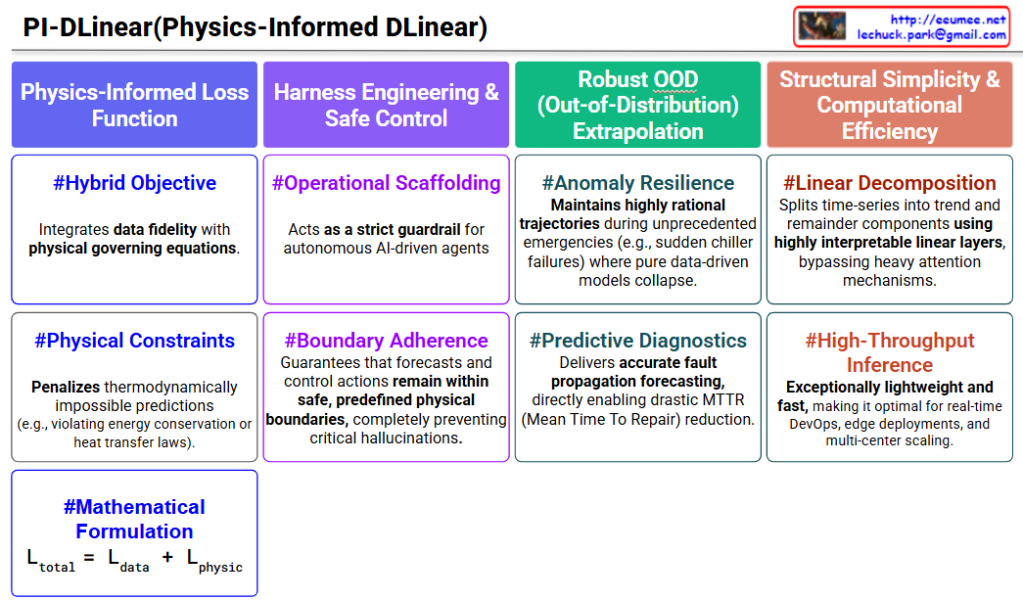
The provided image is a structured infographic slide titled “PI-DLinear (Physics-Informed DLinear).” It visually organizes the model’s core features into four distinct, color-coded columns:
1. Physics-Informed Loss Function (Blue Column)
This section focuses on how physical laws are integrated into the model’s learning process.
- #Hybrid Objective: It explains that the model integrates data fidelity with physical governing equations.
- #Physical Constraints: It states that the model penalizes thermodynamically impossible predictions (e.g., violating energy conservation or heat transfer laws).
- #Mathematical Formulation: It provides the core equation for the loss function: Ltotal = Ldata + Lphysic.
2. Harness Engineering & Safe Control (Purple Column)
This column emphasizes the safety and control aspects for AI operations.
- #Operational Scaffolding: It describes the model as acting as a strict guardrail for autonomous AI-driven agents.
- #Boundary Adherence: It guarantees that forecasts and control actions remain within safe, predefined physical boundaries, completely preventing critical hallucinations.
3. Robust OOD (Out-of-Distribution) Extrapolation (Green Column)
This section highlights the model’s reliability during unexpected scenarios.
- #Anomaly Resilience: It notes that the model maintains highly rational trajectories during unprecedented emergencies (like sudden chiller failures) where pure data-driven models would collapse.
- #Predictive Diagnostics: It points out that the model delivers accurate fault propagation forecasting, which directly enables a drastic reduction in MTTR (Mean Time To Repair).
4. Structural Simplicity & Computational Efficiency (Red Column)
The final column outlines the architectural benefits of the model.
- #Linear Decomposition: It explains that the model splits time-series into trend and remainder components using highly interpretable linear layers, bypassing heavy attention mechanisms.
- #High-Throughput Inference: It emphasizes that the model is exceptionally lightweight and fast, making it optimal for real-time DevOps, edge deployments, and multi-center scaling.
Summary
The infographic effectively presents PI-DLinear as a powerful hybrid model for time-series forecasting. By combining the computational speed and simplicity of linear architectures with the strict mathematical boundaries of physical laws, it creates a highly reliable AI tool. It is specifically designed to handle unexpected anomalies safely and efficiently, making it ideal for critical infrastructure management where AI hallucinations cannot be tolerated.
#PIDLinear #PhysicsInformedAI #TimeSeriesForecasting #AIOps #MachineLearning #SafeAI #PredictiveMaintenance #HarnessEngineering
With Gemini

