
Learning with AI

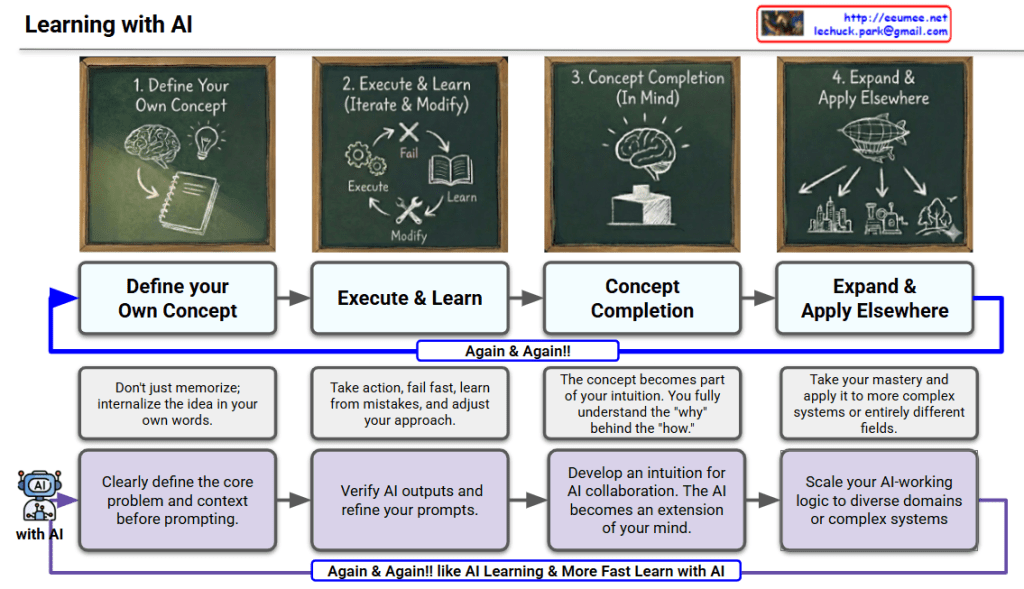
The concept of “Again & Again” is the heartbeat of this framework. It represents both the human commitment to iterative growth and the synergistic power of AI’s massive learning capacity to accelerate that very process.


Learning with AI: The Power of Iteration

1. Define Your Own Concept (The Architect)

Before prompting, you must own the “Why”.

  • Action: Internalize the problem and define the context in your own words.
  • Insight: AI cannot navigate without a human-defined destination.

2. Execute & Learn (The Editor)

The first “Again & Again” happens here—the loop of Iterative Growth.

  • Action: Take action, fail fast, and refine your prompts based on AI’s output.
  • Insight: Each repetition refines your understanding and the AI’s accuracy.

3. Concept Completion (The Director)

The concept moves from a task to your intuition.

  • Action: Develop a deep “gut feeling” for how to direct the AI.
  • Insight: AI becomes a seamless extension of your own cognitive process.

4. Expand & Apply Elsewhere (The Innovator)

The bottom “Again & Again” focuses on Synergistic Speed.

  • Action: Scale your mastered logic to solve complex, multi-domain problems.
  • Insight: Just as AI learns through massive repetition, you use AI to exponentially increase the frequency of your own learning cycles.

Summary

  1. Iterative Evolution: The middle “Again & Again” drives personal mastery through the constant refinement of your own concepts.
  2. AI Mirroring: The bottom “Again & Again” acknowledges that AI masters knowledge through massive repetition—just as we do.
  3. Accelerated Synergy: By collaborating with AI, you can complete these learning cycles faster than ever, achieving “High-Speed Mastery”.

#AgainAndAgain #AI_Synergy #IterativeGrowth #RapidMastery #HumanAI_Loop #LearningVelocity

With Gemini
AI DC Power Risk with BESS


Technical Analysis: The Impact of AI Loads on Weak Grids

1. The Problem: A Threat to Grid Stability

Large-scale AI loads combined with “Weak Grids” (where the Short Circuit Ratio, or SCR, is less than 3) significantly threaten power grid stability.

  • AI Workload Characteristics: These loads are defined by sudden “Step Power Changes” and “Pulse-type Profiles” rather than steady consumption.
  • Sensitivity: NERC (2025) warns that the decrease in voltage-sensitive loads and the rise of periodic workloads are major drivers of grid instability.

2. The Vicious Cycle of Instability

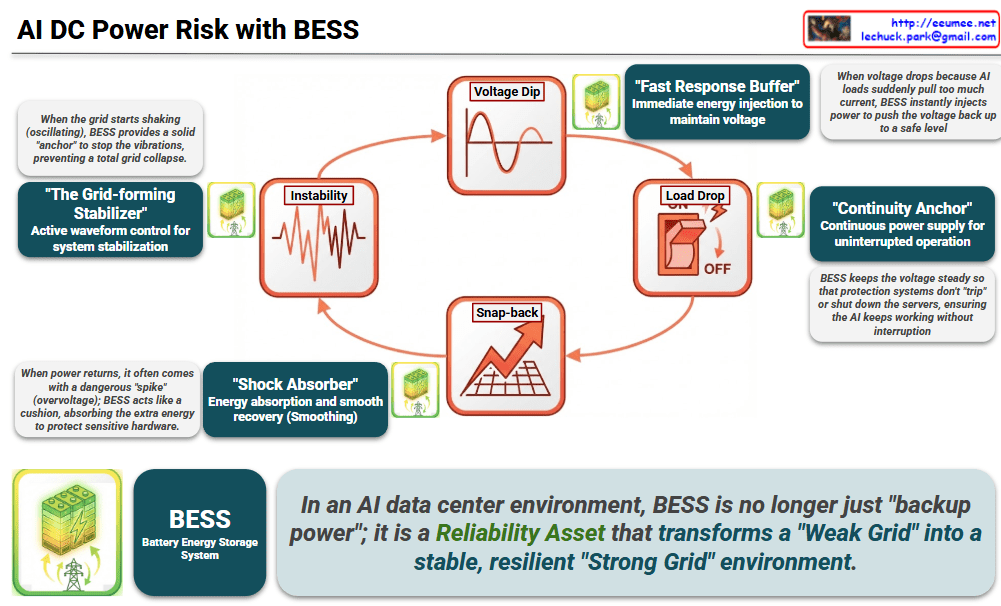
The images illustrate a four-stage downward spiral triggered by the interaction between AI hardware and a fragile power infrastructure:

  • Voltage Dip: As AI loads suddenly spike, the grid’s high impedance causes a temporary but sharp drop in voltage levels. This degrades #PowerQuality and causes #VoltageSag.
  • Load Drop: When voltage falls too low, protection systems trigger a sudden disconnection of the load ($P \rightarrow 0$). This leads to #ServiceDowntime and massive #LoadShedding.
  • Snap-back: As the grid tries to recover or the load re-engages, there is a rapid and sudden power surge. This creates dangerous #Overvoltage and #SurgeInflow.
  • Instability: The repetition of these fluctuations leads to waveform distortion and oscillation. Eventually, this causes #GridCollapse and a total #LossOfControl.

3. The Solution: BESS as a Reliability Asset

The final analysis reveals that a Battery Energy Storage System (BESS) acts as the critical circuit breaker for this vicious cycle.

  • Fast Response Buffer: BESS provides immediate energy injection the moment a dip is detected, maintaining voltage levels.
  • Continuity Anchor: By holding the voltage steady, it prevents protection systems from “tripping,” ensuring uninterrupted operation for AI servers.
  • Shock Absorber: During power recovery, BESS absorbs excess energy to “smooth” the transition and protect sensitive hardware from spikes.
  • The Grid-forming Stabilizer: It uses active waveform control to stop oscillations, providing the “virtual inertia” needed to prevent total grid collapse.

Summary

  1. AI Load Dynamics: The erratic “pulse” nature of AI power consumption acts as a physical shock to weak grids, necessitating a new layer of protection.
  2. Beyond Backup Power: In this context, BESS is redefined as a Reliability Asset that transforms a “Weak Grid” into a resilient “Strong Grid” environment.
  3. Operational Continuity: By filling gaps, absorbing shocks, and anchoring the grid, BESS ensures that AI data centers remain operational even during severe transient events.

#BESS #GridStability #AIDataCenter #PowerQuality #WeakGrid #EnergyStorage #NERC2025 #VoltageSag #VirtualInertia #TechInfrastructure

with Gemini
Predictive/Proactive/Reactive

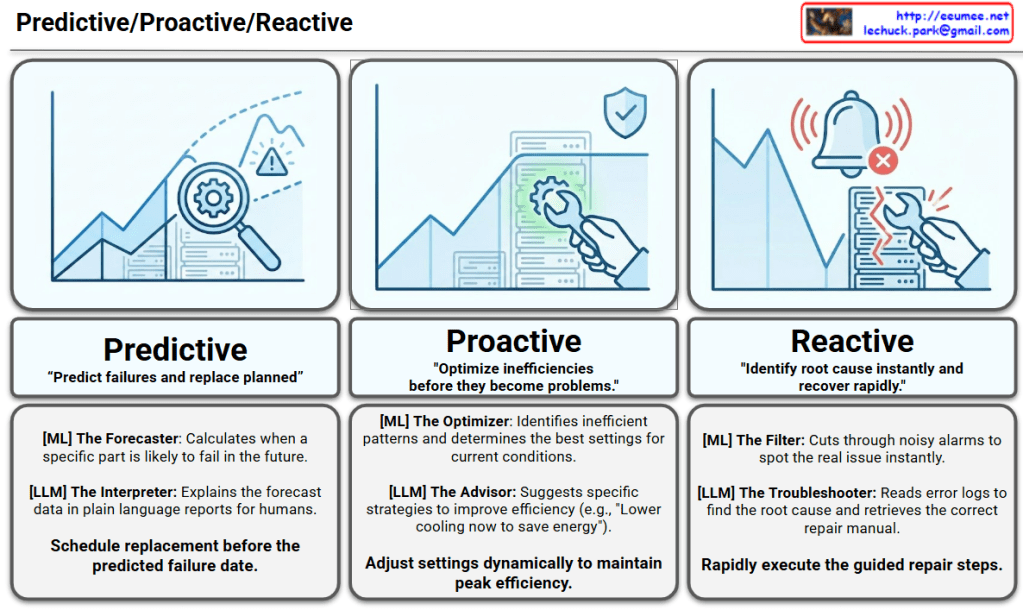
The infographic visualizes how AI technologies (Machine Learning and Large Language Models) are applied across Predictive, Proactive, and Reactive stages of facility management.


1. Predictive Stage

This is the most advanced stage, anticipating future issues before they occur.

  • Core Goal: “Predict failures and replace planned.”
  • Icon Interpretation: A magnifying glass is used to examine a future point on a rising graph, identifying potential risks (peaks and warnings) ahead of time.
  • Role of AI:
    • [ML] The Forecaster: Analyzes historical data to calculate precisely when a specific component is likely to fail in the future.
    • [LLM] The Interpreter: Translates complex forecast data and probabilities into plain language reports that are easy for human operators to understand.
  • Key Activity: Scheduling parts replacement and maintenance windows well before the predicted failure date.

2. Proactive Stage

This stage focuses on optimizing current conditions to prevent problems from developing.

  • Core Goal: “Optimize inefficiencies before they become problems.”
  • Icon Interpretation: On a stable graph, a wrench is shown gently fine-tuning the system for optimization, protected by a shield icon representing preventative measures.
  • Role of AI:
    • [ML] The Optimizer: Identifies inefficient operational patterns and determines the optimal configurations for current environmental conditions.
    • [LLM] The Advisor: Suggests specific, actionable strategies to improve efficiency (e.g., “Lower cooling now to save energy”).
  • Key Activity: Dynamically adjusting system settings in real-time to maintain peak efficiency.

3. Reactive Stage

This stage deals with responding rapidly and accurately to incidents that have already occurred.

  • Core Goal: “Identify root cause instantly and recover rapidly.”
  • Icon Interpretation: A sharp drop in the graph accompanied by emergency alarms, showing an urgent repair being performed on a broken server rack.
  • Role of AI:
    • [ML] The Filter: Cuts through the noise of massive alarm volumes to instantly isolate the true, critical issue.
    • [LLM] The Troubleshooter: Reads and analyzes complex error logs to determine the root cause and retrieves the correct Standard Operating Procedure (SOP) or manual.
  • Key Activity: Rapidly executing the guided repair steps provided by the system.

Summary

  • The image illustrates the evolution of data center operations from traditional Reactive responses to intelligent Proactive optimization and Predictive maintenance.
  • It clearly delineates the roles of AI, where Machine Learning (ML) handles data analysis and forecasting, while Large Language Models (LLMs) interpret these insights and provide actionable guidance.
  • Ultimately, this integrated AI approach aims to maximize uptime, enhance energy efficiency, and accelerate incident recovery in critical infrastructure.

#DataCenter #AIOps #PredictiveMaintenance #SmartInfrastructure #ArtificialIntelligence #MachineLearning #LLM #FacilityManagement #ITOps

with Gemini
AI DC Power Risk


Technical Analysis: AI Load & Weak Grid Interaction

The integration of massive AI workloads into a Weak Grid (SCR:Short Circuit Ratio < 3) creates a high-risk environment where electrical Transients can escalate into systemic failures.

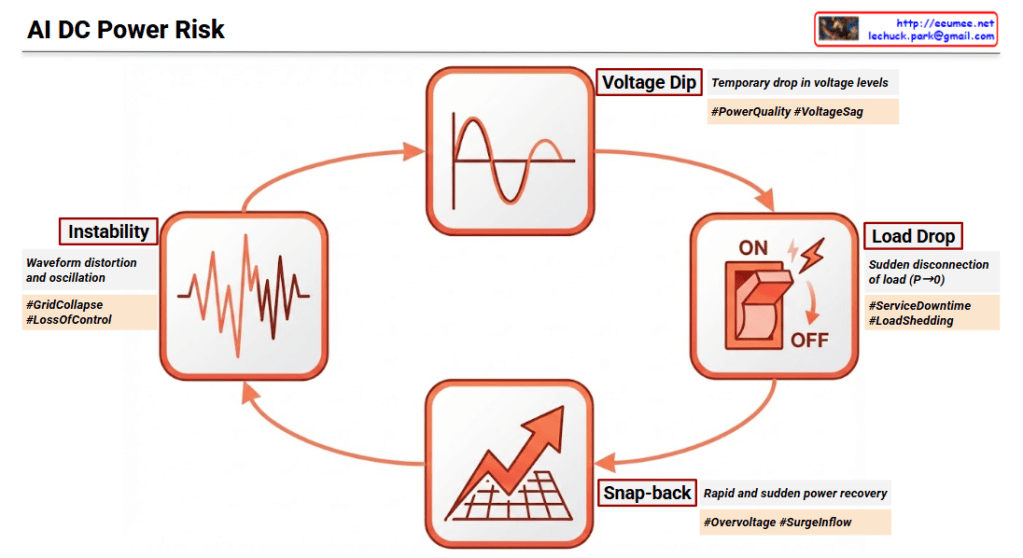
1. Voltage Dip (Transient Voltage Sag)

  • Mechanism: AI workloads are characterized by Step Power Changes and Pulse-type Profiles. When these massive loads activate simultaneously, they cause an immediate Transient Voltage Sag in a weak grid due to high impedance.
  • Impact: This compromises Power Quality, leading to potential malfunctions in voltage-sensitive AI hardware.

2. Load Drop (Transient Load Rejection)

  • Mechanism: If the voltage sag exceeds safety thresholds, protection systems trigger Load Rejection, causing the power consumption to plummet to zero (P -> 0).
  • Impact: This results in Service Downtime and creates a massive power imbalance in the grid, often referred to as Load Shedding.

3. Snap-back (Transient Recovery & Inrush)

  • Mechanism: As the grid attempts to recover or the load is re-engaged, it creates a Transient Recovery Voltage (TRV).
  • Impact: This phase often sees Overvoltage (Overshoot) and a massive Surge Inflow (Inrush Current), which places extreme electrical stress on power components and can damage sensitive circuitry.

4. Instability (Dynamic & Harmonic Oscillation)

  • Mechanism: The repetition of sags and surges leads to Dynamic Oscillation. The control systems of power converters may lose synchronization with the grid frequency.
  • Impact: The result is severe Waveform Distortion, Loss of Control, and eventually a total Grid Collapse (Blackout).

Key Insight (NERC 2025 Warning)

The North American Electric Reliability Corporation (NERC) warns that the reduction of voltage-sensitive loads and the rise of periodic, pulse-like AI workloads are primary drivers of modern grid instability.


Summary

  1. AI Load Dynamics: Rapid step-load changes in AI data centers act as a “shock” to weak grids, triggering a self-reinforcing cycle of electrical failure.
  2. Transient Progression: The cycle moves from a Voltage Sag to a Load Trip, followed by a damaging Power Surge, eventually leading to non-damped Oscillations.
  3. Strategic Necessity: To break this cycle, data centers must implement advanced solutions like Grid-forming Inverters or Fast-acting BESS to provide synthetic inertia and voltage support.

#PowerTransients #WeakGrid #AIDataCenter #GridStability #NERC2025 #VoltageSag #LoadShedding #ElectricalEngineering #AIInfrastructure #SmartGrid #PowerQuality

With Gemini
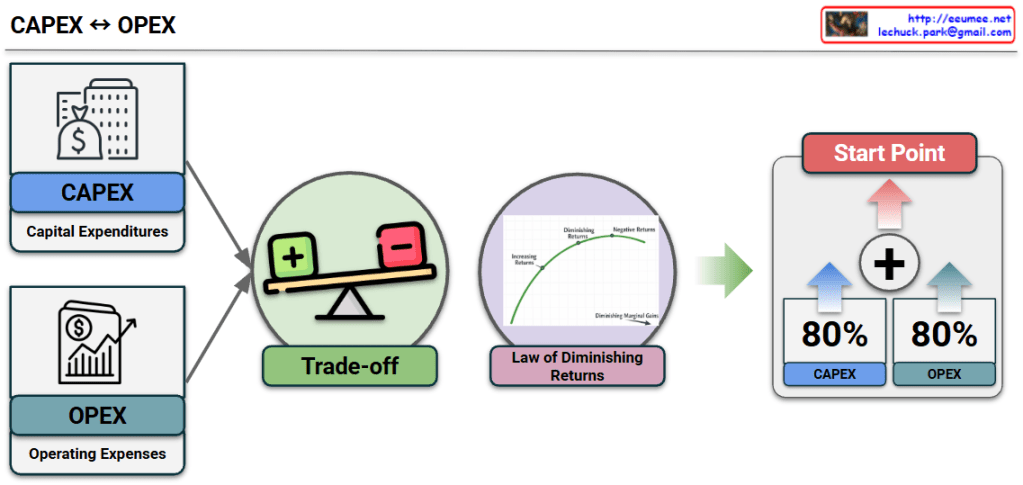
CAPEX & OPEX

1. Definitions (The Pillars)

  • CAPEX (Capital Expenditures): Upfront investments for physical assets (e.g., hardware, infrastructure) to create future value.
  • OPEX (Operating Expenses): Ongoing costs required to run the day-to-day operations (e.g., maintenance, utilities, subscriptions).

2. The Economic Logic

  • Trade-off: There is a natural tension between the two; higher upfront investment (CAPEX) can lower future operating costs (OPEX), and vice versa.
  • Law of Diminishing Returns: This graph warns that striving for 100% perfection in optimization yields progressively smaller benefits relative to the effort and cost invested.

3. Strategic Conclusion: The 80% Rule

  • The infographic proposes a pragmatic “Start Point.”
  • Instead of delaying for perfection, it suggests that achieving 80% readiness in CAPEX and 80% efficiency in OPEX is the sweet spot. This balance allows for a timely launch without falling into the trap of diminishing returns.

Summary

  1. While CAPEX and OPEX involve a necessary trade-off, striving for 100% optimization in both leads to diminishing returns.
  2. Over-optimization drains resources and delays execution without proportional gains.
  3. The most efficient strategy is to define the “Start Point” at 80% readiness for both, favoring speed and agility over perfection.

#CAPEXvsOPEX #BusinessStrategy #CostOptimization #DiminishingReturns #TechInfrastructure #OperationalEfficiency #Infographic #TechVisualizer #DecisionMaking