Data Center Shift with AI

Data Center Shift with AI

This diagram illustrates how data centers are transforming as they enter the AI era.

πŸ“… Timeline of Technological Evolution

The top section shows major technology revolutions and their timelines:

  • Internet ’95 (Internet era)
  • Mobile ’07 (Mobile era)
  • Cloud ’10 (Cloud era)
  • Blockchain
  • AI(LLM) ’22 (Large Language Model-based AI era)

🏒 Traditional Data Center Components

Conventional data centers consisted of the following core components:

  • Software
  • Server
  • Network
  • Power
  • Cooling

These were designed as relatively independent layers.

πŸš€ New Requirements in the AI Era

With the introduction of AI (especially LLMs), data centers require specialized infrastructure:

  1. LLM Model – Operating large language models
  2. GPU – High-performance graphics processing units (essential for AI computations)
  3. High B/W – High-bandwidth networks (for processing large volumes of data)
  4. SMR/HVDC – Switched-Mode Rectifier/High-Voltage Direct Current power systems
  5. Liquid/CDU – Liquid cooling/Cooling Distribution Units (for cooling high-heat GPUs)

πŸ”— Key Characteristic of AI Data Centers: Integrated Design

The circular connection in the center of the diagram represents the most critical feature of AI data centers:

Tight Interdependency between SW/Computing/Network ↔ Power/Cooling

Unlike traditional data centers, in AI data centers:

  • GPU-based computing consumes enormous power and generates significant heat
  • High B/W networks consume additional power during massive data transfers between GPUs
  • Power systems (SMR/HVDC) must stably supply high power density
  • Liquid cooling (Liquid/CDU) must handle high-density GPU heat in real-time

These elements must be closely integrated in design, and optimizing just one element cannot guarantee overall system performance.

πŸ’‘ Key Message

AI workloads require moving beyond the traditional layer-by-layer independent design approach of conventional data centers, demanding that computing-network-power-cooling be designed as one integrated system. This demonstrates that a holistic approach is essential when building AI data centers.


πŸ“ Summary

AI data centers fundamentally differ from traditional data centers through the tight integration of computing, networking, power, and cooling systems. GPU-based AI workloads create unprecedented power density and heat generation, requiring liquid cooling and HVDC power systems. Success in AI infrastructure demands holistic design where all components are co-optimized rather than independently engineered.

#AIDataCenter #DataCenterEvolution #GPUInfrastructure #LiquidCooling #AIComputing #LLM #DataCenterDesign #HighPerformanceComputing #AIInfrastructure #HVDC #HolisticDesign #CloudComputing #DataCenterCooling #AIWorkloads #FutureOfDataCenters

With Claude

Cooling with AI works

AI Workload Cooling Systems: Bidirectional Physical-Software Optimization

This image summarizes four cutting-edge research studies demonstrating the bidirectional optimization relationship between AI LLMs and cooling systems. It proves that physical cooling infrastructure and software workloads are deeply interconnected.

πŸ”„ Core Concept of Bidirectional Optimization

Direction 1: Physical Cooling β†’ AI Performance Impact

  • Cooling methods directly affect LLM/VLM throughput and stability

Direction 2: AI Software β†’ Cooling Control

  • LLMs themselves act as intelligent controllers for cooling systems

πŸ“Š Research Analysis

1. Physical Cooling Impact on AI Performance (2025 arXiv)

[Cooling HW β†’ AI SW Performance]

  • Experiment: Liquid vs Air cooling comparison on H100 nodes
  • Physical Differences:
    • GPU Temperature: Liquid 41-50Β°C vs Air 54-72Β°C (up to 22Β°C difference)
    • GPU Power Consumption: 148-173W reduction
    • Node Power: ~1kW savings
  • Software Performance Impact:
    • Throughput: 54 vs 46 TFLOPs/GPU (+17% improvement)
    • Sustained and predictable performance through reduced throttling
    • Improved performance/watt (perf/W) ratio

β†’ Physical cooling improvements directly enhance AI workload real-time processing capabilities

2. AI Controls Cooling Systems (2025 arXiv)

[AI SW β†’ Cooling HW Control]

  • Method: Offline Reinforcement Learning (RL) for automated data center cooling control
  • Results: 14-21% cooling energy reduction in 2000-hour real deployment
  • Bidirectional Effects:
    • AI algorithms optimally control physical cooling equipment (CRAC, pumps, etc.)
    • Saved energy β†’ enables more LLM job execution
    • Secured more power headroom for AI computation expansion

β†’ AI software intelligently controls physical cooling to improve overall system efficiency

3. LLM as Cooling Controller (2025 OpenReview)

[AI SW ↔ Cooling HW Interaction]

  • Innovative Approach: Using LLMs as interpretable controllers for liquid cooling systems
  • Simulation Results:
    • Temperature Stability: +10-18% improvement vs RL
    • Energy Efficiency: +12-14% improvement
  • Bidirectional Interaction Significance:
    • LLMs interpret real-time physical sensor data (temperature, flow rate, etc.)
    • Multi-objective trade-off optimization between cooling requirements and energy saving
    • Interpretability: LLM decision-making process is human-understandable
    • Result: Reduced throttling/interruptions β†’ improved AI workload stability

β†’ Complete closed-loop where AI controls physical systems, and results feedback to AI performance

4. Physical Cooling Innovation Enables AI Training (E-Energy’25 PolyU)

[Cooling HW β†’ AI SW Training Stability]

  • Method: Immersion cooling applied to LLM training
  • Physical Benefits:
    • Dramatically reduced fan/CRAC overhead
    • Lower PUE (Power Usage Effectiveness) achieved
    • Uniform and stable heat removal
  • Impact on AI Training:
    • Enables stable long-duration training (eliminates thermal spikes)
    • Quantitative power-delay trade-off optimization per workload
    • Continuous training environment without interruptions

β†’ Advanced physical cooling technology secures feasibility of large-scale LLM training

πŸ” Physical-Software Interdependency Map

β”Œβ”€β”€β”€β”€β”€β”€β”€β”€β”€β”€β”€β”€β”€β”€β”€β”€β”€β”€β”€β”€β”€β”€β”€β”€β”€β”€β”€β”€β”€β”€β”€β”€β”€β”€β”€β”€β”€β”€β”€β”€β”€β”€β”€β”€β”€β”€β”€β”€β”€β”€β”€β”€β”€β”€β”€β”€β”€β”
β”‚              Physical Cooling Systems                    β”‚
β”‚    (Liquid cooling, Immersion, CRAC, Heat exchangers)   β”‚
β””β”€β”€β”€β”€β”€β”€β”€β”€β”€β”€β”€β”€β”€β”€β”¬β”€β”€β”€β”€β”€β”€β”€β”€β”€β”€β”€β”€β”€β”€β”€β”€β”€β”€β”€β”€β”€β”€β”€β”€β”¬β”€β”€β”€β”€β”€β”€β”€β”€β”€β”€β”€β”€β”€β”€β”€β”€β”€β”˜
               ↓                        ↑
        Temp↓ Power↓ Stability↑    AI-based Control
               ↓                   RL/LLM Controllers
β”Œβ”€β”€β”€β”€β”€β”€β”€β”€β”€β”€β”€β”€β”€β”€β”΄β”€β”€β”€β”€β”€β”€β”€β”€β”€β”€β”€β”€β”€β”€β”€β”€β”€β”€β”€β”€β”€β”€β”€β”€β”΄β”€β”€β”€β”€β”€β”€β”€β”€β”€β”€β”€β”€β”€β”€β”€β”€β”€β”
β”‚              AI Workloads (LLM/VLM)                      β”‚
β”‚    Performance↑ Throughput↑ Throttling↓ Training Stability↑│
β””β”€β”€β”€β”€β”€β”€β”€β”€β”€β”€β”€β”€β”€β”€β”€β”€β”€β”€β”€β”€β”€β”€β”€β”€β”€β”€β”€β”€β”€β”€β”€β”€β”€β”€β”€β”€β”€β”€β”€β”€β”€β”€β”€β”€β”€β”€β”€β”€β”€β”€β”€β”€β”€β”€β”€β”€β”€β”€β”€β”˜

πŸ’‘ Key Insights: Bidirectional Optimization Synergy

1. Bottom-Up Influence (Physical β†’ Software)

  • Better cooling β†’ maintains higher clock speeds/throughput
  • Temperature stability β†’ predictable performance, no training interruptions
  • Power efficiency β†’ enables simultaneous operation of more GPUs

2. Top-Down Influence (Software β†’ Physical)

  • AI algorithms provide real-time optimal control of cooling equipment
  • LLM’s interpretable decision-making ensures operational transparency
  • Adaptive cooling strategies based on workload characteristics

3. Virtuous Cycle Effect

Better cooling β†’ AI performance improvement β†’ smarter cooling control
β†’ Energy savings β†’ more AI jobs β†’ advanced cooling optimization
β†’ Sustainable large-scale AI infrastructure

🎯 Practical Implications

These studies demonstrate:

  1. Cooling is no longer passive infrastructure: It’s an active determinant of AI performance
  2. AI optimizes its own environment: Meta-level self-optimizing systems
  3. Hardware-software co-design is essential: Isolated optimization is suboptimal
  4. Simultaneous achievement of sustainability and performance: Synergy, not trade-off

πŸ“ Summary

These four studies establish that next-generation AI data centers must evolve into integrated ecosystems where physical cooling and software workloads interact in real-time to self-optimize. The bidirectional relationshipβ€”where better cooling enables superior AI performance, and AI algorithms intelligently control cooling systemsβ€”creates a virtuous cycle that simultaneously achieves enhanced performance, energy efficiency, and sustainable scalability for large-scale AI infrastructure.

#EnergyEfficiency#GreenAI#SustainableAI#DataCenterOptimization#ReinforcementLearning#AIControl#SmartCooling

With Claude

CDU Metrics & Control

This image shows a CDU (Coolant Distribution Unit) Metrics & Control System diagram illustrating the overall structure. The system can be organized as follows:

System Structure

Upper Section: CDU Structure

  • First Loop: CPU with Coolant Distribution Unit
  • Second Main Loop: Row Manifold and Rack Manifold configuration
  • Process Chill Water Supply/Return: Process chilled water circulation system

Lower Section: Data Collection & Control Devices

  • Control Devices:
    • Pump (Pump RPM, Rate of max speed)
    • Valve (Valve Open %)
  • Sensor Configuration:
    • Temperature & Pressure Sensors on manifolds
  • Supply System:
    • Rack Water Supply/Return

Main Control Methods

1. Fixed Pressure Control (Fixed Pressure Drop)

  • Primary Method: Maintaining fixed pressure drop between rack supply-return
  • Alternatives: Fixed flow rate, fixed supply temperature, fixed return temperature, fixed speed control

2. Approach Temperature Control

  • Primary Method: Maintaining constant approach temperature
  • Alternatives: Fixed open, fixed secondary supply temperature control

Summary

This CDU system provides precise cooling control for data centers through dual management of pressure and temperature. The system integrates sensor feedback from manifolds with pump and valve control to maintain optimal cooling conditions across server racks.

#CDU #CoolantDistribution #DataCenterCooling #TemperatureControl #PressureControl #ThermalManagement

with Claude

CDU ( OCP Project Deschutes ) Numbers

OCP CDU (Deschutes) Standard Overview

The provided visual summarizes the key performance metrics of the CDU (Cooling Distribution Unit) that adheres to the OCP (Open Compute Project) ‘Project Deschutes’ specification. This CDU is designed for high-performance computing environments, particularly for massive-scale liquid cooling of AI/ML workloads.


Key Performance Indicators

  • System Availability: The primary target for system availability is 99.999%. This represents an extremely high level of reliability, with less than 5 minutes and 15 seconds of downtime per year.
  • Thermal Load Capacity: The CDU is designed to handle a thermal load of up to 2,000 kW, which is among the highest thermal capacities in the industry.
  • Power Usage: The CDU itself consumes 74 kW of power.
  • IT Flow Rate: It supplies coolant to the servers at a rate of 500 GPM (approximately 1,900 LPM).
  • Operating Pressure: The overall system operating pressure is within a range of 0-130 psig (approximately 0-900 kPa).
  • IT Differential Pressure: The pressure difference required on the server side is 80-90 psi (approximately 550-620 kPa).
  • Approach Temperature: The approach temperature, a key indicator of heat exchange efficiency, is targeted at ≀3∘C. A lower value is better, as it signifies more efficient heat removal.

Why Cooling is Crucial for GPU Performance

Cooling has a direct and significant impact on GPU performance and stability. Because GPUs are highly sensitive to heat, if they are not maintained within an optimal temperature range, they will automatically reduce their performance through a process called thermal throttling to prevent damage.

The ‘Project Deschutes’ CDU is engineered to prevent this by handling a massive thermal load of 2,000 kW with a powerful 500 GPM flow rate and a low approach temperature of ≀3∘C. This robust cooling capability ensures that GPUs can operate at their maximum potential without being limited by heat, which is essential for maximizing performance in demanding AI workloads.

with Gemini

‘tightly fused’

This illustration visualizes the evolution of data centers, contrasting the traditionally separated components with the modern AI data center where software, compute, network, and crucially, power and cooling systems are ‘tightly fused’ together. It emphasizes how power and advanced cooling are organically intertwined with GPU and memory, directly impacting AI performance and highlighting their inseparable role in meeting the demands of high-performance AI. This tight integration symbolizes a pivotal shift for the modern AI era.

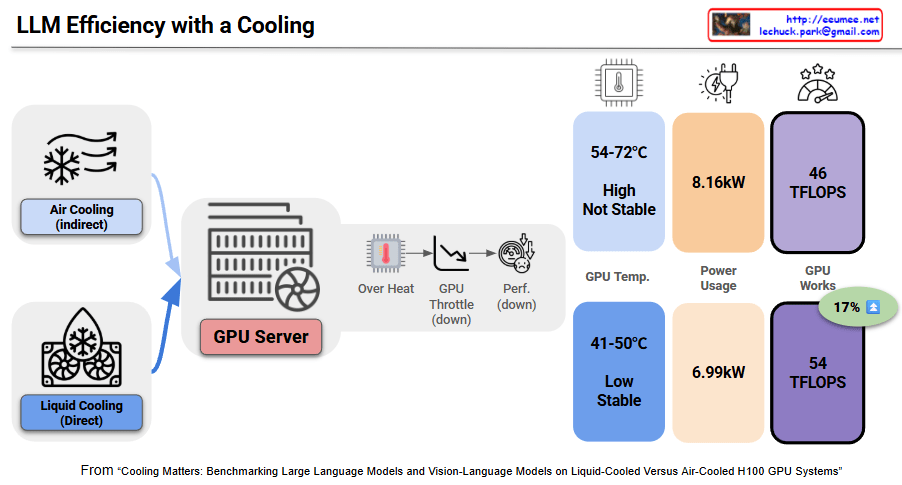
LLM Efficiency with a Cooling

This image demonstrates the critical impact of cooling stability on both LLM performance and energy efficiency in GPU servers through benchmark results.

Cascading Effects of Unstable Cooling

Problems with Unstable Air Cooling:

  • GPU Temperature: 54-72Β°C (high and unstable)
  • Thermal throttling occurs – where GPUs automatically reduce clock speeds to prevent overheating, leading to significant performance degradation
  • Result: Double penalty of reduced performance + increased power consumption

Energy Efficiency Impact:

  • Power Consumption: 8.16kW (high)
  • Performance: 46 TFLOPS (degraded)
  • Energy Efficiency: 5.6 TFLOPS/kW (poor performance-to-power ratio)

Benefits of Stable Liquid Cooling

Temperature Stability Achievement:

  • GPU Temperature: 41-50Β°C (low and stable)
  • No thermal throttling β†’ sustained optimal performance

Energy Efficiency Improvement:

  • Power Consumption: 6.99kW (14% reduction)
  • Performance: 54 TFLOPS (17% improvement)
  • Energy Efficiency: 7.7 TFLOPS/kW (38% improvement)

Core Mechanisms: How Cooling Affects Energy Efficiency

  1. Thermal Throttling Prevention: Stable cooling allows GPUs to maintain peak performance continuously
  2. Power Efficiency Optimization: Eliminates inefficient power consumption caused by overheating
  3. Performance Consistency: Unstable cooling can cause GPUs to use 50% of power budget while delivering only 25% performance

Advanced cooling systems can achieve energy savings ranging from 17% to 23% compared to traditional methods. This benchmark paradoxically shows that proper cooling investment dramatically improves overall energy efficiency.

Final Summary

Unstable cooling triggers thermal throttling that simultaneously degrades LLM performance while increasing power consumption, creating a dual efficiency loss. Stable liquid cooling achieves 17% performance gains and 14% power savings simultaneously, improving energy efficiency by 38%. In AI infrastructure, adequate cooling investment is essential for optimizing both performance and energy efficiency.

With Claude

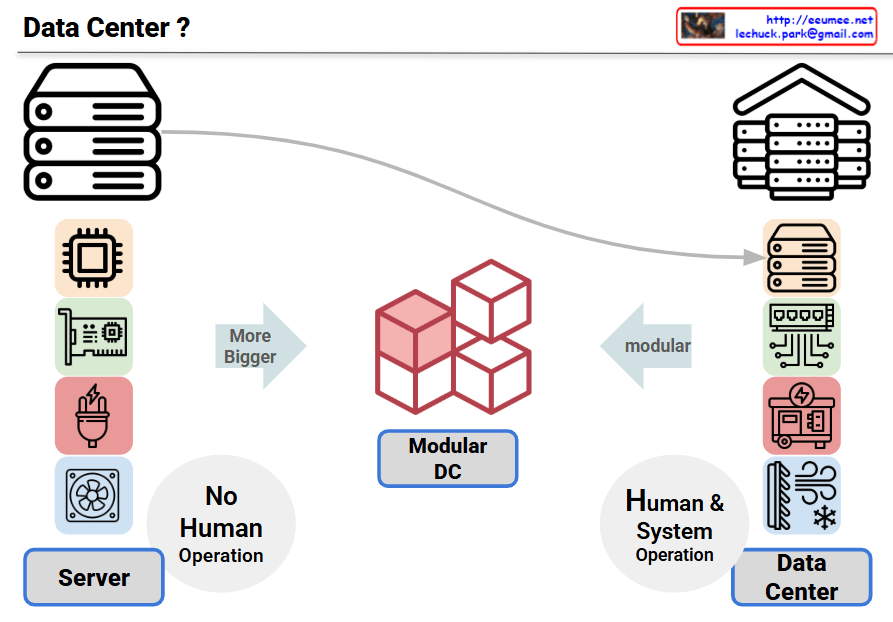
Data Center ?

This infographic compares the evolution from servers to data centers, showing the progression of IT infrastructure complexity and operational requirements.

Left – Server

  • Shows individual hardware components: CPU, motherboard, power supply, cooling fans
  • Labeled “No Human Operation,” indicating basic automated functionality

Center – Modular DC

  • Represented by red cubes showing modular architecture
  • Emphasizes “More Bigger” scale and “modular” design
  • Represents an intermediate stage between single servers and full data centers

Right – Data Center

  • Displays multiple server racks and various infrastructure components (networking, power, cooling systems)
  • Marked as “Human & System Operation,” suggesting more complex management requirements

Additional Perspective on Automation Evolution:

While the image shows data centers requiring human intervention, the actual industry trend points toward increasing automation:

  1. Advanced Automation: Large-scale data centers increasingly use AI-driven management systems, automated cooling controls, and predictive maintenance to minimize human intervention.
  2. Lights-Out Operations Goal: Hyperscale data centers from companies like Google, Amazon, and Microsoft ultimately aim for complete automated operations with minimal human presence.
  3. Paradoxical Development: As scale increases, complexity initially requires more human involvement, but advanced automation eventually enables a return toward unmanned operations.

Summary: This diagram illustrates the current transition from simple automated servers to complex data centers requiring human oversight, but the ultimate industry goal is achieving fully automated “lights-out” data center operations. The evolution shows increasing complexity followed by sophisticated automation that eventually reduces the need for human intervention.

With Claude