Everything is

From Claude with some prompting
This diagram titled “Everything is” illustrates the process of human perception and understanding:

  1. “Input” represents all information received through human senses, depicted by a group of people icons and various symbols.
  2. This input connects to “EVERYTHING”, suggesting that we perceive the world through our senses.
  3. The note “Only Meaning Very very small” indicates that the initial meaning of information at the input stage is limited.
  4. The “More & More” box represents the expansion of human understanding through two methods:
    • “Logics”: Human thought processes
    • “Auto Logics”: AI or automated thinking processes
  5. “More Micro” and “More Macro” arrows show that this expanded thinking develops into more microscopic and macroscopic perspectives.

In essence, this diagram portrays how humans receive information through their senses and process it using both human logical thinking and automated thinking (like AI). This continuous process expands our understanding of the world, allowing us to comprehend “EVERYTHING” from increasingly detailed (micro) and broad (macro) viewpoints. The diagram illustrates our journey towards a deeper and wider understanding of everything around us.
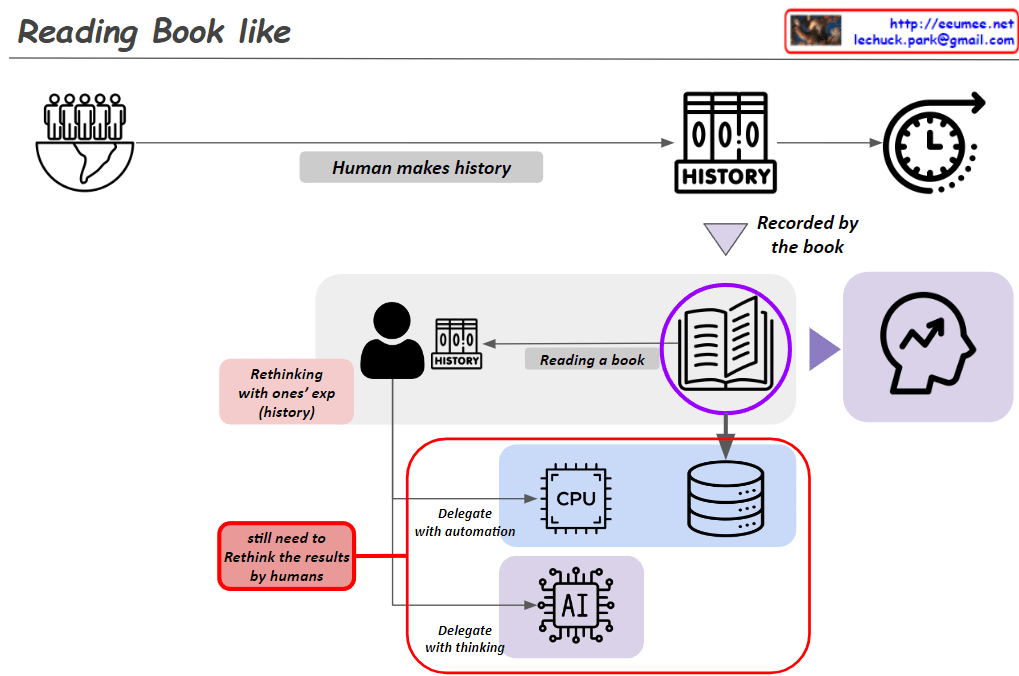
Reading book like

This diagram illustrates the process of learning history and technological advancement, highlighting the crucial role of humans:

  1. Creation and Recording of History:
    • Humans make history, which is recorded and transmitted through books.
  2. Knowledge Acquisition and Personal Growth:
    • Individuals learn history through books and reinterpret it by combining it with their own experiences.
  3. Technological Advancements and Utilization:
    • Automation of calculations through CPU
    • Delegation of some thinking processes to AI
  4. The Pivotal Role of Humans – Rethinking:
    • The key message is “still need to Rethink the results by humans”
    • This emphasizes that humans must critically evaluate and reinterpret the results obtained through technology
    • Through the process of rethinking, humans gain deeper understanding, new insights, and continue to develop
  5. Continuous Development Cycle:
    • Human rethinking generates new ideas and perspectives, which in turn become part of the history-making process

In conclusion, this diagram underscores that despite technological progress, human cognitive abilities, especially rethinking, are essential for individual and societal development. While humans use technology as a tool, the final interpretation and meaning-making remain uniquely human abilities, achieved through critical thinking and reinterpretation.

Computing with supers

From Claude with some prompting
This diagram titled “Computing works with supers” illustrates the structure and operational principles of modern high-performance computing systems. Key features include:

  1. Power Management: The “Making Power” section features a power icon labeled “Super,” indicating the massive power supply required for high-performance computing. This is emphasized by the phrase “Super Energy is required.”
  2. Central Processing Unit (CPU): Responsible for “Making Infra” and “Making Logic,” performing basic computational functions.
  3. Graphics Processing Unit (GPU) and AI: Located below the CPU, the GPU is directly connected to an AI model. The phrase “Delegate work to AI” demonstrates AI’s significant role in handling complex computing tasks.
  4. Heat Management: The diagram shows “Making Super Heat” from the GPU, managed by a “Control It with Cooling” system, highlighting the importance of thermal management.
  5. Integrated Management: The right sidebar groups power, GPU, and cooling systems together, with the caption “Must Manage All connected Supers.” This underscores the interconnectedness of these core elements and the need for integrated management.
  6. System Efficiency: Each major component is labeled “Super,” emphasizing their crucial roles in the high-performance system. This suggests that harmonious management of these elements determines the overall system’s efficiency and performance.
  7. Output: The “Super” human icon at the top right implies that this high-performance system produces exceptional results.

This diagram emphasizes that power management, GPU utilization, heat management, and AI integration are critical in modern high-performance computing. It highlights that efficient integrated management of these elements is key to determining the overall system’s performance and efficiency. Additionally, it suggests the growing importance of AI and automation technologies in effectively managing such complex systems.

personalized RAG

from Claude with some prompting
This diagram illustrates a personalized RAG (Retrieval-Augmented Generation) system that allows individuals to use their personal data with various LLM (Large Language Model) implementations. Key aspects include:

  1. User input: Represented by a person icon and notebook on the left, indicating personal data or queries.
  2. On-Premise storage: Contains LLM models that can be managed and run locally by the user.
  3. Cloud integration: An API connects to cloud-based LLM services, represented by icons in the “on cloud” section. These also symbolize different cloud-based LLM models.
  4. Flexible model utilization: The structure enables users to leverage both on-premise and cloud-based LLM models, allowing for combination of different models’ strengths or selection of the most suitable model for specific tasks.
  5. Privacy protection: A “Control a privacy Filter” icon emphasizes the importance of managing privacy filters to prevent inappropriate exposure of sensitive information to LLMs.
  6. Model selection: The “Use proper Foundation models” icon stresses the importance of choosing appropriate base models for different tasks.

This system empowers individual users to safely manage their data while flexibly utilizing various LLM models, both on-premise and cloud-based. It places a strong emphasis on privacy protection, which is crucial in RAG systems dealing with personal data.

The diagram effectively showcases how personal data can be integrated with advanced LLM technologies while maintaining control over privacy and model selection.

What to do first

From Claude with some prompting
This image outlines a progressive approach to data monitoring and alert systems, starting with simple metrics and evolving to more complex AI-driven solutions. The key steps are:

  1. “Keeping a Temperature”: Basic monitoring of system temperatures.
  2. “Monitoring”: Continuous observation of temperature data.
  3. “Alerts with thresholds”: Simple threshold-based alerts.
  4. More complex metrics: Including 10-minute thresholds, change counts, averages, and derivations.
  5. “More Indicators”: Expanding to additional KPIs and metrics.
  6. “Machine Learning ARIMA/LSTM”: Implementing advanced predictive models.
  7. “Alerts with predictions”: AI-driven predictive alerts.

The central message “EASY FIRST BEFORE THE AI !!” emphasizes starting with simpler methods before advancing to AI solutions.

Importantly, the image also implies that these simpler metrics and indicators established early on will later serve as valuable training data for AI models. This is shown by the arrows connecting all stages to the machine learning component, suggesting that the data collected throughout the process contributes to the AI’s learning and predictive capabilities.

This approach not only allows for a gradual build-up of system complexity but also ensures that when AI is implemented, it has a rich dataset to learn from, enhancing its effectiveness and accuracy.

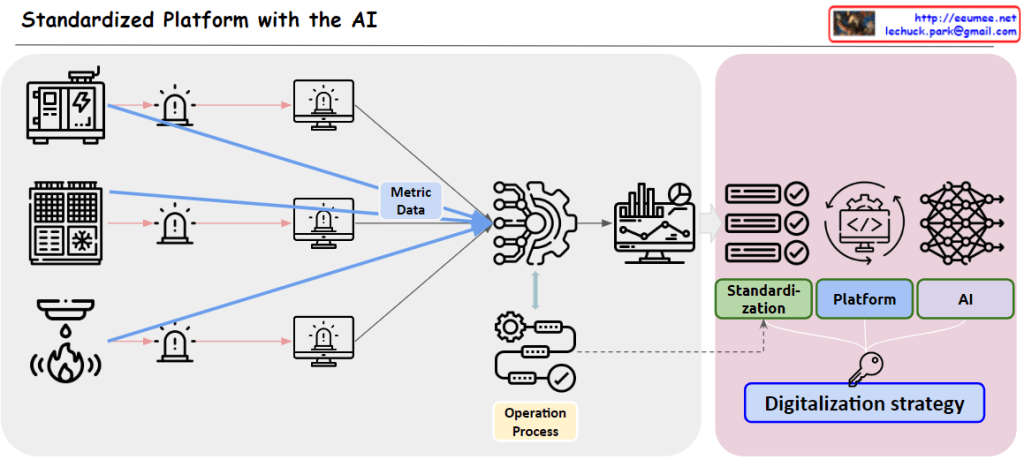
Standardized Platform with the AI

From Claude with some prompting
This image illustrates a “Standardized Platform with the AI”. Here’s a breakdown of the key components and processes:

  1. Left side: Various devices or systems (generator, HVAC system, fire detector, etc.) are shown. Each device is connected to an alarm system and a monitoring screen.
  2. Center: “Metric Data” from these devices is sent to a central gear-shaped icon, representing a data processing system.
  3. Upper right: The processed data is displayed on a dashboard or analytics screen.
  4. Lower right: There’s a section labeled “Operation Process”, indicating management or optimization of operational processes.
  5. Far right: Boxes representing the system’s components:
    • “Standardization”
    • “Platform”
    • “AI”
  6. Bottom: “Digitalization strategy” serves as the foundation for the entire system.

This diagram visualizes a digital transformation strategy that collects data from various systems and devices, processes it using AI on a standardized platform, and uses this to optimize and manage operations.

The flow shows how raw data from different sources is standardized, processed, and utilized to create actionable insights and improve operational efficiency, all underpinned by a comprehensive digitalization strategy.

Simple & Complex

This image illustrates the evolution of problem-solving approaches, contrasting traditional methods with modern AI-based solutions:

‘Before’ stage:

  1. Starts with Simple data
  2. Proceeds through Research
  3. Find out Rules with formula
  4. Resolves Complex problems

This process represents the traditional approach where humans collect simple data, conduct research, and discover rules to solve complex problems.

‘Now with AI Infra’ stage:

  1. Begins with Simple data
  2. Accumulates too much Simple data
  3. Utilizes Computing for big data and Computing AI
  4. Solves Complex problems by too much simple

This new process showcases a modern approach based on AI infrastructure. It involves analyzing vast amounts of simple data using computational power to address more evolved forms of complexity.

The ‘Complex Evolution’ arrow indicates that the level of complexity we can handle is evolving due to this shift in approach.

In essence, the image conveys that while the past relied on limited data to discover simple rules for solving complexity, the present leverages AI and big data to analyze enormous amounts of simple data, enabling us to tackle more sophisticated and complex problems. This shift represents a significant evolution in our problem-solving capabilities, allowing us to address complexities that were previously beyond our reach.