From Claude with some prompting Server Room Stability & Optimization
Cooling Supply: Ensuring sufficient cooling capacity to effectively dissipate the heat generated by the servers
Power Usage: Monitoring and managing the power consumption of the servers
Power Supply: Maintaining a stable and reliable power supply to the server room
Resource Check:
Power Resource: Verifying the ability to provide the necessary power supply for the server usage
Cooling Resource: Checking the cooling capacity to effectively handle the heat generated by the servers
Anomaly Detection: Identifying any anomalies or unusual patterns in the server room’s behavior
Stability: Maintaining the power and cooling resource supply to meet or exceed the server usage requirements
Optimizing: Based on the stability analysis, optimizing the power and cooling resource supply to match the server usage
The key focus is on the appropriate management and provisioning of both power and cooling resources to ensure the overall stability and optimization of the server room operations.
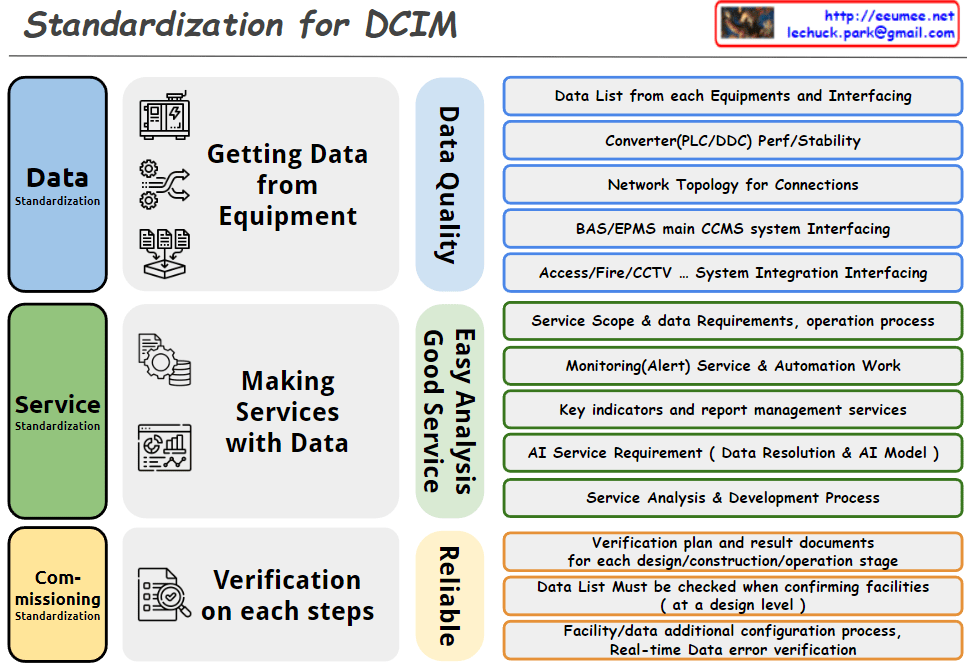
From Claude with some prompting Data Standardization:
Defined a clear process for systematically collecting data from equipment.
Proposed an integrated data management approach, including network topology and interfacing between various systems.
Emphasized data quality management as a key factor to establish a reliable data foundation.
Service Standardization:
Structured the process of connecting data to actual services.
Highlighted practical service implementation, including monitoring services and automation tasks.
Specified AI service requirements, showing a forward-looking approach.
Established a foundation for continuous service improvement by including service analysis and development processes.
Commissioning Standardization:
Emphasized verification plans and documentation of results at each stage of design, construction, and operation to enable quality management throughout the entire lifecycle.
Prepared an immediate response system for potential operational issues by including real-time data error verification.
Considered system scalability and flexibility by incorporating processes for adding facilities and data configurations.
Overall Evaluation:
This DCIM standardization approach comprehensively addresses the core elements of data center infrastructure management. The structured process, from data collection to service delivery and continuous verification, is particularly noteworthy. By emphasizing fundamental data quality management and system stability while considering advanced technologies like AI, the approach is both practical and future-oriented. This comprehensive framework will be a valuable guideline for the implementation and operation of DCIM.
From Claude with some prompting This image depicts a diagram of the “DC op Platform” (Data Center Operations Platform). The main components are as follows:
On the left, there’s “DC Op Env.” (Data Center Operations Environment), which consists of three main parts:
DCIM (Data Center Infrastructure Management)
Auto Control
Facility These three elements undergo a “Standardization” process.
In the center, there are two “Standardization” server icons, representing the standardization process of the platform.
On the right, there’s the “Data Center Op. Platform”, which comprises three main components:
Service Development
Integrated operations
Server Room Digital Twin
Arrows show how the standardized elements connect to these three main components.
This diagram visually illustrates how the data center operations environment evolves through a standardization process into an integrated data center operations platform.
From Claude with some prompting focusing on the importance of the digital twin-based floor operation optimization system for high-performance computing rooms in AI data centers, emphasizing stability and energy efficiency. I’ll highlight the key elements marked with exclamation points.
Purpose of the system:
Enhance stability
Improve energy efficiency
Optimize floor operations
Key elements (marked with exclamation points):
Interface:
Efficient data collection interface using IPMI, Redis and Nvidia DCGM
Real-time monitoring of high-performance servers and GPUs to ensure stability
Intelligent/Smart PDU:
Precise power usage measurement contributing to energy efficiency
Early detection of anomalies to improve stability
High Resolution under 1 sec:
High-resolution data collection in less than a second enables real-time response
Immediate detection of rapid changes or anomalies to enhance stability
Analysis with AI:
AI-based analysis of collected data to derive optimization strategies
Utilized for predictive maintenance and energy usage optimization
Computing Room Digital Twin:
Virtual replication of the actual computing room for simulation and optimization
Scenario testing for various situations to improve stability and efficiency
This system collects and analyzes data from high-power servers, power distribution units, cooling facilities, and environmental sensors. It optimizes the operation of AI data center computing rooms, enhances stability, and improves energy efficiency.
By leveraging digital twin technology, the system enables not only real-time monitoring but also predictive maintenance, energy usage optimization, and proactive response to potential issues. This leads to improved stability and reduced operational costs in high-performance computing environments.
Ultimately, this system serves as a critical infrastructure for efficient operation of AI data centers, energy conservation, and stable service provision. It addresses the unique challenges of managing high-density, high-performance computing environments, ensuring optimal performance while minimizing risks and energy consumption.
From Claude with some prompting This image titled “AI DC Key” illustrates the key components of an AI data center. Here’s an interpretation of the diagram:
On the left, there’s an icon representing “Massive Data”.
The center showcases four core elements of AI:
“Super Power”
“Super Computing” (utilizing GPU)
“Super Cooling”
“Optimizing Operation”
Below each core element, key considerations are listed:
Super Power: “Nature & Consistent”
Super Computing: “Super Parallel”
Super Cooling: “Liquid Cooling”
Optimizing Operation: “Data driven Auto & AI”
On the right, an icon represents “Analyzed Data”.
The overall flow illustrates the process of massive data being input, processed through the AI core elements, and resulting in analyzed data.
This diagram visualizes the essential components of a modern AI data center and their key considerations. It demonstrates how high-performance computing, efficient power management, advanced cooling technology, and optimized operations effectively process and analyze large-scale data, emphasizing the critical technologies or approaches for each element.
From Claude with some prompting This diagram titled “Computing works with supers” illustrates the structure and operational principles of modern high-performance computing systems. Key features include:
Power Management: The “Making Power” section features a power icon labeled “Super,” indicating the massive power supply required for high-performance computing. This is emphasized by the phrase “Super Energy is required.”
Central Processing Unit (CPU): Responsible for “Making Infra” and “Making Logic,” performing basic computational functions.
Graphics Processing Unit (GPU) and AI: Located below the CPU, the GPU is directly connected to an AI model. The phrase “Delegate work to AI” demonstrates AI’s significant role in handling complex computing tasks.
Heat Management: The diagram shows “Making Super Heat” from the GPU, managed by a “Control It with Cooling” system, highlighting the importance of thermal management.
Integrated Management: The right sidebar groups power, GPU, and cooling systems together, with the caption “Must Manage All connected Supers.” This underscores the interconnectedness of these core elements and the need for integrated management.
System Efficiency: Each major component is labeled “Super,” emphasizing their crucial roles in the high-performance system. This suggests that harmonious management of these elements determines the overall system’s efficiency and performance.
Output: The “Super” human icon at the top right implies that this high-performance system produces exceptional results.
This diagram emphasizes that power management, GPU utilization, heat management, and AI integration are critical in modern high-performance computing. It highlights that efficient integrated management of these elements is key to determining the overall system’s performance and efficiency. Additionally, it suggests the growing importance of AI and automation technologies in effectively managing such complex systems.
From Claude with some prompting This diagram illustrates the structure of an AI DCIM (Data Center Infrastructure Management) system for AI Data Centers (AI DC). Here’s an explanation of the key components and their roles:
EPMS BAS(BMS): Energy and Building Management System, controlling the basic infrastructure of the data center.
DCIM: Data Center Infrastructure Management system, integrated with EPMS/BAS to manage overall data center operations.
AI and Big Data: Linked with DCIM to process large-scale data and perform AI-based analysis and decision-making.
Super Computing: Provides high-performance computing capabilities to support complex AI tasks and large-scale data analysis.
Super Power: Represents the high-performance power supply system necessary for AI DC.
Super Cooling: Signifies the high-efficiency cooling system essential for large-scale computing environments.
AI DCIM for AI DC: Integrates all these elements to create a new management system for AI data centers. This enables greater data processing capacity and faster analysis.
The goal of this system is emphasized by “Faster and more accurate is required!!”, highlighting the need for quicker and more precise operations and analysis in AI DC environments.
This structure enhances traditional DCIM systems with AI and big data technologies, presenting a new paradigm of data center management capable of efficiently managing and optimizing large-scale AI workloads. Through this, AI DCs can operate more intelligently and efficiently, smoothly handling the increasing demands for data processing and complex AI tasks.
The integration of these components aims to create a new facility management system for AI DCs, enabling the processing of larger datasets and faster analysis. This approach represents a significant advancement in data center management, tailored specifically to meet the unique demands of AI-driven infrastructures.



 Lechuck Park