BAS + EPMS + @ = DCIM

From Claude with some prompting
This image illustrates the distinction between BAS (Building Automation System), EPMS (Energy Power Management System), and DCIM (Data Center Infrastructure Management), explaining their development and relationships.

  1. BAS (Building Automation System):
    • Focuses on general buildings
    • Emphasizes water management and HVAC (cooling) systems
    • Named “BAS” because water and air conditioning were crucial elements in building management
    • Primarily deals with low-power usage environments
    • Includes water control, cooling control, flow control, and pipe/plumbing management
  2. EPMS (Energy Power Management System):
    • Specialized for high-power usage environments
    • Concentrates on power generation, distribution, and control
    • Developed separately from BAS due to the unique complexities of high-power environments
  3. DCIM (Data Center Infrastructure Management):
    • Tailored for data center environments
    • Integrates functions of both BAS and EPMS
    • Manages power (EPMS) and cooling/environmental (BAS) aspects
    • Addresses additional requirements specific to data centers

The diagram clearly shows the background and characteristics of each system’s development:

  • BAS evolved from the need to manage water and air conditioning in general buildings
  • EPMS developed separately due to the specific requirements of high-power environments
  • DCIM integrates and expands on BAS and EPMS functionalities to meet the complex needs of data centers

The formula “BAS + EPMS + @ = DCIM” indicates that DCIM incorporates the functions of BAS and EPMS, while also including additional management capabilities (@) specific to data centers.

This structure effectively demonstrates how each system has specialized and evolved to suit particular environments and requirements, and how they are ultimately integrated in DCIM for comprehensive management of data center infrastructures.
Automatic Control System

From Claude with some prompting
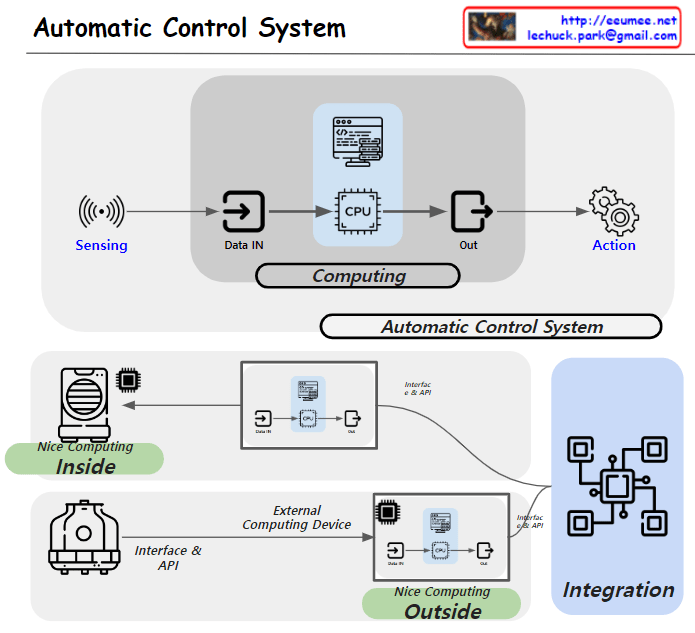
focusing on the importance of computing in automatic control systems and the distinction between devices with sufficient computing power and those without:

  1. Basic Structure of Automatic Control System:
    • The system operates in the sequence of Sensing -> Data IN -> CPU -> Out -> Action.
    • This entire process occurs within the ‘Computing’ phase, which is crucial for automatic control.
  2. Device Classification Based on Computing Capability:
    • ‘Nice Computing Inside’: Represents devices with sufficient computing power. These devices can process complex control logic independently.
    • ‘Nice Computing Outside’: Indicates devices with limited computing capabilities. These devices rely on external computing resources for automatic control.
  3. Utilization of External Computing Resources:
    • The ‘External Computing Device’ allows devices with limited computing power to perform advanced automatic control functions.
    • This is implemented through external computing devices such as PLCs (Programmable Logic Controllers) or DDCs (Direct Digital Controls).
  4. System Integration:
    • ‘Interface & API’ facilitates the connection and communication between various devices and external computing resources.
    • The ‘Integration’ section demonstrates how these diverse elements function as a unified automatic control system.
  5. Importance of Computing:
    • In automatic control systems, computing plays a crucial role in data processing, decision-making, and generating control commands.
    • By appropriately utilizing internal or external computing resources, various types of equipment can function as part of an efficient automatic control system.

This diagram effectively illustrates the flexibility and scalability of automatic control systems, explaining different approaches based on computing capabilities. The forthcoming explanation about PLC/DDC and other external computing devices will likely provide more concrete insights into the practical implementation of these systems.

SCADA & EPMS

From Perplexity with some prompting
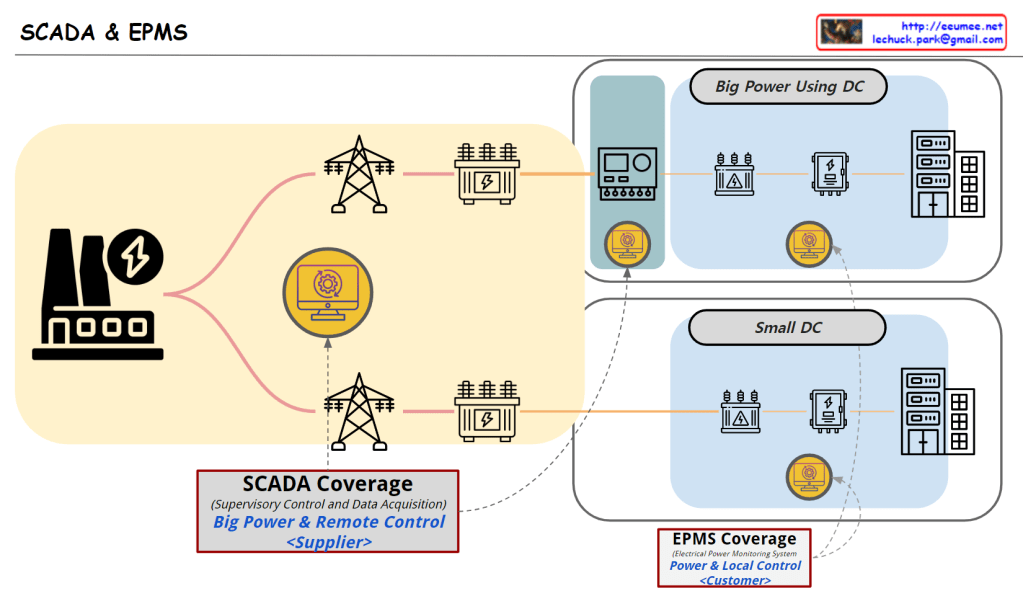
The image illustrates the roles and coverage of SCADA and EPMS systems in power management for data centers.

SCADA System

  • Target: Power Suppliers and Large Power Consumers (Big Power Using DC)
  • Role:
    • Power Suppliers: Remotely monitor and control infrastructure like power plants and substations to ensure the stability of large-scale power grids.
    • Large Data Centers: Manage complex power infrastructure and ensure stable power supply by utilizing some SCADA functionalities.
  • Coverage: Large power management and remote control

EPMS System

  • Target: Small Data Centers (Small DC)
  • Role:
    • Monitor and manage power usage within the data center to optimize energy efficiency.
    • Perform detailed local control of power management.
  • Coverage: Power monitoring and local control

Key Distinctions

  • SCADA focuses on large-scale power management and remote control, suitable for power suppliers and large consumers.
  • EPMS is used primarily in small data centers for optimizing energy consumption through local control.

In conclusion, large data centers benefit from using both SCADA and EPMS to effectively manage complex power infrastructures, while small data centers typically rely on EPMS for efficient energy management.

Standardization

From Claude + ChatGPT with some prompting
The image you provided shows a standardization process aimed at delivering high-quality data and consistent services. Here’s a breakdown of the structure based on the image:

Key Areas:

  1. [Data]
    • Facility: Represents physical systems or infrastructure.
    • Auto Control: Automatic controls used to manage the system.
  2. [Service]
    • Mgt. System: Management system that controls and monitors operations.
    • Process: Processes to maintain efficiency and quality.

Optimization Paths:

  1. Legacy Optimization:
    • a) Configure List-Up: Listing and organizing the configurations for the existing system.
    • b) Configure Optimization (Standardization): Optimizing and standardizing the existing system to improve performance.
    • Outcome: Enhances the existing system by improving its efficiency and consistency.
  2. New Setup:
    • a) Configure List-Up: Listing and organizing configurations for the new system.
    • b) Configure Optimization (Standardization): Optimizing and standardizing the configuration for the new system.
    • c) Configuration Requirement: Defining the specific requirements for setting up the new system.
    • d) Verification (on Installation): Verifying that the system operates correctly after installation.
    • Outcome: Builds a completely new system that provides high-quality data and consistent services.

Outcome:

The aim for both paths is to provide high-quality data and consistent service by standardizing either through optimizing legacy systems or creating entirely new setups.

This structured approach helps improve efficiency, consistency, and system performance.

Golden Circle For DC Operation

From perplexity with some prompting
The image explains the “Golden Circle for DC Operation,” focusing on optimizing data center operations.

WHY: Data Center Operation Optimization

  • Purpose: To optimize the operation of data centers.
  • Service Development: Through data-driven processes, including monitoring, automation, tool development, and customer-focused services.

HOW: Consistent Process & Data Management

  • Method: Ensures reliable data through consistent processes and management.
  • Standardization: Achieved through data lists, hardware/software protocols, and service/process views and flows.

WHAT: Integrated Digital Operation Platform

  • Objective: To build an integrated digital operation platform.
  • Platform: Operator-led development that involves analysis, AI integration, and service creation.

This structure emphasizes efficiency, standardization, and a data-centric approach to data center operations.

Server Room Stability & Optimization

From Claude with some prompting
Server Room Stability & Optimization

  1. Cooling Supply: Ensuring sufficient cooling capacity to effectively dissipate the heat generated by the servers
  2. Power Usage: Monitoring and managing the power consumption of the servers
  3. Power Supply: Maintaining a stable and reliable power supply to the server room
  4. Resource Check:
    • Power Resource: Verifying the ability to provide the necessary power supply for the server usage
    • Cooling Resource: Checking the cooling capacity to effectively handle the heat generated by the servers
  5. Anomaly Detection: Identifying any anomalies or unusual patterns in the server room’s behavior
  6. Stability: Maintaining the power and cooling resource supply to meet or exceed the server usage requirements
  7. Optimizing: Based on the stability analysis, optimizing the power and cooling resource supply to match the server usage

The key focus is on the appropriate management and provisioning of both power and cooling resources to ensure the overall stability and optimization of the server room operations.

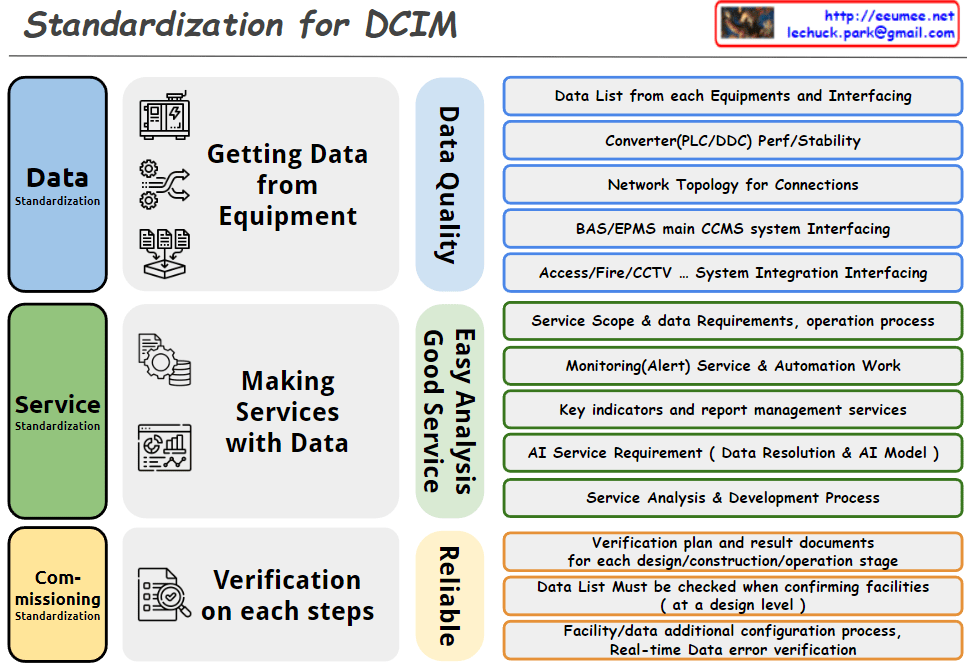
Standardization for DCIM

From Claude with some prompting
Data Standardization:

  • Defined a clear process for systematically collecting data from equipment.
  • Proposed an integrated data management approach, including network topology and interfacing between various systems.
  • Emphasized data quality management as a key factor to establish a reliable data foundation.

Service Standardization:

  • Structured the process of connecting data to actual services.
  • Highlighted practical service implementation, including monitoring services and automation tasks.
  • Specified AI service requirements, showing a forward-looking approach.
  • Established a foundation for continuous service improvement by including service analysis and development processes.

Commissioning Standardization:

  • Emphasized verification plans and documentation of results at each stage of design, construction, and operation to enable quality management throughout the entire lifecycle.
  • Prepared an immediate response system for potential operational issues by including real-time data error verification.
  • Considered system scalability and flexibility by incorporating processes for adding facilities and data configurations.

Overall Evaluation:

This DCIM standardization approach comprehensively addresses the core elements of data center infrastructure management. The structured process, from data collection to service delivery and continuous verification, is particularly noteworthy. By emphasizing fundamental data quality management and system stability while considering advanced technologies like AI, the approach is both practical and future-oriented. This comprehensive framework will be a valuable guideline for the implementation and operation of DCIM.