Big Changes with AI

This image illustrates the dramatic growth in computing performance and data throughput from the Internet era to the AI/LLM era.

Key Development Stages

1. Internet Era

  • 10 TWh (terawatt-hours) power consumption
  • 2 PB/day (petabytes/day) data processing
  • 1K DC (1,000 data centers)
  • PUE 3.0 (Power Usage Effectiveness)

2. Mobile & Cloud Era

  • 200 TWh (20x increase)
  • 20,000 PB/day (10,000x increase)
  • 4K DC (4x increase)
  • PUE 1.8 (improved efficiency)

3. AI/LLM (Transformer) Era – “Now Here?” point

  • 400+ TWh (40x additional increase)
  • 1,000,000,000 PB/day = 1 billion PB/day (500,000x increase)
  • 12K DC (12x increase)
  • PUE 1.4 (further improved efficiency)

Summary

The chart demonstrates unprecedented exponential growth in data processing and power consumption driven by AI and Large Language Models. While data center efficiency (PUE) has improved significantly, the sheer scale of computational demands has skyrocketed. This visualization emphasizes the massive infrastructure requirements that modern AI systems necessitate.

#AI #LLM #DataCenter #CloudComputing #MachineLearning #ArtificialIntelligence #BigData #Transformer #DeepLearning #AIInfrastructure #TechTrends #DigitalTransformation #ComputingPower #DataProcessing #EnergyEfficiency

Large Scale Network Driven Design ( Deepseek V3)

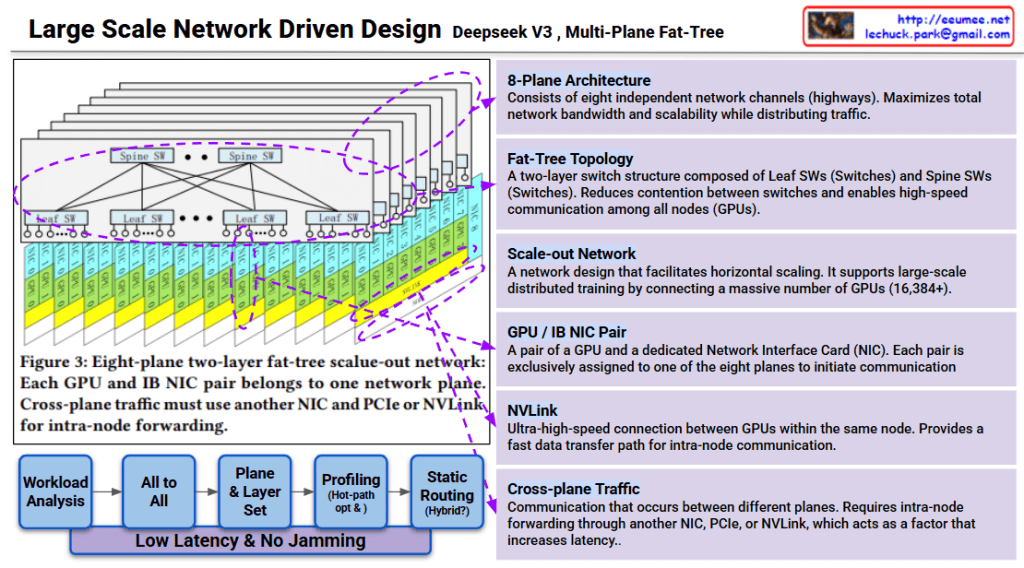
Deepseek v3 Large-Scale Network Architecture Analysis

This image explains the Multi-Plane Fat-Tree network structure of Deepseek v3.

Core Architecture

1. 8-Plane Architecture

  • Consists of eight independent network channels (highways)
  • Maximizes network bandwidth and distributes traffic for enhanced scalability

2. Fat-Tree Topology

  • Two-layer switch structure:
    • Leaf SW (Leaf Switches): Directly connected to GPUs
    • Spine SW (Spine Switches): Interconnect leaf switches
  • Enables high-speed communication among all nodes (GPUs) while minimizing switch contention

3. GPU/IB NIC Pair

  • Each GPU is paired with a dedicated Network Interface Card (NIC)
  • Each pair is exclusively assigned to one of the eight planes to initiate communication

Communication Methods

NVLink

  • Ultra-high-speed connection between GPUs within the same node
  • Fast data transfer path used for intra-node communication

Cross-plane Traffic

  • Occurs when communication happens between different planes
  • Requires intra-node forwarding through another NIC, PCIe, or NVLink
  • Primary factor that increases latency

Network Optimization Process

The workflow below minimizes latency and prevents network congestion:

  1. Workload Analysis
  2. All to All (analyzing all-to-all communication patterns)
  3. Plane & Layer Set (plane and layer assignment)
  4. Profiling (Hot-path opt K) (hot-path optimization)
  5. Static Routing (Hybrid) (hybrid static routing approach)

Goal: Low latency & no jamming

Scalability

This design is a scale-out network for large-scale distributed training supporting 16,384+ GPUs. Each plane operates independently to maximize overall system throughput.


3-Line Summary

Deepseek v3 uses an 8-plane fat-tree network architecture that connects 16,384+ GPUs through independent communication channels, minimizing contention and maximizing bandwidth. The two-layer switch topology (Spine and Leaf) combined with dedicated GPU-NIC pairs enables efficient traffic distribution across planes. Cross-plane traffic management and hot-path optimization ensure low-latency, high-throughput communication for large-scale AI training.

#DeepseekV3 #FatTreeNetwork #MultiPlane #NetworkArchitecture #ScaleOut #DistributedTraining #AIInfrastructure #GPUCluster #HighPerformanceComputing #NVLink #DataCenterNetworking #LargeScaleAI

With Claude

AI approach

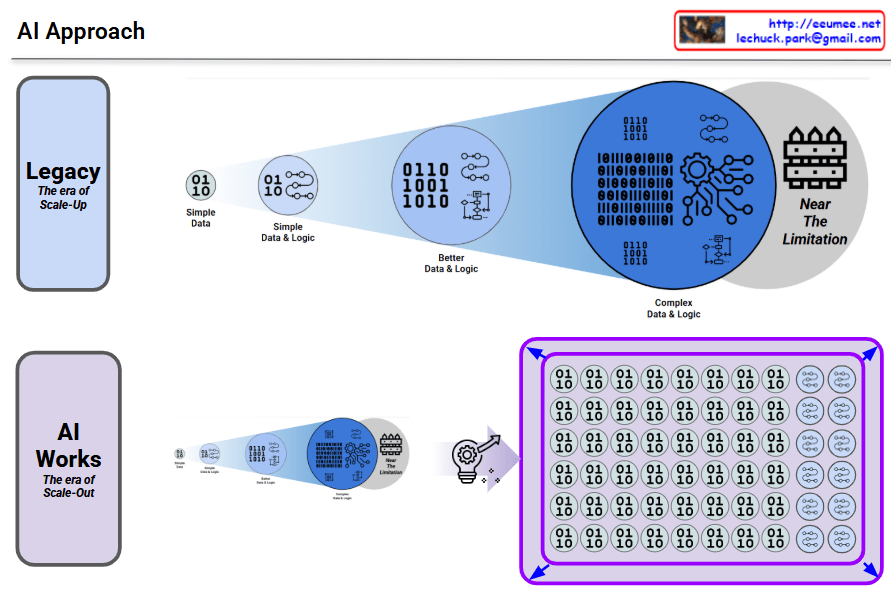
Legacy – The Era of Scale-Up

Traditional AI approach showing its limitations:

  • Simple Data: Starting with basic data
  • Simple Data & Logic: Combining data with logic
  • Better Data & Logic: Improving data and logic
  • Complex Data & Logic: Advancing to complex data and logic
  • Near The Limitation: Eventually hitting a fundamental ceiling

This approach gradually increases complexity, but no matter how much it improves, it inevitably runs into fundamental scalability limitations.

AI Works – The Era of Scale-Out

Modern AI transcending the limitations of the legacy approach through a new paradigm:

  • The left side shows the limitations of the old approach
  • The lightbulb icon in the middle represents a paradigm shift (Breakthrough)
  • The large purple box on the right demonstrates a completely different approach:
    • Massive parallel processing of countless “01/10” units (neural network neurons)
    • Horizontal scaling (Scale-Out) instead of sequential complexity increase
    • Fundamentally overcoming the legacy limitations

Key Message

No matter how much you improve the legacy approach, there’s a ceiling. AI breaks through that ceiling with a completely different architecture.


Summary

  • Legacy AI hits fundamental limits by sequentially increasing complexity (Scale-Up)
  • Modern AI uses massive parallel processing architecture to transcend these limitations (Scale-Out)
  • This represents a paradigm shift from incremental improvement to architectural revolution

#AI #MachineLearning #DeepLearning #NeuralNetworks #ScaleOut #Parallelization #AIRevolution #Paradigmshift #LegacyVsModern #AIArchitecture #TechEvolution #ArtificialIntelligence #ScalableAI #DistributedComputing #AIBreakthrough

Optimize LLM

LLM Optimization: Integration of Traditional Methods and New Paradigms

Core Message

LLM (Transformer) optimization requires more than just traditional optimization methodologies – new perspectives must be added.


1. Traditional Optimization Methodology (Left Side)

SW (Software) Optimization

  • Data Optimization
    • Structure: Data structure design
    • Copy: Data movement optimization
  • Logics Optimization
    • Algorithm: Efficient algorithm selection
    • Profiling: Performance analysis and bottleneck identification

Characteristics: Deterministic, logical approach

HW (Hardware) Optimization

  • Functions & Speed (B/W): Function and speed/bandwidth optimization
  • Fit For HW: Optimization for existing hardware
  • New HW implementation: New hardware design and implementation

Characteristics: Physical performance improvement focus


2. New Perspectives Required for LLM (Right Side)

SW Aspect: Human-Centric Probabilistic Approach

  • Human Language View / Human’s View
    • Human language understanding methods
    • Human thinking perspective
  • Human Learning
    • Mimicking human learning processes

Key Point: Statistical and Probabilistic Methodology

  • Different from traditional deterministic optimization
  • Language patterns, probability distributions, and context understanding are crucial

HW Aspect: Massive Parallel Processing

  • Massive Simple Parallel
    • Parallel processing of large-scale simple computations
    • Hardware architecture capable of parallel processing (GPU/TPU) is essential

Key Point: Efficient parallel processing of large-scale matrix operations


3. Integrated Perspective

LLM Optimization = Traditional Optimization + New Paradigm

DomainTraditional MethodLLM Additional Elements
SWAlgorithm, data structure optimization+ Probabilistic/statistical approach (human language/learning perspective)
HWFunction/speed optimization+ Massive parallel processing architecture

Conclusion

For effective LLM optimization:

  1. Traditional optimization techniques (data, algorithms, hardware) as foundation
  2. Probabilistic approach reflecting human language and learning methods
  3. Hardware perspective supporting massive parallel processing

These three elements must be organically combined – this is the core message of the diagram.


Summary

LLM optimization requires integrating traditional deterministic SW/HW optimization with new paradigms: probabilistic/statistical approaches that mirror human language understanding and learning, plus hardware architectures designed for massive parallel processing. This represents a fundamental shift from conventional optimization, where human-centric probabilistic thinking and large-scale parallelism are not optional but essential dimensions.


#LLMOptimization #TransformerArchitecture #MachineLearningOptimization #ParallelProcessing #ProbabilisticAI #HumanLanguageView #GPUComputing #DeepLearningHardware #StatisticalML #AIInfrastructure #ModelOptimization #ScalableAI #NeuralNetworkOptimization #AIPerformance #ComputationalEfficiency

From Tokenization to Output

From Tokenization to Output: Understanding NLP and Transformer Models

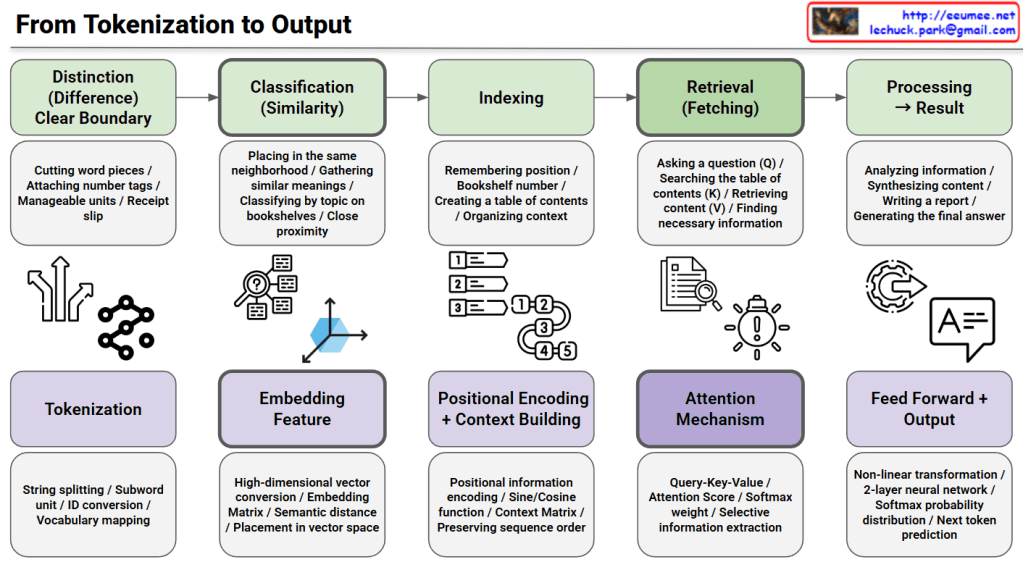
This image illustrates the complete process from tokenization to output in Natural Language Processing (NLP) and transformer models.

Top Section: Traditional Information Retrieval Process (Green Boxes)

  1. Distinction (Difference) – Clear Boundary
    • Cutting word pieces, attaching number tags, creating manageable units, generating receipt slips
  2. Classification (Similarity)
    • Placing in the same neighborhood, gathering similar meanings, classifying by topic on bookshelves, organizing by close proximity
  3. Indexing
    • Remembering position, assigning bookshelf numbers, creating a table of contents, organizing context
  4. Retrieval (Fetching)
    • Asking a question, searching the table of contents, retrieving content, finding necessary information
  5. Processing → Result
    • Analyzing information, synthesizing content, writing a report, generating the final answer

Bottom Section: Actual Transformer Model Implementation (Purple Boxes)

  1. Tokenization
    • String splitting, subword units, ID conversion, vocabulary mapping
  2. Embedding Feature
    • High-dimensional vector conversion, embedding matrix, semantic distance, placement in vector space
  3. Positional Encoding + Context Building
    • Positional information encoding, sine/cosine functions, context matrix, preserving sequence order
  4. Attention Mechanism
    • Query-Key-Value, attention scores, softmax weights, selective information extraction
  5. Feed Forward + Output
    • Non-linear transformation, 2-layer neural network, softmax probability distribution, next token prediction

Key Concept

This diagram maps traditional information retrieval concepts to modern transformer architecture implementations. It visualizes how abstract concepts in the top row are realized through concrete technical implementations in the bottom row, providing an educational resource for understanding how models like GPT and BERT work internally at each stage.


Summary

This diagram explains the end-to-end pipeline of transformer models by mapping traditional information retrieval concepts (distinction, classification, indexing, retrieval, processing) to technical implementations (tokenization, embedding, positional encoding, attention mechanism, feed-forward output). The top row shows abstract conceptual stages while the bottom row reveals the actual neural network components used in models like GPT and BERT. It serves as an educational bridge between high-level understanding and low-level technical architecture.

#NLP #TransformerModels #DeepLearning #Tokenization #AttentionMechanism #MachineLearning #AI #NeuralNetworks #GPT #BERT #PositionalEncoding #Embedding #InformationRetrieval #ArtificialIntelligence #DataScience

With Claude