
Next AI Computing


The Evolution of AI Computing

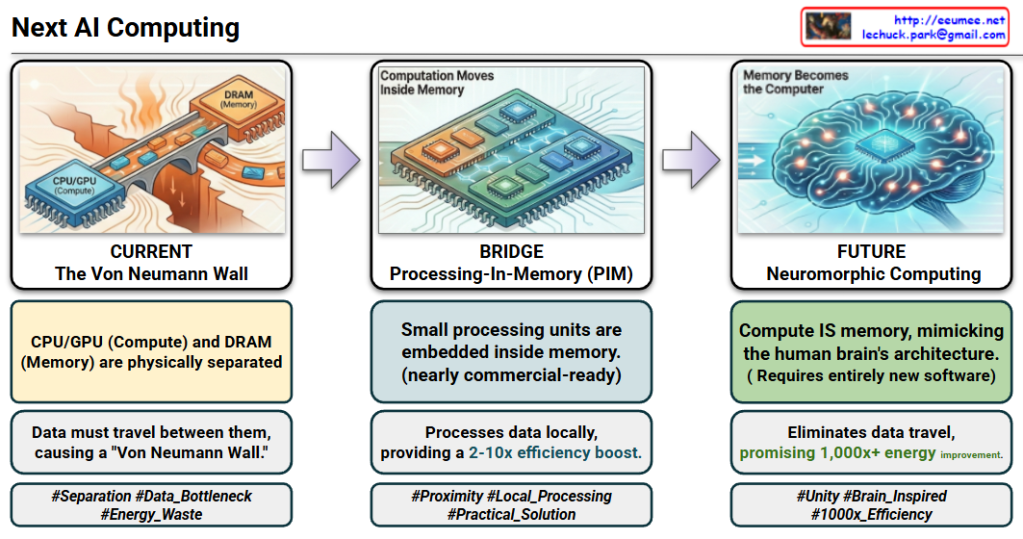
The provided images illustrate the architectural shift in AI computing from the traditional “Separation” model to a “Unified” brain-inspired model, focusing on overcoming energy inefficiency and data bottlenecks.

1. CURRENT: The Von Neumann Wall (Separation)

  • Status: The industry standard today.
  • Structure: Computation (CPU/GPU) and Memory (DRAM) are physically separate.
  • Problem: Constant data movement between components creates a “Von Neumann Wall” (bottleneck).
  • Efficiency: Extremely wasteful; 60-80% of energy is consumed just moving data, not processing it.

2. BRIDGE: Processing-In-Memory (PIM) (Proximity)

  • Status: Practical, near-term solution; nearly commercial-ready.
  • Structure: Small processing units are embedded inside the memory.
  • Benefit: Processes data locally to provide a 2-10x efficiency boost.
  • Primary Use: Ideal for accelerating Large Language Models (LLMs).

3. FUTURE: Neuromorphic Computing (Unity)

  • Status: Future-oriented paradigm shift.
  • Structure: Compute IS memory, mimicking the human brain’s architecture where memory elements perform calculations.
  • Benefit: Eliminates data travel entirely, promising a massive 1,000x+ energy improvement.
  • Requirement: Requires a complete overhaul of current software stacks.
  • Primary Use: Ultra-low power Edge devices and Robotics.

#AIComputing #NextGenAI #VonNeumannWall #PIM #ProcessingInMemory #NeuromorphicComputing #EnergyEfficiency #LLM #EdgeAI #Semiconductor #FutureTech #ComputerArchitecture

With Gemini
AI Cost


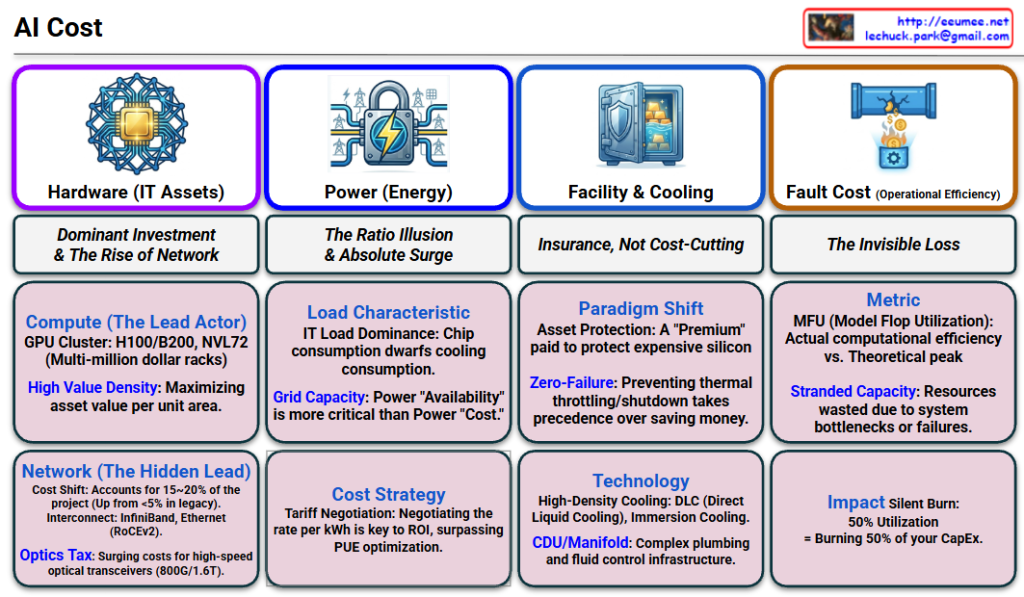
Strategic Analysis of the AI Cost Chart

1. Hardware (IT Assets): “The Investment Core”

  • Icon: A chip embedded in a complex network web.
  • Key Message: The absolute dominant force, consuming ~70% of the total budget.
  • Details:
    • Compute (The Lead): Features GPU clusters (H100/B200, NVL72). These are not just servers; they represent “High Value Density.”
    • Network (The Hidden Lead): No longer just cabling. The cost of Interconnects (InfiniBand/RoCEv2) and Optics (800G/1.6T) has surged to 15~20%, acting as the critical nervous system of the cluster.

2. Power (Energy): “The Capacity War”

  • Icon: An electric grid secured by a heavy lock (representing capacity security).
  • Key Message: A “Ratio Illusion.” While the percentage (~20%) seems stable due to the skyrocketing hardware costs, the absolute electricity bill has exploded.
  • Details:
    • Load Characteristic: The IT Load (Chip power) dwarfs the cooling load.
    • Strategy: The battle is not just about Efficiency (PUE), but about Availability (Grid Capacity) and Tariff Negotiation.

3. Facility & Cooling: “The Insurance Policy”

  • Icon: A vault holding gold bars (Asset Protection).
  • Key Message: Accounting for ~10% of CapEx, this is not an area for cost-cutting, but for “Premium Insurance.”
  • Details:
    • Paradigm Shift: The facility exists to protect the multi-million dollar “Silicon Assets.”
    • Technology: Zero-Failure is the goal. High-density technologies like DLC (Direct Liquid Cooling) and Immersion Cooling are mandatory to prevent thermal throttling.

4. Fault Cost (Operational Efficiency): “The Invisible Loss”

  • Icon: A broken pipe leaking coins (burning money).
  • Key Message: A “Hidden Cost” that determines the actual success or failure of the business.
  • Details:
    • Metric: The core KPI is MFU (Model Flop Utilization).
    • Impact: Any bottleneck (network stall, storage wait) results in “Stranded Capacity.” If utilization drops to 50%, you are effectively engaging in a “Silent Burn” of 50% of your massive CapEx investment.

💡 Architect’s Note

This chart perfectly illustrates “Why we need an AI DC Operating System.”

“Pillars 1, 2, and 3 (Hardware, Power, Facility) represent the massive capital burned during CONSTRUCTION.

Pillar 4 (Fault Cost) is the battleground for OPERATION.”

Your Operating System is the solution designed to plug the leak in Pillar 4, ensuring that the astronomical investments in Pillars 1, 2, and 3 translate into actual computational value.


Summary

The AI Data Center is a “High-Value Density Asset” where Hardware dominates CapEx (~70%), Power dominates OpEx dynamics, and Facility acts as Insurance. However, the Operational System (OS) is the critical differentiator that prevents Fault Cost—the silent killer of ROI—by maximizing MFU.

#AIDataCenter #AIInfrastructure #GPUUnitEconomics #MFU #FaultCost #DataCenterOS #LiquidCooling #CapExStrategy #TechArchitecture
AI Explosion

Analysis of the “AI Explosion” Diagram

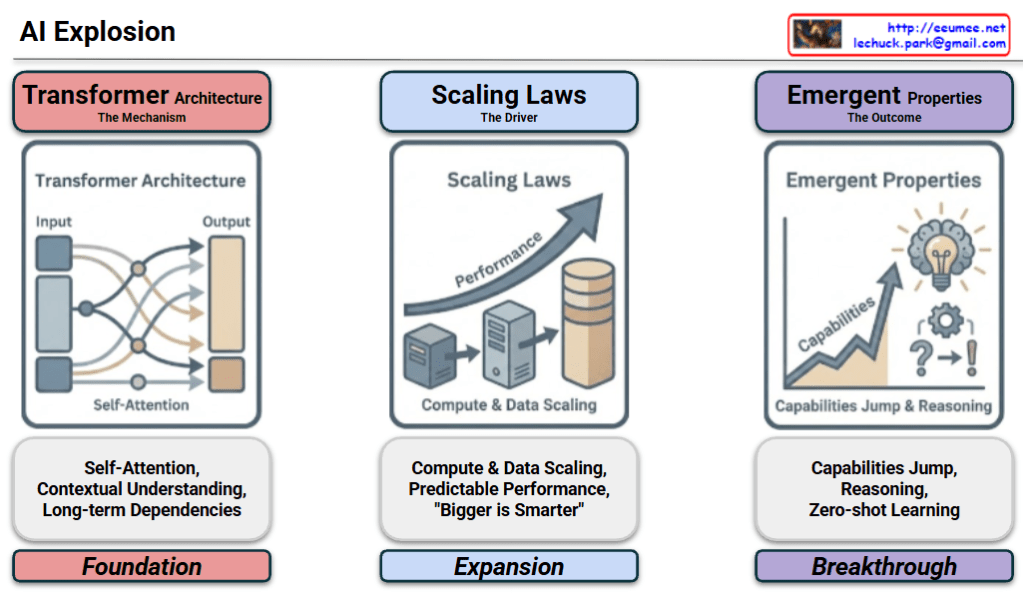
This diagram provides a structured visual narrative of how modern AI (LLM) achieved its rapid advancement, organized into a logical flow: Foundation → Expansion → Breakthrough.

1. The Foundation: Transformer Architecture

  • Role: The Mechanism
  • Analysis: This is the starting point of the explosion. Unlike previous sequential processing models, the “Self-Attention” mechanism allows the AI to grasp context and understand long-term dependencies within data.
  • Significance: It established the technical “container” capable of deeply understanding human language.

2. The Expansion: Scaling Laws

  • Role: The Driver
  • Analysis: This phase represents the massive injection of resources into the established foundation. It follows the principle that performance improves predictably as data and compute power increase.
  • Significance: Driven by the belief that “Bigger is Smarter,” this is the era of quantitative growth where model size and infrastructure were aggressively scaled.

3. The Breakthrough: Emergent Properties

  • Role: The Outcome
  • Analysis: This is where quantitative expansion leads to a qualitative shift. Once the model size crossed a certain threshold, sophisticated capabilities that were not explicitly taught—such as Reasoning and Zero-shot Learning—suddenly appeared.
  • Significance: This marks the “singularity” moment where the system moves beyond simple pattern matching to exhibiting genuine intelligent behaviors.

Summary

The diagram effectively illustrates the causal relationship of AI evolution: The Transformer provided the capability to learn, Scaling Laws amplified that capability through size, and Emergent Properties were the revolutionary outcome of that scale.

#AIExplosion #LLM #TransformerArchitecture #ScalingLaws #EmergentProperties #GenerativeAI #TechTrends

With Gemini
Numeric Data Processing


Architecture Overview

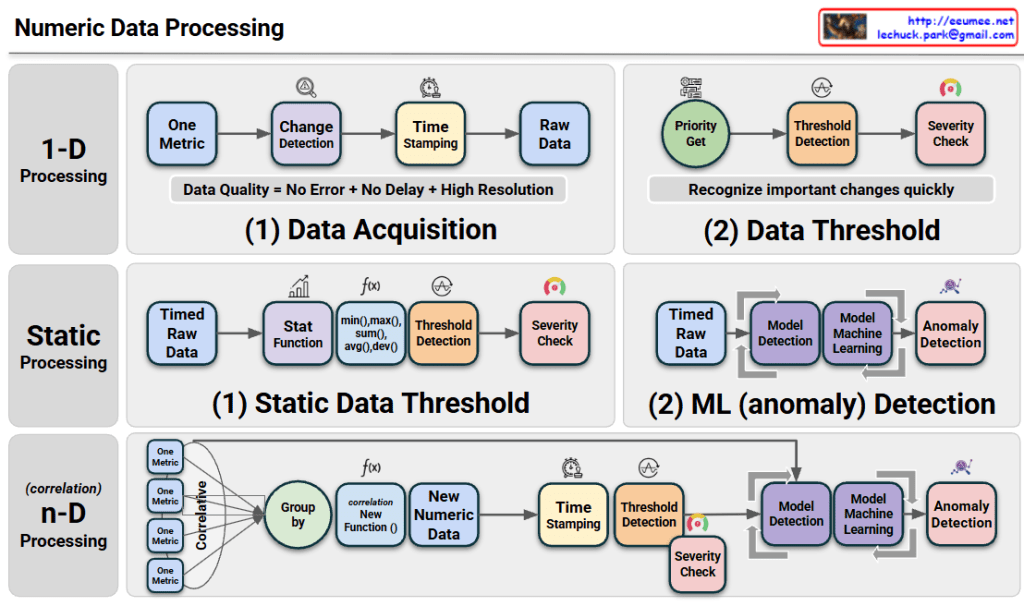
The diagram illustrates a tiered approach to Numeric Data Processing, moving from simple monitoring to advanced predictive analytics:

  • 1-D Processing (Real-time Detection): This layer focuses on individual metrics. It emphasizes high-resolution data acquisition with precise time-stamping to ensure data quality. It uses immediate threshold detection to recognize critical changes as they happen.
  • Static Processing (Statistical & ML Analysis): This stage introduces historical context. It applies statistical functions (like averages and deviations) to identify trends and uses Machine Learning (ML) models to detect anomalies that simple thresholds might miss.
  • n-D Processing (Correlative Intelligence): This is the most sophisticated layer. It groups multiple metrics to find correlations, creating “New Numeric Data” (synthetic metrics). By analyzing the relationship between different data points, it can identify complex root causes in highly interleaved systems.

Summary

  1. The framework transitions from reactive 1-D monitoring to proactive n-D correlation, enhancing the depth of system observability.
  2. It integrates statistical functions and machine learning to filter noise and identify true anomalies based on historical patterns rather than just fixed limits.
  3. The ultimate goal is to achieve high-fidelity data processing that enables automated severity detection and complex pattern recognition across multi-dimensional datasets.

#DataProcessing #AIOps #MachineLearning #Observability #Telemetry #SystemArchitecture #AnomalyDetection #DigitalTwin #DataCenterOps #InfrastructureMonitoring

With Gemini
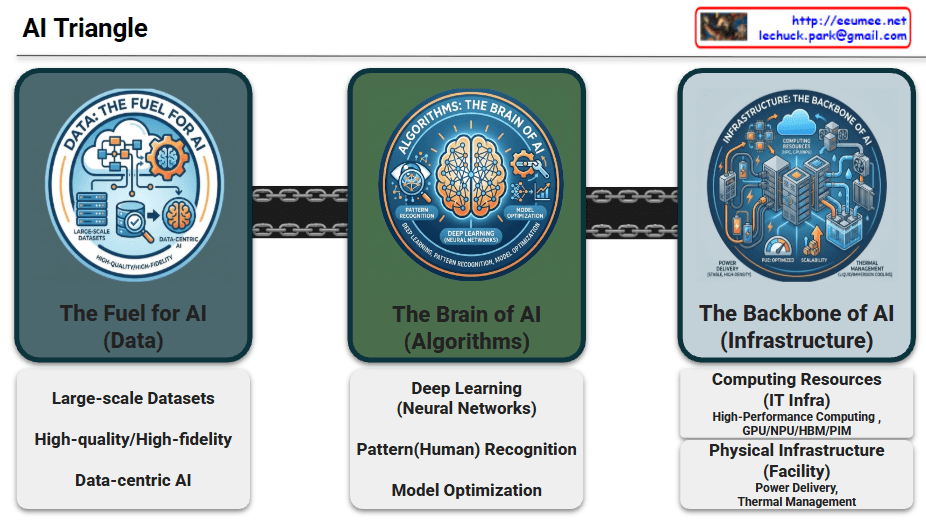
AI Triangle


📐 The AI Triangle: Core Pillars of Evolution

1. Data: The Fuel for AI

Data serves as the essential raw material that determines the intelligence and accuracy of AI models.

  • Large-scale Datasets: Massive volumes of information required for foundational training.
  • High-quality/High-fidelity: The emphasis on clean, accurate, and reliable data to ensure superior model performance.
  • Data-centric AI: A paradigm shift focusing on enhancing data quality rather than just iterating on model code.

2. Algorithms: The Brain of AI

Algorithms provide the logical framework and mathematical structures that allow machines to learn from data.

  • Deep Learning (Neural Networks): Multi-layered architectures inspired by the human brain to process complex information.
  • Pattern Recognition: The ability to identify hidden correlations and make predictions from raw inputs.
  • Model Optimization: Techniques to improve efficiency, reduce latency, and minimize computational costs.

3. Infrastructure: The Backbone of AI

The physical and digital foundation that enables massive computations and ensures system stability.

  • Computing Resources (IT Infra):
    • HPC & Accelerators: High-performance clusters utilizing GPUs, NPUs, and HBM/PIM for parallel processing.
  • Physical Infrastructure (Facilities):
    • Power Delivery: Reliable, high-density power systems including UPS, PDU, and smart energy management.
    • Thermal Management: Advanced cooling solutions like Liquid Cooling and Immersion Cooling to handle extreme heat from AI chips.
    • Scalability & PUE: Focus on sustainable growth and maximizing energy efficiency (Power Usage Effectiveness).

📝 Summary

  1. The AI Triangle represents the vital synergy between high-quality Data, sophisticated Algorithms, and robust Infrastructure.
  2. While data fuels the model and algorithms provide the logic, infrastructure acts as the essential backbone that supports massive scaling and operational reliability.
  3. Modern AI evolution increasingly relies on advanced facility management, specifically optimized power delivery and high-efficiency cooling, to sustain next-generation workloads.

#AITriangle #AIInfrastructure #DataCenter #DeepLearning #GPU #LiquidCooling #DataCentric #Sustainability #PUE #TechArchitecture

With Gemini