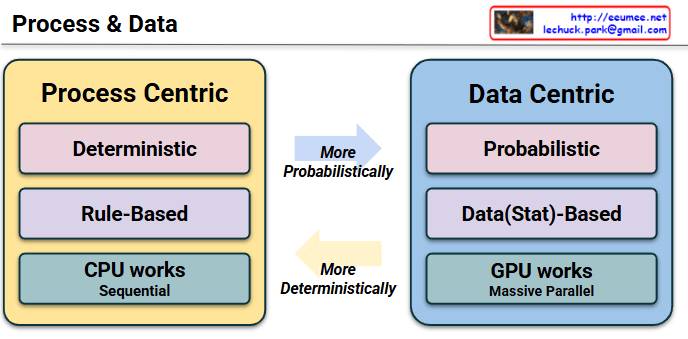
This slide, titled ‘Process & Data’, illustrates the technical differences between traditional computing environments and modern AI/data-centric environments, as well as the organic relationship between the two paradigms.
1. Left: Process Centric Paradigm
First, the yellow area labeled ‘Process Centric’ represents the realm of traditional software engineering that we have utilized for a long time.
- Deterministic: It has a clear structure where identical inputs always yield 100% identical outputs.
- Rule-Based: The system is controlled by algorithms and conditional statements (If-Then) defined in advance by developers.
- CPU works / Sequential: All these processes rely on the sequential processing capabilities of a CPU, which executes instructions one by one in a step-by-step order.
2. Right: Data Centric Paradigm
On the other hand, the blue area labeled ‘Data Centric’ represents the paradigm pursued by modern machine learning, deep learning, and large-scale artificial intelligence (AI) systems.
- Probabilistic: Rather than seeking a 100% perfect definitive answer, it infers the most likely ‘probability’ based on statistical evidence.
- Data(Stat)-Based: Instead of fixed rules, it operates based on statistical patterns discovered by training on massive amounts of real-world data.
- GPU works / Massive Parallel: It fundamentally requires a GPU architecture that performs massive parallel processing using thousands of cores to simultaneously train and infer enormous amounts of data.
3. Center: Paradigm Shift and Interaction (Arrows)
The most notable aspect is the two arrows located in the center. These systems are not isolated; they interact in a mutually complementary way.
- Upward Arrow (More Probabilistically): This signifies the direction of evolving from a traditional rule-based system into a “more probabilistic and flexible” AI-based system (e.g., automation, predictive modeling) by integrating big data and high-performance GPU infrastructure.
- Downward Arrow (More Deterministically): Conversely, this signifies the direction of securing system stability by converting complex and somewhat uncertain AI inference results or statistical data back into clear rules or formalized processes that humans can ultimately control (e.g., applying AI guardrails, cost optimization controls).
[Summary & Implications]
The core message of this slide is that the computing paradigm is expanding from traditional CPU-based, rule-centric computing (Process Centric) to GPU-based, massive data processing and probabilistic inference computing (Data Centric). To build a successful IT infrastructure, it is essential to understand the characteristics of both paradigms and properly connect them in both directions (More Probabilistically ↔ More Deterministically).
#ParadigmShift #DataCentric #ProcessCentric #AIInfrastructure #GPUComputing #ParallelProcessing #CPUvsGPU #ProbabilisticInference #RuleBasedSystem #ITArchitecture #DigitalTransformation
With Gemini