From Von Neumann to Neuromorphic Computing
1. Core Concept
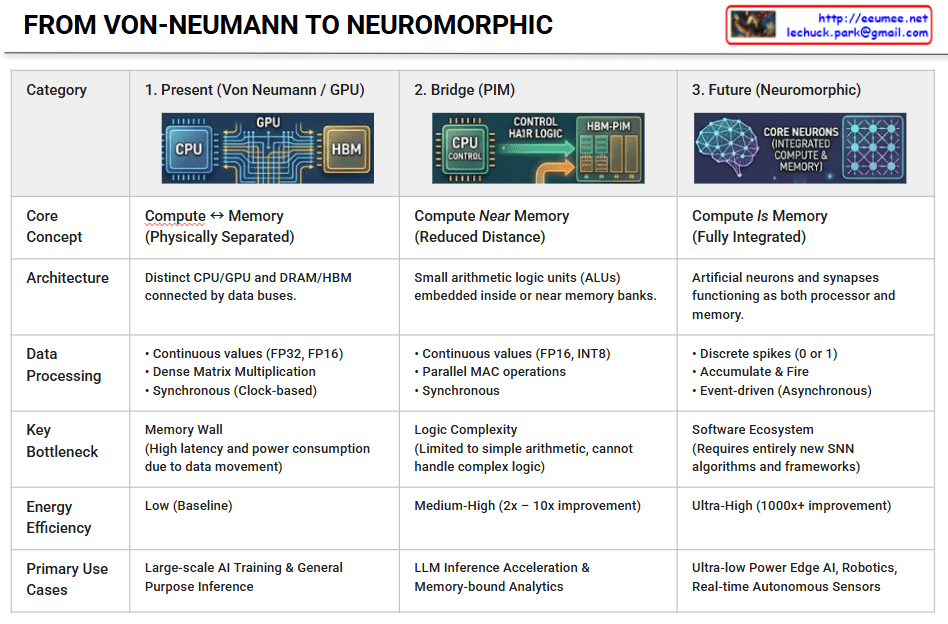
- Present (Von Neumann / GPU): Compute -> Memory (Physically Separated) – Processing units and memory units are distinct and physically separated, requiring constant data transfer.
- Bridge (PIM – Processing-In-Memory): Compute Near Memory (Reduced Distance) – Processing capabilities are brought closer to or inside the memory to drastically minimize data movement distance.
- Future (Neuromorphic): Compute Is Memory (Fully Integrated) – Processing and memory functions are entirely integrated into a single unified structure, mimicking the human brain.
2. Architecture
- Present (Von Neumann / GPU): Composed of distinct CPU/GPU and DRAM/HBM components interconnected via traditional data buses.
- Bridge (PIM): Small arithmetic logic units (ALUs) are embedded directly inside or adjacent to the memory banks.
- Future (Neuromorphic): Built with artificial neurons and synapses that simultaneously function as both processors and memory storage.
3. Data Processing
- Present (Von Neumann / GPU): Processes continuous values (e.g., FP32, FP16) utilizing dense matrix multiplication under a synchronous (clock-based) mechanism.
- Bridge (PIM): Processes continuous values (e.g., FP16, INT8) using parallel MAC (Multiply-Accumulate) operations under a synchronous mechanism.
- Future (Neuromorphic): Processes discrete spikes (0 or 1) using an “Accumulate & Fire” method under an event-driven (asynchronous) mechanism.
4. Key Bottleneck
- Present (Von Neumann / GPU): Memory Wall – High latency and massive power consumption caused by the constant bottleneck of moving data back and forth between the processor and memory.
- Bridge (PIM): Logic Complexity – Restricted to simple arithmetic and operations; struggles to handle highly complex logic tasks natively.
- Future (Neuromorphic): Software Ecosystem – Lacks standard adoption; requires completely new Spiking Neural Network (SNN) algorithms, programming paradigms, and software frameworks.
5. Energy Efficiency
- Present (Von Neumann / GPU): Low (Serves as the baseline).
- Bridge (PIM): Medium-High (2x to 10x improvement compared to the baseline).
- Future (Neuromorphic): Ultra-High (1000x+ improvement compared to the baseline).
6. Primary Use Cases
- Present (Von Neumann / GPU): Large-scale AI model training and general-purpose inference workloads.
- Bridge (PIM): Large Language Model (LLM) inference acceleration and memory-bound big data analytics.
- Future (Neuromorphic): Ultra-low-power Edge AI devices, advanced robotics, and real-time autonomous sensor systems.
Summary
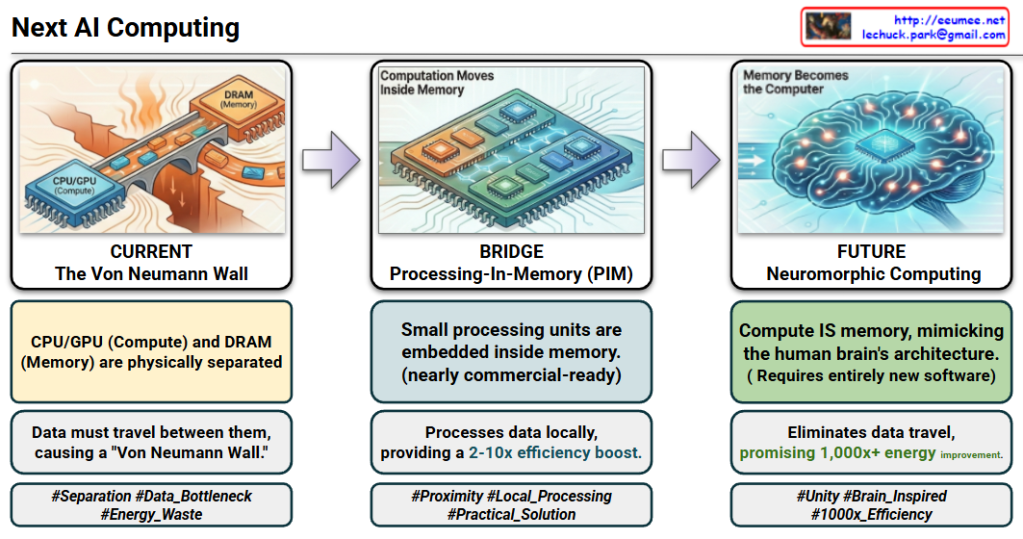
The landscape of computing architecture is shifting from the traditional Von Neumann model to brain-inspired Neuromorphic computing to overcome the critical “Memory Wall” bottleneck. PIM (Processing-In-Memory) serves as an immediate bridge by placing basic computing logic inside memory chips to accelerate data-heavy tasks like LLM inference. Ultimately, the future lies in Neuromorphic architecture, which completely integrates processing and memory using asynchronous, event-driven spikes. This evolution promises an unparalleled leap in energy efficiency (over 1000x), paving the way for autonomous, ultra-low-power intelligent systems at the edge.
#AIHardware #NeuromorphicComputing #ProcessingInMemory #PIM #VonNeumann #GPU #Semiconductor #NextGenTech #EdgeAI #ComputerArchitecture
With Gemini

 Lechuck Park