Ready For AI DC


Ready for AI DC

This slide illustrates the “Preparation and Operation Strategy for AI Data Centers (AI DC).”

In the era of Generative AI and Large Language Models (LLM), it outlines the drastic changes data centers face and proposes a specific three-stage operation strategy (Digitization, Solutions, Operations) to address them.

1. Left Side: AI “Extreme” Changes

Core Theme: AI Data Center for Generative AI & LLM

  • High Cost, High Risk:
    • Establishing and operating AI DCs involves immense costs due to expensive infrastructure like GPU servers.
    • It entails high power consumption and system complexity, leading to significant risks in case of failure.
  • New Techs for AI:
    • Unlike traditional centers, new power and cooling technologies (e.g., high-density racks, immersion cooling) and high-performance computing architectures are essential.

2. Right Side: AI Operation Strategy

Three solutions to overcome the “High Cost, High Risk, and New Tech” environment.

A. Digitization (Securing Data)

  • High Precision, High Resolution: Collecting precise, high-resolution operational data (e.g., second-level power usage, chip-level temperature) rather than rough averages.
  • Computing-Power-Cooling All-Relative Data: Securing integrated data to analyze the tight correlations between IT load (computing), power, and cooling systems.

B. Solutions (Adopting Tools)

  • “Living” Digital Twin: Building a digital twin linked in real-time to the actual data center for dynamic simulation and monitoring, going beyond static 3D modeling.
  • LLM AI Agent: Introducing LLM-based AI agents to assist or automate complex data center management tasks.

C. Operations (Innovating Processes)

  • Integration for Multi/Edge(s): Establishing a unified management system that covers not only centralized centers but also distributed multi-cloud and edge locations.
  • DevOps for the Fast: Applying agile DevOps methodologies to development and operations to adapt quickly to the rapidly changing AI infrastructure.

๐Ÿ’ก Summary & Key Takeaways

The slide suggests that traditional operating methods are unsustainable due to the costs and risks associated with AI workloads.

Success in the AI era requires precisely integrating IT and facility data (Digitization), utilizing advanced technologies like Digital Twins and AI Agents (Solutions), and adopting fast, integrated processes (Operations).


#AIDataCenter #AIDC #GenerativeAI #LLM #DataCenterStrategy #DigitalTwin #DevOps #AIInfrastructure #TechTrends #SmartOperations #EnergyEfficiency #EdgeComputing #AIInnovation

With Gemini

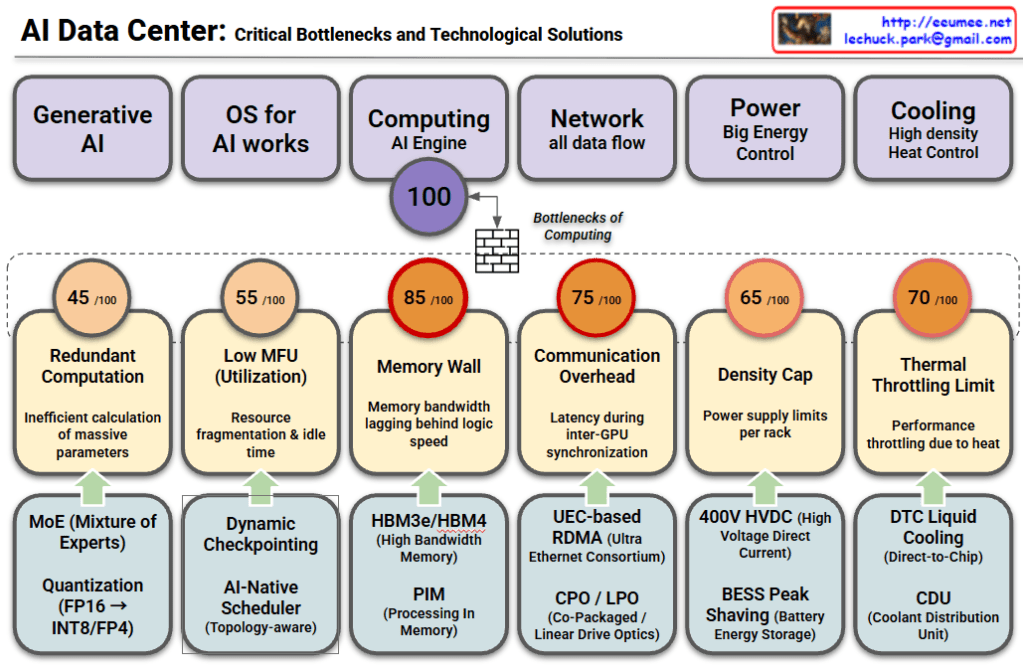
AI Data Center: Critical Bottlenecks and Technological Solutions


AI Data Center: Critical Bottlenecks and Technological Solutions

This chart analyzes the major challenges facing modern AI Data Centers across six key domains. It outlines the [Domain] โ†’ [Bottleneck/Problem] โ†’ [Solution] flow, indicating the severity of each bottleneck with a score out of 100.

1. Generative AI

  • Bottleneck (45/100): Redundant Computation
    • Inefficiencies occur when calculating massive parameters for large models.
  • Solutions:
    • MoE (Mixture of Experts): Uses only relevant sub-models (experts) for specific tasks to reduce computation.
    • Quantization (FP16 โ†’ INT8/FP4): Reduces data precision to speed up processing and save memory.

2. OS for AI Works

  • Bottleneck (55/100): Low MFU (Model Flops Utilization)
    • Issues with resource fragmentation and idle time result in underutilization of hardware.
  • Solutions:
    • Dynamic Checkpointing: Efficiently saves model states during training.
    • AI-Native Scheduler: Optimizes task distribution based on network topology.

3. Computing / AI Engine (Most Critical)

  • Bottleneck (85/100): Memory Wall
    • Marked as the most severe bottleneck, where memory bandwidth cannot keep up with the speed of logic processors.
  • Solutions:
    • HBM3e/HBM4: Next-generation High Bandwidth Memory.
    • PIM (Processing In Memory): Performs calculations directly within memory to reduce data movement.

4. Network

  • Bottleneck (75/100): Communication Overhead
    • Latency issues arise during synchronization between multiple GPUs.
  • Solutions:
    • UEC-based RDMA: Ultra Ethernet Consortium standards for faster direct memory access.
    • CPO / LPO: Advanced optics (Co-Packaged/Linear Drive) to improve data transmission efficiency.

5. Power

  • Bottleneck (65/100): Density Cap
    • Physical limits on how much power can be supplied per server rack.
  • Solutions:
    • 400V HVDC: High Voltage Direct Current for efficient power delivery.
    • BESS Peak Shaving: Using Battery Energy Storage Systems to manage peak power loads.

6. Cooling

  • Bottleneck (70/100): Thermal Throttling Limit
    • Performance drops (throttling) caused by excessive heat in high-density racks.
  • Solutions:
    • DTC Liquid Cooling: Direct-to-Chip liquid cooling technologies.
    • CDU: Coolant Distribution Units for effective heat management.

Summary

  1. The “Memory Wall” (85/100) is identified as the most critical bottleneck in AI Data Centers, meaning memory bandwidth is the primary constraint on performance.
  2. To overcome these limits, the industry is adopting advanced hardware like HBM and Liquid Cooling, alongside software optimizations like MoE and Quantization.
  3. Scaling AI infrastructure requires a holistic approach that addresses computing, networking, power efficiency, and thermal management simultaneously.

#AIDataCenter #ArtificialIntelligence #MemoryWall #HBM #LiquidCooling #GenerativeAI #TechTrends #AIInfrastructure #Semiconductor #CloudComputing

With Gemini

Big Changes with AI

This image illustrates the dramatic growth in computing performance and data throughput from the Internet era to the AI/LLM era.

Key Development Stages

1. Internet Era

  • 10 TWh (terawatt-hours) power consumption
  • 2 PB/day (petabytes/day) data processing
  • 1K DC (1,000 data centers)
  • PUE 3.0 (Power Usage Effectiveness)

2. Mobile & Cloud Era

  • 200 TWh (20x increase)
  • 20,000 PB/day (10,000x increase)
  • 4K DC (4x increase)
  • PUE 1.8 (improved efficiency)

3. AI/LLM (Transformer) Era – “Now Here?” point

  • 400+ TWh (40x additional increase)
  • 1,000,000,000 PB/day = 1 billion PB/day (500,000x increase)
  • 12K DC (12x increase)
  • PUE 1.4 (further improved efficiency)

Summary

The chart demonstrates unprecedented exponential growth in data processing and power consumption driven by AI and Large Language Models. While data center efficiency (PUE) has improved significantly, the sheer scale of computational demands has skyrocketed. This visualization emphasizes the massive infrastructure requirements that modern AI systems necessitate.

#AI #LLM #DataCenter #CloudComputing #MachineLearning #ArtificialIntelligence #BigData #Transformer #DeepLearning #AIInfrastructure #TechTrends #DigitalTransformation #ComputingPower #DataProcessing #EnergyEfficiency