Data with the AI

From Claude with some prompting
the key points from the diagram:

  1. Reality of Internet Open Data:
    • Vast amount of open data exists on the internet including:
      • Mobile device data
      • Email communications
      • Video content
      • Location data
    • This open data is utilized by major AI companies for LLM training
    • Key players:
      • OpenAI’s ChatGPT
      • Anthropic’s Claude
      • Google’s Gemini
      • Meta’s LLaMA
  2. Competition Implications:
    • Competition between LLMs trained on similar internet data
    • “Who Winner?” and “A Winner Takes ALL?” suggests potential monopoly in the base LLM market
    • This refers specifically to models trained on public internet data
  3. Market Outlook:
    • While the base LLM market might be dominated by a few players
    • Private enterprise data remains a key differentiator
    • “Still Differentiated and Competitive” indicates ongoing competition through enterprise-specific data
    • Companies can leverage RAG-like technology to combine their private data with LLMs for unique solutions
  4. Key Implications:
    • Base LLM market (trained on internet data) may be dominated by few winners
    • Enterprise competition remains vibrant through:
      • Unique private data assets
      • RAG integration with base LLMs
      • Company-specific implementations
    • Market likely to evolve into dual structure:
      • Foundation LLMs (based on internet data)
      • Enterprise-specific AI services (leveraging private data)

This structure suggests that while base LLM technology might be dominated by a few players, enterprises can maintain competitive advantage through their unique private data assets and specialized implementations using RAG-like technologies.

This creates a market where companies can differentiate themselves even while using the same foundation models, by leveraging their proprietary data and specific use-case implementations.

personalized RAG

from Claude with some prompting
This diagram illustrates a personalized RAG (Retrieval-Augmented Generation) system that allows individuals to use their personal data with various LLM (Large Language Model) implementations. Key aspects include:

  1. User input: Represented by a person icon and notebook on the left, indicating personal data or queries.
  2. On-Premise storage: Contains LLM models that can be managed and run locally by the user.
  3. Cloud integration: An API connects to cloud-based LLM services, represented by icons in the “on cloud” section. These also symbolize different cloud-based LLM models.
  4. Flexible model utilization: The structure enables users to leverage both on-premise and cloud-based LLM models, allowing for combination of different models’ strengths or selection of the most suitable model for specific tasks.
  5. Privacy protection: A “Control a privacy Filter” icon emphasizes the importance of managing privacy filters to prevent inappropriate exposure of sensitive information to LLMs.
  6. Model selection: The “Use proper Foundation models” icon stresses the importance of choosing appropriate base models for different tasks.

This system empowers individual users to safely manage their data while flexibly utilizing various LLM models, both on-premise and cloud-based. It places a strong emphasis on privacy protection, which is crucial in RAG systems dealing with personal data.

The diagram effectively showcases how personal data can be integrated with advanced LLM technologies while maintaining control over privacy and model selection.

RAG

From Claude with some prompting
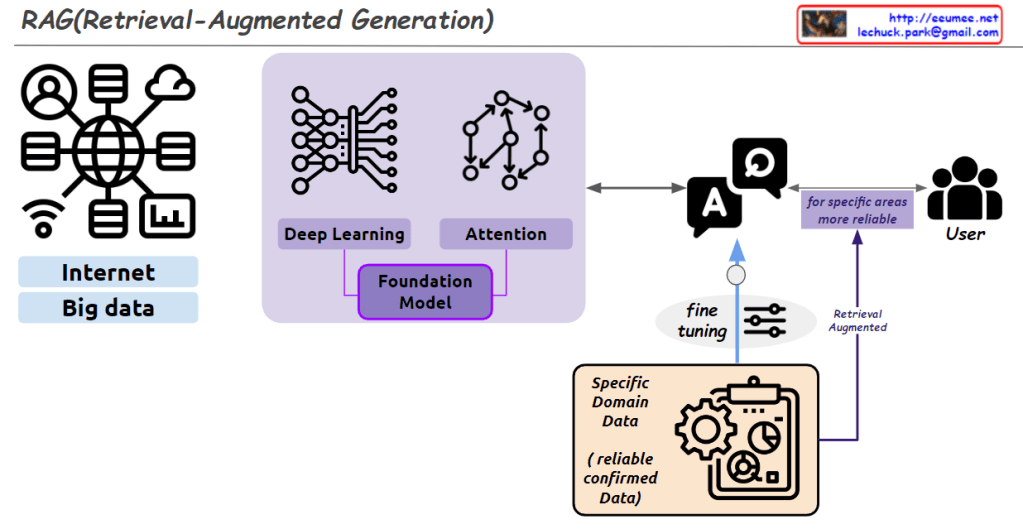
This image explains the concept and structure of the RAG (Retrieval-Augmented Generation) model.

First, a large amount of data is collected from the “Internet” and “Big Data” to train a Foundation Model. This model utilizes Deep Learning and Attention mechanisms.

Next, the Foundation Model is fine-tuned using reliable and confirmed data from a Specific Domain (Specific Domain Data). This process creates a model specialized for that particular domain.

Ultimately, this allows the model to provide more reliable responses to users in that specific area. The overall process is summarized by the concept of Retrieval-Augmented Generation.

The image visually represents the components of the RAG model and the flow of data through the system effectively.