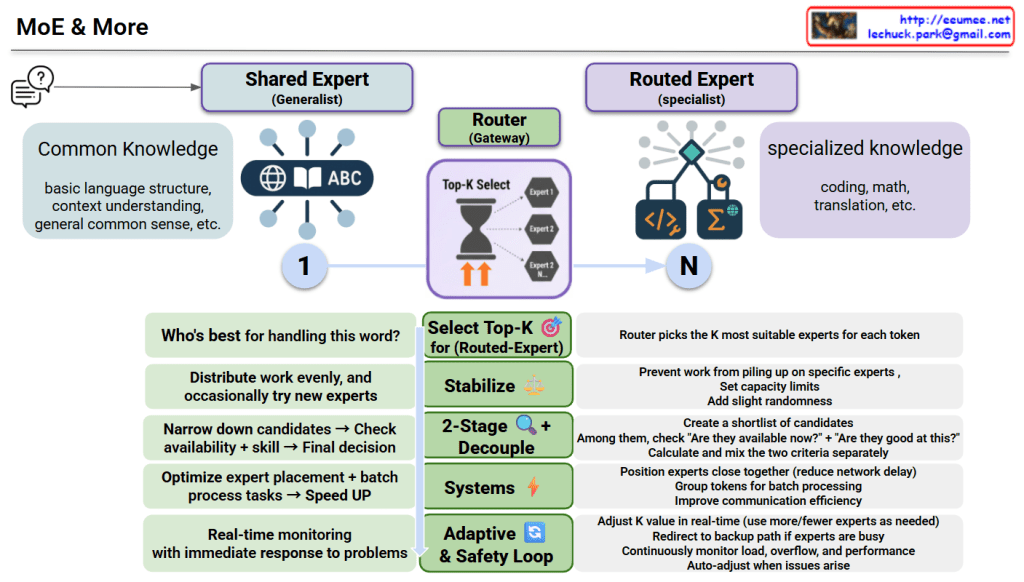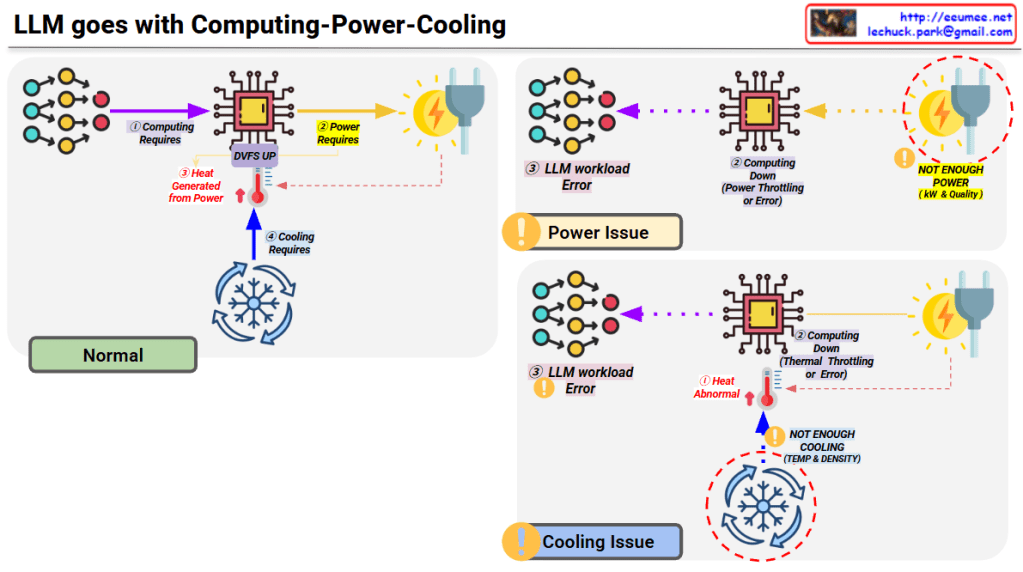
Insights into DeepSeek-V3

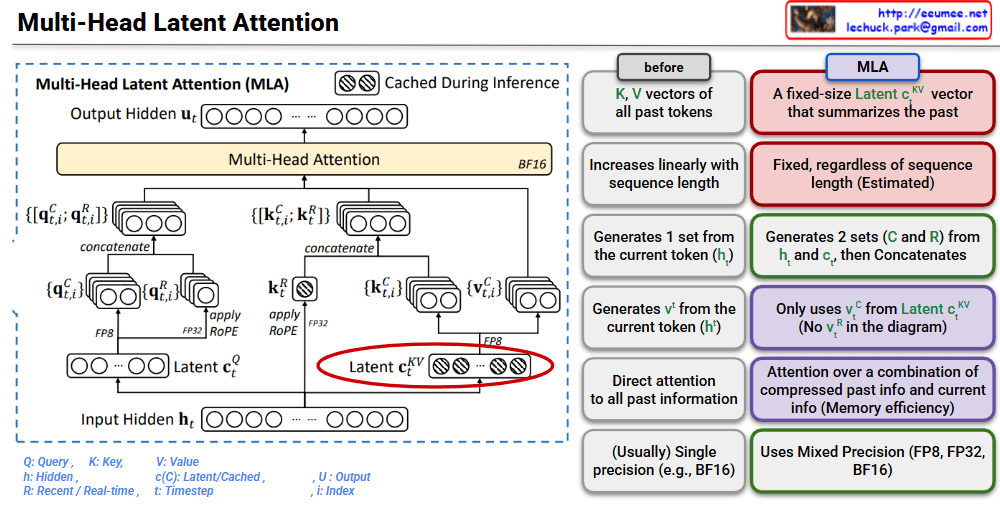
This image presents an insights overview of DeepSeek-V3, highlighting its key technical innovations and architectural features.

Core Technical Components

1. MLA (Multi-Head Latent Attention)

  • Focuses on memory efficiency
  • Processes attention mechanisms through latent representations to reduce memory footprint

2. MoE (Mixture-of-Experts)

  • Enables cost-effective scaling
  • Activates only relevant experts for each input, reducing computational overhead while maintaining performance

3. FP8 Mixed-Precision Training

  • Achieves efficient computation
  • Combines FP8 and FP32 precision levels strategically

4. MTP (Multi-Token Prediction)

  • Enables faster autoregressive inference
  • Predicts multiple tokens simultaneously (“look ahead two or three letters instead of one at a time”)

5. Multi-Plane Network Topology

  • Provides scalable, efficient cluster networking
  • Acts like a multi-lane highway to prevent bottlenecks

Right Panel Technical Details

KV Cache Compression (latent space)

  • Handles long contexts with low memory and fast decoding

Aux-loss-free Load Balancing + Expert Parallel (All-to-All)

  • Reduces FLOPs/costs while maintaining training/inference performance

Weights/Matmul in FP8 + FP32 Accumulation

  • Computes in lightweight units but sums precisely for critical totals (lower memory, bandwidth, compute, stable accuracy)

Predict Multiple Tokens at Once During Training

  • Delivers higher speed and accuracy boosts in benchmarks

2-tier Fat-Tree Γ— Multiple Planes (separated per RDMA-NIC pair)

  • Provides inter-plane congestion isolation, resilience, and reduced cost/latency

Summary

DeepSeek-V3 represents a comprehensive optimization of large language models through innovations in attention mechanisms, expert routing, mixed-precision training, multi-token prediction, and network architecture. These techniques collectively address the three critical bottlenecks: memory, computation, and communication. The result is a highly efficient model capable of scaling to massive sizes while maintaining cost-effectiveness and performance.

#DeepSeekV3 #LLM #MixtureOfExperts #EfficientAI #ModelOptimization #MultiTokenPrediction #FP8Training #LatentAttention #ScalableAI #AIInfrastructure

With Claude

Cooling with AI works

AI Workload Cooling Systems: Bidirectional Physical-Software Optimization

This image summarizes four cutting-edge research studies demonstrating the bidirectional optimization relationship between AI LLMs and cooling systems. It proves that physical cooling infrastructure and software workloads are deeply interconnected.

πŸ”„ Core Concept of Bidirectional Optimization

Direction 1: Physical Cooling β†’ AI Performance Impact

  • Cooling methods directly affect LLM/VLM throughput and stability

Direction 2: AI Software β†’ Cooling Control

  • LLMs themselves act as intelligent controllers for cooling systems

πŸ“Š Research Analysis

1. Physical Cooling Impact on AI Performance (2025 arXiv)

[Cooling HW β†’ AI SW Performance]

  • Experiment: Liquid vs Air cooling comparison on H100 nodes
  • Physical Differences:
    • GPU Temperature: Liquid 41-50Β°C vs Air 54-72Β°C (up to 22Β°C difference)
    • GPU Power Consumption: 148-173W reduction
    • Node Power: ~1kW savings
  • Software Performance Impact:
    • Throughput: 54 vs 46 TFLOPs/GPU (+17% improvement)
    • Sustained and predictable performance through reduced throttling
    • Improved performance/watt (perf/W) ratio

β†’ Physical cooling improvements directly enhance AI workload real-time processing capabilities

2. AI Controls Cooling Systems (2025 arXiv)

[AI SW β†’ Cooling HW Control]

  • Method: Offline Reinforcement Learning (RL) for automated data center cooling control
  • Results: 14-21% cooling energy reduction in 2000-hour real deployment
  • Bidirectional Effects:
    • AI algorithms optimally control physical cooling equipment (CRAC, pumps, etc.)
    • Saved energy β†’ enables more LLM job execution
    • Secured more power headroom for AI computation expansion

β†’ AI software intelligently controls physical cooling to improve overall system efficiency

3. LLM as Cooling Controller (2025 OpenReview)

[AI SW ↔ Cooling HW Interaction]

  • Innovative Approach: Using LLMs as interpretable controllers for liquid cooling systems
  • Simulation Results:
    • Temperature Stability: +10-18% improvement vs RL
    • Energy Efficiency: +12-14% improvement
  • Bidirectional Interaction Significance:
    • LLMs interpret real-time physical sensor data (temperature, flow rate, etc.)
    • Multi-objective trade-off optimization between cooling requirements and energy saving
    • Interpretability: LLM decision-making process is human-understandable
    • Result: Reduced throttling/interruptions β†’ improved AI workload stability

β†’ Complete closed-loop where AI controls physical systems, and results feedback to AI performance

4. Physical Cooling Innovation Enables AI Training (E-Energy’25 PolyU)

[Cooling HW β†’ AI SW Training Stability]

  • Method: Immersion cooling applied to LLM training
  • Physical Benefits:
    • Dramatically reduced fan/CRAC overhead
    • Lower PUE (Power Usage Effectiveness) achieved
    • Uniform and stable heat removal
  • Impact on AI Training:
    • Enables stable long-duration training (eliminates thermal spikes)
    • Quantitative power-delay trade-off optimization per workload
    • Continuous training environment without interruptions

β†’ Advanced physical cooling technology secures feasibility of large-scale LLM training

πŸ” Physical-Software Interdependency Map

β”Œβ”€β”€β”€β”€β”€β”€β”€β”€β”€β”€β”€β”€β”€β”€β”€β”€β”€β”€β”€β”€β”€β”€β”€β”€β”€β”€β”€β”€β”€β”€β”€β”€β”€β”€β”€β”€β”€β”€β”€β”€β”€β”€β”€β”€β”€β”€β”€β”€β”€β”€β”€β”€β”€β”€β”€β”€β”€β”
β”‚              Physical Cooling Systems                    β”‚
β”‚    (Liquid cooling, Immersion, CRAC, Heat exchangers)   β”‚
β””β”€β”€β”€β”€β”€β”€β”€β”€β”€β”€β”€β”€β”€β”€β”¬β”€β”€β”€β”€β”€β”€β”€β”€β”€β”€β”€β”€β”€β”€β”€β”€β”€β”€β”€β”€β”€β”€β”€β”€β”¬β”€β”€β”€β”€β”€β”€β”€β”€β”€β”€β”€β”€β”€β”€β”€β”€β”€β”˜
               ↓                        ↑
        Temp↓ Power↓ Stability↑    AI-based Control
               ↓                   RL/LLM Controllers
β”Œβ”€β”€β”€β”€β”€β”€β”€β”€β”€β”€β”€β”€β”€β”€β”΄β”€β”€β”€β”€β”€β”€β”€β”€β”€β”€β”€β”€β”€β”€β”€β”€β”€β”€β”€β”€β”€β”€β”€β”€β”΄β”€β”€β”€β”€β”€β”€β”€β”€β”€β”€β”€β”€β”€β”€β”€β”€β”€β”
β”‚              AI Workloads (LLM/VLM)                      β”‚
β”‚    Performance↑ Throughput↑ Throttling↓ Training Stability↑│
β””β”€β”€β”€β”€β”€β”€β”€β”€β”€β”€β”€β”€β”€β”€β”€β”€β”€β”€β”€β”€β”€β”€β”€β”€β”€β”€β”€β”€β”€β”€β”€β”€β”€β”€β”€β”€β”€β”€β”€β”€β”€β”€β”€β”€β”€β”€β”€β”€β”€β”€β”€β”€β”€β”€β”€β”€β”€β”€β”€β”˜

πŸ’‘ Key Insights: Bidirectional Optimization Synergy

1. Bottom-Up Influence (Physical β†’ Software)

  • Better cooling β†’ maintains higher clock speeds/throughput
  • Temperature stability β†’ predictable performance, no training interruptions
  • Power efficiency β†’ enables simultaneous operation of more GPUs

2. Top-Down Influence (Software β†’ Physical)

  • AI algorithms provide real-time optimal control of cooling equipment
  • LLM’s interpretable decision-making ensures operational transparency
  • Adaptive cooling strategies based on workload characteristics

3. Virtuous Cycle Effect

Better cooling β†’ AI performance improvement β†’ smarter cooling control
β†’ Energy savings β†’ more AI jobs β†’ advanced cooling optimization
β†’ Sustainable large-scale AI infrastructure

🎯 Practical Implications

These studies demonstrate:

  1. Cooling is no longer passive infrastructure: It’s an active determinant of AI performance
  2. AI optimizes its own environment: Meta-level self-optimizing systems
  3. Hardware-software co-design is essential: Isolated optimization is suboptimal
  4. Simultaneous achievement of sustainability and performance: Synergy, not trade-off

πŸ“ Summary

These four studies establish that next-generation AI data centers must evolve into integrated ecosystems where physical cooling and software workloads interact in real-time to self-optimize. The bidirectional relationshipβ€”where better cooling enables superior AI performance, and AI algorithms intelligently control cooling systemsβ€”creates a virtuous cycle that simultaneously achieves enhanced performance, energy efficiency, and sustainable scalability for large-scale AI infrastructure.

#EnergyEfficiency#GreenAI#SustainableAI#DataCenterOptimization#ReinforcementLearning#AIControl#SmartCooling

With Claude

‘tightly fused’

This illustration visualizes the evolution of data centers, contrasting the traditionally separated components with the modern AI data center where software, compute, network, and crucially, power and cooling systems are ‘tightly fused’ together. It emphasizes how power and advanced cooling are organically intertwined with GPU and memory, directly impacting AI performance and highlighting their inseparable role in meeting the demands of high-performance AI. This tight integration symbolizes a pivotal shift for the modern AI era.

Multi-DCs Operation with a LLM (4)

LLM-Based Multi-Datacenter Operation System

System Architecture

3-Stage Processing Pipeline: Collector β†’ Integrator β†’ Analyst

  • Event collection from various protocols
  • Data normalization through local integrators
  • Intelligent analysis via LLM/AI analyzers
  • RAG data expansion through bottom Data Add-On modules

Core Functions

1. Time-Based Event Aggregation Analysis

  • 60-second intervals (adjustable) for event bundling
  • Comprehensive situational analysis instead of individual alarms
  • LLM queries with predefined prompts

Effectiveness:

  • βœ… Resolves alarm fatigue and enables correlation analysis
  • βœ… Improves operational efficiency through periodic comprehensive reports
  • ⚠️ Potential delay in immediate response to critical issues ( -> Using a legacy/local monitoring system )

2. RAG-Based Data Enhancement

  • Extension data: Metrics, manuals, configurations, maintenance records
  • Reuse of past analysis results as learning data
  • Improved accuracy through domain-specific knowledge accumulation

Effectiveness:

  • βœ… Continuous improvement of analysis quality and increased automation
  • βœ… Systematization of operational knowledge and organizational capability enhancement

Innovative Value

  • Paradigm Shift: Reactive β†’ Predictive/Contextual analysis
  • Operational Burden Reduction: Transform massive alarms into meaningful insights
  • Self-Evolution: Continuous learning system through RAG framework

Executive Summary: This system overcomes the limitations of traditional individual alarm approaches and represents an innovative solution that intelligentizes datacenter operations through time-based event aggregation and LLM analysis. As a self-evolving monitoring system that continuously learns and develops through RAG-based data enhancement, it is expected to dramatically improve operational efficiency and analysis accuracy.

With Claude

LLM Efficiency with a Cooling

This image demonstrates the critical impact of cooling stability on both LLM performance and energy efficiency in GPU servers through benchmark results.

Cascading Effects of Unstable Cooling

Problems with Unstable Air Cooling:

  • GPU Temperature: 54-72Β°C (high and unstable)
  • Thermal throttling occurs – where GPUs automatically reduce clock speeds to prevent overheating, leading to significant performance degradation
  • Result: Double penalty of reduced performance + increased power consumption

Energy Efficiency Impact:

  • Power Consumption: 8.16kW (high)
  • Performance: 46 TFLOPS (degraded)
  • Energy Efficiency: 5.6 TFLOPS/kW (poor performance-to-power ratio)

Benefits of Stable Liquid Cooling

Temperature Stability Achievement:

  • GPU Temperature: 41-50Β°C (low and stable)
  • No thermal throttling β†’ sustained optimal performance

Energy Efficiency Improvement:

  • Power Consumption: 6.99kW (14% reduction)
  • Performance: 54 TFLOPS (17% improvement)
  • Energy Efficiency: 7.7 TFLOPS/kW (38% improvement)

Core Mechanisms: How Cooling Affects Energy Efficiency

  1. Thermal Throttling Prevention: Stable cooling allows GPUs to maintain peak performance continuously
  2. Power Efficiency Optimization: Eliminates inefficient power consumption caused by overheating
  3. Performance Consistency: Unstable cooling can cause GPUs to use 50% of power budget while delivering only 25% performance

Advanced cooling systems can achieve energy savings ranging from 17% to 23% compared to traditional methods. This benchmark paradoxically shows that proper cooling investment dramatically improves overall energy efficiency.

Final Summary

Unstable cooling triggers thermal throttling that simultaneously degrades LLM performance while increasing power consumption, creating a dual efficiency loss. Stable liquid cooling achieves 17% performance gains and 14% power savings simultaneously, improving energy efficiency by 38%. In AI infrastructure, adequate cooling investment is essential for optimizing both performance and energy efficiency.

With Claude

Corpus, Ontology and LLM

This diagram presents a unified framework consisting of three core structures, their interconnected relationships, and complementary utilization as the foundation for LLM advancement.

Three Core Structures

1. Corpus Structure

  • Token-based raw linguistic data
  • Provides statistical language patterns and usage frequency information

2. Ontology Structure

  • Systematically human-defined conceptual knowledge structure
  • Provides logical relationships and semantic hierarchies

3. LLM Structure

  • Neural network-based language processing model
  • Possesses pattern learning and generation capabilities

Interconnected Relationships and Interactions

  • Corpus β†’ Vector Space: Numerical representation transformation of linguistic data
  • Ontology β†’ Basic Concepts: Conceptual abstraction of structured knowledge
  • Vector Space ↔ Ontology: Mutual validation between statistical patterns and logical structures
  • Integrated Concepts β†’ LLM: Multi-layered knowledge input

LLM Development Foundation through Complementary Relationships

Each structure compensates for the limitations of others:

  • Corpus’s statistical accuracy + Ontology’s logical consistency β†’ Balanced knowledge foundation
  • Ontology’s explicit rules + LLM’s pattern learning β†’ Flexible yet systematic reasoning
  • Corpus’s real-usage data + LLM’s generative capability β†’ Natural and accurate language generation

Final Achievement

This triangular complementary structure overcomes the limitations of single approaches to achieve:

  • Error minimization
  • Human-centered reasoning capabilities
  • Intelligent and reliable response generation

This represents the core foundation for next-generation LLM development.

With Claude

Multi-DCs Operation with a LLM(3)

This diagram presents the 3 Core Expansion Strategies for Event Message-based LLM Data Center Operations System.

System Architecture Overview

Basic Structure:

  • Collects event messages from various event protocols (Log, Syslog, Trap, etc.)
  • 3-stage processing pipeline: Collector β†’ Integrator β†’ Analyst
  • Final stage performs intelligent analysis using LLM and AI

3 Core Expansion Strategies

1️⃣ Data Expansion (Data Add On)

Integration of additional data sources beyond Event Messages:

  • Metrics: Performance indicators and metric data
  • Manuals: Operational manuals and documentation
  • Configures: System settings and configuration information
  • Maintenance: Maintenance history and procedural data

2️⃣ System Extension

Infrastructure scalability and flexibility enhancement:

  • Scale Up/Out: Vertical/horizontal scaling for increased processing capacity
  • To Cloud: Cloud environment expansion and hybrid operations

3️⃣ LLM Model Enhancement (More Better Model)

Evolution toward DC Operations Specialized LLM:

  • Prompt Up: Data center operations-specialized prompt engineering
  • Nice & Self LLM Model: In-house development of DC operations specialized LLM model construction and tuning

Strategic Significance

These 3 expansion strategies present a roadmap for evolving from a simple event log analysis system to an Intelligent Autonomous Operations Data Center. Particularly, through the development of in-house DC operations specialized LLM, the goal is to build an AI system that achieves domain expert-level capabilities specifically tailored for data center operations, rather than relying on generic AI tools.

With Claude