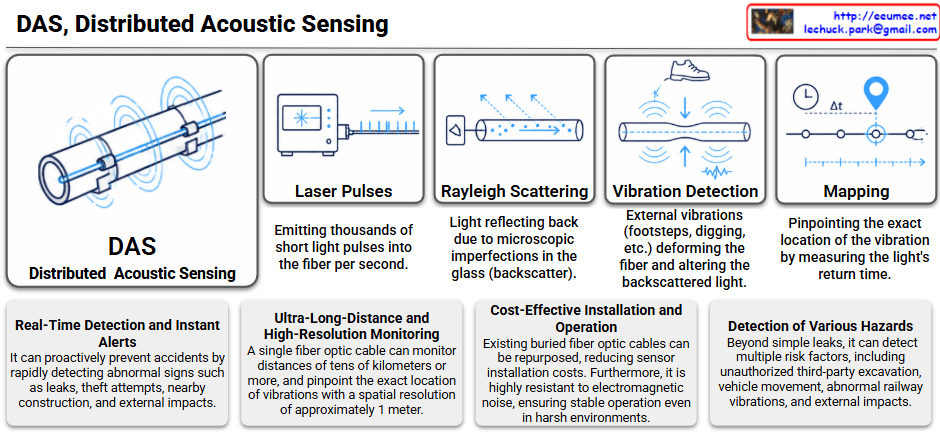
Imagine turning a standard fiber optic cable—the kind buried underground for internet and telecommunications—into a giant, continuous microphone thousands of kilometers long. This is exactly what Distributed Acoustic Sensing (DAS) does. It is a revolutionary technology that monitors environments in real-time, pinpointing disturbances with incredible precision.
How DAS Works: The Step-by-Step Process
- Emitting Laser PulsesThe system begins with a specialized interrogation unit that shoots thousands of short, rapid pulses of laser light down the fiber optic cable every single second.
- Catching Rayleigh ScatteringAs the light travels along the cable, it hits microscopic, natural imperfections inherently present inside the glass fiber. When this happens, a tiny fraction of the light bounces back to the source. This phenomenon is called Rayleigh backscatter. Under normal conditions, this return signal is steady and predictable.
- Detecting Environmental VibrationsWhen an external event occurs nearby—such as someone walking, a machine digging, a pipe leaking, or a train passing by—it creates acoustic waves or physical vibrations. These waves penetrate the ground and subtly deform (stretch or compress) the fiber optic cable. This tiny physical change alters the pattern of the backscattered light at that exact moment.
- Precise Location MappingBy precisely measuring the time delay ($\Delta t$) between sending the laser pulse and receiving the altered reflection back, the system calculates the exact distance along the cable where the disturbance occurred, achieving an accuracy of down to about 1 meter.
Key Benefits of DAS Technology
- Real-Time Prevention: It provides instant alerts for anomalies like leaks, theft, or unauthorized construction, allowing operators to prevent catastrophic accidents before they happen.
- Ultra-Long Range & High Resolution: A single cable can monitor vast distances (tens of kilometers) while maintaining a sharp spatial resolution of 1 meter.
- Cost-Effective & Robust: Because it can utilize existing, already-buried “dark fiber” cables, installation costs are minimal. Additionally, since it relies on light rather than electricity, it is immune to electromagnetic interference and works reliably in harsh environments.
- Versatile Hazard Detection: It is smart enough to distinguish between various types of threats, from third-party illegal excavations and vehicle movements to railway anomalies.
Summary
Distributed Acoustic Sensing (DAS) transforms existing fiber optic cables into hyper-sensitive, long-distance acoustic sensors. By sending laser pulses and analyzing the reflected light (Rayleigh scattering), it detects minute vibrations caused by external events. This allows for real-time, highly accurate, and cost-effective monitoring of critical infrastructure over tens of kilometers.
#DistributedAcousticSensing #DAS #FiberOpticSensor #InfrastructureMonitoring #SmartSensing #RealTimeDetection #RayleighScattering #TechExplanation #AssetProtection
With Gemini


