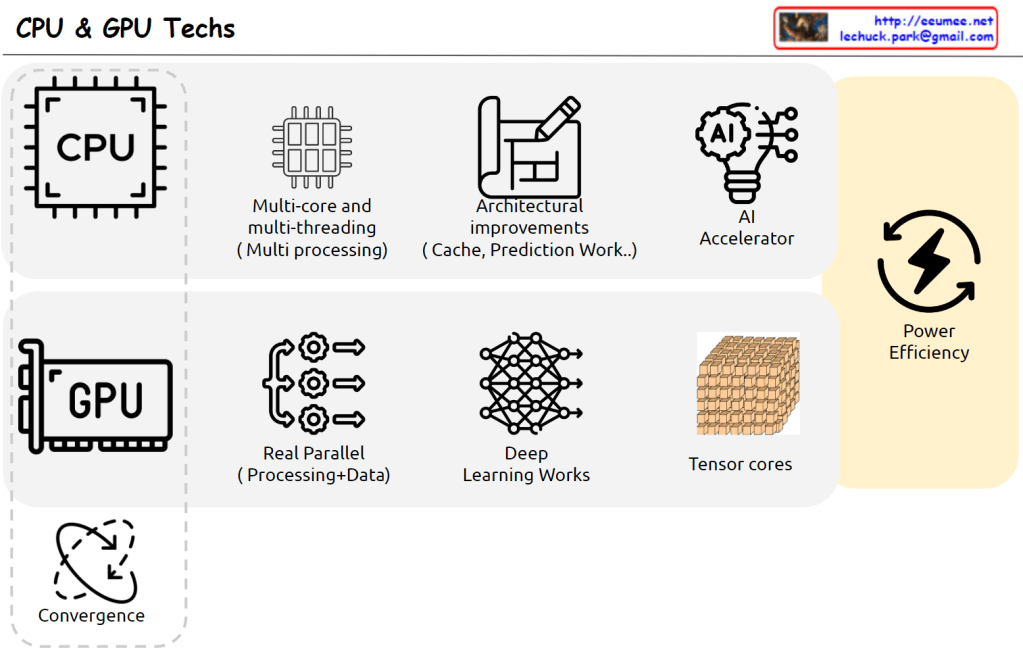
From Claude with some prompting This image outlines the latest trends and developments in CPU and GPU technologies. The key points are:
CPU: It shows advancements in multi-core and multi-threading (multi-processing) capabilities, as well as architectural improvements (cache, prediction work).
GPU: It highlights the improvements in real-time parallel processing and data-centric processing capabilities.
AI Accelerator: Hardware technologies that accelerate AI algorithms are evolving.
Power Efficiency: Improving power efficiency is emerging as an important challenge.
Convergence: The image suggests a trend of convergence and integration between CPUs and GPUs.
Overall, the image presents the evolving directions where CPU and GPU technologies are complementing each other and converging. This is expected to drive improvements in performance and power efficiency.
From Claude with some prompting focusing on the importance of the digital twin-based floor operation optimization system for high-performance computing rooms in AI data centers, emphasizing stability and energy efficiency. I’ll highlight the key elements marked with exclamation points.
Purpose of the system:
Enhance stability
Improve energy efficiency
Optimize floor operations
Key elements (marked with exclamation points):
Interface:
Efficient data collection interface using IPMI, Redis and Nvidia DCGM
Real-time monitoring of high-performance servers and GPUs to ensure stability
Intelligent/Smart PDU:
Precise power usage measurement contributing to energy efficiency
Early detection of anomalies to improve stability
High Resolution under 1 sec:
High-resolution data collection in less than a second enables real-time response
Immediate detection of rapid changes or anomalies to enhance stability
Analysis with AI:
AI-based analysis of collected data to derive optimization strategies
Utilized for predictive maintenance and energy usage optimization
Computing Room Digital Twin:
Virtual replication of the actual computing room for simulation and optimization
Scenario testing for various situations to improve stability and efficiency
This system collects and analyzes data from high-power servers, power distribution units, cooling facilities, and environmental sensors. It optimizes the operation of AI data center computing rooms, enhances stability, and improves energy efficiency.
By leveraging digital twin technology, the system enables not only real-time monitoring but also predictive maintenance, energy usage optimization, and proactive response to potential issues. This leads to improved stability and reduced operational costs in high-performance computing environments.
Ultimately, this system serves as a critical infrastructure for efficient operation of AI data centers, energy conservation, and stable service provision. It addresses the unique challenges of managing high-density, high-performance computing environments, ensuring optimal performance while minimizing risks and energy consumption.
From Claude with some prompting This image illustrates a more comprehensive structure of a new operating system integrated with AI. Here’s a summary of the key changes and features:
Cloud Connectivity: A “Cloud Connected” element has been added, linked to AI Applications. This represents the integration between local AI and cloud-based AI services.
User Data Protection: The “User Data (Private)” section now includes various icons, visualizing the management of different types of user data and emphasizing privacy protection.
New Interface: The Q&A-style “New Interface” is more prominently displayed, highlighting direct interaction between AI and users.
AI Application Integration: AI Applications are closely connected to User Applications, the Inference Model, and User Data.
Hardware Utilization: The GPU (inference) is clearly marked as specialized hardware for AI tasks.
Localized Learning Data: “Learned Data (Localized)” is included as part of the system, indicating the capability to provide personalized AI experiences.
This structure offers several advantages:
Enhanced User Experience: Intuitive interaction through AI-based interfaces
Privacy Protection: Secure management of user data
Hybrid Cloud-Local AI: Balanced use of local processing and cloud resources
Performance Optimization: Efficient AI task processing through GPU
Personalization: Customized AI services using localized learning data
This new OS architecture integrates AI as a core component, seamlessly combining traditional OS functions with advanced AI capabilities to present a next-generation computing environment.
From Claude with some prompting This image titled “AI DC Key” illustrates the key components of an AI data center. Here’s an interpretation of the diagram:
On the left, there’s an icon representing “Massive Data”.
The center showcases four core elements of AI:
“Super Power”
“Super Computing” (utilizing GPU)
“Super Cooling”
“Optimizing Operation”
Below each core element, key considerations are listed:
Super Power: “Nature & Consistent”
Super Computing: “Super Parallel”
Super Cooling: “Liquid Cooling”
Optimizing Operation: “Data driven Auto & AI”
On the right, an icon represents “Analyzed Data”.
The overall flow illustrates the process of massive data being input, processed through the AI core elements, and resulting in analyzed data.
This diagram visualizes the essential components of a modern AI data center and their key considerations. It demonstrates how high-performance computing, efficient power management, advanced cooling technology, and optimized operations effectively process and analyze large-scale data, emphasizing the critical technologies or approaches for each element.
From Claude with some prompting This diagram titled “Computing works with supers” illustrates the structure and operational principles of modern high-performance computing systems. Key features include:
Power Management: The “Making Power” section features a power icon labeled “Super,” indicating the massive power supply required for high-performance computing. This is emphasized by the phrase “Super Energy is required.”
Central Processing Unit (CPU): Responsible for “Making Infra” and “Making Logic,” performing basic computational functions.
Graphics Processing Unit (GPU) and AI: Located below the CPU, the GPU is directly connected to an AI model. The phrase “Delegate work to AI” demonstrates AI’s significant role in handling complex computing tasks.
Heat Management: The diagram shows “Making Super Heat” from the GPU, managed by a “Control It with Cooling” system, highlighting the importance of thermal management.
Integrated Management: The right sidebar groups power, GPU, and cooling systems together, with the caption “Must Manage All connected Supers.” This underscores the interconnectedness of these core elements and the need for integrated management.
System Efficiency: Each major component is labeled “Super,” emphasizing their crucial roles in the high-performance system. This suggests that harmonious management of these elements determines the overall system’s efficiency and performance.
Output: The “Super” human icon at the top right implies that this high-performance system produces exceptional results.
This diagram emphasizes that power management, GPU utilization, heat management, and AI integration are critical in modern high-performance computing. It highlights that efficient integrated management of these elements is key to determining the overall system’s performance and efficiency. Additionally, it suggests the growing importance of AI and automation technologies in effectively managing such complex systems.
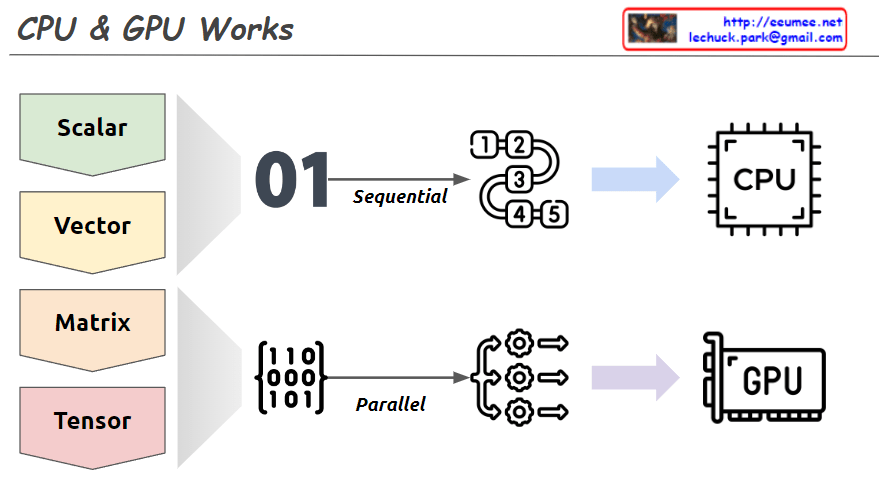
From Claude with some prompting This image explains the working principles of CPU (Central Processing Unit) and GPU (Graphics Processing Unit) in a visual manner.
Data Types:
Scalar: A single value
Vector: One-dimensional array
Matrix: Two-dimensional array
Tensor: Multi-dimensional array
CPU Work Method:
Sequential processing, denoted by ’01’
Tasks are processed in order, as shown by 1, 2, 3, 4, 5
Icons show multiple tasks being processed simultaneously
Mainly deals with multi-dimensional data like matrices or tensors, processing many tasks in parallel
The image demonstrates that while CPUs process tasks sequentially, GPUs can handle many tasks simultaneously in parallel. This helps explain which processing unit is more efficient based on the complexity and volume of data. Complex and large-scale data (matrices, tensors) are better suited for GPUs, while simple, sequential tasks are more appropriate for CPUs.
From Claude with some prompting This image illustrates the internal architecture of the Nvidia H100 GPU. It shows the key components and interconnections within the GPU. A few key points from the image:
The PCIe Gen5 interface connects the H100 GPU to the external system, CPUs, storage devices, an
The NVLink allows interconnecting multiple H100 GPUs, supporting up to 6 NVlink connections with a 900GB/s bandwidth.
The GPU has an internal HBM3 memory of 80GB, which is 2x faster than the previous HBM2 memory.



 Lechuck Park