CPU & GPU Works

From Claude with some prompting
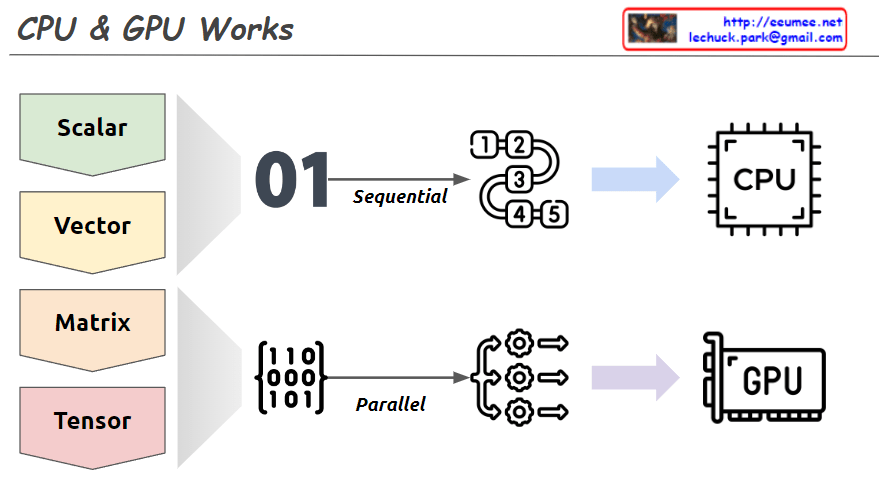
This image explains the working principles of CPU (Central Processing Unit) and GPU (Graphics Processing Unit) in a visual manner.

  1. Data Types:
    • Scalar: A single value
    • Vector: One-dimensional array
    • Matrix: Two-dimensional array
    • Tensor: Multi-dimensional array
  2. CPU Work Method:
    • Sequential processing, denoted by ’01’
    • Tasks are processed in order, as shown by 1, 2, 3, 4, 5
    • Primarily handles scalar data, processing complex tasks sequentially
  3. GPU Work Method:
    • Parallel processing, represented by a matrix
    • Icons show multiple tasks being processed simultaneously
    • Mainly deals with multi-dimensional data like matrices or tensors, processing many tasks in parallel

The image demonstrates that while CPUs process tasks sequentially, GPUs can handle many tasks simultaneously in parallel. This helps explain which processing unit is more efficient based on the complexity and volume of data. Complex and large-scale data (matrices, tensors) are better suited for GPUs, while simple, sequential tasks are more appropriate for CPUs.

Inside H100

From Claude with some prompting
This image illustrates the internal architecture of the Nvidia H100 GPU. It shows the key components and interconnections within the GPU. A few key points from the image:

The PCIe Gen5 interface connects the H100 GPU to the external system, CPUs, storage devices, an

The NVLink allows interconnecting multiple H100 GPUs, supporting up to 6 NVlink connections with a 900GB/s bandwidth.

The GPU has an internal HBM3 memory of 80GB, which is 2x faster than the previous HBM2 memory.

New infra age

From Claude with some prompting
This image illustrates the surge in data and the advancement of AI technologies, particularly parallel processing techniques that efficiently handle massive amounts of data. As a result, there is a growing need for infrastructure technologies that can support such data processing capabilities. Technologies like big data processing, parallel processing, direct memory access, and GPU computing have evolved to meet this demand. The overall flow depicts the data explosion, the advancement of AI and parallel processing techniques, and the evolution of supporting infrastructure technologies.

CPU,FPGA,ASIC

From Claude with some prompting
The CPU is described as a central processing unit for general-purpose computing, handling diverse tasks with high performance but at a low cost/price ratio.

This image provides an overview of different types of processors and their key characteristics. It compares CPUs, ASICs (Application-Specific Integrated Circuits), FPGAs (Field-Programmable Gate Arrays), and GPUs (Graphics Processing Units).

The ASIC is an application-specific integrated circuit designed for specific tasks like cryptography and AI. It has low performance per price but is highly optimized for its intended use cases.

The FPGA is a reconfigurable processor that allows design changes and prototyping. It has medium performance per price and is suitable for data processing sequences.

The GPU is designed for graphic processing and parallel data processing. It excels at high-performance computing for graphics-intensive applications, but has a medium to high cost/price ratio.

The image highlights the key differences in terms of processing capability, specialization, reconfigurability, performance, and cost among these processor types.

GPU works for

From ChatGPT with some prompting
The image is a schematic representation of GPU applications across three domains, emphasizing the GPU’s strength in parallel processing:

Image Processing: GPUs are employed to perform parallel updates on image data, which is often in matrix form, according to graphical instructions, enabling rapid rendering and display of images.

Blockchain Processing: For blockchain, GPUs accelerate the calculation of new transaction hashes and the summing of existing block hashes. This is crucial in the race of mining, where the goal is to compute new block hashes as efficiently as possible.

Deep Learning Processing: In deep learning, GPUs are used for their ability to process multidimensional data, like tensors, in parallel. This speeds up the complex computations required for neural network training and inference.

A common thread across these applications is the GPU’s ability to handle multidimensional data structures—matrices and tensors—in parallel, significantly speeding up computations compared to sequential processing. This parallelism is what makes GPUs highly effective for a wide range of computationally intensive tasks.

Processing UNIT

From DALL-E With some prompting

Processing Unit

  • CPU (Central Processing Unit): Central / General
    • Cache/Control Unit (CU)/Arithmetic Logic Unit (ALU)/Pipeline
  • GPU (Graphics Processing Unit): Graphic
    • Massive Parallel Architecture
    • Stream Processor & Texture Units and Render Output Units
  • NPU (Neural Processing Unit): Neural (Matrix Computation)
    • Specialized Computation Units
    • High-Speed Data Transfer Paths
    • Parallel Processing Structure
  • DPU (Data Processing Unit): Data
    • Networking Capabilities & Security Features
    • Storage Processing Capabilities
    • Virtualization Support
  • TPU (Tensor Processing Unit): Tensor
    • Tensor Cores
    • Large On-Chip Memory
    • Parallel Data Paths

Additional Information:

  • NPU and TPU are differentiated by their low power, specialized AI purpose.
  • TPU is developed by Google for large AI models in big data centers and features large on-chip memory.

The diagram emphasizes the specialized nature of NPU and TPU for AI tasks, highlighting their low power consumption and specialized computation capabilities, particularly for neural and tensor computations. It also contrasts these with the more general-purpose capabilities of CPUs and the graphic processing orientation of GPUs. DPU is presented as specialized for handling data-centric tasks involving networking, security, and storage in virtualized environments.

Video/Matrix processing

From DALL-E with some prompting
The image highlights the system configuration for graphics-intensive tasks like video processing, emphasizing the use of a dedicated PCIe route instead of the CPU’s general bus for data transmission. This enables the GPU to quickly process image and matrix data in parallel. The direct access provided by the PCIe interface offers a data transfer speed range from 250MB to 1GB/s and more, significantly accelerating machine learning (ML) data processing. This setup provides an optimized pathway not only for rapid video processing but also for data-intensive tasks such as ML.