Infiniband vs RoCE v2

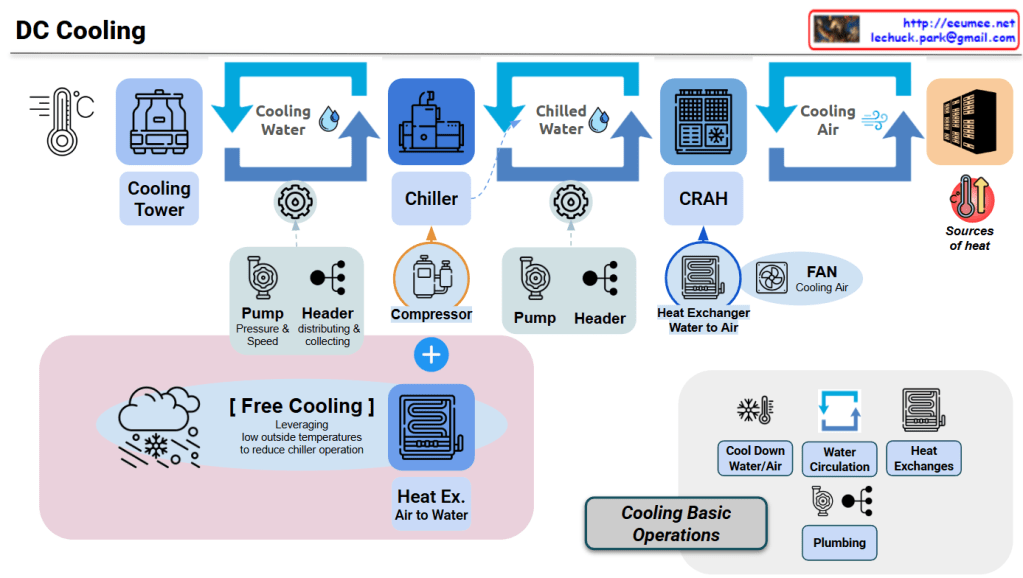
This image provides a technical comparison between InfiniBand and RoCE v2 (RDMA over Converged Ethernet), the two dominant networking protocols used in modern AI data centers and High-Performance Computing (HPC) environments.


1. Architectural Philosophy

  • InfiniBand (Dedicated Hardware): Designed from the ground up specifically for high-throughput, low-latency communication. It is a proprietary ecosystem largely driven by NVIDIA (Mellanox).
  • RoCE v2 (General-Purpose + Optimization): An evolution of standard Ethernet designed to bring RDMA (Remote Direct Memory Access) capabilities to traditional network infrastructures. It is backed by the Open Consortium.

2. Hardware vs. Software Logic

  • Hardwired ASIC (InfiniBand): The protocol logic is baked directly into the silicon. This “Native” approach ensures consistent performance with minimal jitter.
  • Firmware & OS Dependent (RoCE v2): Relies more heavily on the NIC’s firmware and operating system configurations, making it more flexible but potentially more complex to stabilize.

3. Data Transfer Efficiency

  • Ultra-low Latency (InfiniBand): Utilizes Cut-through switching, where the switch starts forwarding the packet as soon as the destination address is read, without waiting for the full packet to arrive.
  • Encapsulation Overhead (RoCE v2): Because it runs on Ethernet, it must wrap RDMA data in UDP/IP/Ethernet headers. This adds “overhead” (extra data bits) and processing time compared to the leaner InfiniBand frames.

4. Reliability and Loss Management

  • Lossless by Design (InfiniBand): It uses a credit-based flow control mechanism at the hardware level, ensuring that a sender never transmits data unless the receiver has room to buffer it. This guarantees zero packet loss.
  • Tuning-Dependent (RoCE v2): Ethernet is natively “lossy.” To make RoCE v2 work effectively, the network must be “Converged” using complex features like PFC (Priority Flow Control) and ECN (Explicit Congestion Notification). Without precise tuning, performance can collapse during congestion.

5. Network Management

  • Subnet Manager (InfiniBand): Uses a centralized “Subnet Manager” to discover the topology and manage routing, which simplifies the management of massive GPU clusters.
  • Distributed Control (RoCE v2): Functions like a traditional IP network where routing and control are distributed across the switches and routers.

Comparison Summary

FeatureInfiniBandRoCE v2
Primary DriverPerformance & StabilityCost-effectiveness & Compatibility
ComplexityPlug-and-play (within IB ecosystem)Requires expert-level network tuning
LatencyAbsolute LowestLow (but higher than IB)
ScalabilityHigh (specifically for AI/HPC)High (standard Ethernet scalability)

Design & Logic: InfiniBand is a dedicated, hardware-native solution for ultra-low latency, whereas RoCE v2 adapts general-purpose Ethernet for RDMA through software-defined optimization and firmware.

Efficiency & Reliability: InfiniBand is “lossless by design” with minimal overhead via cut-through switching, while RoCE v2 incurs encapsulation overhead and requires precise network tuning to prevent packet loss.

Control & Management: InfiniBand utilizes centralized hardware-level management (Subnet Manager) for peak stability, while RoCE v2 relies on distributed software-level control over standard UDP/IP/Ethernet stacks.

#InfiniBand #RoCEv2 #RDMA #AIDataCenter #NetworkingArchitecture #NVIDIA #HighPerformanceComputing #GPUCluster #DataCenterDesign #Ethernet #AITraining
Externals of Modular DC

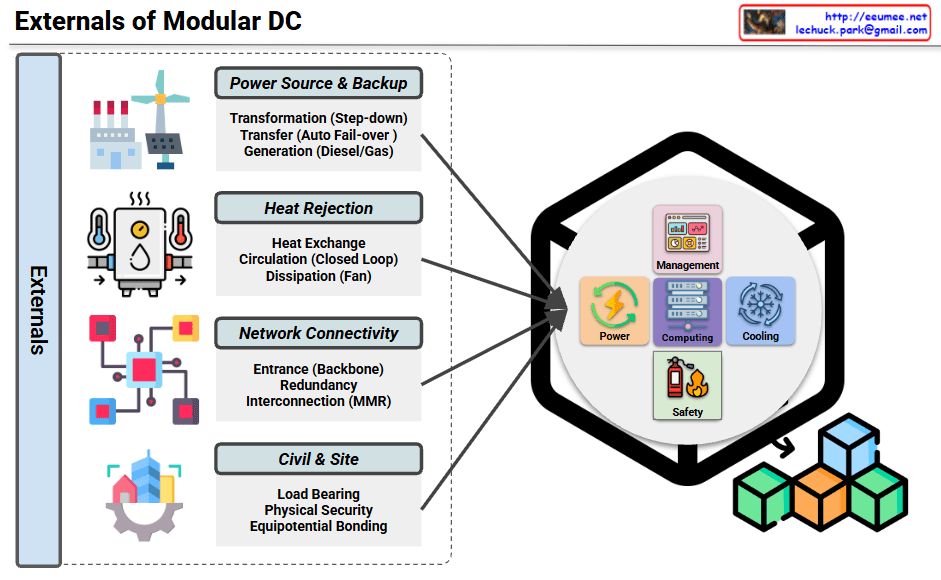
Externals of Modular DC Infrastructure

This diagram illustrates the external infrastructure systems that support a Modular Data Center (Modular DC).

Main Components

1. Power Source & Backup

  • Transformation (Step-down transformer)
  • Transfer switch (Auto Fail-over)
  • Generation (Diesel/Gas generators)

Ensures stable power supply and emergency backup capabilities.

2. Heat Rejection

  • Heat Exchange equipment
  • Circulation system (Closed Loop)
  • Dissipation system (Fan-based)

Cooling infrastructure that removes heat generated from the data center to the outside environment.

3. Network Connectivity

  • Entrance (Backbone connection)
  • Redundancy configuration
  • Interconnection (MMR – Meet Me Room)

Provides connectivity and telecommunication infrastructure with external networks.

4. Civil & Site

  • Load Bearing structures
  • Physical Security facilities
  • Equipotential Bonding

Handles building foundation and physical security requirements.

Internal Management Systems

The module integrates the following management elements:

  • Management: Integrated control system
  • Power: Power management
  • Computing: Computing resource management
  • Cooling: Cooling system control
  • Safety: Safety management

Summary

Modular data centers require four critical external infrastructure systems: power supply with backup generation, heat rejection for thermal management, network connectivity for communications, and civil/site infrastructure for physical foundation and security. These external systems work together to support the internal management components (power, computing, cooling, and safety) within the modular unit. This architecture enables rapid deployment while maintaining enterprise-grade reliability and scalability.

#ModularDataCenter #DataCenterInfrastructure #DCInfrastructure #EdgeComputing #HybridIT #DataCenterDesign #CriticalInfrastructure #PowerBackup #CoolingSystem #NetworkRedundancy #PhysicalSecurity #ModularDC #DataCenterSolutions #ITInfrastructure #EnterpriseIT

With Claude

Modular Data Center

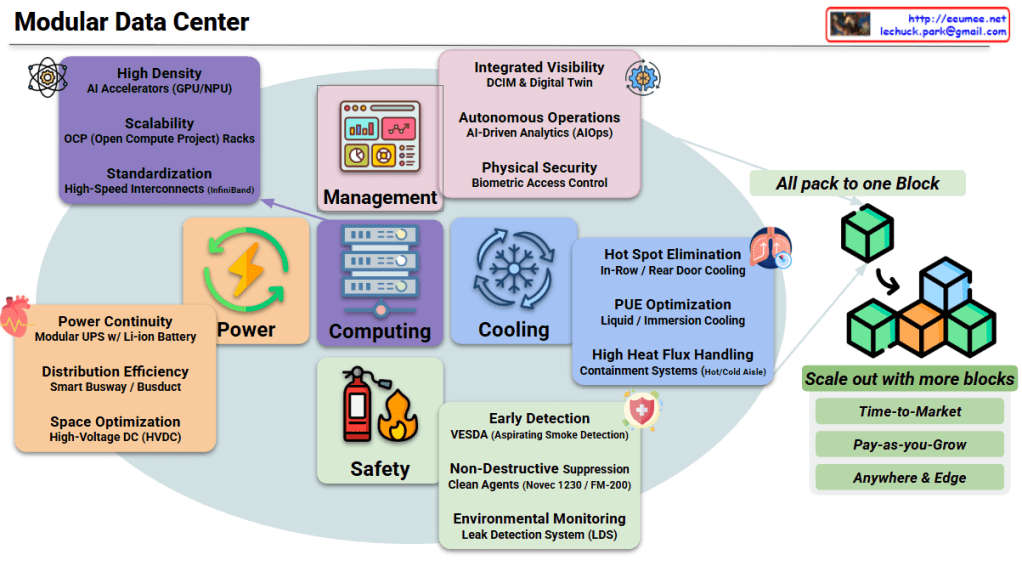
Modular Data Center Architecture Analysis

This image illustrates a comprehensive Modular Data Center architecture designed specifically for modern AI/ML workloads, showcasing integrated systems and their key capabilities.

Core Components

1. Management Layer

  • Integrated Visibility: DCIM & Digital Twin for real-time monitoring
  • Autonomous Operations: AI-Driven Analytics (AIOps) for predictive maintenance
  • Physical Security: Biometric Access Control for enhanced protection

2. Computing Infrastructure

  • High Density AI Accelerators: GPU/NPU optimized for AI workloads
  • Scalability: OCP (Open Compute Project) Racks for standardized deployment
  • Standardization: High-Speed Interconnects (InfiniBand) for low-latency communication

3. Power Systems

  • Power Continuity: Modular UPS with Li-ion Battery for reliable uptime
  • Distribution Efficiency: Smart Busway/Busduct for optimized power delivery
  • Space Optimization: High-Voltage DC (HVDC) for reduced footprint

4. Cooling Solutions

  • Hot Spot Elimination: In-Row/Rear Door Cooling for targeted heat removal
  • PUE Optimization: Liquid/Immersion Cooling for maximum efficiency
  • High Heat Flux Handling: Containment Systems (Hot/Cold Aisle) for AI density

5. Safety & Environmental

  • Early Detection: VESDA (Very Early Smoke Detection Apparatus)
  • Non-Destructive Suppression: Clean Agents (Novec 1230/FM-200)
  • Environmental Monitoring: Leak Detection System (LDS)

Why Modular DC is Critical for AI Data Centers

Speed & Agility

Traditional data centers take 18-24 months to build, but AI demands are exploding NOW. Modular DCs deploy in 3-6 months, allowing organizations to capture market opportunities and respond to rapidly evolving AI compute requirements without lengthy construction cycles.

AI-Specific Thermal Challenges

AI workloads generate 3-5x more heat per rack (30-100kW) compared to traditional servers (5-10kW). Modular designs integrate advanced liquid cooling and containment systems from day one, purpose-built to handle GPU/NPU thermal density that would overwhelm conventional infrastructure.

Elastic Scalability

AI projects often start experimental but can scale exponentially. The “pay-as-you-grow” model lets organizations deploy one block initially, then add capacity incrementally as models grow—avoiding massive upfront capital while maintaining consistent architecture and avoiding stranded capacity.

Edge AI Deployment

AI inference increasingly happens at the edge for latency-sensitive applications (autonomous vehicles, smart manufacturing). Modular DCs’ compact, self-contained design enables AI deployment anywhere—from remote locations to urban centers—with full data center capabilities in a standardized package.

Operational Efficiency

AI workloads demand maximum PUE efficiency to manage operational costs. Modular DCs achieve PUE of 1.1-1.3 through integrated cooling optimization, HVDC power distribution, and AI-driven management—versus 1.5-2.0 in traditional facilities—critical when GPU clusters consume megawatts.

Key Advantages

📦 “All pack to one Block” – Complete infrastructure in pre-integrated modules 🧩 “Scale out with more blocks” – Linear, predictable expansion without redesign

  • ⏱️ Time-to-Market: 4-6x faster deployment vs traditional builds
  • 💰 Pay-as-you-Grow: CapEx aligned with revenue/demand curves
  • 🌍 Anywhere & Edge: Containerized deployment for any location

Summary

Modular Data Centers are essential for AI infrastructure because they deliver pre-integrated, high-density compute, power, and cooling blocks that deploy 4-6x faster than traditional builds, enabling organizations to rapidly scale GPU clusters from prototype to production while maintaining optimal PUE efficiency and avoiding massive upfront capital investment in uncertain AI workload trajectories.

The modular approach specifically addresses AI’s unique challenges: extreme thermal density (30-100kW/rack), explosive demand growth, edge deployment requirements, and the need for liquid cooling integration—all packaged in standardized blocks that can be deployed anywhere in months rather than years.

This architecture transforms data center infrastructure from a multi-year construction project into an agile, scalable platform that matches the speed of AI innovation, allowing organizations to compete in the AI economy without betting the company on fixed infrastructure that may be obsolete before completion.


#ModularDataCenter #AIInfrastructure #DataCenterDesign #EdgeComputing #LiquidCooling #GPUComputing #HyperscaleAI #DataCenterModernization #AIWorkloads #GreenDataCenter #DCInfrastructure #SmartDataCenter #PUEOptimization #AIops #DigitalTwin #EdgeAI #DataCenterInnovation #CloudInfrastructure #EnterpriseAI #SustainableTech

With Claude

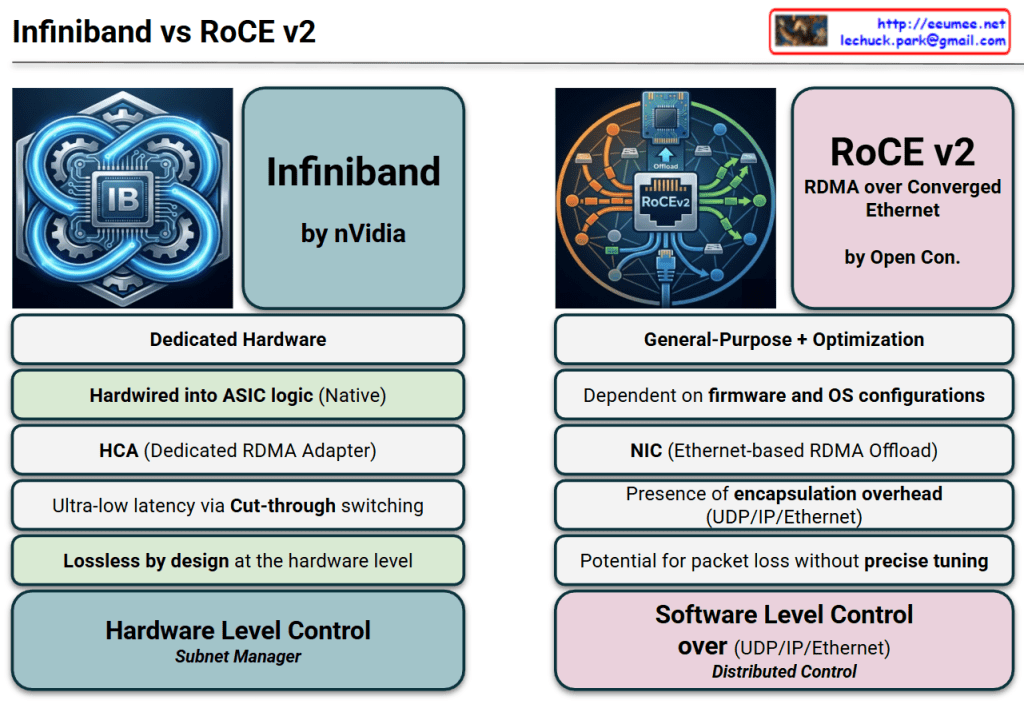
DC Cooling (R)

Data Center Cooling System Core Structure

This diagram illustrates an integrated data center cooling system centered on chilled water/cooling water circulation and heat exchange.

Core Cooling Circulation Structure

Primary Loop: Cooling Water Loop

Cooling Tower → Cooling Water → Chiller → (Heat Exchange) → Cooling Tower

  • Cooling Tower: Dissipates heat from cooling water to atmosphere using outdoor air
  • Pump/Header: Controls cooling water pressure and flow rate through circulation pipes
  • Heat Exchange in Chiller: Cooling water exchanges heat with refrigerant to cool the refrigerant

Secondary Loop: Chilled Water Loop

Chiller → Chilled Water → CRAH → (Heat Exchange) → Chiller

  • Chiller: Generates chilled water (7-12°C) through compressor and refrigerant cycle
  • Pump/Header: Circulates chilled water to CRAH units and returns it back
  • Heat Exchange in CRAH: Chilled water exchanges heat with air to cool the air

Tertiary Loop: Cooling Air Loop

CRAH → Cooling Air → Servers → Hot Air → CRAH

  • CRAH (Computer Room Air Handler): Generates cooling air through water-to-air heat exchanger
  • FAN: Forces circulation of cooling air throughout server room
  • Heat Absorption: Air absorbs server heat and returns to CRAH

Heat Exchange Critical Points

Heat Exchange #1: Inside Chiller

  • Cooling Water ↔ Refrigerant: Transfers refrigerant heat to cooling water in condenser
  • Refrigerant ↔ Chilled Water: Absorbs heat from chilled water to refrigerant in evaporator

Heat Exchange #2: CRAH

  • Chilled Water ↔ Air: Transfers air heat to chilled water in water-to-air heat exchanger
  • Chilled water temperature rises → Returns to chiller

Heat Exchange #3: Server Room

  • Hot Air ↔ Servers: Air absorbs heat from servers
  • Temperature-increased air → Returns to CRAH

Energy Efficiency: Free Cooling

Low-Temperature Outdoor Air → Air-to-Water Heat Exchanger → Chilled Water Cooling → Reduced Chiller Load

  • Condition: When outdoor temperature is sufficiently low
  • Effect: Reduces chiller operation and compressor power consumption (up to 30-50%)
  • Method: Utilizes natural cooling through cooling tower or dedicated heat exchanger

Cooling System Control Elements

Cooling Basic Operations Components:

  • Cool Down: Controls water/air temperature reduction
  • Water Circulation: Adjusts flow rate through pump speed/pressure control
  • Heat Exchanges: Optimizes heat exchanger efficiency
  • Plumbing: Manages circulation paths and pressure loss

Heat Flow Summary

Server Heat → Air → CRAH (Heat Exchange) → Chilled Water → Chiller (Heat Exchange) → 
Cooling Water → Cooling Tower → Atmospheric Discharge


Summary

This system efficiently removes server heat to the outdoor atmosphere through three cascading circulation loops (air → chilled water → cooling water) and three strategic heat exchange points (CRAH, Chiller, Cooling Tower). Free cooling optimization reduces energy consumption by up to 50% when outdoor conditions permit. The integrated pump/header network ensures precise flow control across all loops for maximum cooling efficiency.


#DataCenterCooling #ChilledWater #CRAH #FreeCooling #HeatExchange #CoolingTower #ThermalManagement #DataCenterInfrastructure #EnergyEfficiency #HVACSystem #CoolingLoop #WaterCirculation #ServerCooling #DataCenterDesign #GreenDataCenter

With Claude