Personal(User/Expert) Data Service

System Overview

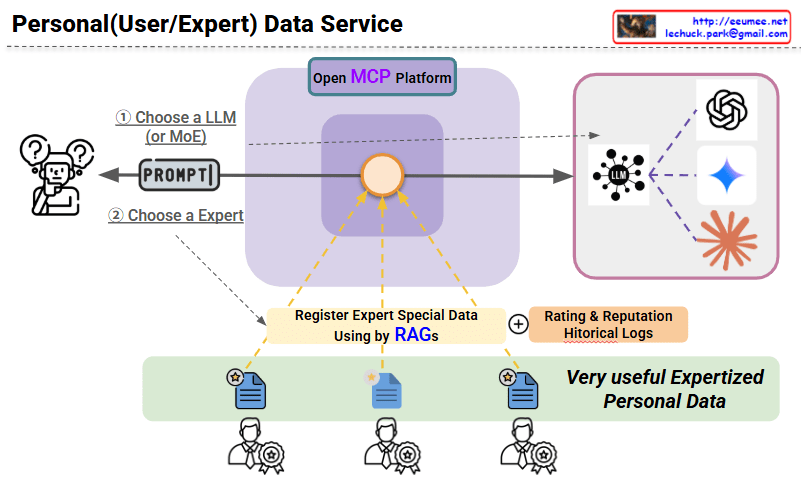
The Personal Data Service is an open expert RAG service platform based on MCP (Model Context Protocol). This system creates a bidirectional ecosystem where both users and experts can benefit mutually, enhancing accessibility to specialized knowledge and improving AI service quality.

Core Components

1. User Interface (Left Side)

  • LLM Model Selection: Users can choose their preferred language model or MoE (Mixture of Experts)
  • Expert Selection: Select domain-specific experts for customized responses
  • Prompt Input: Enter specific questions or requests

2. Open MCP Platform (Center)

  • Integrated Management Hub: Connects and coordinates all system components
  • Request Processing: Matches user requests with appropriate expert RAG systems
  • Service Orchestration: Manages and optimizes the entire workflow

3. LLM Service Layer (Right Side)

  • Multi-LLM Support: Integration with various AI model services
  • OAuth Authentication: Direct user selection of paid/free services
  • Vendor Neutrality: Open architecture independent of specific AI services

4. Expert RAG Ecosystem (Bottom)

  • Specialized Data Registration: Building expert-specific knowledge databases through RAG
  • Quality Management System: Ensuring reliability through evaluation and reputation management
  • Historical Logs: Continuous quality improvement through service usage records

Key Features

  1. Bidirectional Ecosystem: Users obtain expert answers while experts monetize their knowledge
  2. Open Architecture: Scalable platform based on MCP standards
  3. Quality Assurance: Expert and answer quality management through evaluation systems
  4. Flexible Integration: Compatibility with various LLM services
  5. Autonomous Operation: Direct data management and updates by experts

With Claude

GPU Server Room : Changes

Image Overview

This dashboard displays the cascading resource changes that occur when GPU workload increases in an AI data center server room monitoring system.

Key Change Sequence (Estimated Values)

  1. GPU Load Increase: 30% → 90% (AI computation tasks initiated)
  2. Power Consumption Rise: 0.42kW → 1.26kW (3x increase)
  3. Temperature Delta Rise: 7°C → 17°C (increased heat generation)
  4. Cooling System Response:
    • Water flow rate: 200 LPM → 600 LPM (3x increase)
    • Fan speed: 600 RPM → 1200 RPM (2x increase)

Operational Prediction Implications

  • Operating Costs: Approximately 3x increase from baseline expected
  • Spare Capacity: 40% cooling system capacity remaining
  • Expansion Capability: Current setup can accommodate additional 67% GPU load

This AI data center monitoring dashboard illustrates the cascading resource changes when GPU workload increases from 30% to 90%, triggering proportional increases in power consumption (3x), cooling flow rate (3x), and fan speed (2x). The system demonstrates predictable operational scaling patterns, with current cooling capacity showing 40% remaining headroom for additional GPU load expansion. Note: All values are estimated figures for demonstration purposes.

Note: All numerical values are estimated figures for demonstration purposes and do not represent actual measured data.

With Claude

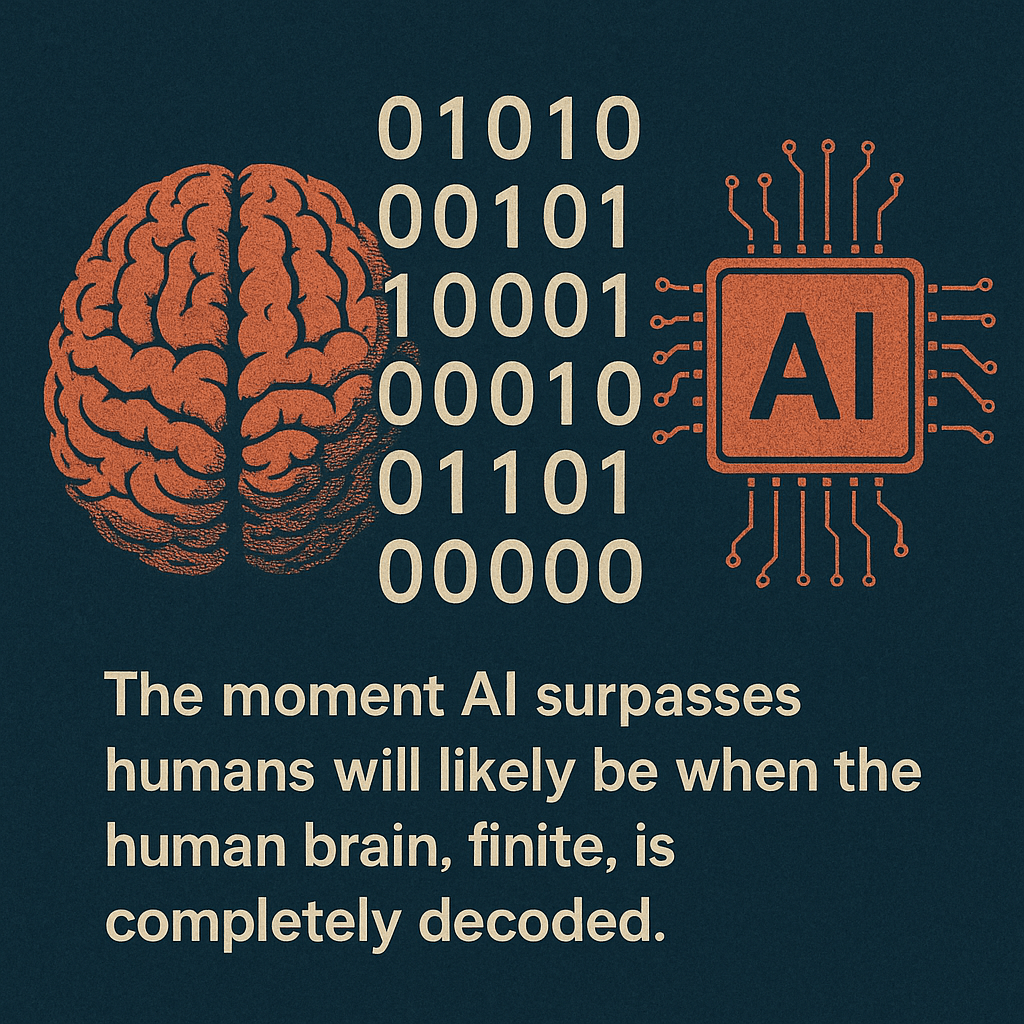
Human Vs AI

The moment AI surpasses humans will come only if the human brain is proven to be finite.
If every neural connection, every thought pattern, and every emotional process can be fully analyzed and translated into code, then AI, with its capacity to process and optimize those codes, can ultimately transcend human capability.
But if the human brain contains layers of complexity that are infinite or fundamentally unquantifiable, then no matter how advanced AI becomes, it will always fall short of complete understanding—and thus remain behind

Attention in a Transformer

Attention Mechanism in Transformer Models

Overview

The attention mechanism in Transformer models is a revolutionary technology that has transformed the field of natural language processing. This technique allows each word (token) in a sentence to form direct relationships with all other words.

Working Principles

  1. Tokenization Stage: Input text is divided into individual tokens.
  2. Attention Application: Each token calculates its relevance to all other tokens.
  3. Mathematical Implementation:
    • Each token is converted into Query, Key, and Value vectors.
    • The relevance between a specific token (Query) and other tokens (Keys) is calculated.
    • Weights are applied to the Values based on the calculated relevance.
    • This is expressed as the ‘sum of Value * Weight’.

Multi-Head Attention

  • Definition: A method that calculates multiple attention vectors for a single token in parallel.
  • Characteristics: Each head (styles A, B, C) captures token relationships from different perspectives.
  • Advantage: Can simultaneously extract various information such as grammatical relationships and semantic associations.

Key Benefits

  1. Contextual Understanding: Enables understanding of word meanings based on context.
  2. Long-Distance Dependency Resolution: Can directly connect words that are far apart in a sentence.
  3. Parallel Processing: High computational efficiency due to simultaneous processing of all tokens.

Applications

Transformer-based models demonstrate exceptional performance in various natural language processing tasks including machine translation, text generation, and question answering. They form the foundation of modern AI models such as GPT and BERT.

With Claude

AI together!!

This diagram titled “AI together!!” illustrates a comprehensive architecture for AI-powered question-answering systems, focusing on the integration of user data, tools, and AI models through standardized protocols.

Key Components:

  1. Left Area (Blue) – User Side:
    • Prompt: The entry point for user queries, represented by a UI interface with chat elements
    • RAG (Retrieval Augmented Generation): A system that enhances AI responses by retrieving relevant information from user data sources
    • My Data: User’s personal data repositories shown as spreadsheets and databases
    • My Tool: Custom tools that can be integrated into the workflow
  2. Right Area (Purple) – AI Model Side:
    • AI Model (foundation): The core AI foundation model represented by a robot icon
    • MOE (Mixture Of Experts): A system that combines multiple specialized AI models for improved performance
    • Domain Specific AI Model: Specialized AI models trained for particular domains or tasks
    • External or Internet: Connection to external knowledge sources and internet resources
  3. Center Area (Green) – Connection Standard:
    • MCP (Model Context Protocol): A standardized protocol that facilitates communication between user-side components and AI models, labeled as “Standard of Connecting”

Information Flow:

  • Questions flow from the prompt interface on the left to the AI models on the right
  • Answers are generated by the AI models and returned to the user interface
  • The RAG system augments queries with relevant information from the user’s data
  • Semantic Search provides additional connections between components
  • All interactions are standardized through the MCP framework

This architecture demonstrates how personal data and custom tools can be seamlessly integrated with foundation and specialized AI models to create a more personalized, context-aware AI system that delivers more accurate and relevant responses to user queries.

With Claude

Nice Action

This “Nice Action” diagram illustrates how decision-making processes work similarly for both humans and AI:

  1. Dual Structure of All Choices: Every decision inherently consists of elements of certainty and uncertainty.
  2. Certainty Expansion Strategy: The first step “① Expansion ‘Certain’ First” demonstrates the strategy of maximizing the use of already certain information. This establishes a foundation for decision-making based on known facts.
  3. Uncertainty Upgrade: The second step “② Upgrade Possibility to near 100%” represents the process of increasing the probability of uncertain elements to bring them as close as possible to certainty. While complete certainty cannot be achieved for all elements, obtaining sufficiently high probability enhances the reliability of decisions.
  4. Similarity to Machine Learning and AI: This decision-making model is remarkably similar to how modern machine learning and AI function. AI systems also operate based on certain data (learned patterns) and use probabilistic approaches for uncertain elements to derive optimal decisions.
  5. Transition to Action: Once sufficient certainty is established, the final “ACTION” step can be taken to implement the decision.

This diagram provides insight into how human intuitive decision-making and AI’s algorithmic approach fundamentally follow the same principle—maximizing certainty while managing uncertainty to an acceptable level. The “AI, too” notation explicitly emphasizes this similarity.

With Claude