Resolution is Speed

Resolution is Speed: Data Resolution Strategy in Rapidly Changing Environments

Core Concept

When facing rapid changes and challenges, increasing data resolution is the key strategy to maximize problem-solving speed. While low-resolution data may suffice in stable, low-change situations, high-resolution data becomes essential in complex, volatile environments.

Processing Framework

  1. High Resolution Sensing: Fine-grained detection of changing environments
  2. Computing Foundation: Securing basic computing capabilities to quantify high-resolution data
  3. Big Data Processing: Rapid processing of large-scale, high-resolution data
  4. AI Amplification: Maximizing big data processing capabilities through AI assistance

Resulting Benefits

Through this high-resolution data processing approach:

  • Fast Reaction Available: Enables rapid response to changes
  • More Stable and Efficient: Achieves real stability and efficiency
  • Attains predictable and controllable states even in highly volatile environments

Real-world Application and Necessity

These changes and challenges are occurring continuously, and AI Data Centers (AI DCs) must become the physical embodiment of rapid change response through high-resolution data processing—this is an urgent imperative. The construction and operation of AI DCs is not an option but a survival necessity, representing essential infrastructure that must be established to maintain competitiveness in the rapidly evolving digital landscape.

#DataResolution #AIDataCenter #BusinessAgility #TechImperative #FutureReady

With Claude

AI Stabilization & Optimization

This diagram illustrates the AI Stabilization & Optimization framework addressing the reality where AI’s explosive development encounters critical physical and technological barriers.

Core Concept: Explosive Change Meets Reality Walls

The AI → Explosion → Wall (Limit) pathway shows how rapid AI advancement inevitably hits real-world constraints, requiring immediate strategic responses.

Four Critical Walls (Real-World Limitations)

  • Data Wall: Training data depletion
  • Computing Wall: Processing power and memory constraints
  • Power Wall: Energy consumption explosion (highlighted in red)
  • Cooling Wall: Thermal management limits

Dual Response Strategy

Stabilization – Managing Change

Stable management of rapid changes:

  • LM SW: Fine-tuning, RAG, Guardrails for system stability
  • Computing: Heterogeneous, efficient, modular architecture
  • Power: UPS, dual path, renewable mix for power stability
  • Cooling: CRAC control, monitoring for thermal stability

Optimization – Breaking Through/Approaching Walls

Breaking limits or maximizing utilization:

  • LM SW: MoE, lightweight solutions for efficiency maximization
  • Computing: Near-memory, neuromorphic, quantum for breakthrough
  • Power: AI forecasting, demand response for power optimization
  • Cooling: Immersion cooling, heat reuse for thermal innovation

Summary

This framework demonstrates that AI’s explosive innovation requires a dual strategy: stabilization to manage rapid changes and optimization to overcome physical limits, both happening simultaneously in response to real-world constraints.

#AIOptimization #AIStabilization #ComputingLimits #PowerWall #AIInfrastructure #TechBottlenecks #AIScaling #DataCenterEvolution #QuantumComputing #GreenAI #AIHardware #ThermalManagement #EnergyEfficiency #AIGovernance #TechInnovation

With Claude

From Stability to Turbulence: Why Smart Operations Matter Most

History always alternates between periods of stability and turbulence. In turbulent times, management and operations become critical, since small decisions can determine survival. This shift mirrors the move from static, stability-focused maintenance to agile, data-driven, and adaptive operations.

#PhilosophyShift #DataDriven #AdaptiveOps #AIDataCenter #ResilientManagement #StabilityToAgility

Computing Evolutions

This diagram illustrates the “Computing Evolutions” from the perspective of data’s core attributes development.

Top: Core Data Properties

  • Data: Foundation of digital information composed of 0s and 1s
  • Store: Data storage technology
  • Transfer: Data movement and network technology
  • Computing: Data processing and computational technology
  • AI Era: The convergence of all these technologies into the artificial intelligence age

Bottom: Evolution Stages Centered on Each Property

  1. Storage-Centric Era: Data Center
    • Focus on large-scale data storage and management
    • Establishment of centralized server infrastructure
  2. Transfer-Centric Era: Internet
    • Dramatic advancement in network technology
    • Completion of global data transmission infrastructure
    • “Data Ready”: The point when vast amounts of data became available and accessible
  3. Computing-Centric Era: Cloud Computing
    • Democratization and scalability of computing power
    • Development of GPU-based parallel processing (blockchain also contributed)
    • “Infra Ready”: The point when large-scale computing infrastructure was prepared

Convergence to AI Era With data prepared through the Internet and computing infrastructure ready through the cloud, all these elements converged to enable the current AI era. This evolutionary process demonstrates how each technological foundation systematically contributed to the emergence of artificial intelligence.

#ComputingEvolution #DigitalTransformation #AIRevolution #CloudComputing #TechHistory #ArtificialIntelligence #DataCenter #TechInnovation #DigitalInfrastructure #FutureOfWork #MachineLearning #TechInsights #Innovation

With Claude

CDU Metrics & Control

This image shows a CDU (Coolant Distribution Unit) Metrics & Control System diagram illustrating the overall structure. The system can be organized as follows:

System Structure

Upper Section: CDU Structure

  • First Loop: CPU with Coolant Distribution Unit
  • Second Main Loop: Row Manifold and Rack Manifold configuration
  • Process Chill Water Supply/Return: Process chilled water circulation system

Lower Section: Data Collection & Control Devices

  • Control Devices:
    • Pump (Pump RPM, Rate of max speed)
    • Valve (Valve Open %)
  • Sensor Configuration:
    • Temperature & Pressure Sensors on manifolds
  • Supply System:
    • Rack Water Supply/Return

Main Control Methods

1. Fixed Pressure Control (Fixed Pressure Drop)

  • Primary Method: Maintaining fixed pressure drop between rack supply-return
  • Alternatives: Fixed flow rate, fixed supply temperature, fixed return temperature, fixed speed control

2. Approach Temperature Control

  • Primary Method: Maintaining constant approach temperature
  • Alternatives: Fixed open, fixed secondary supply temperature control

Summary

This CDU system provides precise cooling control for data centers through dual management of pressure and temperature. The system integrates sensor feedback from manifolds with pump and valve control to maintain optimal cooling conditions across server racks.

#CDU #CoolantDistribution #DataCenterCooling #TemperatureControl #PressureControl #ThermalManagement

with Claude

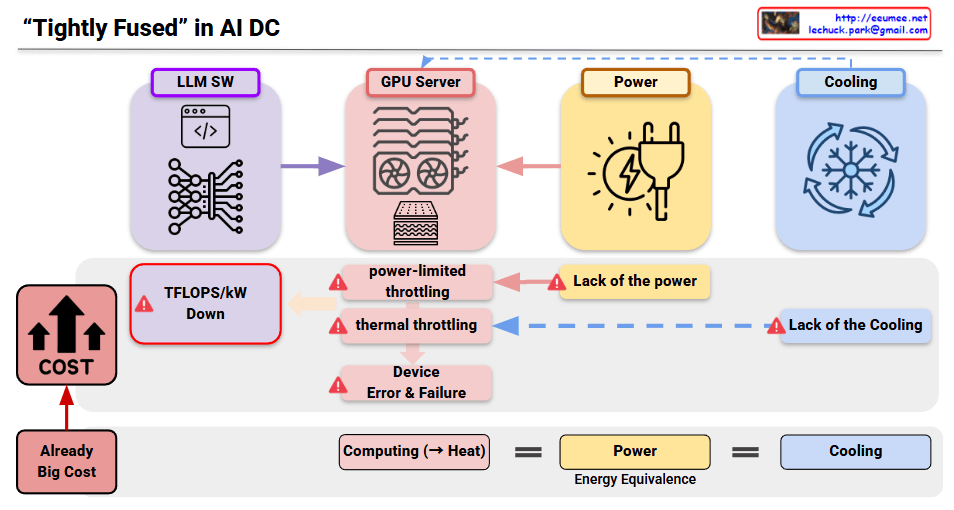
“Tightly Fused” in AI DC

This diagram illustrates a “Tightly Fused” AI datacenter architecture showing the interdependencies between system components and their failure points.

System Components

  • LLM SW: Large Language Model Software
  • GPU Server: Computing infrastructure with cooling fans
  • Power: Electrical power supply system
  • Cooling: Thermal management system

Critical Issues

1. Power Constraints

  • Lack of power leads to power-limited throttling in GPU servers
  • Results in decreased TFLOPS/kW (computational efficiency per watt)

2. Cooling Limitations

  • Insufficient cooling causes thermal throttling
  • Increases risk of device errors and failures

3. Cost Escalation

  • Already high baseline costs
  • System bottlenecks drive costs even higher

Core Principle

The bottom equation demonstrates the fundamental relationship: Computing (→ Heat) = Power = Cooling

This shows that computational workload generates heat, requiring equivalent power supply and cooling capacity to maintain optimal performance.

Summary

This diagram highlights how AI datacenters require perfect balance between computing, power, and cooling systems – any bottleneck in one area cascades into performance degradation and cost increases across the entire infrastructure.

#AIDatacenter #MLInfrastructure #GPUComputing #DataCenterDesign #AIInfrastructure #ThermalManagement #PowerEfficiency #ScalableAI #HPC #CloudInfrastructure #AIHardware #SystemArchitecture

With Claude