AI Infrastructure Architect & Technical Visualizer "Complex Systems, Simplified. I translate massive AI infrastructure into visual intelligence." I love to learn computer tech and help people by the digital.
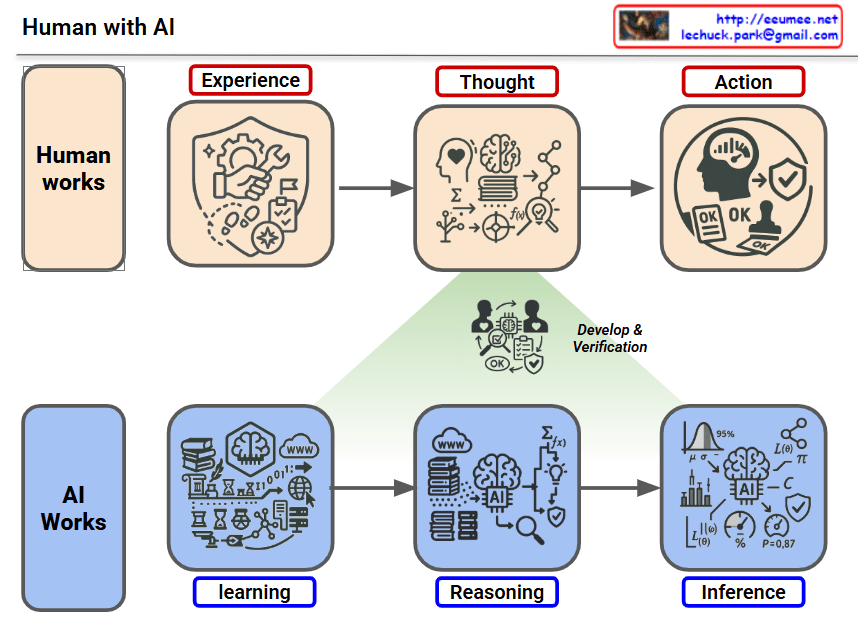
This image titled “Human with AI” illustrates the collaborative structure between humans and AI.
Top: Human works
Humans operate through three stages:
Experience – Collecting various experiences and information
Thought – Thinking and judging by combining emotions, logic, and intuition
Action – Executing final decisions
Bottom: AI Works
AI operates through similar three stages:
Learning – Learning from databases and patterns
Reasoning – Analyzing and judging through algorithms and calculations
Inference – Deriving results based on statistics and probabilities
Core: Human-AI Collaboration Structure
The green arrow in the center with “Develop & Verification” represents the process where humans verify AI’s reasoning results and make final judgments (Thought) to connect them to actual actions (Action).
In other words, when AI analyzes data and presents reasoning results, humans review and verify them to ultimately decide whether to execute – representing a Human-in-the-loop system. AI assists decision-making, but the final judgment and action are under human responsibility.
Summary
This diagram illustrates a Human-in-the-loop AI system where AI processes data and provides reasoning, but humans retain final decision-making authority. Both humans and AI follow similar learning-thinking-acting cycles, but human verification serves as the critical bridge between AI inference and real-world action. This structure emphasizes responsible AI deployment with human oversight.
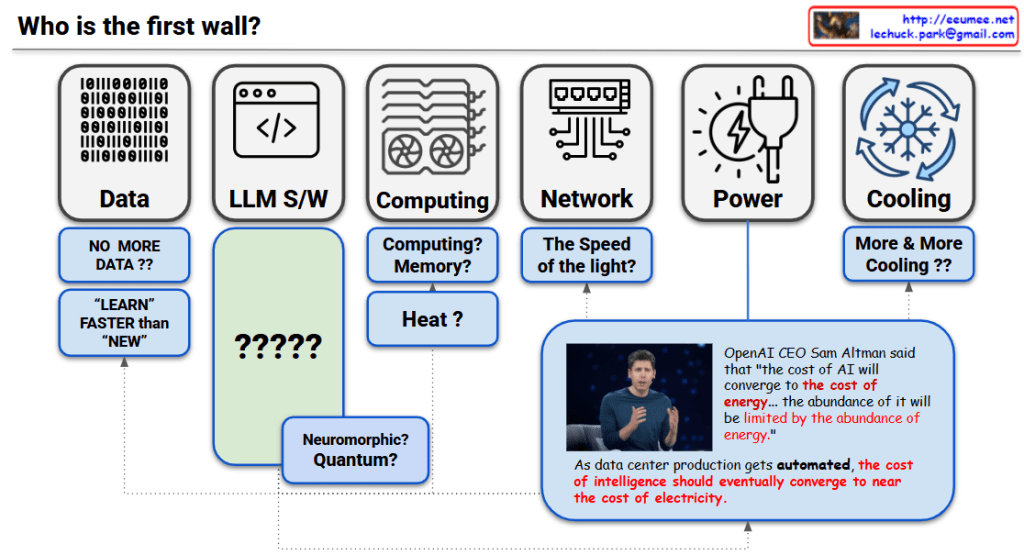
Sam Altman: “The cost of AI will converge to the cost of energy. The abundance of AI will be limited by the abundance of energy”
Power infrastructure (transmission lines, transformers) takes years to build
Data centers projected to consume 7.5% of US electricity by 2030
6. Cooling
Advanced technologies like liquid cooling required. Infrastructure upgrades take 1+ year
“Who is the first wall?”
Critical Bottlenecks by Timeline:
Current (2025): Memory bandwidth + Data quality
Short-to-Mid term: Power infrastructure (5-10 years to build)
Long-term: Physical limit of the speed of light
Summary
The “first wall” in AI scaling is not a single barrier but a multi-layered constraint system that emerges sequentially over time. Today’s immediate challenges are memory bandwidth and data quality, followed by power infrastructure limitations in the mid-term, and ultimately the fundamental physical constraint of the speed of light. As Sam Altman emphasized, AI’s future abundance will be fundamentally limited by energy abundance, with all bottlenecks interconnected through the computing→heat→cooling→power chain.
This diagram illustrates how data centers are transforming as they enter the AI era.
📅 Timeline of Technological Evolution
The top section shows major technology revolutions and their timelines:
Internet ’95 (Internet era)
Mobile ’07 (Mobile era)
Cloud ’10 (Cloud era)
Blockchain
AI(LLM) ’22 (Large Language Model-based AI era)
🏢 Traditional Data Center Components
Conventional data centers consisted of the following core components:
Software
Server
Network
Power
Cooling
These were designed as relatively independent layers.
🚀 New Requirements in the AI Era
With the introduction of AI (especially LLMs), data centers require specialized infrastructure:
LLM Model – Operating large language models
GPU – High-performance graphics processing units (essential for AI computations)
High B/W – High-bandwidth networks (for processing large volumes of data)
SMR/HVDC – Switched-Mode Rectifier/High-Voltage Direct Current power systems
Liquid/CDU – Liquid cooling/Cooling Distribution Units (for cooling high-heat GPUs)
🔗 Key Characteristic of AI Data Centers: Integrated Design
The circular connection in the center of the diagram represents the most critical feature of AI data centers:
Tight Interdependency between SW/Computing/Network ↔ Power/Cooling
Unlike traditional data centers, in AI data centers:
GPU-based computing consumes enormous power and generates significant heat
High B/W networks consume additional power during massive data transfers between GPUs
Power systems (SMR/HVDC) must stably supply high power density
Liquid cooling (Liquid/CDU) must handle high-density GPU heat in real-time
These elements must be closely integrated in design, and optimizing just one element cannot guarantee overall system performance.
💡 Key Message
AI workloads require moving beyond the traditional layer-by-layer independent design approach of conventional data centers, demanding that computing-network-power-cooling be designed as one integrated system. This demonstrates that a holistic approach is essential when building AI data centers.
📝 Summary
AI data centers fundamentally differ from traditional data centers through the tight integration of computing, networking, power, and cooling systems. GPU-based AI workloads create unprecedented power density and heat generation, requiring liquid cooling and HVDC power systems. Success in AI infrastructure demands holistic design where all components are co-optimized rather than independently engineered.
Verification: Validate speed, resource usage through benchmarking and profiling
Summary:
Optimization aims to increase speed and reduce resources by removing unnecessary operations. It follows a staged approach starting from software-level improvements and extending to hardware implementation when needed. The process ensures predictable, verifiable results through deterministic inputs/outputs and rule-based methods.
PUE Improvement: Power Usage Effectiveness (overall power efficiency metric)
Key Message
This diagram emphasizes that for successful AI implementation:
Technical Foundation: Both Data/Chips (Computing) and Power/Cooling (Infrastructure) are necessary
Tight Integration: These two axes are not separate but must be firmly connected like a chain and optimized simultaneously
Implementation Technologies: Specific advanced technologies for stability and optimization in each domain must provide support
The central link particularly visualizes the interdependent relationship where “increasing computing power requires strengthening energy and cooling in tandem, and computing performance cannot be realized without infrastructure support.”
Summary
AI systems require two inseparable pillars: Computing (Data/Chips) and Infrastructure (Power/Cooling), which must be tightly integrated and optimized together like links in a chain. Each pillar is supported by advanced technologies spanning from AI model optimization (FlashAttention, Quantization) to next-gen hardware (GB200, TPU) and sustainable infrastructure (SMR, Liquid Cooling, AI-driven optimization). The key insight is that scaling AI performance demands simultaneous advancement across all layers—more computing power is meaningless without proportional energy supply and cooling capacity.




 Lechuck Park