Big Changes with AI

This image illustrates the dramatic growth in computing performance and data throughput from the Internet era to the AI/LLM era.

Key Development Stages

1. Internet Era

  • 10 TWh (terawatt-hours) power consumption
  • 2 PB/day (petabytes/day) data processing
  • 1K DC (1,000 data centers)
  • PUE 3.0 (Power Usage Effectiveness)

2. Mobile & Cloud Era

  • 200 TWh (20x increase)
  • 20,000 PB/day (10,000x increase)
  • 4K DC (4x increase)
  • PUE 1.8 (improved efficiency)

3. AI/LLM (Transformer) Era – “Now Here?” point

  • 400+ TWh (40x additional increase)
  • 1,000,000,000 PB/day = 1 billion PB/day (500,000x increase)
  • 12K DC (12x increase)
  • PUE 1.4 (further improved efficiency)

Summary

The chart demonstrates unprecedented exponential growth in data processing and power consumption driven by AI and Large Language Models. While data center efficiency (PUE) has improved significantly, the sheer scale of computational demands has skyrocketed. This visualization emphasizes the massive infrastructure requirements that modern AI systems necessitate.

#AI #LLM #DataCenter #CloudComputing #MachineLearning #ArtificialIntelligence #BigData #Transformer #DeepLearning #AIInfrastructure #TechTrends #DigitalTransformation #ComputingPower #DataProcessing #EnergyEfficiency

Computing Evolutions

This diagram illustrates the “Computing Evolutions” from the perspective of data’s core attributes development.

Top: Core Data Properties

  • Data: Foundation of digital information composed of 0s and 1s
  • Store: Data storage technology
  • Transfer: Data movement and network technology
  • Computing: Data processing and computational technology
  • AI Era: The convergence of all these technologies into the artificial intelligence age

Bottom: Evolution Stages Centered on Each Property

  1. Storage-Centric Era: Data Center
    • Focus on large-scale data storage and management
    • Establishment of centralized server infrastructure
  2. Transfer-Centric Era: Internet
    • Dramatic advancement in network technology
    • Completion of global data transmission infrastructure
    • “Data Ready”: The point when vast amounts of data became available and accessible
  3. Computing-Centric Era: Cloud Computing
    • Democratization and scalability of computing power
    • Development of GPU-based parallel processing (blockchain also contributed)
    • “Infra Ready”: The point when large-scale computing infrastructure was prepared

Convergence to AI Era With data prepared through the Internet and computing infrastructure ready through the cloud, all these elements converged to enable the current AI era. This evolutionary process demonstrates how each technological foundation systematically contributed to the emergence of artificial intelligence.

#ComputingEvolution #DigitalTransformation #AIRevolution #CloudComputing #TechHistory #ArtificialIntelligence #DataCenter #TechInnovation #DigitalInfrastructure #FutureOfWork #MachineLearning #TechInsights #Innovation

With Claude

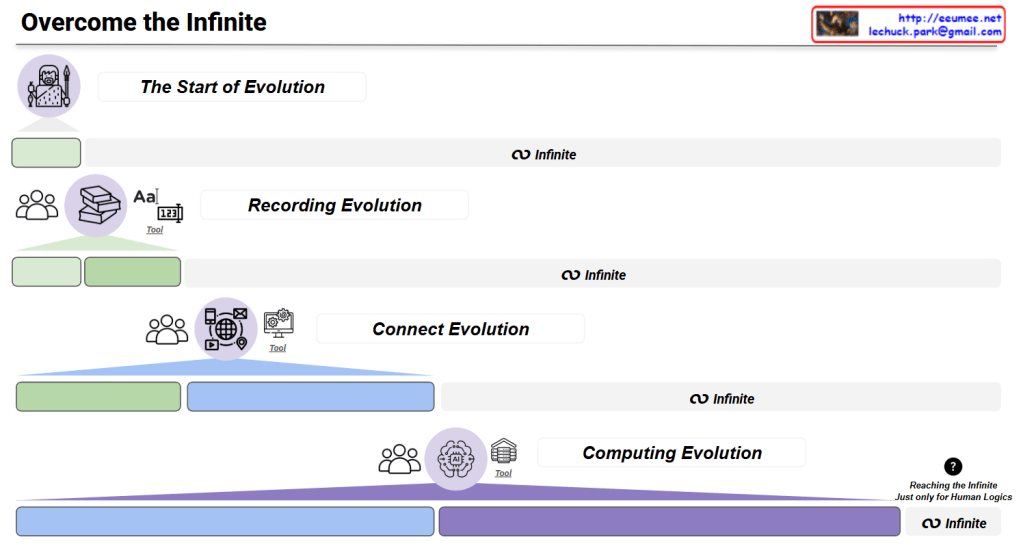
Overcome the Infinite

Overcome the Infinite – Game Interface Analysis

Overview

This image presents a philosophical game interface titled “Overcome the Infinite” that chronicles the evolutionary journey of human civilization through four revolutionary stages of innovation.

Game Structure

Stage 1: The Start of Evolution

  • Icon: Primitive human figure
  • Description: The beginning of human civilization and consciousness

Stage 2: Recording Evolution

  • Icon: Books and writing materials
  • Innovation: The revolution of knowledge storage through numbers, letters, and books
  • Significance: Transition from oral tradition to written documentation, enabling permanent knowledge preservation

Stage 3: Connect Evolution

  • Icon: Network/internet symbols with people
  • Innovation: The revolution of global connectivity through computers and the internet
  • Significance: Worldwide information sharing and communication breakthrough

Stage 4: Computing Evolution

  • Icon: AI/computing symbols with data centers
  • Innovation: The revolution of computational processing through data centers and artificial intelligence
  • Significance: The dawn of the AI era and advanced computational capabilities

Progress Indicators

  • Green and blue progress bars show advancement through each evolutionary stage
  • Each stage maintains the “∞ Infinite” symbol, suggesting unlimited potential at every level

Philosophical Message

“Reaching the Infinite Just only for Human Logics” (Bottom right)

This critical message embodies the game’s central philosophical question:

  • Can humanity truly overcome or reach the infinite through these innovations?
  • Even if we approach the infinite, it remains constrained within the boundaries of human perception and logic
  • Represents both technological optimism and humble acknowledgment of human limitations

Theme

The interface presents a contemplative journey through human technological evolution, questioning whether our innovations truly bring us closer to transcending infinite boundaries, or merely expand the scope of our human-limited understanding.

With Claude

Usage Evolutions : The Evolution of Human Tools and Knowledge Sharing

With a Claude’s Help
This diagram illustrates how humanity’s methods of sharing and expanding knowledge have evolved alongside the development of tools throughout history.

The Four Stages of Evolution

1. Experience-Based Era

  • Tool: Direct Human Experience
  • Characteristics: Knowledge sharing through face-to-face interactions based on personal experience
  • Limited scope of knowledge transfer and collaboration

2. Literature-Based Era

  • Tool: Books and Documents
  • Characteristics: Documentation of experiences and knowledge
  • Knowledge transfer possible across time and space

3. Internet-Based Era

  • Tool: Internet and Digital Platforms
  • Characteristics: Real-time information sharing and two-way communication
  • Formation of networks where multiple users simultaneously influence each other

4. AI-Based Era

  • Tool: Artificial Intelligence
  • Characteristics: Creation of new digital worlds through AI
  • Revolutionary expansion of knowledge creation, processing, and sharing

Key Characteristics of Evolution Process

  1. Increase in Data (More Data)
  • Exponential growth in the amount of information accumulated through each stage
  1. Enhanced Connectivity (More Connected)
  • Expansion of knowledge sharing networks
  • Dramatic increase in speed and scope of information transfer
  1. Increased Need for Verification (More Requires of Verification)
  • Growing demand for information reliability and accuracy
  • Heightened importance of data verification

This evolutionary process demonstrates more than just technological advancement; it shows fundamental changes in how humanity uses tools to expand and share knowledge. The emergence of new tools at each stage has enabled more effective and widespread knowledge sharing than before, becoming a key driving force in accelerating the development of human civilization.

This progression represents a continuous journey from individual experience-based learning to AI-enhanced global knowledge sharing, highlighting how each tool has revolutionized our ability to communicate, learn, and innovate as a species.

The evolution also underscores the increasing complexity and sophistication of our knowledge-sharing mechanisms, while emphasizing the growing importance of managing and verifying the ever-expanding volume of information available to us.

Data with the AI

From Claude with some prompting
the key points from the diagram:

  1. Reality of Internet Open Data:
    • Vast amount of open data exists on the internet including:
      • Mobile device data
      • Email communications
      • Video content
      • Location data
    • This open data is utilized by major AI companies for LLM training
    • Key players:
      • OpenAI’s ChatGPT
      • Anthropic’s Claude
      • Google’s Gemini
      • Meta’s LLaMA
  2. Competition Implications:
    • Competition between LLMs trained on similar internet data
    • “Who Winner?” and “A Winner Takes ALL?” suggests potential monopoly in the base LLM market
    • This refers specifically to models trained on public internet data
  3. Market Outlook:
    • While the base LLM market might be dominated by a few players
    • Private enterprise data remains a key differentiator
    • “Still Differentiated and Competitive” indicates ongoing competition through enterprise-specific data
    • Companies can leverage RAG-like technology to combine their private data with LLMs for unique solutions
  4. Key Implications:
    • Base LLM market (trained on internet data) may be dominated by few winners
    • Enterprise competition remains vibrant through:
      • Unique private data assets
      • RAG integration with base LLMs
      • Company-specific implementations
    • Market likely to evolve into dual structure:
      • Foundation LLMs (based on internet data)
      • Enterprise-specific AI services (leveraging private data)

This structure suggests that while base LLM technology might be dominated by a few players, enterprises can maintain competitive advantage through their unique private data assets and specialized implementations using RAG-like technologies.

This creates a market where companies can differentiate themselves even while using the same foundation models, by leveraging their proprietary data and specific use-case implementations.

HTTP Service components

From Claude with some prompting
This image illustrates the network structure of an HTTP service. The main components are:

Client Side:

  • Browser: Handles URL requests, HTML parsing, and JavaScript execution
  • OS: Runs the browser, translates URL (domain) to IP

Internet:

  • DNS: Converts domain names to IP addresses
  • IP: Transfers data using IP addresses

Server Side:

  • OS (Operating System): Runs applications, manages IP network
  • TLS: Handles encryption
  • WEB:
    • Manages HTML embedding
    • Handles JSP (JavaServer Pages)
    • Typically deals with static content and some dynamic content generation
  • WAS (Web Application Server):
    • Handles server-side programming and application logic
    • Manages complex dynamic content generation
    • Interacts with the database
    • Handles business logic of the application
  • DB: Database for storing and retrieving data for web services

The diagram shows the entire process of how an HTTP request is handled, from the web browser to the server’s database. It briefly explains the technologies and protocols involved at each step, providing a helpful overview of the basic structure of web services.

My own AI agent

From DALL-E with some prompting
This image appears to be a conceptual diagram of an individual’s AI agent, divided into several parts:

  1. Personal Area: There’s a user icon with arrows labeled ‘Control’ and ‘Sensing All’. This suggests the user can direct the AI agent and the AI is capable of gathering comprehensive information from its environment.
  2. Micro & Macro Infinite World: This part features illustrations that seem to represent microorganisms, plants, butterflies, etc., indicating that the AI collects data from both microscopic and macroscopic environments.
  3. Personalized Resource: The icon resembling a human brain could represent personalized services or data tailored to the user.
  4. Cloud Infra: The cloud infrastructure is presumably responsible for data processing and storage.
  5. Cloud Service: Depicted as a server providing various services, connected to the cloud infrastructure.
  6. Internet Connected: A globe icon with various network points suggests that the AI agent is connected to global information and knowledge via the internet.

Overall, the diagram illustrates a personalized AI agent that collects information under the user’s control, processes it through cloud infrastructure and services, and ultimately contributes to collective intelligence through an internet connection.