Human Control

Human-Centered AI Decision-Making System

This diagram illustrates a human-in-the-loop AI system where humans maintain control over critical decision-making processes.

System Components

Top Process Flow:

  • Data QualityAnalysisDecision
  • Sequential workflow with human oversight at each stage

Bottom Control Layer:

  • AI Works in the central processing area
  • Ethics Human Rules (left side) – Human-defined ethical guidelines
  • Probability Control (right side) – Human oversight of AI confidence levels

Human Control Points:

  • Human Intent feeds into the system at the beginning
  • Final Decision remains with humans at the end
  • Human Control emphasized as the foundation of the entire system

Key Principles

  1. Human Agency: People retain ultimate decision-making authority
  2. AI as Tool: AI performs analysis but doesn’t make final decisions
  3. Ethical Oversight: Human-defined rules guide AI behavior
  4. Transparency: Probability controls allow humans to understand AI confidence
  5. Accountability: Clear human responsibility throughout the process

Summary: This represents a responsible AI framework where artificial intelligence enhances human decision-making capabilities while ensuring humans remain in control of critical choices and ethical considerations.

With Claude

Human & Data with AI

Data Accumulation Perspective

History → Internet: All knowledge and information accumulated throughout human history is digitized through the internet and converted into AI training data. This consists of multimodal data including text, images, audio, and other formats.

Foundation Model: Large language models (LLMs) and multimodal models are pre-trained based on this vast accumulated data. Examples include GPT, BERT, CLIP, and similar architectures.

Human to AI: Applying Human Cognitive Patterns to AI

1. Chain of Thoughts

  • Implementation of human logical reasoning processes in the Reasoning stage
  • Mimicking human cognitive patterns that break down complex problems into step-by-step solutions
  • Replicating the human approach of “think → analyze → conclude” in AI systems

2. Mixture of Experts

  • AI implementation of human expert collaboration systems utilized in the Experts domain
  • Architecting the way human specialists collaborate on complex problems into model structures
  • Applying the human method of synthesizing multiple expert opinions for problem-solving into AI

3. Retrieval-Augmented Generation (RAG)

  • Implementing the human process of searching existing knowledge → generating new responses into AI systems
  • Systematizing the human approach of “reference material search → comprehensive judgment”

Personal/Enterprise/Sovereign Data Utilization

1. Personal Level

  • Utilizing individual documents, history, preferences, and private data in RAG systems
  • Providing personalized AI assistants and customized services

2. Enterprise Level

  • Integrating organizational internal documents, processes, and business data into RAG systems
  • Implementing enterprise-specific AI solutions and workflow automation

3. Sovereign Level

  • Connecting national or regional strategic data to RAG systems
  • Optimizing national security, policy decisions, and public services

Overall Significance: This architecture represents a Human-Centric AI system that transplants human cognitive abilities and thinking patterns into AI while utilizing multi-layered data from personal to national levels to evolve general-purpose AI (Foundation Models) into intelligent systems specialized for each level. It goes beyond simple data processing to implement human thinking methodologies themselves into next-generation AI systems.

With Claude

AI together!!

This diagram titled “AI together!!” illustrates a comprehensive architecture for AI-powered question-answering systems, focusing on the integration of user data, tools, and AI models through standardized protocols.

Key Components:

  1. Left Area (Blue) – User Side:
    • Prompt: The entry point for user queries, represented by a UI interface with chat elements
    • RAG (Retrieval Augmented Generation): A system that enhances AI responses by retrieving relevant information from user data sources
    • My Data: User’s personal data repositories shown as spreadsheets and databases
    • My Tool: Custom tools that can be integrated into the workflow
  2. Right Area (Purple) – AI Model Side:
    • AI Model (foundation): The core AI foundation model represented by a robot icon
    • MOE (Mixture Of Experts): A system that combines multiple specialized AI models for improved performance
    • Domain Specific AI Model: Specialized AI models trained for particular domains or tasks
    • External or Internet: Connection to external knowledge sources and internet resources
  3. Center Area (Green) – Connection Standard:
    • MCP (Model Context Protocol): A standardized protocol that facilitates communication between user-side components and AI models, labeled as “Standard of Connecting”

Information Flow:

  • Questions flow from the prompt interface on the left to the AI models on the right
  • Answers are generated by the AI models and returned to the user interface
  • The RAG system augments queries with relevant information from the user’s data
  • Semantic Search provides additional connections between components
  • All interactions are standardized through the MCP framework

This architecture demonstrates how personal data and custom tools can be seamlessly integrated with foundation and specialized AI models to create a more personalized, context-aware AI system that delivers more accurate and relevant responses to user queries.

With Claude

Data Security

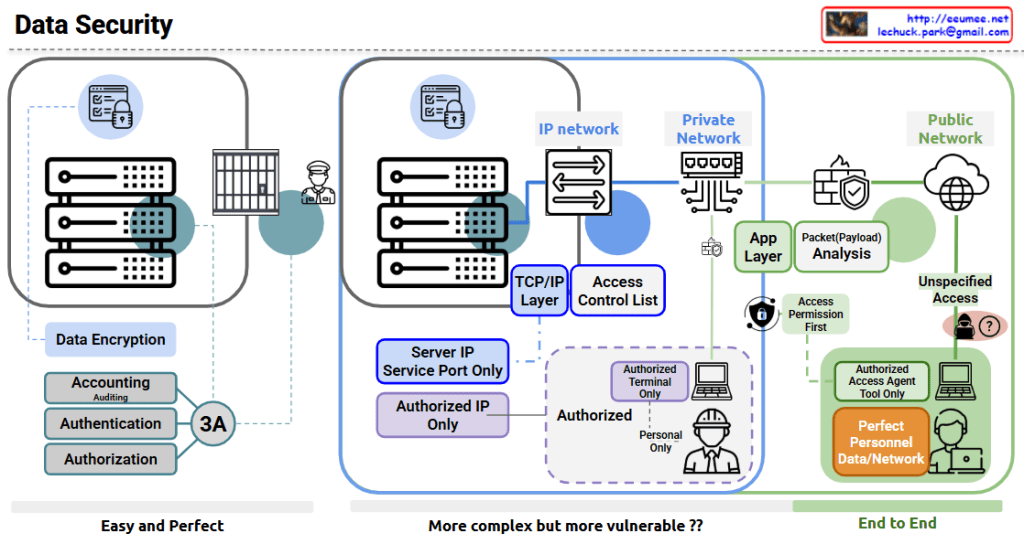
The image shows a comprehensive data security diagram with three main approaches to securing data systems. Let me explain each section:

  1. Left Section – “Easy and Perfect”:
    • Features data encryption for secure storage
    • Implements the “3A” security principles: Accounting (with Auditing), Authentication, and Authorization
    • Shows server hardware protected by physical security (guard)
    • Represents a straightforward but effective security approach
  2. Middle Section – “More complex but more vulnerable??”:
    • Shows an IP network architecture with:
      • Server IP and service port restrictions
      • TCP/IP layer security
      • Access Control Lists
      • Authorized IP only policy
      • Authorized terminal restrictions
      • Personnel authorization controls
  3. Right Section – “End to End”:
    • Divides security between Private Network and Public Network
    • Includes:
      • Application layer security
      • Packet/Payload analysis
      • Access Permission First principle
      • Authorized Access Agent Tool restrictions
      • “Perfect Personnel Data/Network” security approach
      • Unspecified Access concerns (shown with question mark)

The diagram illustrates the evolution of data security approaches from simpler encryption and authentication methods to more complex network security architectures, and finally to comprehensive end-to-end security solutions. The diagram questions whether more complex systems might actually introduce more vulnerabilities, suggesting that complexity doesn’t always equal better security.

With Claude

Connected in AI DC

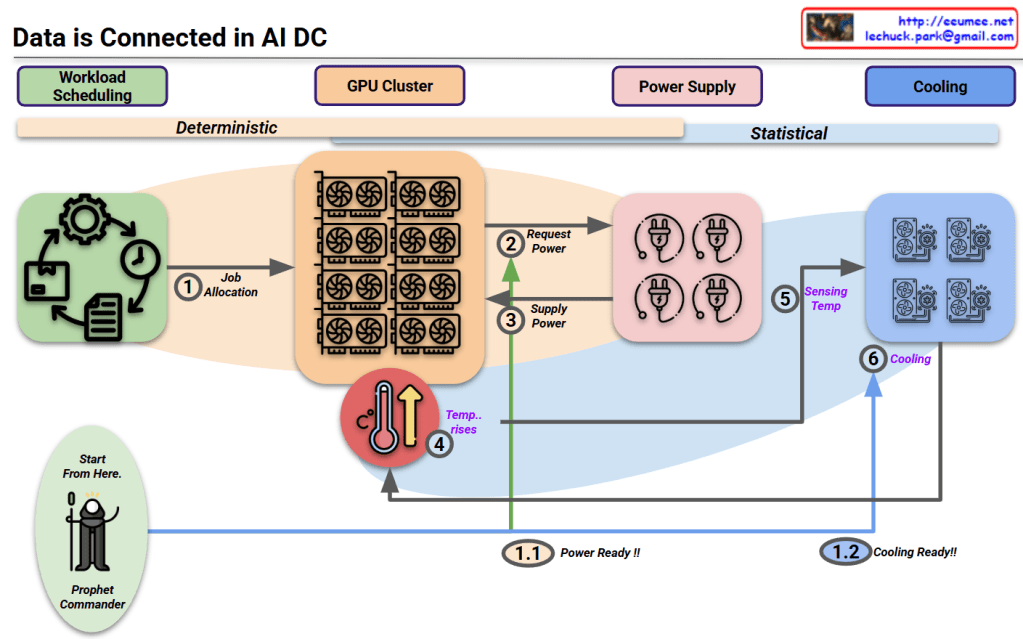
This diagram titled “Data is Connected in AI DC” illustrates the relationships starting from workload scheduling in an AI data center.

Key aspects of the diagram:

  1. The entire system’s interconnected relationships begin with workload scheduling.
  2. The diagram divides the process into two major phases:
    • Deterministic phase: Primarily concerned with power requirements that operate in a predictable, planned manner.
    • Statistical phase: Focused on cooling requirements, where predictions vary based on external environmental conditions.
  3. The “Prophet Commander” at the workload scheduling stage can predict/direct future requirements, allowing the system to prepare power (1.1 Power Ready!!) and cooling (1.2 Cooling Ready!!) in advance.
  4. Process flow:
    • Job allocation from workload scheduling to GPU cluster
    • GPUs request and receive power
    • Temperature rises due to operations
    • Cooling system detects temperature and activates cooling

This diagram illustrates the interconnected workflow in AI data centers, beginning with workload scheduling that enables predictive resource management. The process flows from deterministic power requirements to statistical cooling needs, with the “Prophet Commander” enabling proactive preparation of power and cooling resources. This integrated approach demonstrates how workload prediction can drive efficient resource allocation throughout the entire AI data center ecosystem.

With Claude

Data Center

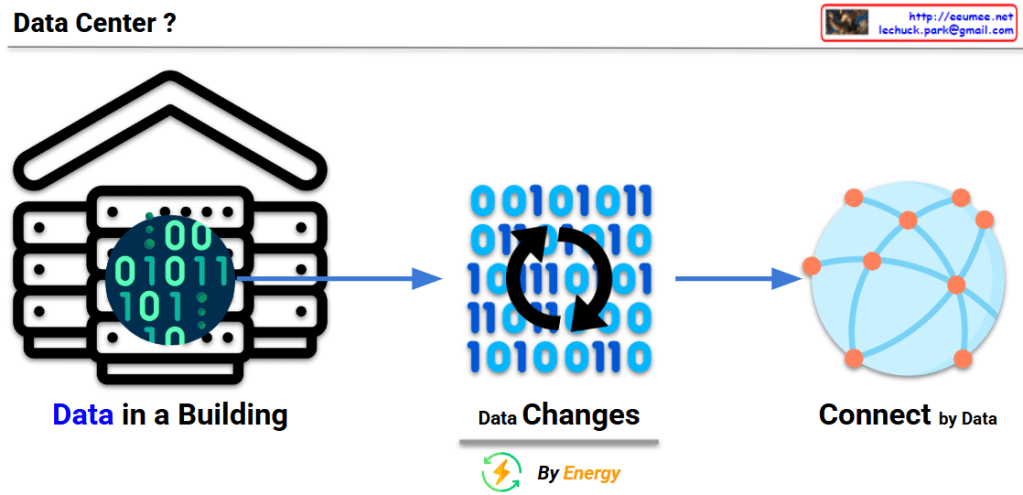
This image explains the fundamental concept and function of a data center:

  1. Left: “Data in a Building” – Illustrates a data center as a physical building that houses digital data (represented by binary code of 0s and 1s).
  2. Center: “Data Changes” – With the caption “By Energy,” showing how data is processed and transformed through the consumption of energy.
  3. Right: “Connect by Data” – Demonstrates how processed data from the data center connects to the outside world, particularly the internet, forming networks.

This diagram visualizes the essential definition of a data center – a physical building that stores data, consumes energy to process that data, and plays a crucial role in connecting this data to the external world through the internet.

With Claude