Basic of Reasoning

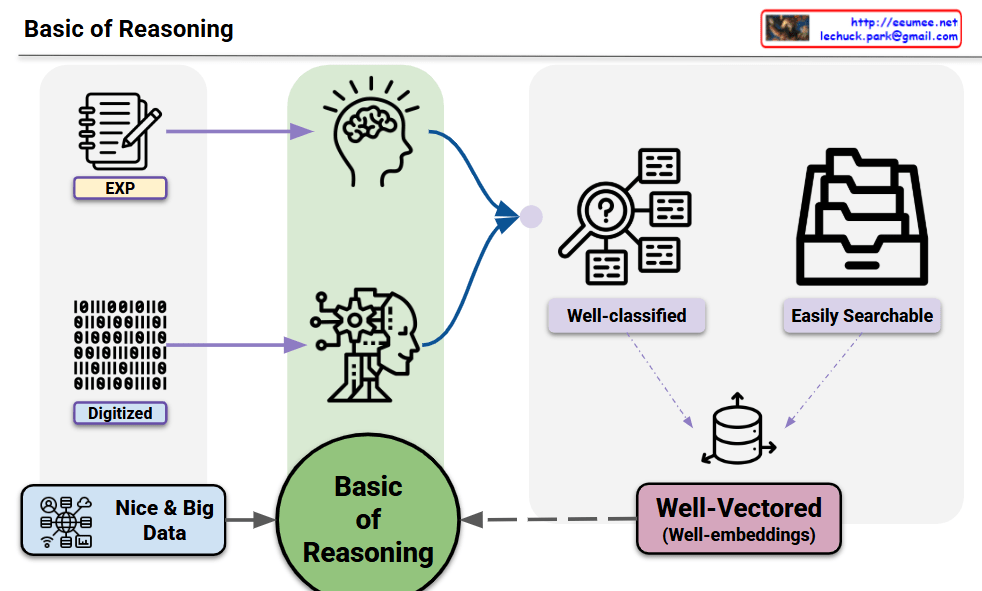
This diagram illustrates that human reasoning and AI reasoning share fundamentally identical structures.

Key Insights:

Common Structure Between Human and AI:

  • Human Experience (EXP) = Digitized Data: Human experiential knowledge and AI’s digital data are essentially the same information in different representations
  • Both rely on high-quality, large-scale data (Nice & Big Data) as their foundation

Shared Processing Pipeline:

  • Both human brain (intuitive thinking) and AI (systematic processing) go through the same Basic of Reasoning process
  • Information gets well-classified and structured to be easily searchable
  • Finally transformed into well-vectorized embeddings for storage

Essential Components for Reasoning:

  1. Quality Data: Whether experience or digital information, sufficient and high-quality data is crucial
  2. Structure: Systematic classification and organization of information
  3. Vectorization: Conversion into searchable and associative formats

Summary: This diagram demonstrates that effective reasoning – whether human or artificial – requires the same fundamental components: quality data and well-structured, vectorized representations. The core insight is that human experiential learning and AI data processing follow identical patterns, both culminating in structured knowledge storage that enables effective reasoning and retrieval.

The Evolution of Mainstream Data in Computing

This diagram illustrates the evolution of mainstream data types throughout computing history, showing how the complexity and volume of processed data has grown exponentially across different eras.

Evolution of Mainstream Data by Computing Era:

  1. Calculate (1940s-1950s)Numerical Data: Basic mathematical computations dominated
  2. Database (1960s-1970s)Structured Data: Tabular, organized data became central
  3. Internet (1980s-1990s)Text/Hypertext: Web pages, emails, and text-based information
  4. Video (2000s-2010s)Multimedia Data: Explosive growth of video, images, and audio content
  5. Machine Learning (2010s-Present)Big Data/Pattern Data: Large-scale, multi-dimensional datasets for training
  6. Human Perceptible/Everything (Future)Universal Cognitive Data: Digitization of all human senses, cognition, and experiences

The question marks on the right symbolize the fundamental uncertainty surrounding this final stage. Whether everything humans perceive – emotions, consciousness, intuition, creativity – can truly be fully converted into computational data remains an open question due to technical limitations, ethical concerns, and the inherent nature of human cognition.

Summary: This represents a data-centric view of computing evolution, progressing from simple numerical processing to potentially encompassing all aspects of human perception and experience, though the ultimate realization of this vision remains uncertain.

With Claude

Human Extends

This image is a conceptual diagram titled “Human Extend” that illustrates the cognitive extension of human capabilities and the role of AI tools.

Core Concept

“Human See” at the center represents the core of human observation and understanding abilities.

Bidirectional Extension Structure

Left: Macro Perspective

  • Represented by an orange circle
  • “A deeper understanding of the micro leads to better macro predictions”

Right: Micro Perspective

  • Represented by a blue circle
  • “A deeper understanding of the macro leads to better micro predictions”

Role of AI and Data

The upper portion shows two supporting tools:

  1. AI (by Tool): Represented by an atomic structure-like icon
  2. Data (by Data): Represented by network and database icons

Overall Meaning

This diagram visually represents the concept that human cognitive abilities can be extended through AI tools and data analysis, enabling deeper mutual understanding between microscopic details and macroscopic patterns. It illustrates the complementary relationship where understanding small details leads to better prediction of the big picture, and understanding the big picture leads to more accurate prediction of details.

The diagram suggests that AI and data serve as amplifying tools that enhance human perception, allowing for more sophisticated analysis across different scales of observation and prediction.

with Claude

3 Key on the AI era

This diagram illustrates the 3 Core Technological Components of AI World and their surrounding challenges.

AI World’s 3 Core Technological Components

Central AI World Components:

  1. AI infra (AI Infrastructure) – The foundational technology that powers AI systems
  2. AI Model – Core algorithms and model technologies represented by neural networks
  3. AI Agent – Intelligent systems that perform actual tasks and operations

Surrounding 3 Key Challenges

1. Data – Left Area

Data management as the raw material for AI technology:

  • Data: Raw data collection
  • Verified: Validated and quality-controlled data
  • Easy to AI: Data preprocessed and optimized for AI processing

2. Optimization – Bottom Area

Performance enhancement of AI technology:

  • Optimization: System optimization
  • Fit to data: Data fitting and adaptation
  • Energy cost: Efficiency and resource management

3. Verification – Right Area

Ensuring reliability and trustworthiness of AI technology:

  • Verification: Technology validation process
  • Right?: Accuracy assessment
  • Humanism: Alignment with human-centered values

This diagram demonstrates how the three core technological elements – AI Infrastructure, AI Model, and AI Agent – form the center of AI World, while interacting with the three fundamental challenges of Data, Optimization, and Verification to create a comprehensive AI ecosystem.

With Claude

Components for AI Work

This diagram visualizes the core concept that all components must be organically connected and work together to successfully operate AI workloads.

Importance of Organic Interconnections

Continuity of Data Flow

  • The data pipeline from Big Data → AI Model → AI Workload must operate seamlessly
  • Bottlenecks at any stage directly impact overall system performance

Cooperative Computing Resource Operations

  • GPU/CPU computational power must be balanced with HBM memory bandwidth
  • SSD I/O performance must harmonize with memory-processor data transfer speeds
  • Performance degradation in one component limits the efficiency of the entire system

Integrated Software Control Management

  • Load balancing, integration, and synchronization coordinate optimal hardware resource utilization
  • Real-time optimization of workload distribution and resource allocation

Infrastructure-based Stability Assurance

  • Stable power supply ensures continuous operation of all computing resources
  • Cooling systems prevent performance degradation through thermal management of high-performance hardware
  • Facility control maintains consistency of the overall operating environment

Key Insight

In AI systems, the weakest link determines overall performance. For example, no matter how powerful the GPU, if memory bandwidth is insufficient or cooling is inadequate, the entire system cannot achieve its full potential. Therefore, balanced design and integrated management of all components is crucial for AI workload success.

The diagram emphasizes that AI infrastructure is not just about having powerful individual components, but about creating a holistically optimized ecosystem where every element supports and enhances the others.

With Claude

Human data

This updated image titled “Data?” presents a deeper philosophical perspective on data and AI.

Core Concept:

Human Perception is Limited

  • Compared to the infinite complexity of the real world, the scope that humans can perceive and define is constrained
  • The gray area labeled “Human perception is limited” visualizes this boundary of recognition

Two Dimensions of AI Application:

  1. Deterministic Data
    • Data domains that humans have already defined and structured
    • Contains clear rules and patterns that AI can process in predictable ways
    • Represents traditional AI problem-solving approaches
  2. Non-deterministic Data
    • Data from domains that humans haven’t fully defined
    • Raw data from the real world with high uncertainty and complexity
    • Areas where AI must discover and utilize patterns without prior human definitions

Key Insight: This diagram illustrates that AI’s true potential extends beyond simply solving pre-defined human problems. While AI can serve as a tool that opens new possibilities by transcending human cognitive boundaries and discovering complex patterns from the real world that we haven’t yet defined or understood, there remains a crucial human element in this process. Even as AI ventures into unexplored territories of reality beyond human-defined problem spaces, humans still play an essential role in determining how to interpret, validate, and responsibly apply these AI-discovered insights. The diagram suggests a collaborative relationship where AI expands our perceptual capabilities, but human judgment and decision-making remain fundamental in guiding how these expanded possibilities are understood and utilized.

With Claude

Road to AI

This image shows a flowchart titled “Road to AI” that illustrates the step-by-step process of AI development.

Main Stages:

  1. Digitization – Starting from a globe icon, data is converted into digital format (binary code)
  2. Central Processing Area – Data is processed through network structures, where two key processes occur in parallel:
    • Verification – Confirming data accuracy
    • Tuning – Improving the model through “Higher Resolution” and “More Relative Data”
  3. AI System – Finally implemented as an AI robot

Development Phases (Right Side):

  • “Easy First, Everybody Know” – Starting with simple tasks that everyone can understand
  • “Again & Again” – Iterative improvement process
  • “More Difficult & Auto Decision” – Advanced stage with complex and automated decision-making

This diagram visually represents how AI development progresses from simple data digitization, through continuous verification and tuning processes, and gradually evolves into sophisticated AI systems capable of complex automated decision-making. The process emphasizes the iterative nature of AI development, moving from basic, universally understood concepts to increasingly complex autonomous systems.

With Claude