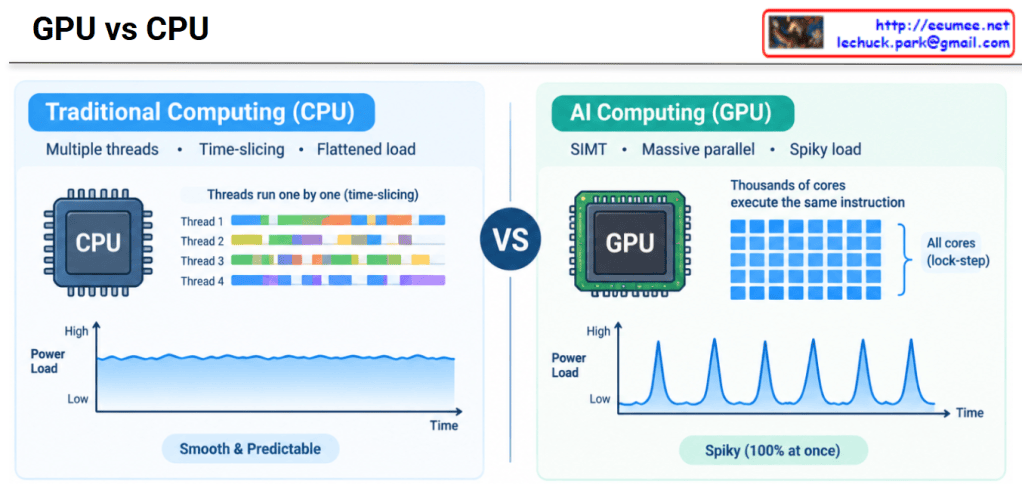
Traditional Computing (CPU)
- It presents ‘Multiple threads’, ‘Time-slicing’, and ‘Flattened load’ as its main features.
- It shows a time-slicing method in the form of bar charts, where multiple threads (Thread 1 to 4) run one by one sequentially by dividing time.
- The Power Load graph over time remains constant without large fluctuations, and this state is described as ‘Smooth & Predictable’.
AI Computing (GPU)
- It presents ‘SIMT’, ‘Massive parallel’, and ‘Spiky load’ as its main features.
- It depicts a massive parallel processing structure where thousands of cores execute the same instruction simultaneously (lock-step), represented by a grid of numerous blue squares.
- The Power Load graph shows a ‘Spiky’ pattern, with power consumption sharply peaking at specific times because it performs operations at 100% at once.
Summary
A CPU processes multiple tasks sequentially by dividing time, resulting in stable and predictable power consumption. In contrast, a GPU utilizes thousands of cores to process massive calculations in parallel all at once, leading to a structural difference where the power load temporarily spikes.
#CPUvsGPU #AIComputing #ParallelProcessing #TimeSlicing #PowerLoad #HardwareArchitecture
With ChatGPT & Gemini


