
AI Workload Cooling Systems: Bidirectional Physical-Software Optimization
This image summarizes four cutting-edge research studies demonstrating the bidirectional optimization relationship between AI LLMs and cooling systems. It proves that physical cooling infrastructure and software workloads are deeply interconnected.
🔄 Core Concept of Bidirectional Optimization
Direction 1: Physical Cooling → AI Performance Impact
- Cooling methods directly affect LLM/VLM throughput and stability
Direction 2: AI Software → Cooling Control
- LLMs themselves act as intelligent controllers for cooling systems
📊 Research Analysis
1. Physical Cooling Impact on AI Performance (2025 arXiv)
[Cooling HW → AI SW Performance]
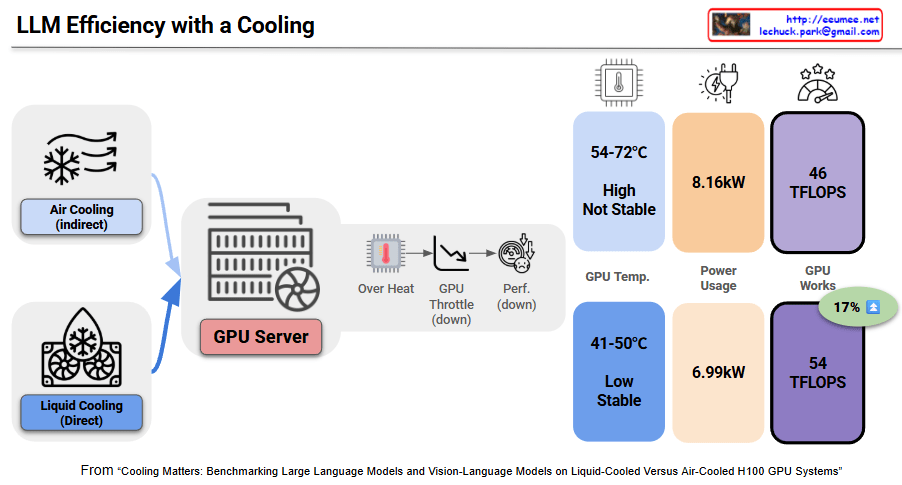
- Experiment: Liquid vs Air cooling comparison on H100 nodes
- Physical Differences:
- GPU Temperature: Liquid 41-50°C vs Air 54-72°C (up to 22°C difference)
- GPU Power Consumption: 148-173W reduction
- Node Power: ~1kW savings
- Software Performance Impact:
- Throughput: 54 vs 46 TFLOPs/GPU (+17% improvement)
- Sustained and predictable performance through reduced throttling
- Improved performance/watt (perf/W) ratio
→ Physical cooling improvements directly enhance AI workload real-time processing capabilities
2. AI Controls Cooling Systems (2025 arXiv)
[AI SW → Cooling HW Control]
- Method: Offline Reinforcement Learning (RL) for automated data center cooling control
- Results: 14-21% cooling energy reduction in 2000-hour real deployment
- Bidirectional Effects:
- AI algorithms optimally control physical cooling equipment (CRAC, pumps, etc.)
- Saved energy → enables more LLM job execution
- Secured more power headroom for AI computation expansion
→ AI software intelligently controls physical cooling to improve overall system efficiency
3. LLM as Cooling Controller (2025 OpenReview)
[AI SW ↔ Cooling HW Interaction]
- Innovative Approach: Using LLMs as interpretable controllers for liquid cooling systems
- Simulation Results:
- Temperature Stability: +10-18% improvement vs RL
- Energy Efficiency: +12-14% improvement
- Bidirectional Interaction Significance:
- LLMs interpret real-time physical sensor data (temperature, flow rate, etc.)
- Multi-objective trade-off optimization between cooling requirements and energy saving
- Interpretability: LLM decision-making process is human-understandable
- Result: Reduced throttling/interruptions → improved AI workload stability
→ Complete closed-loop where AI controls physical systems, and results feedback to AI performance
4. Physical Cooling Innovation Enables AI Training (E-Energy’25 PolyU)
[Cooling HW → AI SW Training Stability]
- Method: Immersion cooling applied to LLM training
- Physical Benefits:
- Dramatically reduced fan/CRAC overhead
- Lower PUE (Power Usage Effectiveness) achieved
- Uniform and stable heat removal
- Impact on AI Training:
- Enables stable long-duration training (eliminates thermal spikes)
- Quantitative power-delay trade-off optimization per workload
- Continuous training environment without interruptions
→ Advanced physical cooling technology secures feasibility of large-scale LLM training
🔁 Physical-Software Interdependency Map
┌─────────────────────────────────────────────────────────┐
│              Physical Cooling Systems                    │
│    (Liquid cooling, Immersion, CRAC, Heat exchangers)   │
└──────────────┬────────────────────────┬─────────────────┘
               ↓                        ↑
        Temp↓ Power↓ Stability↑    AI-based Control
               ↓                   RL/LLM Controllers
┌──────────────┴────────────────────────┴─────────────────┐
│              AI Workloads (LLM/VLM)                      │
│    Performance↑ Throughput↑ Throttling↓ Training Stability↑│
└───────────────────────────────────────────────────────────┘
💡 Key Insights: Bidirectional Optimization Synergy
1. Bottom-Up Influence (Physical → Software)
- Better cooling → maintains higher clock speeds/throughput
- Temperature stability → predictable performance, no training interruptions
- Power efficiency → enables simultaneous operation of more GPUs
2. Top-Down Influence (Software → Physical)
- AI algorithms provide real-time optimal control of cooling equipment
- LLM’s interpretable decision-making ensures operational transparency
- Adaptive cooling strategies based on workload characteristics
3. Virtuous Cycle Effect
Better cooling → AI performance improvement → smarter cooling control
→ Energy savings → more AI jobs → advanced cooling optimization
→ Sustainable large-scale AI infrastructure
🎯 Practical Implications
These studies demonstrate:
- Cooling is no longer passive infrastructure: It’s an active determinant of AI performance
- AI optimizes its own environment: Meta-level self-optimizing systems
- Hardware-software co-design is essential: Isolated optimization is suboptimal
- Simultaneous achievement of sustainability and performance: Synergy, not trade-off
📝 Summary
These four studies establish that next-generation AI data centers must evolve into integrated ecosystems where physical cooling and software workloads interact in real-time to self-optimize. The bidirectional relationship—where better cooling enables superior AI performance, and AI algorithms intelligently control cooling systems—creates a virtuous cycle that simultaneously achieves enhanced performance, energy efficiency, and sustainable scalability for large-scale AI infrastructure.
#EnergyEfficiency#GreenAI#SustainableAI#DataCenterOptimization#ReinforcementLearning#AIControl#SmartCooling
With Claude



 Lechuck Park