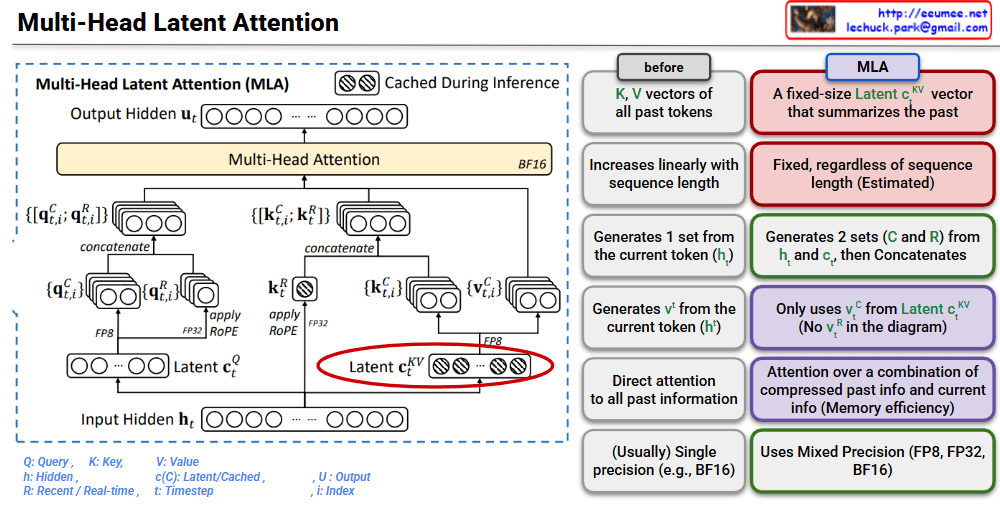
This image is a technical diagram explaining the structure of Multi-Head Latent Attention (MLA).
π― Core Concept
MLA is a mechanism that improves the memory efficiency of traditional Multi-Head Attention.
Traditional Approach (Before) vs MLA
Traditional Approach:
Stores K, V vectors of all past tokens
Memory usage increases linearly with sequence length
MLA:
Summarizes past information with a fixed-size Latent vector (c^KV)
Maintains constant memory usage regardless of sequence length
π Architecture Explanation
1. Input Processing
Starts from Input Hidden State (h_t)
2. Latent Vector Generation
Latent c_t^Q: For Query of current token (compressed representation)
Latent c_t^KV: For Key-Value (cached and reused)
3. Query, Key, Value Generation
Query (q): Generated from current token (h_t)
Key-Value: Generated from Latent c_t^KV
Creates Compressed (C) and Recent (R) versions from c_t^KV
Concatenates both for use
4. Multi-Head Attention Execution
Performs attention computation with generated Q, K, V
Uses BF16 (Mixed Precision)
β Key Advantages
Memory Efficiency: Compresses past information into fixed-size vectors
Faster Inference: Reuses cached Latent vectors
Information Preservation: Maintains performance by combining compressed and recent information
Mixed Precision Support: Utilizes FP8, FP32, BF16
π Key Differences
v_t^R from Latent c_t^KV is not used (purple box on the right side of diagram)
Value of current token is directly generated from h_t
This enables efficient combination of compressed past information and current information
This architecture is an innovative approach to solve the KV cache memory problem during LLM inference.
Summary
MLA replaces the linearly growing KV cache with fixed-size latent vectors, dramatically reducing memory consumption during inference. It combines compressed past information with current token data through an efficient attention mechanism. This innovation enables faster and more memory-efficient LLM inference while maintaining model performance.
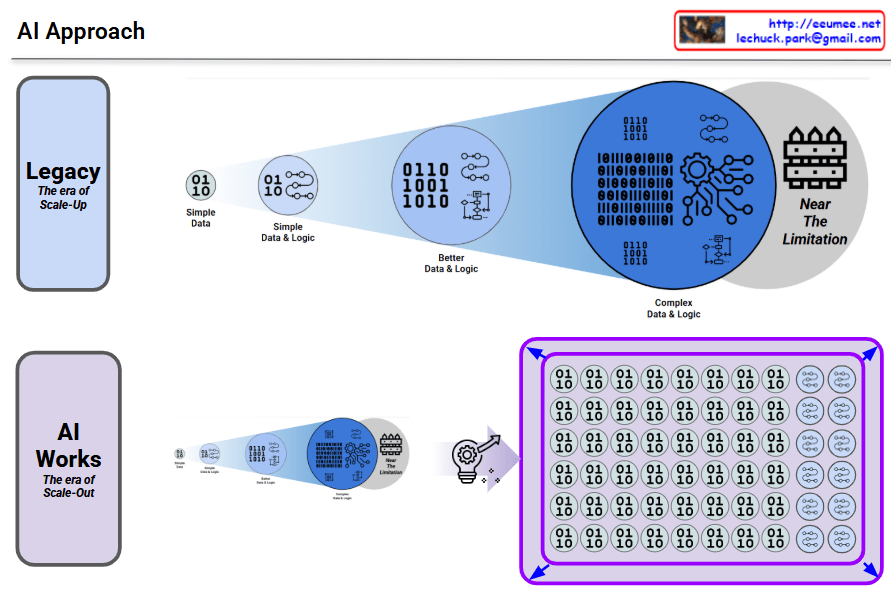
This image contrasts traditional programming, where developers must explicitly code rules and logic (shown with a flowchart and a thoughtful programmer), with AI, where neural networks automatically learn patterns from large amounts of data (depicted with a network diagram and a smiling programmer). It illustrates the paradigm shift from manually defining rules to machines learning patterns autonomously from data.
AI Workload Cooling Systems: Bidirectional Physical-Software Optimization
This image summarizes four cutting-edge research studies demonstrating the bidirectional optimization relationship between AI LLMs and cooling systems. It proves that physical cooling infrastructure and software workloads are deeply interconnected.
π Core Concept of Bidirectional Optimization
Direction 1: Physical Cooling β AI Performance Impact
Cooling methods directly affect LLM/VLM throughput and stability
Direction 2: AI Software β Cooling Control
LLMs themselves act as intelligent controllers for cooling systems
π Research Analysis
1. Physical Cooling Impact on AI Performance (2025 arXiv)
[Cooling HW β AI SW Performance]
Experiment: Liquid vs Air cooling comparison on H100 nodes
Physical Differences:
GPU Temperature: Liquid 41-50Β°C vs Air 54-72Β°C (up to 22Β°C difference)
GPU Power Consumption: 148-173W reduction
Node Power: ~1kW savings
Software Performance Impact:
Throughput: 54 vs 46 TFLOPs/GPU (+17% improvement)
Sustained and predictable performance through reduced throttling
Adaptive cooling strategies based on workload characteristics
3. Virtuous Cycle Effect
Better cooling β AI performance improvement β smarter cooling control
β Energy savings β more AI jobs β advanced cooling optimization
β Sustainable large-scale AI infrastructure
π― Practical Implications
These studies demonstrate:
Cooling is no longer passive infrastructure: It’s an active determinant of AI performance
AI optimizes its own environment: Meta-level self-optimizing systems
Hardware-software co-design is essential: Isolated optimization is suboptimal
Simultaneous achievement of sustainability and performance: Synergy, not trade-off
π Summary
These four studies establish that next-generation AI data centers must evolve into integrated ecosystems where physical cooling and software workloads interact in real-time to self-optimize. The bidirectional relationshipβwhere better cooling enables superior AI performance, and AI algorithms intelligently control cooling systemsβcreates a virtuous cycle that simultaneously achieves enhanced performance, energy efficiency, and sustainable scalability for large-scale AI infrastructure.
This image presents a diagram titled “New Era of Digitals” that illustrates the evolution of computing paradigms.
Overall Structure:
The diagram shows a progression from left to right, transitioning from being “limited by Humans” to achieving “Everything by Digitals.”
Key Stages:
Human Desire: The process begins with humans’ fundamental need to “wanna know it clearly,” representing our desire for understanding and knowledge.
Rule-Based Era (1000s):
Deterministic approach
Using Logics and Rules
Automation with Specific Rules
Record with a human recognizable format
Data-Driven Era:
Probabilistic approach (Not 100% But OK)
Massive Computing (Energy Resource)
Neural network-like structures represented by interconnected nodes
Core Message:
The diagram illustrates how computing has evolved from early systems that relied on human-defined explicit rules and logic to modern data-driven, probabilistic approaches. This represents the shift toward AI and machine learning, where we achieve “Not 100% But OK” results through massive computational resources rather than perfect deterministic rules.
The transition shows how we’ve moved from systems that required everything to be “human recognizable” to systems that can process and understand patterns beyond direct human comprehension, marking the current digital revolution where algorithms and data-driven approaches can handle complexity that exceeds traditional rule-based systems.
This illustration visualizes the evolution of data centers, contrasting the traditionally separated components with the modern AI data center where software, compute, network, and crucially, power and cooling systems are ‘tightly fused’ together. It emphasizes how power and advanced cooling are organically intertwined with GPU and memory, directly impacting AI performance and highlighting their inseparable role in meeting the demands of high-performance AI. This tight integration symbolizes a pivotal shift for the modern AI era.
This image demonstrates the critical impact of cooling stability on both LLM performance and energy efficiency in GPU servers through benchmark results.
Cascading Effects of Unstable Cooling
Problems with Unstable Air Cooling:
GPU Temperature: 54-72Β°C (high and unstable)
Thermal throttling occurs – where GPUs automatically reduce clock speeds to prevent overheating, leading to significant performance degradation
Result: Double penalty of reduced performance + increased power consumption
Energy Efficiency Impact:
Power Consumption: 8.16kW (high)
Performance: 46 TFLOPS (degraded)
Energy Efficiency: 5.6 TFLOPS/kW (poor performance-to-power ratio)
Benefits of Stable Liquid Cooling
Temperature Stability Achievement:
GPU Temperature: 41-50Β°C (low and stable)
No thermal throttling β sustained optimal performance
Energy Efficiency Improvement:
Power Consumption: 6.99kW (14% reduction)
Performance: 54 TFLOPS (17% improvement)
Energy Efficiency: 7.7 TFLOPS/kW (38% improvement)
Core Mechanisms: How Cooling Affects Energy Efficiency
Power Efficiency Optimization: Eliminates inefficient power consumption caused by overheating
Performance Consistency: Unstable cooling can cause GPUs to use 50% of power budget while delivering only 25% performance
Advanced cooling systems can achieve energy savings ranging from 17% to 23% compared to traditional methods. This benchmark paradoxically shows that proper cooling investment dramatically improves overall energy efficiency.
Final Summary
Unstable cooling triggers thermal throttling that simultaneously degrades LLM performance while increasing power consumption, creating a dual efficiency loss.Stable liquid cooling achieves 17% performance gains and 14% power savings simultaneously, improving energy efficiency by 38%.In AI infrastructure, adequate cooling investment is essential for optimizing both performance and energy efficiency.