Power for AI

AI Data Center Power Infrastructure: 3 Key Transformations

Traditional Data Center Power Structure (Baseline)

Power Grid → Transformer → UPS → Server (220V AC)

  • Single power grid connection
  • Standard UPS backup (10-15 minutes)
  • AC power distribution
  • 200-300W per server

3 Critical Changes for AI Data Centers

🔴 1. More Power (Massive Power Supply)

Key Changes:

  • Diversified power sources:
    • SMR (Small Modular Reactor) – Stable baseload power
    • Renewable energy integration
    • Natural gas turbines
    • Long-term backup generators + large fuel tanks

Why: AI chips (GPU/TPU) consume kW to tens of kW per server

  • Traditional server: 200-300W
  • AI server: 5-10 kW (25-50x increase)
  • Total data center power demand: Hundreds of MW scale

🔴 2. Stable Power (Power Quality & Conditioning)

Key Changes:

  • 800V HVDC system – High-voltage DC transmission
  • ESS (Energy Storage System) – Large-scale battery storage
  • Peak Shaving – Peak load control and leveling
  • UPS + Battery/Flywheel – Instantaneous outage protection
  • Power conditioning equipment – Voltage/frequency stabilization

Why: AI workload characteristics

  • Instantaneous power surges (during inference/training startup)
  • High power density (30-100 kW per rack)
  • Power fluctuation sensitivity – Training interruption = days of work lost
  • 24/7 uptime requirements

🔴 3. Server Power (High-Efficiency Direct DC Delivery)

Key Changes:

  • Direct-to-Chip DC power delivery
  • Rack-level battery systems (Lithium/Supercapacitor)
  • High-density power distribution

Why: Maximize efficiency

  • Eliminate AC→DC conversion losses (5-15% efficiency gain)
  • Direct chip-level power supply – Minimize conversion stages
  • Ultra-high rack density support (100+ kW/rack)
  • Even minor voltage fluctuations are critical – Chip-level stabilization needed

Key Differences Summary

CategoryTraditional DCAI Data Center
Power ScaleFew MWHundreds of MW
Rack Density5-10 kW/rack30-100+ kW/rack
Power MethodAC-centricHVDC + Direct DC
Backup PowerUPS (10-15 min)Multi-tier (Generator+ESS+UPS)
Power StabilityStandardExtremely high reliability
Energy SourcesSingle gridMultiple sources (Nuclear+Renewable)

Summary

AI data centers require 25-50x more power per server, demanding massive power infrastructure with diversified sources including SMRs and renewables

Extreme workload stability needs drive multi-tier backup systems (ESS+UPS+Generator) and advanced power conditioning with 800V HVDC

Direct-to-chip DC power delivery eliminates conversion losses, achieving 5-15% efficiency gains critical for 100+ kW/rack densities

#AIDataCenter #DataCenterPower #HVDC #DirectDC #EnergyStorageSystem #PeakShaving #SMR #PowerInfrastructure #HighDensityComputing #GPUPower #DataCenterDesign #EnergyEfficiency #UPS #BackupPower #AIInfrastructure #HyperscaleDataCenter #PowerConditioning #DCPower #GreenDataCenter #FutureOfComputing

With Claude

Programming … AI

This image contrasts traditional programming, where developers must explicitly code rules and logic (shown with a flowchart and a thoughtful programmer), with AI, where neural networks automatically learn patterns from large amounts of data (depicted with a network diagram and a smiling programmer). It illustrates the paradigm shift from manually defining rules to machines learning patterns autonomously from data.

#AI #MachineLearning #Programming #ArtificialIntelligence #AIvsTraditionalProgramming

Insights into DeepSeek-V3

This image presents an insights overview of DeepSeek-V3, highlighting its key technical innovations and architectural features.

Core Technical Components

1. MLA (Multi-Head Latent Attention)

  • Focuses on memory efficiency
  • Processes attention mechanisms through latent representations to reduce memory footprint

2. MoE (Mixture-of-Experts)

  • Enables cost-effective scaling
  • Activates only relevant experts for each input, reducing computational overhead while maintaining performance

3. FP8 Mixed-Precision Training

  • Achieves efficient computation
  • Combines FP8 and FP32 precision levels strategically

4. MTP (Multi-Token Prediction)

  • Enables faster autoregressive inference
  • Predicts multiple tokens simultaneously (“look ahead two or three letters instead of one at a time”)

5. Multi-Plane Network Topology

  • Provides scalable, efficient cluster networking
  • Acts like a multi-lane highway to prevent bottlenecks

Right Panel Technical Details

KV Cache Compression (latent space)

  • Handles long contexts with low memory and fast decoding

Aux-loss-free Load Balancing + Expert Parallel (All-to-All)

  • Reduces FLOPs/costs while maintaining training/inference performance

Weights/Matmul in FP8 + FP32 Accumulation

  • Computes in lightweight units but sums precisely for critical totals (lower memory, bandwidth, compute, stable accuracy)

Predict Multiple Tokens at Once During Training

  • Delivers higher speed and accuracy boosts in benchmarks

2-tier Fat-Tree × Multiple Planes (separated per RDMA-NIC pair)

  • Provides inter-plane congestion isolation, resilience, and reduced cost/latency

Summary

DeepSeek-V3 represents a comprehensive optimization of large language models through innovations in attention mechanisms, expert routing, mixed-precision training, multi-token prediction, and network architecture. These techniques collectively address the three critical bottlenecks: memory, computation, and communication. The result is a highly efficient model capable of scaling to massive sizes while maintaining cost-effectiveness and performance.

#DeepSeekV3 #LLM #MixtureOfExperts #EfficientAI #ModelOptimization #MultiTokenPrediction #FP8Training #LatentAttention #ScalableAI #AIInfrastructure

With Claude

DC Power(R)

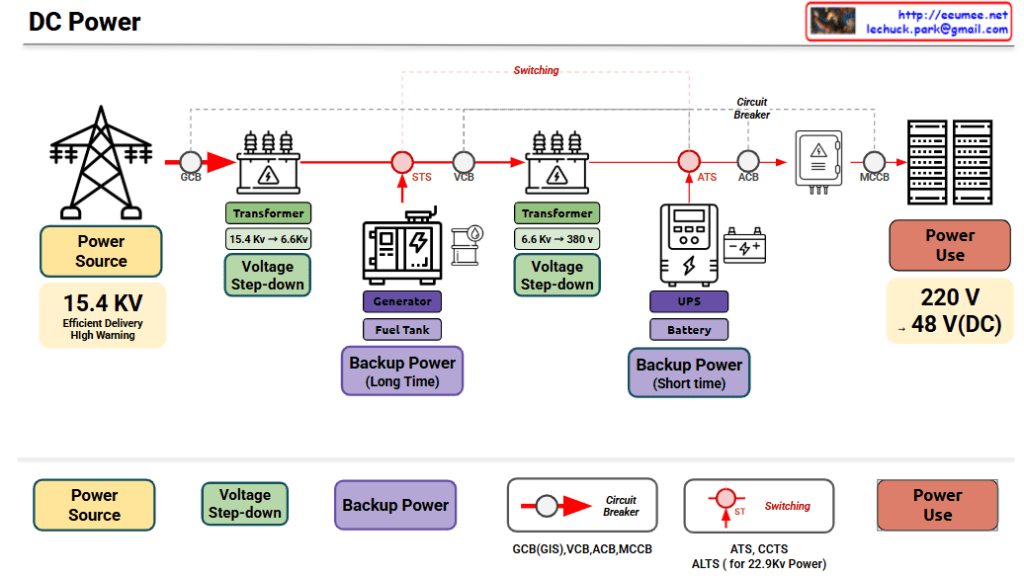
Data Center DC Power System Comprehensive Overview

This diagram illustrates the complete DC (Direct Current) power supply system for a data center infrastructure.

1. Core Components

① Power Source

  • 15.4 KV High Voltage AC Power
  • Received from utility grid
  • Efficient long-distance transmission (Efficient Delivery)
  • High voltage warning indicator (High Warning)

② Primary Transformer

  • Voltage conversion: 15.4 KV → 6.6 KV
  • Function: Steps down high voltage to medium voltage
  • Transformation method: Voltage Step-down
  • Adjusts voltage for internal data center distribution

③ Backup Power #1 – Generator System (Long-Time Backup)

  • Configuration: Diesel generator + Fuel tank
  • Characteristic: Long-duration backup capability
  • Purpose: Continuous power supply during main power outage
  • Advantage: Unlimited operation as long as fuel is supplied

④ Secondary Transformer

  • Voltage conversion: 6.6 KV → 380 V
  • Function: Steps down medium voltage to low voltage
  • Transformation method: Voltage Step-down
  • Provides appropriate voltage for UPS and final loads

⑤ Backup Power #2 – UPS System (Short-Time Backup)

  • Configuration: UPS + Battery
  • Characteristic: Short-duration instantaneous backup
  • Purpose: Ensures uninterrupted power during main-to-generator transition
  • Role: Supplies power during generator startup time (10-30 seconds)

⑥ Final Load (Power Use)

  • Output voltage: 220 V AC or 48 V DC
  • Target: Servers, network equipment, storage systems
  • Feature: Stable IT infrastructure operation with DC power

2. Voltage Conversion Flow

15.4 KV (AC)  →  6.6 KV (AC)  →  380 V (AC)  →  48 V (DC) / 220 V
  [Reception]   [Primary TX]   [Secondary TX]   [Final Conversion]

3. Redundant Backup Architecture

Two-Tier Backup System

Main Power (15.4 KV) ─────┐
                          ├──→ Transform ──→ Load
Generator (Long-term) ────┘
         ↓
    UPS/Battery (Short-term) ──→ Instantaneous uninterrupted guarantee

Backup Strategy:

  • Generator: Hours to days operation (fuel-dependent)
  • UPS: Minutes to tens of minutes operation (battery capacity-dependent)
  • Combined effect: UPS covers generator startup gap to achieve complete uninterrupted power

4. Operating Scenarios

Scenario 1: Normal Operation

Utility power (15.4KV) → Primary transform (6.6KV) → Secondary transform (380V) → UPS → DC load (48V)

Scenario 2: Momentary Power Outage

  1. Main power interruption detected (< 4ms)
  2. UPS battery immediately engaged
  3. Continuous power supply to load with zero interruption

Scenario 3: Extended Power Outage

  1. Main power interruption detected
  2. UPS battery immediately engaged (maintains uninterrupted power)
  3. Generator automatically starts (10-30 seconds required)
  4. Generator reaches rated capacity and replaces main power
  5. Generator power charges UPS + supplies load
  6. Long-term operation with continuous fuel supply

Scenario 4: Generator Failure

  • Limited-time operation within UPS battery capacity
  • Priority operation for critical systems or graceful shutdown

5. Additional Protection and Control Devices

Supplementary devices for system stability and safety:

Circuit Breaker Hierarchy

  • GCB (Generator Circuit Breaker): Primary protection at reception point
  • VCB (Vacuum Circuit Breaker): Vacuum interruption, medium voltage protection
  • ACB (Air Circuit Breaker): Low voltage distribution panel protection
  • MCCB (Molded Case Circuit Breaker): Individual load protection
  • Role: Circuit interruption during overload or short circuit to protect equipment and personnel

Switching Devices

  • STS (Static Transfer Switch): High-speed transfer between main power ↔ generator
  • ATS (Automatic Transfer Switch): Automatic transfer between power sources ( UPS level)
  • ALTS (Automatic Load Transfer Switch): Automatic load transfer ( for 22.9kV class)
  • CCTS: Circuit breaker control and transfer system
  • Role: Automatic/immediate transfer to backup power during power failure

Switching Points (Red circle indicators)

  • Reception point, before/after transformers, backup power injection points
  • Critical points for power path changes and redundancy implementation

6. Key System Features

Uninterruptible Power Supply: Three-stage protection with main power → generator → UPS
Multi-stage Voltage Conversion: Ensures both transmission efficiency and usage safety
Automated Backup Transfer: Automatic switching without human intervention
Hierarchical Protection: Stage-by-stage circuit breakers prevent cascading failures
Scalable Architecture: Modular configuration enables easy capacity expansion


Summary

This DC power system architecture ensures continuous, uninterrupted operation of mission-critical data center infrastructure through a sophisticated combination of redundant power sources, automated failover mechanisms, and multi-layered protection systems. The integration of long-term generator backup and short-term UPS battery systems creates a seamless power continuity solution that can handle any grid interruption scenario. The multi-stage voltage transformation (15.4KV → 6.6KV → 380V → 48V DC) optimizes both transmission efficiency and end-user safety while providing flexibility for diverse IT equipment requirements.


#DataCenter #DCPower #PowerSystems #CriticalInfrastructure #UPS #BackupPower #DataCenterDesign #ElectricalEngineering #PowerDistribution #MissionCritical #DataCenterInfrastructure #FacilityManagement #PowerReliability #UninterruptiblePowerSupply #DataCenterOperations

With Claude

Evolution … Changes

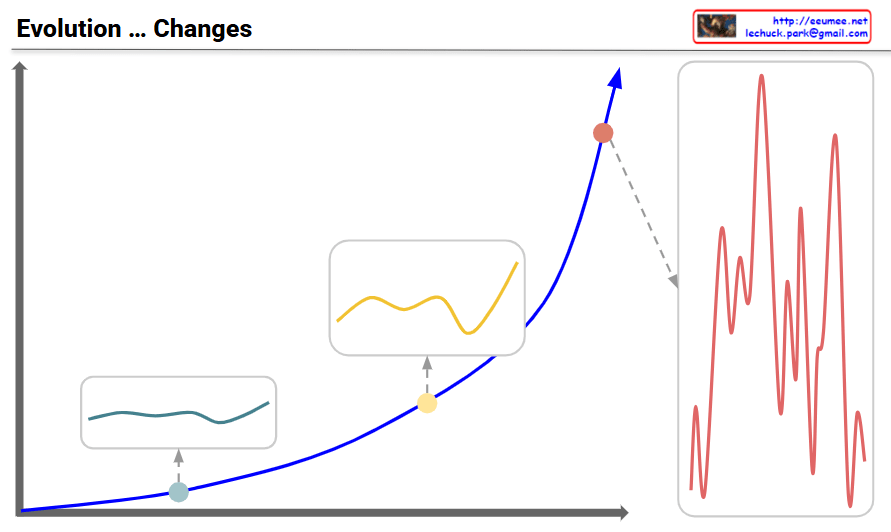
Evolution and Changes: Navigating Through Transformation

Overview:

Main Graph (Blue Curve)

  • Shows the pattern of evolutionary change transitioning from gradual growth to exponential acceleration over time
  • Three key developmental stages are marked with distinct points

Three-Stage Development Process:

Stage 1: Initial Phase (Teal point and box – bottom left)

  • Very gradual and stable changes
  • Minimal volatility with a flat curve
  • Evolutionary changes are slow and predictable
  • Response Strategy: Focus on incremental improvements and stable maintenance

Stage 2: Intermediate Phase (Yellow point and box – middle)

  • Fluctuations begin to emerge
  • Volatility increases but remains limited
  • Transitional period showing early signs of change
  • Response Strategy: Detect change signals and strengthen preparedness

Stage 3: Turbulent Phase (Red point and box on right – top)

  • Critical turning point where exponential growth begins
  • Volatility maximizes with highly irregular and large-amplitude changes
  • The red graph on the right details the intense and frequent fluctuations during this period
  • Characterized by explosive and unpredictable evolutionary changes
  • Response Imperative: Rapid and flexible adaptation is essential for survival in the face of high volatility and dramatic shifts

Key Message:

Evolution progresses through stable initial phases → emerging changes in the intermediate period → explosive transformation in the turbulent phase. During the turbulent phase, volatility peaks, making the ability to anticipate and actively respond critical for survival and success. Traditional stable approaches become obsolete; rapid adaptation and innovative transformation become essential.


#Evolution #Change #Transformation #Adaptation #Innovation #DigitalTransformation

With Claude

AI goes exponentially with ..

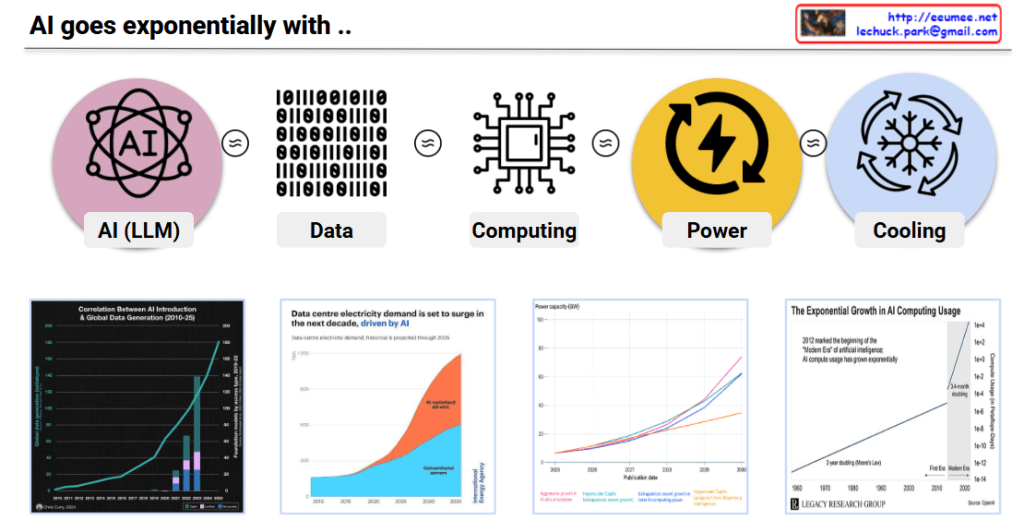
This infographic illustrates how AI’s exponential growth triggers a cascading exponential expansion across all interconnected domains.

Core Concept: Exponential Chain Reaction

Top Process Chain: AI’s exponential growth creates proportionally exponential demands at each stage:

  • AI (LLM)DataComputingPowerCooling

The “≈” symbol indicates that each element grows exponentially in proportion to the others. When AI doubles, the required data, computing, power, and cooling all scale proportionally.

Evidence of Exponential Growth Across Domains

1. AI Networking & Global Data Generation (Top Left)

  • Exponential increase beginning in the 2010s
  • Vertical surge post-2020

2. Data Center Electricity Demand (Center Left)

  • Sharp increase projected between 2026-2030
  • Orange (AI workloads) overwhelms blue (traditional workloads)
  • AI is the primary driver of total power demand growth

3. Power Production Capacity (Center Right)

  • 2005-2030 trends across various energy sources
  • Power generation must scale alongside AI demand

4. AI Computing Usage (Right)

  • Most dramatic exponential growth
  • Modern AI era begins in 2012
  • Doubling every 6 months (extremely rapid exponential growth)
  • Over 300,000x increase since 2012
  • Three exponential growth phases shown (1e+0, 1e+2, 1e+4, 1e+6)

Key Message

This infographic demonstrates that AI development is not an isolated phenomenon but triggers exponential evolution across the entire ecosystem:

  • As AI models advance → Data requirements grow exponentially
  • As data increases → Computing power needs scale exponentially
  • As computing expands → Power consumption rises exponentially
  • As power consumption grows → Cooling systems must expand exponentially

All elements are tightly interconnected, creating a ‘cascading exponential effect’ where exponential growth in one domain simultaneously triggers exponential development and demand across all other domains.


#ArtificialIntelligence #ExponentialGrowth #AIInfrastructure #DataCenters #ComputingPower #EnergyDemand #TechScaling #AIRevolution #DigitalTransformation #Sustainability #TechInfrastructure #MachineLearning #LLM #DataScience #FutureOfAI #TechTrends #TechnologyEvolution

With Claude