Labeling for AI World

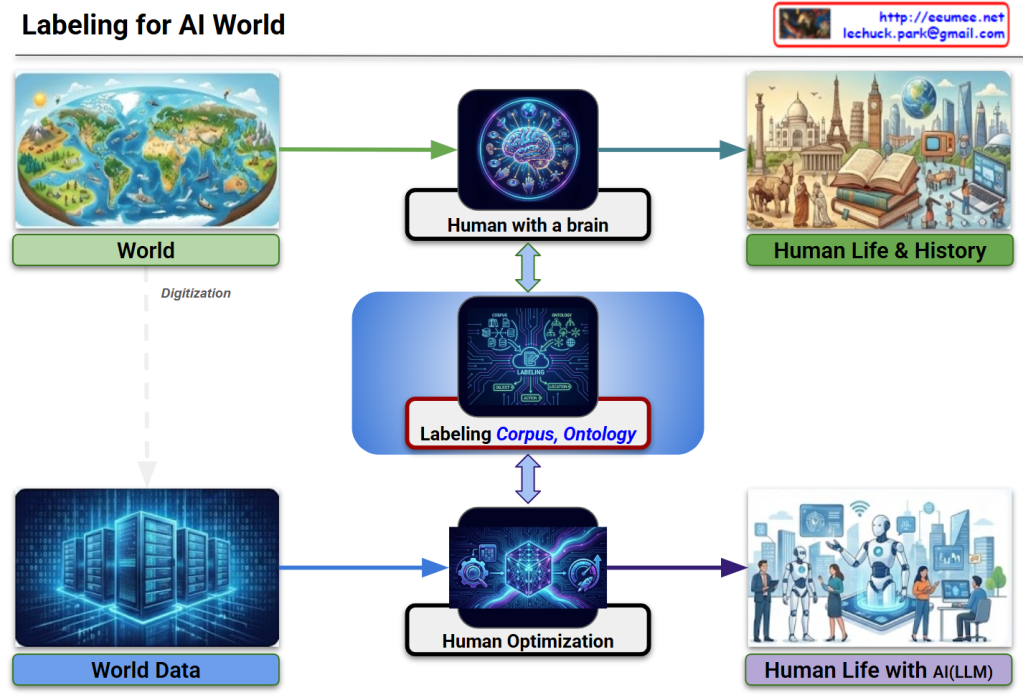
The image illustrates a logical framework titled “Labeling for AI World,” which maps how human cognitive processes are digitized and utilized to train Large Language Models (LLMs). It emphasizes the transition from natural human perception to optimized AI integration.


1. The Natural Cognition Path (Top)

This track represents the traditional human experience:

  • World to Human with a Brain: Humans sense the physical world through biological organs, which the brain then analyzes and processes into information.
  • Human Life & History: This cognitive processing results in the collective knowledge, culture, and documented history of humanity.

2. The Digital Optimization Path (Bottom)

This track represents the technical pipeline for AI development:

  • World Data: Through Digitization, the physical world is converted into raw data stored in environments like AI Data Centers.
  • Human Optimization: This raw data is refined through processes like RLHF (Reinforcement Learning from Human Feedback) or fine-tuning to align AI behavior with human intent.
  • Human Life with AI (LLM): The end goal is a lifestyle where humans and LLMs coexist, with the AI acting as a sophisticated partner in daily life.

3. The Central Bridge: Labeling (Corpus & Ontology)

The most critical element of the diagram is the central blue box, which acts as a bridge between human logic and machine processing:

  • Corpus: Large-scale structured text data necessary for training.
  • Ontology: The formal representation of categories, properties, and relationships between concepts that define the human “worldview.”
  • The Link: High-quality Labeling ensures that AI optimization is grounded in human-defined logic (Ontology) and comprehensive language data (Corpus), ensuring both Quality and Optimization.

Summary

The diagram demonstrates that Data Labeling, guided by Corpus and Ontology, is the essential mechanism that translates human cognition into the digital realm. It ensures that LLMs are not just processing raw numbers, but are optimized to understand the world through a human-centric logical framework.

#AI #DataLabeling #LLM #Ontology #Corpus #CognitiveComputing #AIOptimization #DigitalTransformation

With Gemini
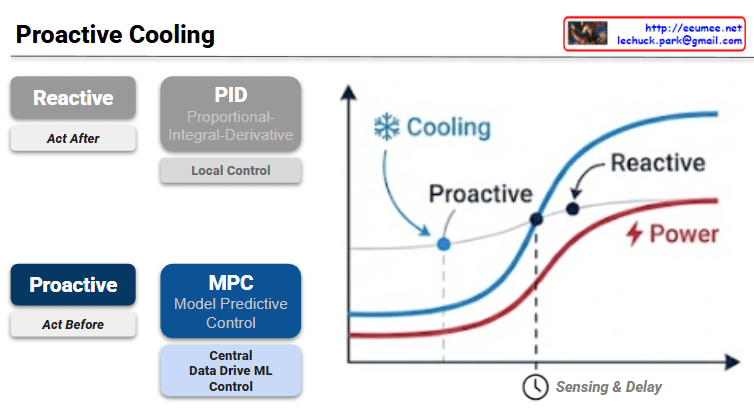
Proactive Cooling

The provided image illustrates the fundamental shift in data center thermal management from traditional Reactive methods to AI-driven Proactive strategies.


1. Comparison of Control Strategies

The slide contrasts two distinct approaches to managing the cooling load in a high-density environment, such as an AI data center.

FeatureReactive (Traditional)Proactive (Advanced)
PhilosophyAct After: Responds to changes.Act Before: Anticipates changes.
MechanismPID Control: Proportional-Integral-Derivative.MPC: Model Predictive Control.
ScopeLocal Control: Focuses on individual units/sensors.Central ML Control: Data-driven, system-wide optimization.
LogicFeedback-based (error correction).Feedforward-based (predictive modeling).

2. Graph Analysis: The “Sensing & Delay” Factor

The graph on the right visualizes the efficiency gap between these two methods:

  • Power (Red Line): Represents the IT load or power consumption which generates heat.
  • Sensing & Delay: There is a temporal gap between when a server starts consuming power and when the cooling system’s sensors detect the temperature rise and physically ramp up the fans or chilled water flow.
  • Reactive Cooling (Dashed Blue Line): Because it “acts after,” the cooling response lags behind the power curve. This often results in thermal overshoot, where the hardware momentarily operates at higher temperatures than desired, potentially triggering throttling.
  • Proactive Cooling (Solid Blue Line): By using Model Predictive Control (MPC), the system predicts the impending power spike. It initiates cooling before the heat is fully sensed, aligning the cooling curve more closely with the power curve to maintain a steady temperature.

3. Technical Implications for AI Infrastructure

In modern data centers, especially those handling fluctuating AI workloads (like LLM training or high-concurrency inference), the “Sensing & Delay” in traditional PID systems can lead to significant energy waste and hardware stress. MPC leverages historical data and real-time telemetry to:

  1. Reduce PUE (Power Usage Effectiveness): By avoiding over-cooling and sudden spikes in fan power.
  2. Improve Reliability: By maintaining a constant thermal envelope, reducing mechanical stress on chips.
  3. Optimize Operational Costs: Through centralized, intelligent resource allocation.

Summary

  1. Proactive Cooling utilizes Model Predictive Control (MPC) and Machine Learning to anticipate heat loads before they occur.
  2. Unlike traditional PID systems that respond to temperature errors, MPC eliminates the Sensing & Delay lag by acting on predicted power spikes.
  3. This shift enables superior energy efficiency and thermal stability, which is critical for high-density AI data center operations.

#DataCenter #AICooling #ModelPredictiveControl #MPC #ThermalManagement #EnergyEfficiency #SmartInfrastructure #PUEOptimization #MachineLearning

With Gemini

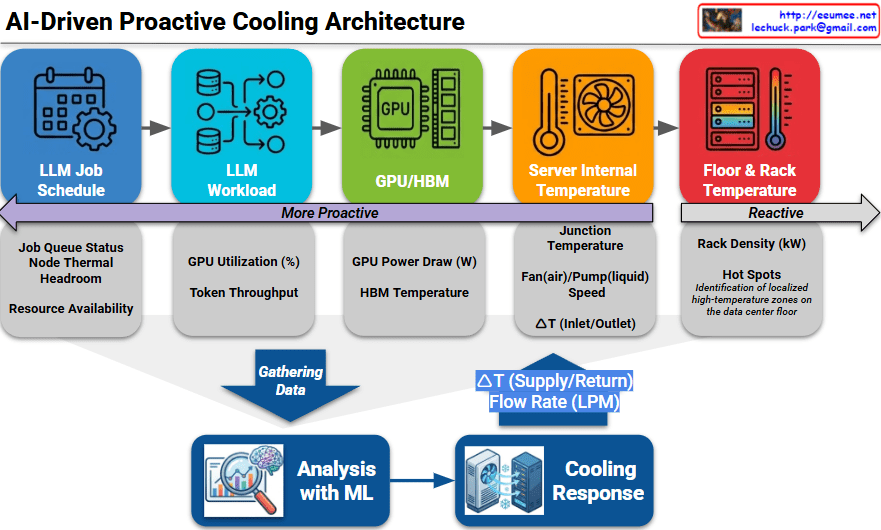
AI-Driven Proactive Cooling Architecture

The provided image illustrates an AI-Driven Proactive Cooling Architecture, detailing a sophisticated pipeline that transforms operational data into precise thermal management.


1. The Proactive Data Hierarchy

The architecture categorizes data sources along a spectrum, moving from “More Proactive” (predicting future heat) to “Reactive” (measuring existing heat).

  • LLM Job Schedule (Most Proactive): This layer looks at the job queue, node thermal headroom, and resource availability. It allows the system to prepare for heat before the first calculation even begins.
  • LLM Workload: Monitors real-time GPU utilization (%) and token throughput to understand the intensity of the current processing task.
  • GPU / HBM: Captures direct hardware telemetry, including GPU power draw (Watts) and High Bandwidth Memory (HBM) temperatures.
  • Server Internal Temperature: Measures the junction temperature, fan/pump speeds, and the $\Delta T$ (temperature difference) between server inlet and outlet.
  • Floor & Rack Temperature (Reactive): The traditional monitoring layer that identifies hot spots and rack density (kW) once heat has already entered the environment.

2. The Analysis and Response Loop

The bottom section of the diagram shows how this multi-layered data is converted into action:

  • Gathering Data: Telemetry from all five layers is aggregated into a central repository.
  • Analysis with ML: A Machine Learning engine processes this data to predict thermal trends. It doesn’t just look at where the temperature is now, but where it will be in the next few minutes based on the workload.
  • Cooling Response: The ML insights trigger physical adjustments in the cooling infrastructure, specifically controlling the $\Delta T$ (Supply/Return) and Flow Rate (LPM – Liters Per Minute) of the coolant.

3. Technical Significance

By shifting the control logic “left” (toward the LLM Job Schedule), data centers can eliminate the thermal lag inherent in traditional systems. This is particularly critical for AI infrastructure, where GPU power consumption can spike almost instantaneously, often faster than traditional mechanical cooling systems can ramp up.


Summary

  1. This architecture shifts cooling from a reactive sensor-based model to a proactive workload-aware model using AI/ML.
  2. It integrates data across the entire stack, from high-level LLM job queues down to chip-level GPU power draw and rack temperatures.
  3. The ML engine predicts thermal demand to dynamically adjust coolant flow rates and supply temperatures, significantly improving energy efficiency and hardware longevity.

#AICooling #DataCenterInfrastructure #ProactiveCooling #GPUManagement #LiquidCooling #LLMOps #ThermalManagement #EnergyEfficiency #SmartDC

With Gemini

AI Model Optimizations


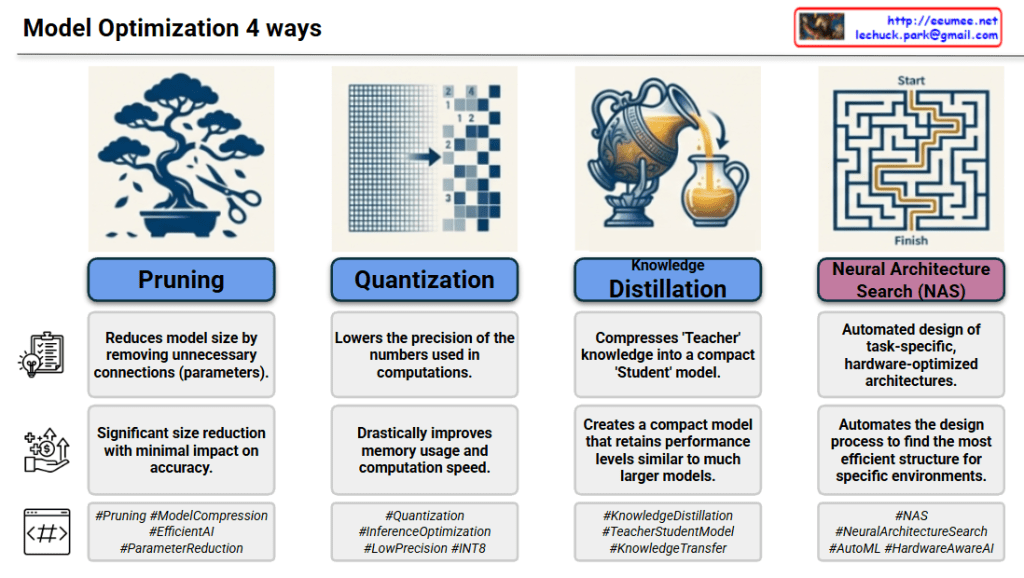
4 Key Methods of Model Optimization

1. Pruning

  • Analogy: Trimming a bonsai tree by cutting off unnecessary branches.
  • Description: This method involves removing redundant or non-essential connections (parameters) within a neural network that do not significantly contribute to the output.
  • Key Benefit: It leads to a significant reduction in model size with minimal impact on accuracy.

2. Quantization

  • Analogy: Reducing the resolution of a grid to make it simpler.
  • Description: This technique lowers the numerical precision of the weights and activations (e.g., converting 32-bit floating-point numbers to 8-bit integers).
  • Key Benefit: It drastically improves memory efficiency and increases computation speed, which is essential for mobile or edge devices.

3. Knowledge Distillation

  • Analogy: Pouring the contents of a large pitcher into a smaller, more efficient cup.
  • Description: A large, complex pre-trained model (the Teacher) transfers its “knowledge” to a smaller, more compact model (the Student).
  • Key Benefit: The Student model achieves performance levels close to the Teacher model but remains much faster and lighter.

4. Neural Architecture Search (NAS)

  • Analogy: Finding the fastest path through a complex maze.
  • Description: Instead of human engineers designing the network, algorithms automatically search for and design the most optimal architecture for a specific task or hardware.
  • Key Benefit: It automates the creation of the most efficient structure tailored to specific environments or performance requirements.

Summary

  1. Efficiency: These techniques reduce AI model size and power consumption while maintaining high performance.
  2. Deployment: Optimization is crucial for running advanced AI on hardware-constrained devices like smartphones and IoT sensors.
  3. Automation: Methods like NAS move beyond manual design to find the mathematically perfect structure for any given hardware.

#AI #DeepLearning #ModelOptimization #Pruning #Quantization #KnowledgeDistillation #NAS #EdgeAI #EfficientAI #MachineLearning

With Gemini

AI Model 3 Works


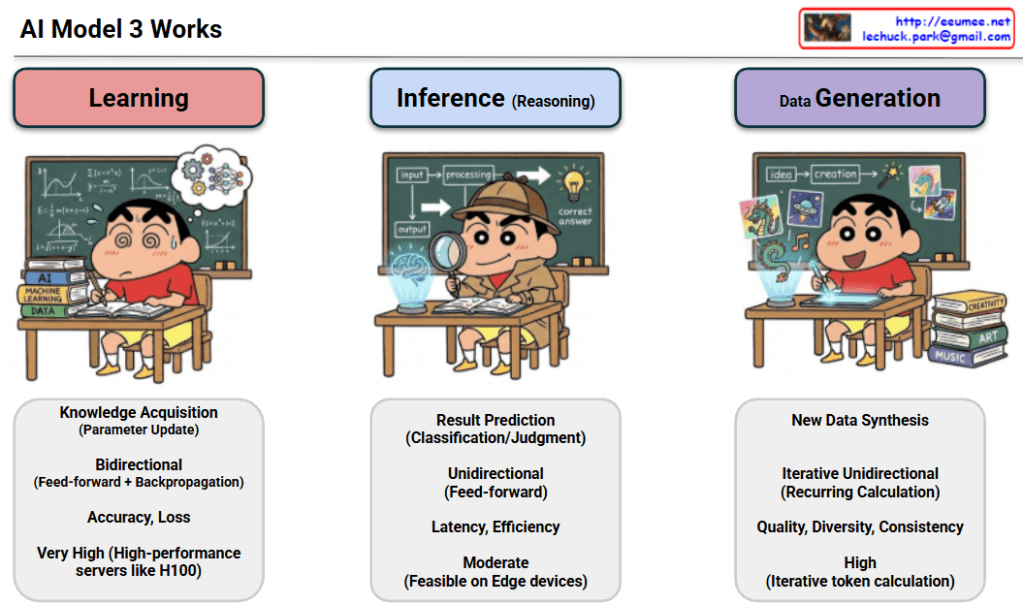
Analysis of AI Model 3 Works

The provided image illustrates the three core stages of how AI models operate: Learning, Inference, and Data Generation.

1. Learning

  • Goal: Knowledge acquisition and parameter updates. This is the stage where the AI “studies” data to find patterns.
  • Mechanism: Bidirectional (Feed-forward + Backpropagation). It processes data to get a result and then goes backward to correct errors by adjusting internal weights.
  • Key Metrics: Accuracy and Loss. The objective is to minimize loss to increase the model’s precision.
  • Resource Requirement: Very High. It requires high-performance server clusters equipped with powerful GPUs like the NVIDIA H100.

2. Inference (Reasoning)

  • Goal: Result prediction, classification, and judgment. This is using a pre-trained model to answer specific questions (e.g., “What is in this picture?”).
  • Mechanism: Unidirectional (Feed-forward). Data simply flows forward through the model to produce an output.
  • Key Metrics: Latency and Efficiency. The focus is on how quickly and cheaply the model can provide an answer.
  • Resource Requirement: Moderate. It is efficient enough to be feasible on “Edge devices” like smartphones or local PCs.

3. Data Generation

  • Goal: New data synthesis. This involves creating entirely new content like text, images, or music (e.g., Generative AI like ChatGPT).
  • Mechanism: Iterative Unidirectional (Recurring Calculation). It generates results piece by piece (token by token) in a repetitive process.
  • Key Metrics: Quality, Diversity, and Consistency. The focus is on how natural and varied the generated output is.
  • Resource Requirement: High. Because it involves iterative calculations for every single token, it requires more power than simple inference.

Summary

  1. AI processes consist of Learning (studying data), Inference (applying knowledge), and Data Generation (creating new content).
  2. Learning requires massive server power for bidirectional updates, while Inference is optimized for speed and can run on everyday devices.
  3. Data Generation synthesizes new information through repetitive, iterative calculations, requiring high resources to maintain quality.

#AI #MachineLearning #GenerativeAI #DeepLearning #TechExplained #AIModel #Inference #DataScience #Learning #DataGeneration

With Gemini