2 GPU Throttling

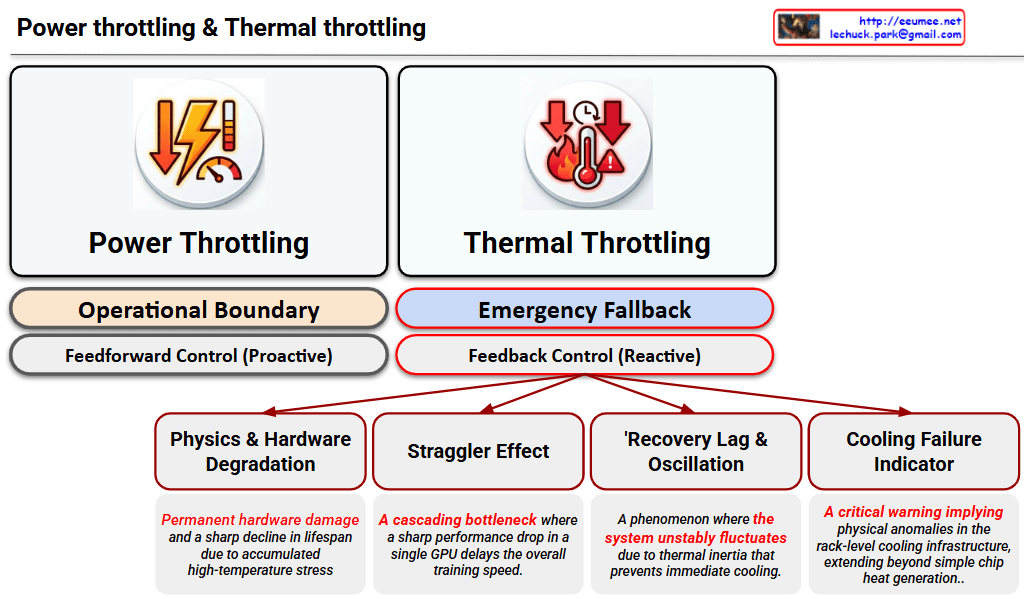
This image is a Visual Engineering diagram that contrasts the fundamental control mechanisms of Power Throttling and Thermal Throttling at a glance, specifically highlighting the critical impact thermal throttling has on the system.


1. Philosophical and Structural Contrast (Top Section)

The diagram places the two throttling methods side-by-side, clearly distinguishing them not just as similar performance limiters, but as mechanisms with completely different operational philosophies.

  • Left: Power Throttling
    • Operational Boundary: Indicates that this acts as a safety line, keeping the system operating ‘normally’ within its designed power limits.
    • Feedforward Control (Proactive): Specifies that this is a proactive control method that restricts input (power demand) before a negative result occurs, fundamentally preventing the issue from happening.
  • Right: Thermal Throttling
    • Emergency Fallback: Shows that this is not a normal operational state, but a ‘last line of defense’ triggered to prevent physical destruction.
    • Feedback Control (Reactive): Emphasizes that this is a reactive control method that drops clock speeds only after detecting the result (high heat exceeding the safe threshold).

2. Four Fatal Risks of Thermal Throttling (Bottom Tree Structure)

The core strength of the diagram lies in placing the sub-tree structure exclusively under Thermal Throttling. This highlights that this phenomenon goes beyond a simple performance drop, breaking down its complex, detrimental impacts on the infrastructure into four key factors:

  1. Physics & Hardware Degradation: Refers to direct damage to semiconductors (silicon) and the shortening of their lifespan (MTBF) due to the accumulated stress of high heat.
  2. Straggler Effect: Points out the bottleneck phenomenon in environments like distributed AI training. A delay in a single, thermally throttled node drags down the synchronization and data processing speed of the entire cluster.
  3. Thermal Inertia & Thermal Oscillations: Describes the unstable fluctuation of system performance. Because heat does not dissipate instantly (thermal inertia), the system repeatedly drops and recovers clock speeds, causing the performance to oscillate.
  4. Cooling Failure Indicator: Acts as a severe alarm. It implies that the issue extends beyond a hot chip—it indicates that the facility’s infrastructure, such as the rack-level Direct Liquid Cooling (DLC) capacity, has reached its physical limit or experienced an anomaly.

Overall Summary:

The diagram logically and intuitively delivers a powerful core message: “Power Throttling is a normal, proactive control within predictable bounds, whereas Thermal Throttling is a severe, reactive warning at both the hardware and infrastructure levels after control is lost.” It is an excellent piece of work that elegantly structures complex system operations using concise text and layout.

#DataCenter #AIInfrastructure #GPUCooling #ThermalThrottling #PowerThrottling #HardwareEngineering #HighPerformanceComputing #LiquidCooling #SystemArchitecture
New Risk @ AI DC

Overview: New Risks at AI Data Centers

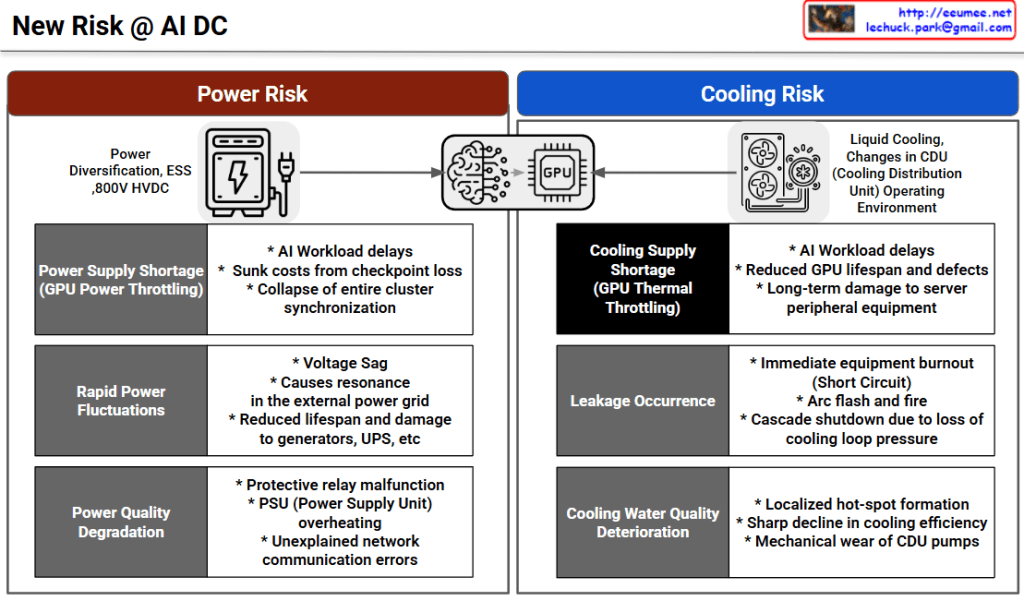
The image outlines the infrastructure challenges faced by modern AI Data Centers (AI DC), specifically focusing on the high demands placed on hardware like GPUs. It divides these challenges into two primary categories: Power Risk and Cooling Risk.

The central graphic illustrates that the core AI processing units (Brains/GPUs) are entirely dependent on these two foundational elements.


⚡ Power Risk

This section highlights issues related to power supply and infrastructure (such as Power Diversification, ESS, and 800V HVDC).

  • Power Supply Shortage (GPU Power Throttling): When the facility cannot provide enough power, GPUs slow down to compensate.
    • Impacts: Delays in AI workloads, financial losses due to lost data checkpoints, and the collapse of synchronization across the entire computing cluster.
  • Rapid Power Fluctuations: Sudden spikes or drops in the power supply.
    • Impacts: Voltage sag, electrical resonance in external grids, and reduced lifespan or physical damage to backup power systems like generators and UPS (Uninterruptible Power Supplies).
  • Power Quality Degradation: When the provided electricity is “noisy” or unstable.
    • Impacts: Malfunctions in protective electrical relays, overheating of server Power Supply Units (PSUs), and unexplained network communication errors.

❄️ Cooling Risk

This section focuses on the challenges of managing the massive heat generated by AI workloads, specifically looking at Liquid Cooling and changes in Cooling Distribution Unit (CDU) environments.

  • Cooling Supply Shortage (GPU Thermal Throttling): When the cooling system cannot remove heat fast enough, GPUs slow down to prevent melting.
    • Impacts: Delays in AI workloads, reduced lifespan and increased defects in GPUs, and long-term damage to surrounding server equipment.
  • Leakage Occurrence: Physical leaks in the liquid cooling system.
    • Impacts: Immediate equipment burnout (short circuits), risk of electrical arc flashes and fires, and cascading system shutdowns due to a loss of pressure in the cooling loop.
  • Cooling Water Quality Deterioration: When the liquid used for cooling becomes contaminated or degrades.
    • Impacts: Formation of localized “hot-spots” where cooling fails, a sharp decline in overall cooling efficiency, and mechanical wear and tear on the CDU pumps.

📝 Summary

  1. AI Data Centers face critical new infrastructure risks divided into two main categories: supplying massive amounts of power and managing extreme heat.
  2. Power-related risks (shortages, fluctuations, and poor quality) lead to severe workload delays, cluster synchronization failures, and damage to backup generators.
  3. Cooling-related risks (insufficient cooling, leaks, and poor water quality) cause thermal throttling, severe hardware damage, and potentially catastrophic fires.

#AIDataCenter #DataCenterInfrastructure #GPUPower #LiquidCooling #DataCenterRisk #ThermalThrottling #TechInfrastructure

With Gemini