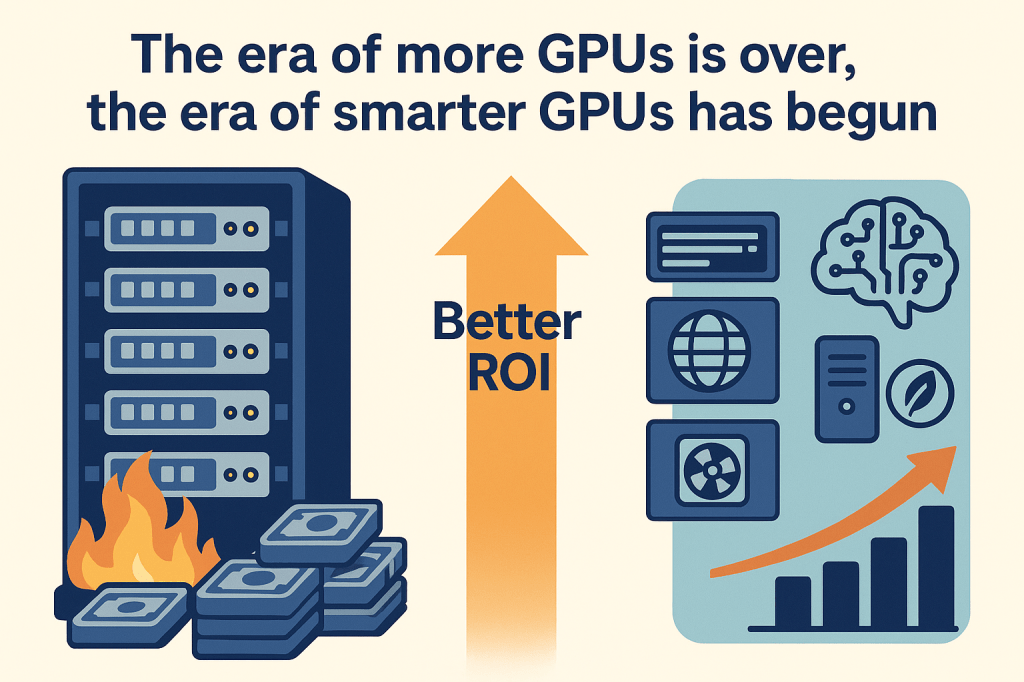
This illustration contrasts an old approach of endlessly adding more GPU servers, burning money for little gain, with a new era where AI-driven optimization of software, network, cooling and power delivers smarter GPUs and a much better ROI.
The Computing for the Fair Human Life.
This illustration contrasts an old approach of endlessly adding more GPU servers, burning money for little gain, with a new era where AI-driven optimization of software, network, cooling and power delivers smarter GPUs and a much better ROI.

This illustration visualizes the evolution of data centers, contrasting the traditionally separated components with the modern AI data center where software, compute, network, and crucially, power and cooling systems are ‘tightly fused’ together. It emphasizes how power and advanced cooling are organically intertwined with GPU and memory, directly impacting AI performance and highlighting their inseparable role in meeting the demands of high-performance AI. This tight integration symbolizes a pivotal shift for the modern AI era.

This diagram visualizes the core concept that all components must be organically connected and work together to successfully operate AI workloads.
Continuity of Data Flow
Cooperative Computing Resource Operations
Integrated Software Control Management
Infrastructure-based Stability Assurance
In AI systems, the weakest link determines overall performance. For example, no matter how powerful the GPU, if memory bandwidth is insufficient or cooling is inadequate, the entire system cannot achieve its full potential. Therefore, balanced design and integrated management of all components is crucial for AI workload success.
The diagram emphasizes that AI infrastructure is not just about having powerful individual components, but about creating a holistically optimized ecosystem where every element supports and enhances the others.
With Claude

This infographic illustrates a software development philosophy titled “There’s such thing as ‘impossible’.” It emphasizes that there are real limitations in development:
The overall message highlights that impossibility does exist in software development due to real-world constraints of time, energy, and resources. It emphasizes the importance of acknowledging these limitations and addressing them through clear problem definition and priority setting for effective development.
With Claude

From Claude with some prompting
This image illustrates an Automation process, consisting of two main parts:
The hammer icon represents manual interventions, working in tandem with automated software systems to enhance overall process efficiency. This approach aims to achieve optimal results by combining human involvement with automation systems.
The image demonstrates how automation integrates real-world tasks with software systems to increase efficiency and reduce costs and resources.

From Claude with some prompting
This image illustrates the concept of abstraction and overlay using software-defined systems. At the top, it shows hardware represented by servers, software as a user interface, and control as a cursor icon. Below, it demonstrates that complex hardware becomes more abstracted through software-defined systems.
The software layer acts as an overlay that simplifies and abstracts the underlying complex hardware infrastructure. This logical abstraction enables automated control and management of the hardware resources through software interfaces.
The image conveys how software-defined approaches decouple the control and management functions from the physical hardware, enabling more flexibility, scalability, and automation in managing IT infrastructure. The progression from hardware to software, and then to logical abstraction and automated control, highlights the benefits of software-defined systems in modern computing environments.

From DALL-E with some prompting
The image illustrates the interaction between an alert system and a data analysis system, comprised of two distinct stages:
Raw Level Hardware (HW) Alert Detection:
This stage emphasizes internal alarms, which are hardwired to ensure that alerts are raised in critical situations without any buffering, allowing for the fastest possible alarm detection. The message “Don’t forget This Step is required” underscores the indispensability of this stage.
Analyzed Software (SW) Alert Detection:
Data passes through storage devices to analysis tools, where it can be subject to delays or potential loss. The data is analyzed by code, enabling advanced analysis with AI. However, the phrase “Even though You have a wonderful Data Analysis System” reiterates the importance of raw-level alert detection, regardless of the sophistication of the data analysis system.
Overall, the image indicates that raw-level alerts are crucial for immediate response needs, and while advanced data analysis can enhance system alerting and monitoring, it cannot replace the need for immediate alert mechanisms. The title “Never miss an alert” emphasizes the critical nature of these alert systems.
 Lechuck Park