Together is not easy

This infographic titled “Together” emphasizes the critical importance of parallel processing = working together across all domains – computing, AI, and human society.

Core Concept:

The Common Thread Across All 5 Domains – ‘Parallel Processing’:

  1. Parallel Processing – Simultaneous task execution in computer systems
  2. Deep Learning – AI’s multi-layered neural networks learning in parallel
  3. Multi Processing – Collaborative work across multiple processors
  4. Co-work – Human collaboration and teamwork
  5. Social – Collective cooperation among community members

Essential Elements of Parallel Processing:

  • Sync (Synchronization) – Coordinating all components to work harmoniously
  • Share (Sharing) – Efficient distribution of resources and information
  • Optimize (Optimization) – Maximizing performance while minimizing energy consumption
  • Energy (Energy) – The inevitable cost required when working together

Reinterpreted Message: “togetherness is always difficult, but it’s something we have to do.”

This isn’t merely about the challenges of cooperation. Rather, it conveys that parallel processing (working together) in all systems requires high energy costs, but only through optimization via synchronization and sharing can we achieve true efficiency and performance.

Whether in computing systems, AI, or human society – all complex systems cannot advance without parallel cooperation among individual components. This is an unavoidable and essential process for any sophisticated system to function and evolve. The insight reveals a fundamental truth: the energy investment in “togetherness” is not just worthwhile, but absolutely necessary for progress.

With Claude

Human Extends

This image is a conceptual diagram titled “Human Extend” that illustrates the cognitive extension of human capabilities and the role of AI tools.

Core Concept

“Human See” at the center represents the core of human observation and understanding abilities.

Bidirectional Extension Structure

Left: Macro Perspective

  • Represented by an orange circle
  • “A deeper understanding of the micro leads to better macro predictions”

Right: Micro Perspective

  • Represented by a blue circle
  • “A deeper understanding of the macro leads to better micro predictions”

Role of AI and Data

The upper portion shows two supporting tools:

  1. AI (by Tool): Represented by an atomic structure-like icon
  2. Data (by Data): Represented by network and database icons

Overall Meaning

This diagram visually represents the concept that human cognitive abilities can be extended through AI tools and data analysis, enabling deeper mutual understanding between microscopic details and macroscopic patterns. It illustrates the complementary relationship where understanding small details leads to better prediction of the big picture, and understanding the big picture leads to more accurate prediction of details.

The diagram suggests that AI and data serve as amplifying tools that enhance human perception, allowing for more sophisticated analysis across different scales of observation and prediction.

with Claude

Human data

This updated image titled “Data?” presents a deeper philosophical perspective on data and AI.

Core Concept:

Human Perception is Limited

  • Compared to the infinite complexity of the real world, the scope that humans can perceive and define is constrained
  • The gray area labeled “Human perception is limited” visualizes this boundary of recognition

Two Dimensions of AI Application:

  1. Deterministic Data
    • Data domains that humans have already defined and structured
    • Contains clear rules and patterns that AI can process in predictable ways
    • Represents traditional AI problem-solving approaches
  2. Non-deterministic Data
    • Data from domains that humans haven’t fully defined
    • Raw data from the real world with high uncertainty and complexity
    • Areas where AI must discover and utilize patterns without prior human definitions

Key Insight: This diagram illustrates that AI’s true potential extends beyond simply solving pre-defined human problems. While AI can serve as a tool that opens new possibilities by transcending human cognitive boundaries and discovering complex patterns from the real world that we haven’t yet defined or understood, there remains a crucial human element in this process. Even as AI ventures into unexplored territories of reality beyond human-defined problem spaces, humans still play an essential role in determining how to interpret, validate, and responsibly apply these AI-discovered insights. The diagram suggests a collaborative relationship where AI expands our perceptual capabilities, but human judgment and decision-making remain fundamental in guiding how these expanded possibilities are understood and utilized.

With Claude

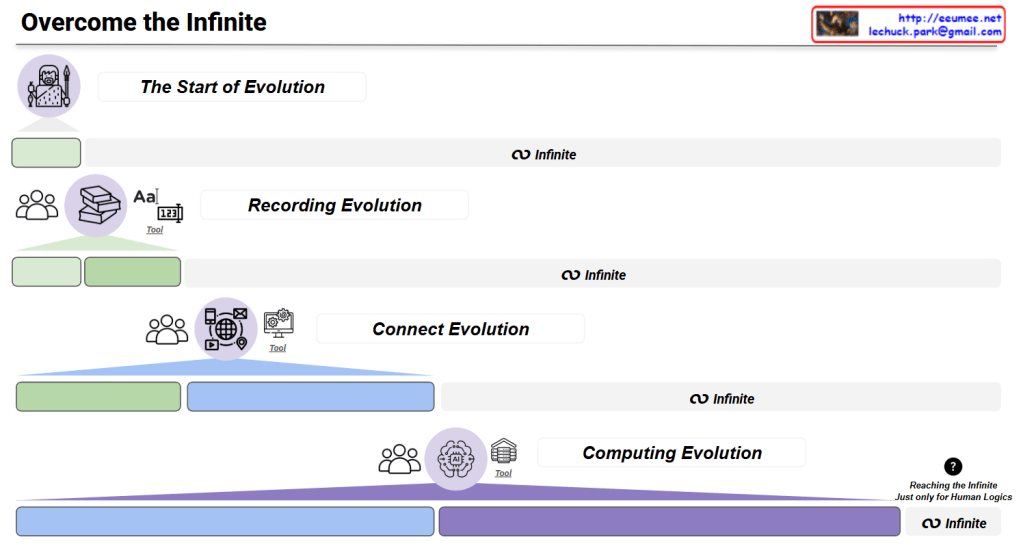
Overcome the Infinite

Overcome the Infinite – Game Interface Analysis

Overview

This image presents a philosophical game interface titled “Overcome the Infinite” that chronicles the evolutionary journey of human civilization through four revolutionary stages of innovation.

Game Structure

Stage 1: The Start of Evolution

  • Icon: Primitive human figure
  • Description: The beginning of human civilization and consciousness

Stage 2: Recording Evolution

  • Icon: Books and writing materials
  • Innovation: The revolution of knowledge storage through numbers, letters, and books
  • Significance: Transition from oral tradition to written documentation, enabling permanent knowledge preservation

Stage 3: Connect Evolution

  • Icon: Network/internet symbols with people
  • Innovation: The revolution of global connectivity through computers and the internet
  • Significance: Worldwide information sharing and communication breakthrough

Stage 4: Computing Evolution

  • Icon: AI/computing symbols with data centers
  • Innovation: The revolution of computational processing through data centers and artificial intelligence
  • Significance: The dawn of the AI era and advanced computational capabilities

Progress Indicators

  • Green and blue progress bars show advancement through each evolutionary stage
  • Each stage maintains the “∞ Infinite” symbol, suggesting unlimited potential at every level

Philosophical Message

“Reaching the Infinite Just only for Human Logics” (Bottom right)

This critical message embodies the game’s central philosophical question:

  • Can humanity truly overcome or reach the infinite through these innovations?
  • Even if we approach the infinite, it remains constrained within the boundaries of human perception and logic
  • Represents both technological optimism and humble acknowledgment of human limitations

Theme

The interface presents a contemplative journey through human technological evolution, questioning whether our innovations truly bring us closer to transcending infinite boundaries, or merely expand the scope of our human-limited understanding.

With Claude

AI Core Internals (1+4)

This image is a diagram titled “AI Core Internals (1+4)” that illustrates the core components of an AI system and their interconnected relationships.

The diagram contains 5 main components:

  1. Data – Located in the top left, represented by database and document icons.
  2. Hardware Infra – Positioned in the top center, depicted with a CPU/chipset icon with radiating connections.
  3. Foundation(AI) Model – Located in the top right, shown as an AI network node with multiple connection points.
  4. Energy Infra – Positioned at the bottom, represented by wind turbine and solar panel icons.
  5. User Group – On the far right, depicted as a collection of diverse people icons in various colors.

The arrows show the flow and connections between components:

  • From Data to Hardware Infrastructure
  • From Hardware Infrastructure to the AI Model
  • From the AI Model to end users
  • From Energy Infrastructure to Hardware Infrastructure (power supply)

This diagram visually explains how modern AI systems integrate data, computing hardware, AI models, and energy infrastructure to deliver services to end users. It effectively demonstrates the interdependent ecosystem required for AI operations, highlighting both the technical components (data, hardware, models) and the supporting infrastructure (energy) needed to serve diverse user communities.

With Claude

Human & Data with AI

Data Accumulation Perspective

History → Internet: All knowledge and information accumulated throughout human history is digitized through the internet and converted into AI training data. This consists of multimodal data including text, images, audio, and other formats.

Foundation Model: Large language models (LLMs) and multimodal models are pre-trained based on this vast accumulated data. Examples include GPT, BERT, CLIP, and similar architectures.

Human to AI: Applying Human Cognitive Patterns to AI

1. Chain of Thoughts

  • Implementation of human logical reasoning processes in the Reasoning stage
  • Mimicking human cognitive patterns that break down complex problems into step-by-step solutions
  • Replicating the human approach of “think → analyze → conclude” in AI systems

2. Mixture of Experts

  • AI implementation of human expert collaboration systems utilized in the Experts domain
  • Architecting the way human specialists collaborate on complex problems into model structures
  • Applying the human method of synthesizing multiple expert opinions for problem-solving into AI

3. Retrieval-Augmented Generation (RAG)

  • Implementing the human process of searching existing knowledge → generating new responses into AI systems
  • Systematizing the human approach of “reference material search → comprehensive judgment”

Personal/Enterprise/Sovereign Data Utilization

1. Personal Level

  • Utilizing individual documents, history, preferences, and private data in RAG systems
  • Providing personalized AI assistants and customized services

2. Enterprise Level

  • Integrating organizational internal documents, processes, and business data into RAG systems
  • Implementing enterprise-specific AI solutions and workflow automation

3. Sovereign Level

  • Connecting national or regional strategic data to RAG systems
  • Optimizing national security, policy decisions, and public services

Overall Significance: This architecture represents a Human-Centric AI system that transplants human cognitive abilities and thinking patterns into AI while utilizing multi-layered data from personal to national levels to evolve general-purpose AI (Foundation Models) into intelligent systems specialized for each level. It goes beyond simple data processing to implement human thinking methodologies themselves into next-generation AI systems.

With Claude