AI DC Power Flow

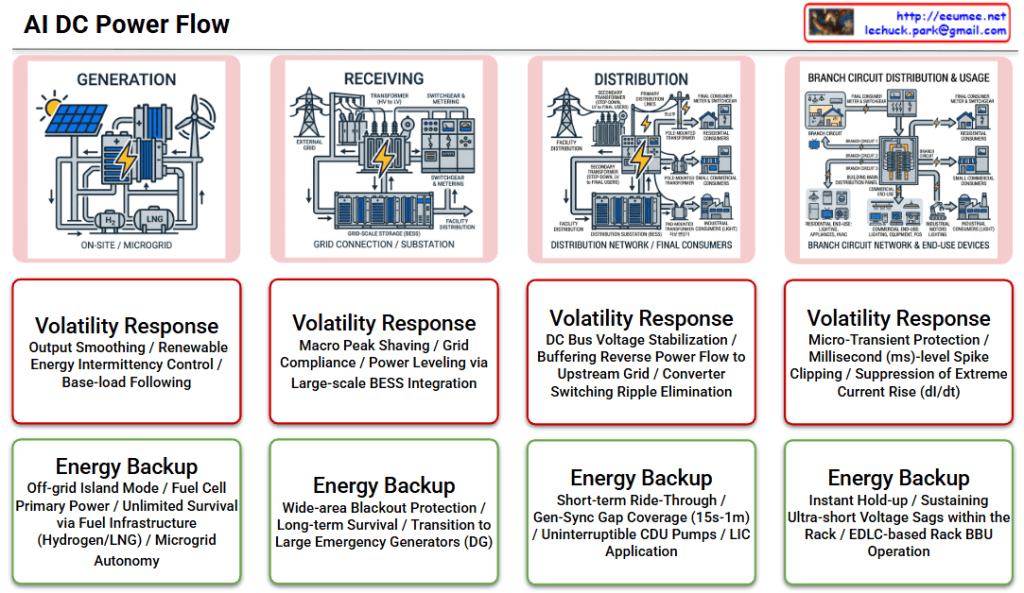
The provided image is a diagram titled “AI DC Power Flow,” which breaks down the entire process of power flow from generation to final consumption into four main stages. For each stage, it provides a conceptual illustration along with specific strategies for “Volatility Response” and “Energy Backup”.

1. Generation (On-site / Microgrid) This stage illustrates an on-site microgrid environment that directly generates power using solar, wind, batteries, and hydrogen (H2) or natural gas (LNG) tanks.

  • Volatility Response: Stabilizes irregular power generation through Output Smoothing, Renewable Energy Intermittency Control, and Base-load Following.
  • Energy Backup: Ensures continuous power production through Off-grid Island Mode, Fuel Cell Primary Power, Unlimited Survival via Fuel Infrastructure (Hydrogen/LNG), and Microgrid Autonomy.

2. Receiving (Grid Connection / Substation) This depicts the stage where power is received from an external grid, passing through transformers (HV to LV), switchgear, and grid-scale storage (BESS) at a substation.

  • Volatility Response: Manages grid fluctuations through Macro Peak Shaving, Grid Compliance, and Power Leveling via Large-scale BESS Integration.
  • Energy Backup: Enhances facility survivability by providing Wide-area Blackout Protection, Long-term Survival capabilities, and Transition to Large Emergency Generators (DG).

3. Distribution (Distribution Network / Final Consumers) This process involves routing the received power through secondary transformers and distribution networks to individual facilities and near final consumers.

  • Volatility Response: Controls power quality during distribution via DC Bus Voltage Stabilization, Buffering Reverse Power Flow to Upstream Grid, and Converter Switching Ripple Elimination.
  • Energy Backup: Defends against momentary power gaps using Short-term Ride-Through, Gen-Sync Gap Coverage (15s-1m), Uninterruptible CDU Pumps, and LIC Application.

4. Branch Circuit Distribution & Usage (Branch Circuit Network & End-Use Devices) This is the final stage where power flows through branch distribution panels to be consumed by residential, commercial, and industrial end-use devices.

  • Volatility Response: Protects sensitive electronics with Micro-Transient Protection, Millisecond (ms)-level Spike Clipping, and Suppression of Extreme Current Rise (dI/dt).
  • Energy Backup: Guarantees uninterrupted power at the device level through Instant Hold-up, Sustaining Ultra-short Voltage Sags within the Rack, and EDLC-based Rack BBU Operation.

Summary

This diagram is a comprehensive power architecture blueprint tailored for AI data centers and modern microgrids. It structures the flow of electricity into four distinct phases—generation, receiving, distribution, and usage—and systematically maps out the specific technologies required at every step to control grid instability (volatility) and prepare for emergency outages (backup).

#AIDataCenter #Microgrid #SmartGrid #PowerGrid #BESS #EnergyBackup #DistributedGeneration

With Gemini
Energy Storage & Backup Power


Energy Storage & Backup Power Comparison

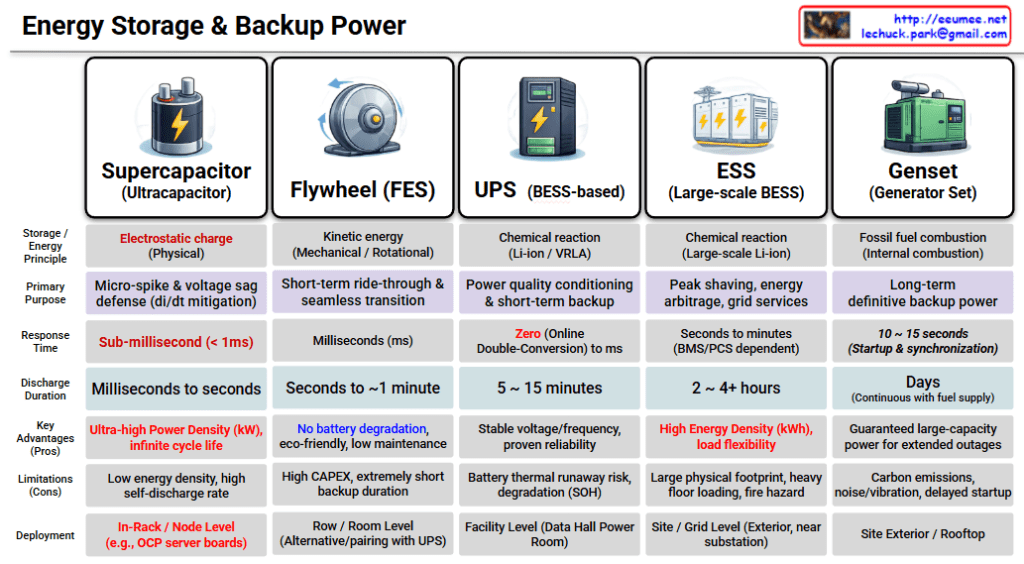
This infographic provides a comprehensive overview of energy storage and backup power technologies used in mission-critical infrastructures like data centers. As you move from left to right, the response time increases, but the backup duration also significantly extends.

1. Supercapacitor (Ultracapacitor)

  • Energy Principle: Electrostatic charge (Physical)
  • Primary Purpose: Micro-spike & voltage sag defense (di/dt mitigation)
  • Response Time: Sub-millisecond (< 1ms)
  • Discharge Duration: Milliseconds to seconds
  • Key Advantages: Ultra-high Power Density (kW), infinite cycle life
  • Limitations: Low energy density, high self-discharge rate
  • Deployment: In-Rack / Node Level (e.g., OCP server boards)

2. Flywheel (FES – Flywheel Energy Storage)

  • Energy Principle: Kinetic energy (Mechanical / Rotational)
  • Primary Purpose: Short-term ride-through & seamless transition
  • Response Time: Milliseconds (ms)
  • Discharge Duration: Seconds to ~1 minute
  • Key Advantages: No battery degradation, eco-friendly, low maintenance
  • Limitations: High CAPEX, extremely short backup duration
  • Deployment: Row / Room Level (Used as an alternative or paired with UPS)

3. UPS (BESS-based)

  • Energy Principle: Chemical reaction (Li-ion / VRLA)
  • Primary Purpose: Power quality conditioning & short-term backup
  • Response Time: Zero (Online Double-Conversion) to ms
  • Discharge Duration: 5 ~ 15 minutes
  • Key Advantages: Stable voltage/frequency, proven reliability
  • Limitations: Battery thermal runaway risk, degradation (SOH – State of Health)
  • Deployment: Facility Level (Data Hall Power Room)

4. ESS (Large-scale BESS)

  • Energy Principle: Chemical reaction (Large-scale Li-ion)
  • Primary Purpose: Peak shaving, energy arbitrage, grid services
  • Response Time: Seconds to minutes (BMS/PCS dependent)
  • Discharge Duration: 2 ~ 4+ hours
  • Key Advantages: High Energy Density (kWh), load flexibility
  • Limitations: Large physical footprint, heavy floor loading, fire hazard
  • Deployment: Site / Grid Level (Exterior, near substation)

5. Genset (Generator Set)

  • Energy Principle: Fossil fuel combustion (Internal combustion)
  • Primary Purpose: Long-term definitive backup power
  • Response Time: 10 ~ 15 seconds (Startup & synchronization)
  • Discharge Duration: Days (Continuous with fuel supply)
  • Key Advantages: Guaranteed large-capacity power for extended outages
  • Limitations: Carbon emissions, noise/vibration, delayed startup
  • Deployment: Site Exterior / Rooftop

Summary of the Spectrum

The hierarchy demonstrates a “Layered Defense” strategy for power reliability:

  • Immediate (ms): Supercapacitors and Flywheels handle transient spikes and sags.
  • Short-term (mins): UPS systems bridge the gap until secondary power kicks in.
  • Long-term (hours/days): ESS manages energy efficiency, while Gensets provide the final safety net for prolonged outages.

#EnergyStorage #BackupPower #DataCenter #UPS #BESS #Flywheel #Supercapacitor #Genset #EnergyEfficiency #PowerReliability #ElectricalEngineering #SmartGrid #EnergyManagement #TechInfographic #Infrastructure

With Gemini