‘tightly fused’

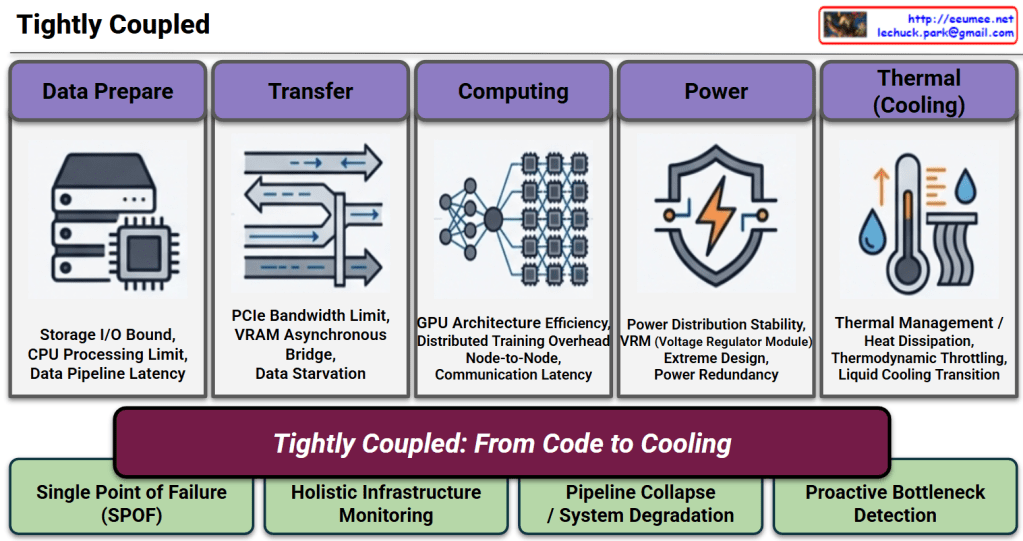
This illustration visualizes the evolution of data centers, contrasting the traditionally separated components with the modern AI data center where software, compute, network, and crucially, power and cooling systems are ‘tightly fused’ together. It emphasizes how power and advanced cooling are organically intertwined with GPU and memory, directly impacting AI performance and highlighting their inseparable role in meeting the demands of high-performance AI. This tight integration symbolizes a pivotal shift for the modern AI era.

CUDA Executive model

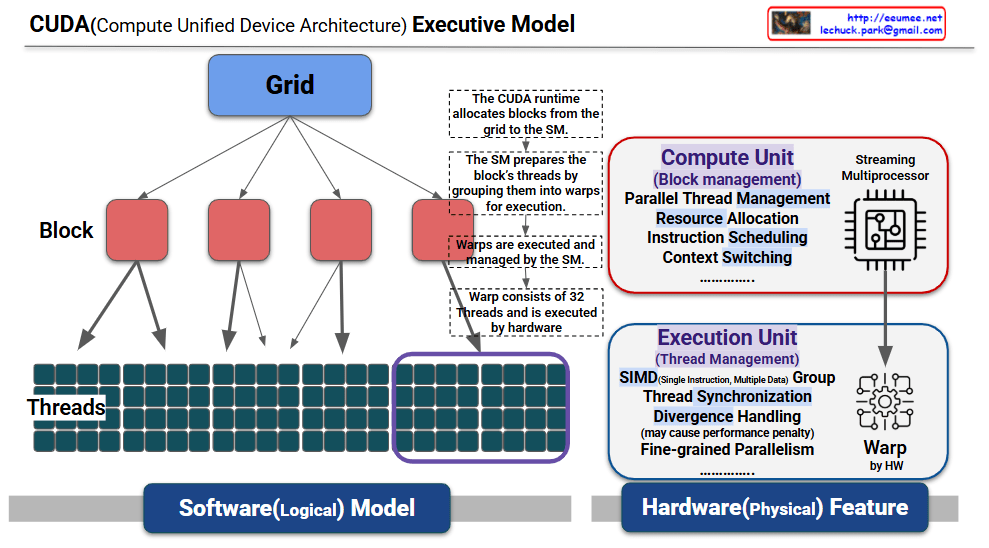
This is a structured explanation based on the provided CUDA (Compute Unified Device Architecture) execution model diagram. This diagram visually represents the relationship between the software (logical model) and hardware (physical device) layers in CUDA, illustrating the parallel processing mechanism step by step. The explanation reflects the diagram’s annotations and structure.


CUDA Executive Model Explanation

1. Software (Logical) Model

  • Grid:
  • The topmost layer of CUDA execution, defining the entire parallel workload. A grid consists of multiple blocks and is specified by the programmer during kernel launch (e.g., <<<blocksPerGrid, threadsPerBlock>>>).
  • Operation: The CUDA runtime allocates blocks from the grid to the Streaming Multiprocessors (SMs) on the GPU, managed dynamically by the global scheduler (e.g., GigaThread Engine). The annotation “The CUDA runtime allocates blocks from the grid to the SM, the grid prepares the block” clarifies this process.
  • Block:
  • Positioned below the grid, each block is a collection of threads. A block is assigned to a single SM for execution, with a maximum of 1024 threads per block (512 in some architectures).
  • Preparation: The SM prepares the block by grouping its threads into warps for execution, as noted in “The SM prepares the block’s threads by grouping them into warps for execution.”
  • Threads:
  • The smallest execution unit within a block, with multiple threads operating in parallel. Each thread is identified by a unique thread ID (threadIdx) and processes different data.
  • Grouping: The SM automatically organizes the block’s threads into warps of 32 threads each.

2. Hardware (Physical) Device

  • Streaming Multiprocessor (SM):
  • The core processing unit of the GPU, responsible for executing blocks. The SM performs the following roles:
    • Block Management: Handles blocks allocated by the CUDA runtime.
    • Parallel Thread Management: Groups threads into warps.
    • Resource Allocation: Assigns resources such as registers and shared memory.
    • Instruction Scheduling: Schedules warps for execution.
    • Context Switching: Supports switching between multiple warps.
  • Annotation: “The SM prepares the block’s threads by grouping them into warps for execution” highlights the SM’s role in thread organization.
  • Warp:
  • A hardware-managed execution unit consisting of 32 threads. Warps operate using the SIMT (Single Instruction, Multiple Thread) model, executing the same instruction simultaneously.
  • Characteristics:
    • Annotation: “Warp consists of 32 Threads and is executed by hardware” specifies the fixed warp size and hardware execution.
    • The SM’s warp scheduler manages multiple warps in parallel to hide memory latency.
  • Divergence: When threads within a warp follow different code paths (e.g., if-else), sequential execution occurs, potentially causing a performance penalty, as noted in “Divergence Handling (may cause performance penalty).”
  • Execution Unit:
  • The hardware component that executes warps, responsible for “Thread Management.” Key functions include:
    • SIMD Group: Processes multiple data with a single instruction.
    • Thread Synchronization: Coordinates threads within a warp.
    • Divergence Handling: Manages path divergences, which may impact performance.
    • Fine-grained Parallelism: Enables high-precision parallel processing.
  • Annotation: “Warps are executed and managed by the SM” indicates that the SM oversees warp execution.

3. Execution Flow

  • Step 1: Block Allocation:
  • The CUDA runtime dynamically allocates blocks from the grid to the SMs, as described in “The CUDA runtime allocates blocks from the grid to the SM.”
  • Step 2: Thread Grouping:
  • The SM groups the block’s threads into warps of 32 threads each to prepare for execution.
  • Step 3: Warp Execution:
  • The SM’s warp scheduler manages and executes the warps using the SIMT model, performing parallel computations. Divergence may lead to performance penalties.

4. Additional Information

  • Constraints: Warps are fixed at 32 threads and executed by hardware. The number of executable blocks and warps is limited by SM resources (e.g., registers, shared memory), though specific details are omitted.

Summary

This diagram illustrates the CUDA execution model by mapping the software layers (grid → block → threads) to the hardware (SM → warp). The CUDA runtime allocates blocks from the grid to the SM, the SM groups threads into warps for execution, and warps perform parallel computations using the SIMT model.


Work with Grok

Data Center ?

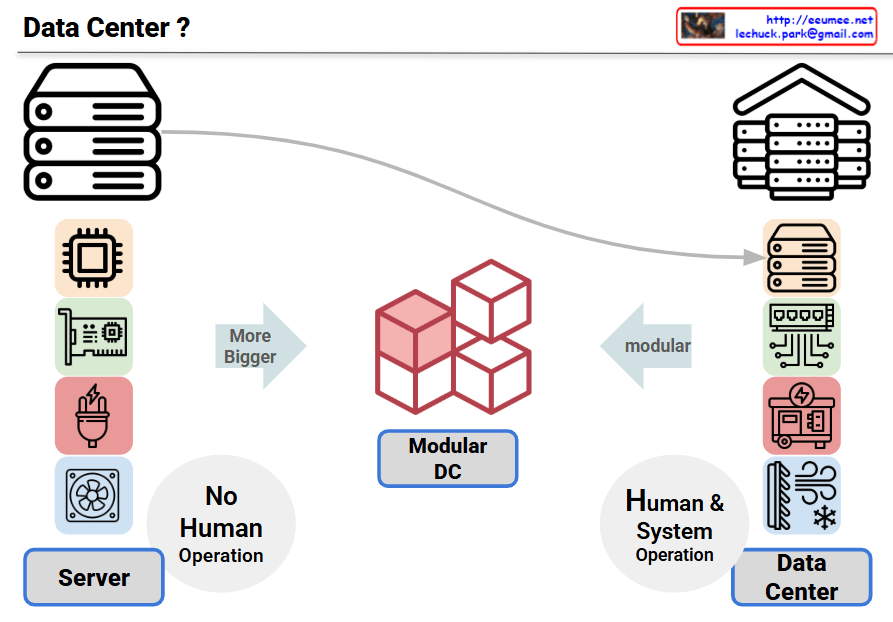
This infographic compares the evolution from servers to data centers, showing the progression of IT infrastructure complexity and operational requirements.

Left – Server

  • Shows individual hardware components: CPU, motherboard, power supply, cooling fans
  • Labeled “No Human Operation,” indicating basic automated functionality

Center – Modular DC

  • Represented by red cubes showing modular architecture
  • Emphasizes “More Bigger” scale and “modular” design
  • Represents an intermediate stage between single servers and full data centers

Right – Data Center

  • Displays multiple server racks and various infrastructure components (networking, power, cooling systems)
  • Marked as “Human & System Operation,” suggesting more complex management requirements

Additional Perspective on Automation Evolution:

While the image shows data centers requiring human intervention, the actual industry trend points toward increasing automation:

  1. Advanced Automation: Large-scale data centers increasingly use AI-driven management systems, automated cooling controls, and predictive maintenance to minimize human intervention.
  2. Lights-Out Operations Goal: Hyperscale data centers from companies like Google, Amazon, and Microsoft ultimately aim for complete automated operations with minimal human presence.
  3. Paradoxical Development: As scale increases, complexity initially requires more human involvement, but advanced automation eventually enables a return toward unmanned operations.

Summary: This diagram illustrates the current transition from simple automated servers to complex data centers requiring human oversight, but the ultimate industry goal is achieving fully automated “lights-out” data center operations. The evolution shows increasing complexity followed by sophisticated automation that eventually reduces the need for human intervention.

With Claude

Massive simple parallel computing

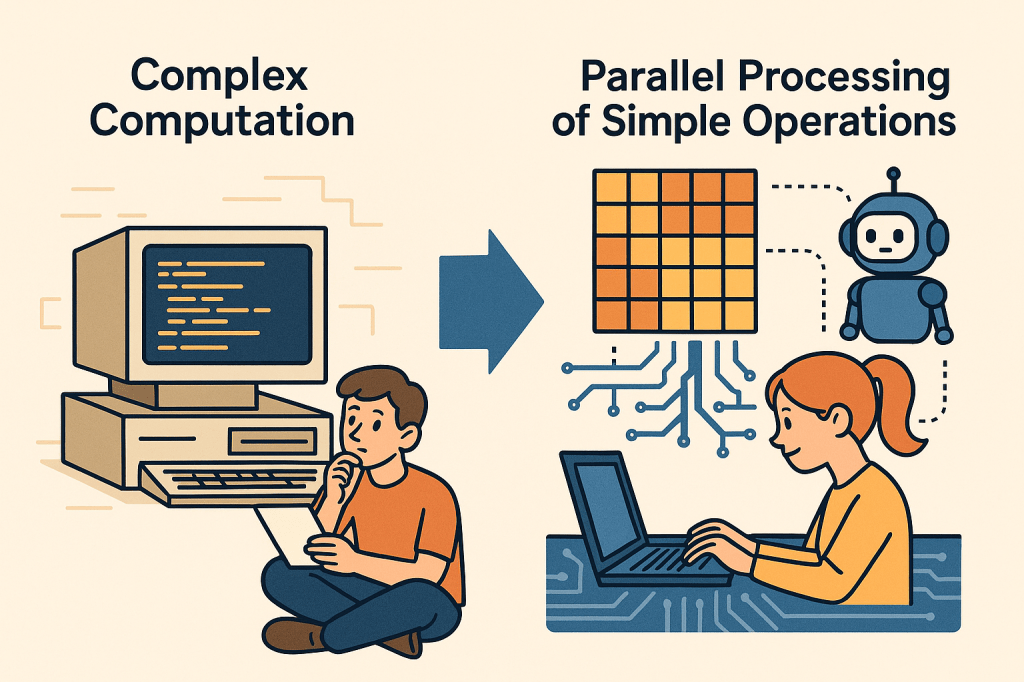
This diagram presents a systematic framework that defines the essence of AI LLMs as “Massive Simple Parallel Computing” and systematically outlines the resulting issues and challenges that need to be addressed.

Core Definition of AI LLM: “Massive Simple Parallel Computing”

Massive: Enormous scale with billions of parameters Simple: Fundamentally simple computational operations (matrix multiplications, etc.) Parallel: Architecture capable of simultaneous parallel processing Computing: All of this implemented through computational processes

Core Issues Arising from This Essential Nature

Big Issues:

  • Black-box unexplainable: Incomprehensibility due to massive and complex interactions
  • Energy-intensive: Enormous energy consumption inevitably arising from massive parallel computing

Essential Requirements Therefore Needed

Very Required:

  • Verification: Methods to ensure reliability of results given the black-box characteristics
  • Optimization: Approaches to simultaneously improve energy efficiency and performance

The Ultimate Question: “By What?”

How can we solve all these requirements?

In other words, this framework poses the fundamental question about specific solutions and approaches to overcome the problems inherent in the essential characteristics of current LLMs. This represents a compressed framework showing the core challenges for next-generation AI technology development.

The diagram effectively illustrates how the defining characteristics of LLMs directly lead to significant challenges, which in turn demand specific capabilities, ultimately raising the critical question of implementation methodology.

With Claude

The Evolution of Mainstream Data in Computing

This diagram illustrates the evolution of mainstream data types throughout computing history, showing how the complexity and volume of processed data has grown exponentially across different eras.

Evolution of Mainstream Data by Computing Era:

  1. Calculate (1940s-1950s)Numerical Data: Basic mathematical computations dominated
  2. Database (1960s-1970s)Structured Data: Tabular, organized data became central
  3. Internet (1980s-1990s)Text/Hypertext: Web pages, emails, and text-based information
  4. Video (2000s-2010s)Multimedia Data: Explosive growth of video, images, and audio content
  5. Machine Learning (2010s-Present)Big Data/Pattern Data: Large-scale, multi-dimensional datasets for training
  6. Human Perceptible/Everything (Future)Universal Cognitive Data: Digitization of all human senses, cognition, and experiences

The question marks on the right symbolize the fundamental uncertainty surrounding this final stage. Whether everything humans perceive – emotions, consciousness, intuition, creativity – can truly be fully converted into computational data remains an open question due to technical limitations, ethical concerns, and the inherent nature of human cognition.

Summary: This represents a data-centric view of computing evolution, progressing from simple numerical processing to potentially encompassing all aspects of human perception and experience, though the ultimate realization of this vision remains uncertain.

With Claude

Components for AI Work

This diagram visualizes the core concept that all components must be organically connected and work together to successfully operate AI workloads.

Importance of Organic Interconnections

Continuity of Data Flow

  • The data pipeline from Big Data → AI Model → AI Workload must operate seamlessly
  • Bottlenecks at any stage directly impact overall system performance

Cooperative Computing Resource Operations

  • GPU/CPU computational power must be balanced with HBM memory bandwidth
  • SSD I/O performance must harmonize with memory-processor data transfer speeds
  • Performance degradation in one component limits the efficiency of the entire system

Integrated Software Control Management

  • Load balancing, integration, and synchronization coordinate optimal hardware resource utilization
  • Real-time optimization of workload distribution and resource allocation

Infrastructure-based Stability Assurance

  • Stable power supply ensures continuous operation of all computing resources
  • Cooling systems prevent performance degradation through thermal management of high-performance hardware
  • Facility control maintains consistency of the overall operating environment

Key Insight

In AI systems, the weakest link determines overall performance. For example, no matter how powerful the GPU, if memory bandwidth is insufficient or cooling is inadequate, the entire system cannot achieve its full potential. Therefore, balanced design and integrated management of all components is crucial for AI workload success.

The diagram emphasizes that AI infrastructure is not just about having powerful individual components, but about creating a holistically optimized ecosystem where every element supports and enhances the others.

With Claude