Usage Evolutions : The Evolution of Human Tools and Knowledge Sharing

With a Claude’s Help
This diagram illustrates how humanity’s methods of sharing and expanding knowledge have evolved alongside the development of tools throughout history.

The Four Stages of Evolution

1. Experience-Based Era

  • Tool: Direct Human Experience
  • Characteristics: Knowledge sharing through face-to-face interactions based on personal experience
  • Limited scope of knowledge transfer and collaboration

2. Literature-Based Era

  • Tool: Books and Documents
  • Characteristics: Documentation of experiences and knowledge
  • Knowledge transfer possible across time and space

3. Internet-Based Era

  • Tool: Internet and Digital Platforms
  • Characteristics: Real-time information sharing and two-way communication
  • Formation of networks where multiple users simultaneously influence each other

4. AI-Based Era

  • Tool: Artificial Intelligence
  • Characteristics: Creation of new digital worlds through AI
  • Revolutionary expansion of knowledge creation, processing, and sharing

Key Characteristics of Evolution Process

  1. Increase in Data (More Data)
  • Exponential growth in the amount of information accumulated through each stage
  1. Enhanced Connectivity (More Connected)
  • Expansion of knowledge sharing networks
  • Dramatic increase in speed and scope of information transfer
  1. Increased Need for Verification (More Requires of Verification)
  • Growing demand for information reliability and accuracy
  • Heightened importance of data verification

This evolutionary process demonstrates more than just technological advancement; it shows fundamental changes in how humanity uses tools to expand and share knowledge. The emergence of new tools at each stage has enabled more effective and widespread knowledge sharing than before, becoming a key driving force in accelerating the development of human civilization.

This progression represents a continuous journey from individual experience-based learning to AI-enhanced global knowledge sharing, highlighting how each tool has revolutionized our ability to communicate, learn, and innovate as a species.

The evolution also underscores the increasing complexity and sophistication of our knowledge-sharing mechanisms, while emphasizing the growing importance of managing and verifying the ever-expanding volume of information available to us.
High-Resolution Timers

With a Claude’s Help
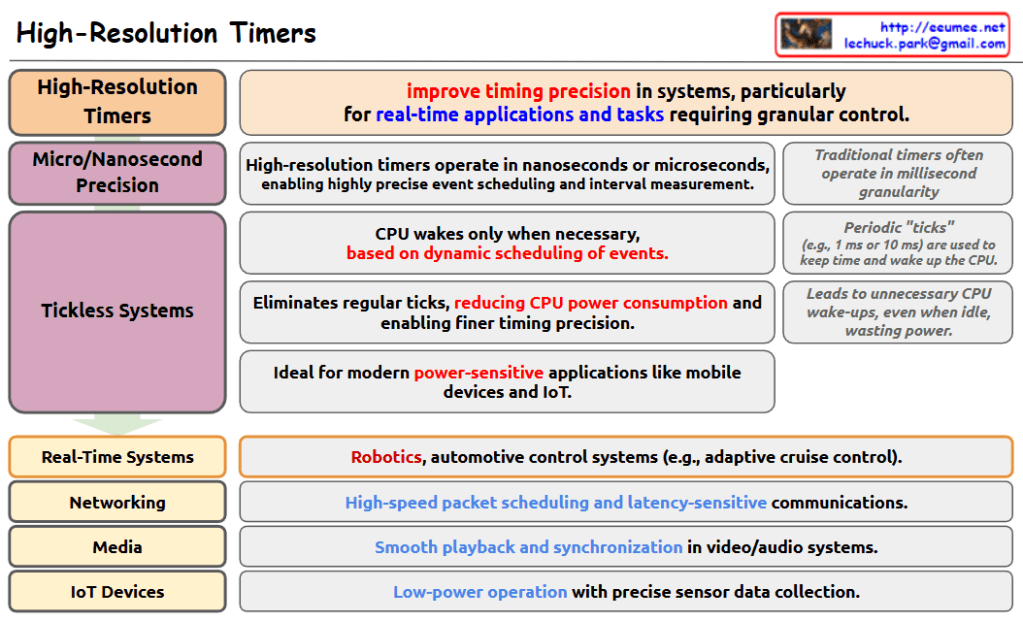
Comprehensive Analysis of High-Resolution Timers

  1. Core Technical Components
  • Micro/Nanosecond Precision
    • Evolution from traditional millisecond units to more precise measurements
    • Enables accurate event scheduling and time measurement
  • Tickless Systems
    • CPU management based on dynamic event scheduling
    • Prevents unnecessary CPU wake-ups, reducing power consumption
    • Optimized architecture for power-sensitive applications
  1. Primary Application Areas
  • Real-Time Systems: Robotics, automotive control
  • Networking: High-speed packet processing, low-latency communications
  • Media: Video/audio synchronization
  • IoT: Low-power sensor data collection
  1. Extended Application Fields
  • Medical Monitoring
    • Real-time vital sign monitoring
    • Precise medication delivery control
    • Immediate emergency response
  • Financial Trading
    • High-frequency trading systems
    • Precise transaction recording
    • Real-time data synchronization
  • Scientific Research
    • Precise experimental data collection
    • High-precision equipment control
    • Astronomical observation systems
  • Smart Grid
    • Power grid real-time monitoring
    • Supply-demand precise control
    • Distributed generation system management
  1. Technical Advantages
  • Enhanced Precision: Nano/microsecond measurement capability
  • Power Efficiency: CPU activation only when necessary
  • Flexibility: Applicable to various fields
  • Reliability: Improved system reliability through accurate timing control
  1. Future Development Directions
  • Optimization for IoT and mobile devices
  • Expanded application in industrial precision control systems
  • Integration with real-time data processing systems
  • Implementation of energy-efficient systems

This technology has evolved beyond simple time measurement to become a crucial infrastructure in modern digital systems. It serves as an essential component in implementing next-generation systems that pursue both precision and efficiency. The technology is particularly valued for achieving both power efficiency and precision, meeting various technical requirements of modern applications.

Key Features:

  1. System timing precision improvement
  2. Power efficiency optimization
  3. Real-time application performance enhancement
  4. Precise data collection and control capability
  5. Extended battery life for IoT and mobile devices
  6. Foundation for high-precision system operations

The high-resolution timer technology represents a fundamental advancement in system timing, enabling everything from precise scientific measurements to efficient power management in mobile devices. Its impact spans across multiple industries, making it an integral part of modern technological infrastructure.

This technology demonstrates how traditional timing systems have evolved to meet the demands of contemporary applications, particularly in areas requiring both precision and energy efficiency. Its versatility and reliability make it a cornerstone technology in the development of advanced digital systems.

Definitions

With a Claude’s Help
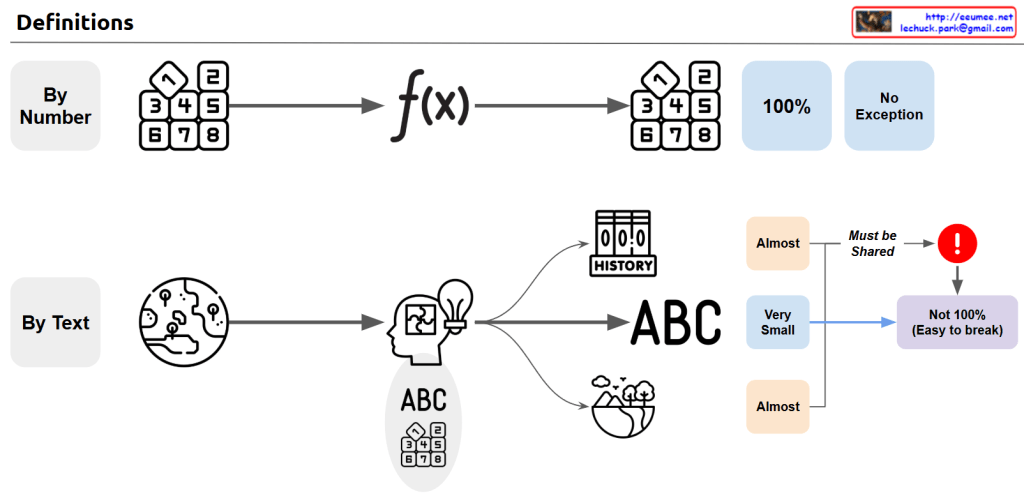
this diagram that illustrates two approaches to definitions:

  1. Definitions By Number:
  • Input and output through function f(x) is precise and clear
  • 100% accuracy in results
  • No exceptions
  • Always yields consistent results regardless of context
  • Mathematical/numerical definitions are unambiguous
  1. Definitions By Text:
  • The concept being defined is connected to multiple contextual elements:
    • Historical background (History)
    • Linguistic expression (ABC)
    • Social/cultural context (represented by the global icon)
  • Characteristics and limitations:
    • Can only directly express a “Very Small” portion of the complete meaning
    • Often uses “Almost” in descriptions
    • Key Point: “Must be Shared”
      • Related background knowledge
      • Historical context
      • Social consensus
      • Cultural understanding
    • If these contextual elements are not properly shared, it becomes “Not 100% (Easy to break)”
      • Perfect communication of meaning becomes difficult
      • Possibility of misunderstanding or misinterpretation exists

The diagram ultimately explains:

  • While numerical definitions are objective and precise
  • Text-based definitions are inherently incomplete on their own
  • For proper understanding of text-based definitions, related contextual knowledge and background must be shared
  • This explains why the same words or sentences can be interpreted differently depending on cultural context and background knowledge

This concept is particularly important in understanding:

  • Why linguistic definitions can vary across cultures
  • The importance of shared context in communication
  • Why mathematical/numerical definitions remain consistent across different contexts
  • The inherent limitations of purely textual definitions without proper context

This diagram effectively shows why precise communication through text alone can be challenging without shared contextual understanding, while numerical definitions remain universally consistent.

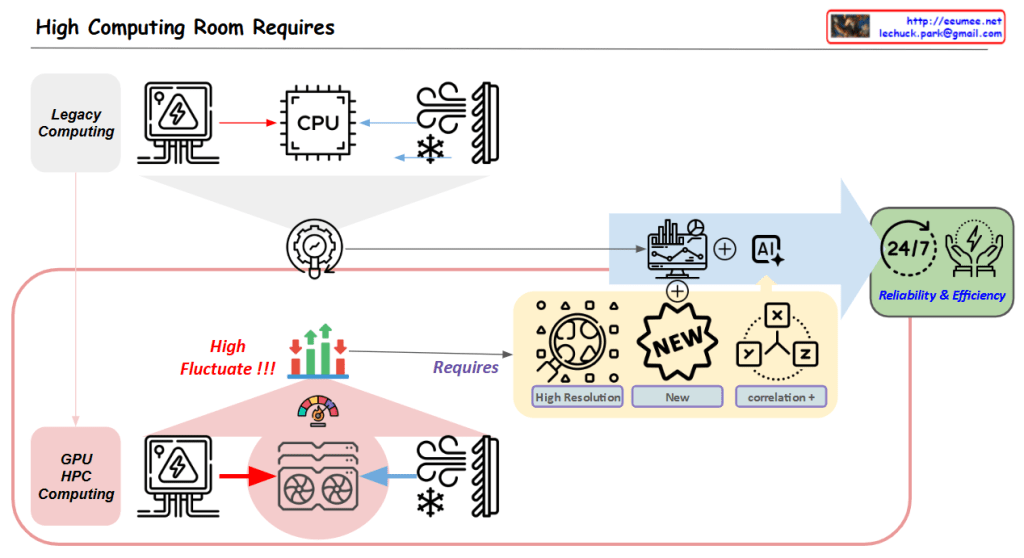
High Computing Room Requires

With a Claude’s Help
Core Challenge:

  1. High Variability in GPU/HPC Computing Room
  • Dramatic fluctuations in computing loads
  • Significant variations in power consumption
  • Changing cooling requirements

Solution Approach:

  1. Establishing New Data Collection Systems
  • High Resolution Data: More granular, time-based data collection
  • New Types of Data Acquisition
  • Identification of previously overlooked data points
  1. New Correlation Analysis
  • Understanding interactions between computing/power/cooling
  • Discovering hidden patterns among variables
  • Deriving predictable correlations

Objectives:

  • Managing variability through AI-based analysis
  • Enhancing system stability
  • Improving overall facility operational efficiency

In essence, the diagram emphasizes that to address the high variability challenges in GPU/HPC environments, the key strategy is to collect more precise and new types of data, which enables the discovery of new correlations, ultimately leading to improved stability and efficiency.

This approach specifically targets the inherent variability of GPU/HPC computing rooms by focusing on data collection and analysis as the primary means to achieve better operational outcomes.

Interrupt Handling for real-time

With a Claude’s Help
the real-time interrupt handling :

Interrupt Handling Components and Process:

  1. Interrupt Prioritization
  • Uses assigned priority levels to determine which interrupt should be handled first
  • Ensures critical tasks are processed in order of importance
  1. Interrupt Queuing
  • When multiple interrupts occur, they are placed in a queue for sequential processing
  • Helps maintain organized processing order
  1. Efficient Handling Process
  • Uses a data structure that maps each interrupt to its corresponding Interrupt Service Routine (ISR)
  • Implements this mapping through the Interrupt Vector Table (IVT)
  1. Interrupt Controllers
  • Modern systems utilize interrupt controllers
  • Manages and prioritizes interrupts efficiently
  1. Types of Interrupts
  • Maskable Interrupts (IRQs)
  • Non-Maskable Interrupts (NMIs)
  • High-priority Interrupts
  • Software Interrupts
  • Hardware Interrupts

Real-Time Performance Benefits:

  1. Critical Task Management
  • Ensures critical tasks are always handled first
  • Maintains system responsiveness
  1. System Stability
  • Ensures no interrupt is missed or lost
  • Maintains reliable system operation
  1. Scalability
  • Efficiently manages a growing number of devices and interrupts
  • Adapts to increasing system complexity
  1. Improved User Experience
  • Creates responsive systems that react quickly to user inputs or events
  • Enhances overall system performance and user interaction

This structure provides a comprehensive framework for handling interrupts in real-time systems, ensuring efficient and reliable processing of system events and user interactions.CopyR

THIS IS KOREA.

현재 한국은 아픔과 위기를 겪고 있습니다.
하지만 이겨내고 극복하고 다시 웃을 것입니다.
힘내고 희생하고 앞으로 나아가는 멋진 국민들이 있기 때문입니다.
감사합니다. 또 감사합니다. 대한민국 만세!!!

Korea is currently experiencing pain and crisis.
But we will overcome, and smile again.
Because we have wonderful people who are strong, who sacrifice and move forward.
Thank you. Thank you again. Fighting!! the Republic of Korea!