DC Changes

This image shows a diagram that matches 3 Environmental Changes in data centers with 3 Operational Response Changes.

Environmental Changes → Operational Response Changes

1. Hyper Scale

Environmental Change: Large-scale/Complexity

  • Systems becoming bigger and more complex
  • Increased management complexity

→ Operational Response: DevOps + Big Data/AI Prediction

  • Development-Operations integration through DevOps
  • Intelligent operations through big data analytics and AI prediction

2. New DC (New Data Center)

Environmental Change: New/Edge and various types of data centers

  • Proliferation of new edge data centers
  • Distributed infrastructure environment

→ Operational Response: Integrated Operations

  • Multi-center integrated management
  • Standardized operational processes
  • Role-based operational framework

3. AI DC (AI Data Center)

Environmental Change: GPU Large-scale Computing/Massive Power Requirements

  • GPU-intensive high-performance computing
  • Enormous power consumption

→ Operational Response: Digital Twin – Real-time Data View

  • Digital replication of actual configurations
  • High-quality data-based monitoring
  • Real-time predictive analytics including temperature prediction

This diagram systematically demonstrates that as data center environments undergo physical changes, operational approaches must also become more intelligent and integrated in response.

with Claude
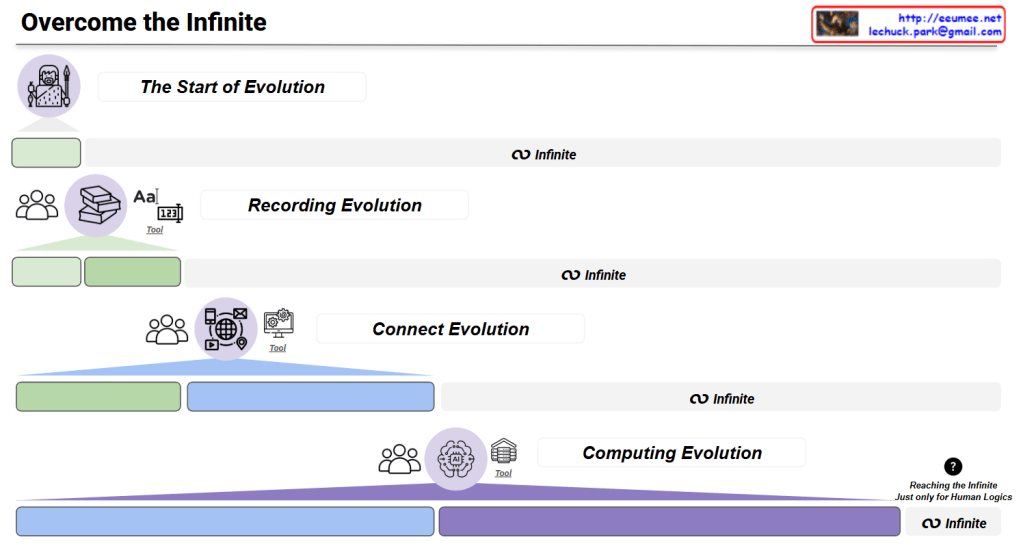
Overcome the Infinite

Overcome the Infinite – Game Interface Analysis

Overview

This image presents a philosophical game interface titled “Overcome the Infinite” that chronicles the evolutionary journey of human civilization through four revolutionary stages of innovation.

Game Structure

Stage 1: The Start of Evolution

  • Icon: Primitive human figure
  • Description: The beginning of human civilization and consciousness

Stage 2: Recording Evolution

  • Icon: Books and writing materials
  • Innovation: The revolution of knowledge storage through numbers, letters, and books
  • Significance: Transition from oral tradition to written documentation, enabling permanent knowledge preservation

Stage 3: Connect Evolution

  • Icon: Network/internet symbols with people
  • Innovation: The revolution of global connectivity through computers and the internet
  • Significance: Worldwide information sharing and communication breakthrough

Stage 4: Computing Evolution

  • Icon: AI/computing symbols with data centers
  • Innovation: The revolution of computational processing through data centers and artificial intelligence
  • Significance: The dawn of the AI era and advanced computational capabilities

Progress Indicators

  • Green and blue progress bars show advancement through each evolutionary stage
  • Each stage maintains the “∞ Infinite” symbol, suggesting unlimited potential at every level

Philosophical Message

“Reaching the Infinite Just only for Human Logics” (Bottom right)

This critical message embodies the game’s central philosophical question:

  • Can humanity truly overcome or reach the infinite through these innovations?
  • Even if we approach the infinite, it remains constrained within the boundaries of human perception and logic
  • Represents both technological optimism and humble acknowledgment of human limitations

Theme

The interface presents a contemplative journey through human technological evolution, questioning whether our innovations truly bring us closer to transcending infinite boundaries, or merely expand the scope of our human-limited understanding.

With Claude

Server Room Workload

This diagram illustrates a server room thermal management system workflow.

System Architecture

Server Internal Components:

  • AI Workload, GPU Workload, and Power Workload are connected to the CPU, generating heat

Temperature Monitoring Points:

  • Supply Temp: Cold air supplied from the cooling system
  • CoolZone Temp: Temperature in the cooling zone
  • Inlet Temp: Server inlet temperature
  • Outlet Temp: Server outlet temperature
  • Hot Zone Temp: Temperature in the heat exhaust zone
  • Return Temp : Hot air return to the cooling system

Cooling System:

  • The Cooling Workload on the left manages overall cooling
  • Closed-loop cooling system that circulates back via Return Temp

Temperature Delta Monitoring

The bottom flowchart shows how each workload affects temperature changes (ΔT):

  • Delta temperature sensors (Δ1, Δ2, Δ3) measure temperature differences across each section
  • This data enables analysis of each workload’s thermal impact and optimization of cooling efficiency

This system appears to be a data center thermal management solution designed to effectively handle high heat loads from AI and GPU-intensive workloads. The comprehensive temperature monitoring allows for precise control and optimization of the cooling infrastructure based on real-time workload demands.

With Claude

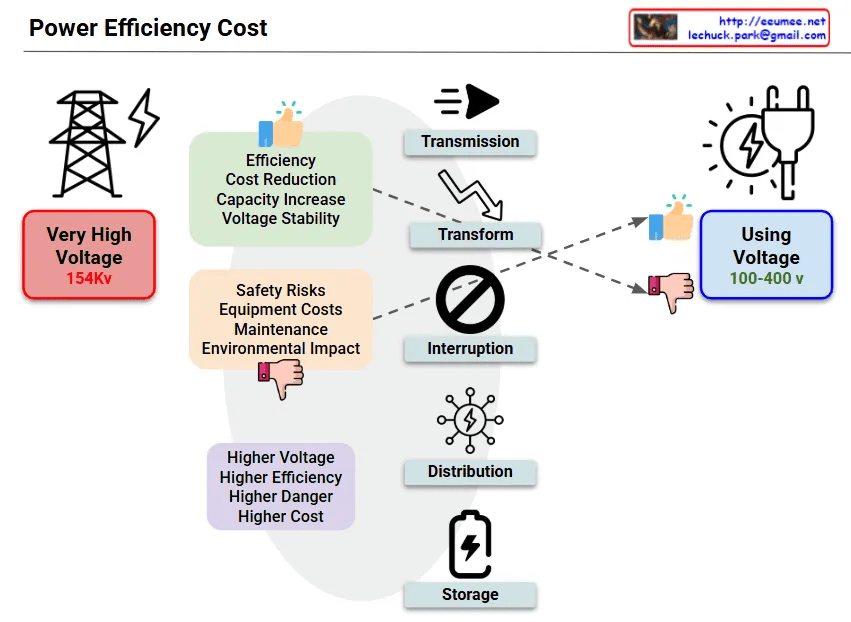
Power Efficiency Cost

AI Data Center Power Efficiency Analysis

The Power Design Dilemma in AI Data Centers

AI data centers, comprised of power-hungry GPU clusters and high-performance servers, face critical decisions where power efficiency directly impacts operational costs and performance capabilities.

The Need for High-Voltage Distribution Systems

  • AI Workload Characteristics: GPU training operations consume hundreds of kilowatts to megawatts continuously
  • Power Density: High power density of 50-100kW per rack demands efficient power transmission
  • Scalability: Rapid power demand growth following AI model size expansion

Efficiency vs Complexity Trade-offs

Advantages (Efficiency Perspective):

  • Minimized Power Losses: High-voltage transmission dramatically reduces I²R losses (potential 20-30% power cost savings)
  • Cooling Efficiency: Reduced power losses mean less heat generation, lowering cooling costs
  • Infrastructure Investment Optimization: Fewer, larger cables can deliver massive power capacity

Disadvantages (Operational Complexity):

  • Safety Risks: High-voltage equipment requires specialized expertise, increased accident risks
  • Capital Investment: Expensive high-voltage transformers, switchgear, and protection equipment
  • Maintenance Complexity: Specialized technical staff required, extended downtime during outages
  • Regulatory Compliance: Complex permitting processes for electrical safety and environmental impact

AI DC Power Architecture Design Strategy

  1. Medium-Voltage Distribution: 13.8kV → 480V stepped transformation balancing efficiency and safety
  2. Modularization: Pod-based power delivery for operational flexibility
  3. Redundant Backup Systems: UPS and generator redundancy preventing AI training interruptions
  4. Smart Monitoring: Real-time power quality surveillance for proactive fault prevention

Financial Impact Analysis

  • CAPEX: 15-25%(?) higher initial investment for high-voltage infrastructure
  • OPEX: 20-35%(?) reduction in power and cooling costs over facility lifetime
  • ROI: Typically 18-24(?) months payback period for hyperscale AI facilities

Conclusion

AI data centers must identify the optimal balance between power efficiency and operational stability. This requires prioritizing long-term operational efficiency over initial capital costs, making strategic investments in sophisticated power infrastructure that can support the exponential growth of AI computational demands while maintaining grid-level reliability and safety standards.

with Claude

Dynamic Voltage and Frequency Scaling (in GPU)

This image illustrates the DVFS (Dynamic Voltage and Frequency Scaling) system workflow, which is a power management technique that dynamically adjusts CPU/GPU voltage and frequency to optimize power consumption.

Key Components and Operation Flow

1. Main Process Flow (Top Row)

  • Workload InitWorkload AnalysisDVFS Policy DecisionClock Frequency AdjustmentVoltage AdjustmentWorkload ExecutionWorkload Finish

2. Core System Components

Power State Management:

  • Basic power states: P0~P12 (P0 = highest performance, P12 = lowest power)
  • Real-time monitoring through PMU (Power Management Unit)

Analysis & Decision Phase:

  • Applies dynamic power consumption formula using algorithms
  • Considers thermal limits in analysis
  • Selects new power state (High: P0-P2, Low: P8-P10)
  • P-State changes occur within 10μs~1ms

Frequency Adjustment (PLL – Phase-Locked Loop):

  • Adjusts GPU core and memory clock frequencies
  • Typical range: 1,410MHz~1,200MHz (memory), 1,000MHz~600MHz (core)
  • Adjustment time: 10-100 microseconds

Voltage Adjustment (VRM – Voltage Regulator Module):

  • Adjusts voltage supplied to GPU core and memory
  • Typical range: 1.1V (P0) to 0.8V (P8)
  • VRM stabilizes voltage within tens of microseconds

3. Real-time Feedback Loop

The system operates a continuous feedback loop that readjusts P-states in real-time based on workload changes, maintaining optimal balance between performance and power efficiency.

4. Execution Phase

The GPU executes workloads at new frequency and voltage settings, with asynchronous adjustments based on frequency and voltage changes. After completion, the system transitions to low-power states (e.g., P10, P12) to conserve energy.


Summary: Key Benefits of DVFS

DVFS technology is for AI data centers as it optimizes GPU efficiency management to achieve maximum overall power efficiency. By intelligently scaling thousands of GPUs based on AI workload demands, DVFS can reduce total data center power consumption by 30-50% while maintaining peak AI performance during training and inference operations, making it essential for sustainable and cost-effective AI infrastructure at scale.

With Claude

Power Control : UPS vs ESS

ESS System Analysis for AI Datacenter Power Control

This diagram illustrates the ESS (Energy Storage System) technology essential for providing flexible high-power supply for AI datacenters. Goldman Sachs Research forecasts that AI will drive a 165% increase in datacenter power demand by 2030, with AI representing about 19% of datacenter power demand by 2028, necessitating advanced power management beyond traditional UPS limitations.

ESS System Features for AI Datacenter Applications

1. High Power Density Battery System

  • Rapid Charge/Discharge: Immediate response to sudden power fluctuations in AI workloads
  • Large-Scale Storage: Massive power backup capacity for GPU-intensive AI processing
  • High Power Density: Optimized for space-constrained datacenter environments

2. Intelligent Power Management Capabilities

  • Overload Management: Handles instantaneous high-power demands during AI inference/training
  • GPU Load Prediction: Analyzes AI model execution patterns to forecast power requirements
  • High Response Speed: Millisecond-level power injection/conversion preventing AI processing interruptions
  • Predictive Analytics: Machine learning-based power demand forecasting

3. Flexible Operation Optimization

  • Peak Shaving: Reduces power costs during AI workload peak hours
  • Load Balancing: Distributes power loads across multiple AI model executions
  • Renewable Energy Integration: Supports sustainable AI datacenter operations
  • Cost Optimization: Minimizes AI operational expenses through intelligent power management

Central Power Management System – Essential Core Component of ESS

The Central Power Management System is not merely an auxiliary feature but a critical essential component of ESS for AI datacenters:

1. Precise Data Collection

  • Real-time monitoring of power consumption patterns by AI workload type
  • Tracking power usage across GPU, CPU, memory, and other components
  • Integration of environmental conditions and cooling system power data
  • Comprehensive telemetry from all datacenter infrastructure elements

2. AI-Based Predictive Analysis

  • Machine learning algorithms for AI workload prediction
  • Power demand pattern learning and optimization
  • Predictive maintenance for failure prevention
  • Dynamic resource allocation based on anticipated needs

3. Fast Automated Logic

  • Real-time automated power distribution control
  • Priority-based power allocation during emergency situations
  • Coordinated control across multiple ESS systems
  • Autonomous decision-making for optimal power efficiency

ESS Advantages over UPS for AI Datacenter Applications

While traditional UPS systems are limited to simple backup power during outages, ESS is specifically designed for the complex and dynamic power requirements of AI datacenters:

Proactive vs. Reactive

  • UPS: Reactive response to power failures
  • ESS: Proactive management of power demands before issues occur

Intelligence Integration

  • UPS: Basic power switching functionality
  • ESS: AI-driven predictive analytics and automated optimization

Scalability and Flexibility

  • UPS: Fixed capacity backup power
  • ESS: Dynamic scaling to handle AI servers that use up to 10 times the power of standard servers

Operational Optimization

  • UPS: Emergency power supply only
  • ESS: Continuous power optimization, cost reduction, and efficiency improvement

This advanced ESS approach is critical as datacenter capacity has grown 50-60% quarter over quarter since Q1 2023, requiring sophisticated power management solutions that can adapt to the unprecedented energy demands of modern AI infrastructure.

Future-Ready Infrastructure

ESS represents the evolution from traditional backup power to intelligent energy management, essential for supporting the next generation of AI datacenters that demand both reliability and efficiency at massive scale.

With Cluade

GPU Server Room : Changes

Image Overview

This dashboard displays the cascading resource changes that occur when GPU workload increases in an AI data center server room monitoring system.

Key Change Sequence (Estimated Values)

  1. GPU Load Increase: 30% → 90% (AI computation tasks initiated)
  2. Power Consumption Rise: 0.42kW → 1.26kW (3x increase)
  3. Temperature Delta Rise: 7°C → 17°C (increased heat generation)
  4. Cooling System Response:
    • Water flow rate: 200 LPM → 600 LPM (3x increase)
    • Fan speed: 600 RPM → 1200 RPM (2x increase)

Operational Prediction Implications

  • Operating Costs: Approximately 3x increase from baseline expected
  • Spare Capacity: 40% cooling system capacity remaining
  • Expansion Capability: Current setup can accommodate additional 67% GPU load

This AI data center monitoring dashboard illustrates the cascading resource changes when GPU workload increases from 30% to 90%, triggering proportional increases in power consumption (3x), cooling flow rate (3x), and fan speed (2x). The system demonstrates predictable operational scaling patterns, with current cooling capacity showing 40% remaining headroom for additional GPU load expansion. Note: All values are estimated figures for demonstration purposes.

Note: All numerical values are estimated figures for demonstration purposes and do not represent actual measured data.

With Claude