AI Infrastructure Architect & Technical Visualizer "Complex Systems, Simplified. I translate massive AI infrastructure into visual intelligence." I love to learn computer tech and help people by the digital.
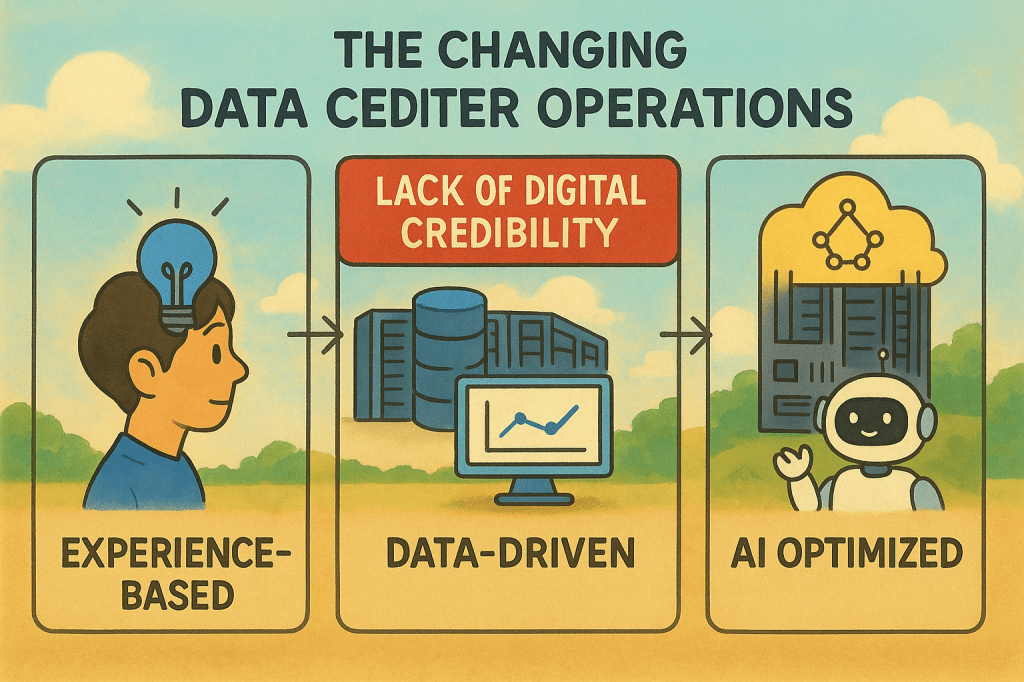
Data center operations are shifting from experience-driven practices toward data-driven and AI-optimized systems. However, a fundamental challenge persists: the lack of digital credibility.
Insufficient data quality: Incomplete monitoring data and unreliable hardware reduce trust.
Limited digital expertise of integrators: Many providers focus on traditional design/operations, lacking strong datafication and automation capabilities.
Absence of verification frameworks: No standardized process to validate or certify collected data and analytical outputs.
These gaps are amplified by the growing scale and complexity of data centers and the expansion of GPU adoption, making them urgent issues that must be addressed for the next phase of digital operations.
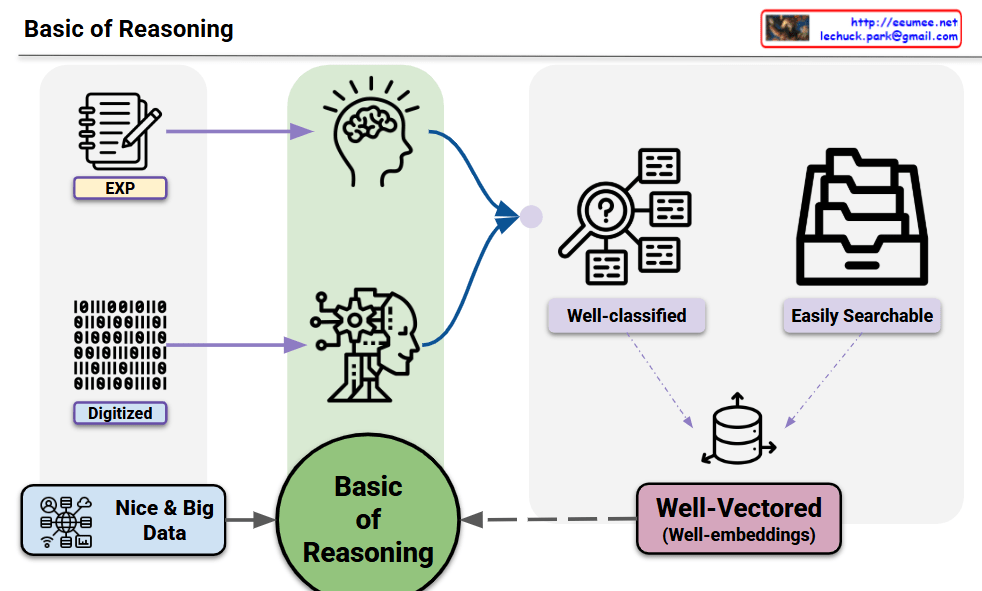
This diagram illustrates that human reasoning and AI reasoning share fundamentally identical structures.
Key Insights:
Common Structure Between Human and AI:
Human Experience (EXP) = Digitized Data: Human experiential knowledge and AI’s digital data are essentially the same information in different representations
Both rely on high-quality, large-scale data (Nice & Big Data) as their foundation
Shared Processing Pipeline:
Both human brain (intuitive thinking) and AI (systematic processing) go through the same Basic of Reasoning process
Information gets well-classified and structured to be easily searchable
Finally transformed into well-vectorized embeddings for storage
Essential Components for Reasoning:
Quality Data: Whether experience or digital information, sufficient and high-quality data is crucial
Structure: Systematic classification and organization of information
Vectorization: Conversion into searchable and associative formats
Summary: This diagram demonstrates that effective reasoning – whether human or artificial – requires the same fundamental components: quality data and well-structured, vectorized representations. The core insight is that human experiential learning and AI data processing follow identical patterns, both culminating in structured knowledge storage that enables effective reasoning and retrieval.
This diagram illustrates the thermodynamic principles and calculation methods for cooling systems, particularly relevant for data center and server room thermal management.
System Components
Left Side (Heat Generation)
Power consumption device (Power kW)
Time element (Time kWh)
Heat-generating source (appears to be server/computer systems)
Right Side (Cooling)
Cooling system (Cooling kW – Remove ‘Heat’)
Cooling control system
Coolant circulation system
Core Formula: Q = m×Cp×ΔT
Heat Generation Side (Red Box)
Q: Heat flow rate (J/s) = Power (kW)
V: Volumetric flow rate (m³/s)
ρ: Air density (approximately 1.2 kg/m³)
Cp: Specific heat capacity of air at constant pressure (approximately 1005 J/(kg·K))
ΔT: Temperature change
Cooling Side (Blue Box)
Q: Cooling capacity (kW)
m: Coolant circulation rate (kg/s)
Cp: Specific heat capacity of coolant (for water, approximately 4.2 kJ/kg·K)
ΔT: Temperature change
System Operation Principle
Heat generated by electronic equipment heats the air
Heated air moves to the cooling system
Circulating coolant absorbs the heat
Cooling control system regulates flow rate or temperature
Processed cool air recirculates back to the system
Key Design Considerations
The cooling control system monitors critical parameters such as:
High flow rate vs. High temperature differential
Optimal balance between energy efficiency and cooling effectiveness
Heat load matching between generation and removal capacity
Summary
This diagram demonstrates the fundamental thermodynamic principles for cooling system design, where electrical power consumption directly translates to heat generation that must be removed by the cooling system. The key relationship Q = m×Cp×ΔT applies to both heat generation (air side) and heat removal (coolant side), enabling engineers to calculate required coolant flow rates and temperature differentials. Understanding these heat balance calculations is essential for efficient thermal management in data centers and server environments, ensuring optimal performance while minimizing energy consumption.
BitNet is an innovative neural network architecture that achieves extreme efficiency through ultra-low precision quantization while maintaining model performance through strategic design choices.
Key Features
1. Ultra-Low Precision (1.58-bit)
Uses only 3 values: {-1, 0, +1} for weights
Entropy calculation: log₂(3) ≈ 1.58 bits
More efficient than standard 2-bit (4 values) representation
2. Weight Quantization
Ternary weight system with correlation-based interpretation:
+1: Positive correlation
-1: Negative correlation
0: No relation
3. Multi-Layer Structure
Leverages combinatorial power of multi-layer architecture
Enables non-linear function approximation despite extreme quantization
4. Precision-Targeted Operations
Minimizes high-precision operations
Combines 8-bit activation (input data) with 1.58-bit weights
Precise activation functions where needed
5. Hardware & Kernel Optimization
CPU (ARM) kernel-level optimization
Leverages bitwise operations (especially multiply → bit operations)
Memory management through SIMD instructions
Supports non-standard nature of 1.58-bit data
6. Token Relationship Computing
Single token uses N weights of {1, -1, 0} to calculate relationships with all other tokens
Summary
BitNet represents a breakthrough in neural network efficiency by using extreme weight quantization (1.58-bit) that dramatically reduces memory usage and computational complexity while preserving model performance through hardware-optimized bitwise operations and multi-layer combinatorial representation power.
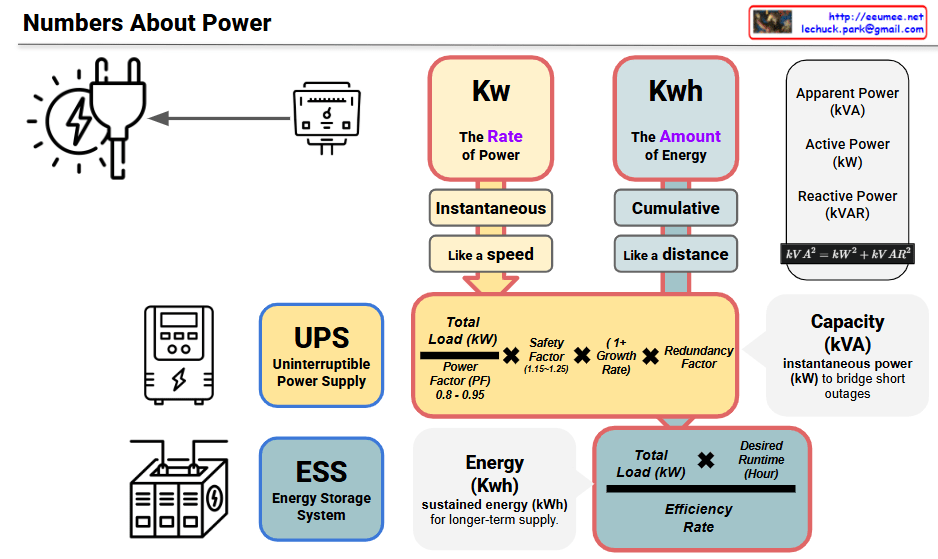
Design actual storage capacity considering efficiency rate
Complementary Operation Strategy
Phase 1: UPS Immediate Response
Power outage → UPS immediately supplies power in kW units
Short-term power supply for minutes to tens of minutes
Phase 2: ESS Long-term Support
Extended outages → ESS provides sustained power in kWh units
Long-term power supply for hours to days
Summary: This structure optimally matches kW (instantaneousness) with UPS strengths and kWh (sustainability) with ESS capabilities. UPS handles immediate power needs while ESS ensures long-duration supply, creating a comprehensive power backup solution.
This image illustrates the collaborative problem-solving process between humans and AI through reasoning, emphasizing their complementary relationship rather than a simple comparison.
Key Components and Interpretation
1. AI’s Operational Flow (Upper Section)
Big Data → Learning → AI Model: The process by which AI builds models through learning from vast amounts of data
Reasoning → Inferencing → Answer: The process by which AI receives questions and generates answers through reasoning
2. Human Role (Lower Section)
Experience: Knowledge and information acquired through direct experience
Logic: A logical thinking framework built upon experience
Reasoning: The cognitive process that combines experience and logic
3. Critical Interaction Mechanisms
Question:
Human reasoning results are input to AI in the form of sophisticated questions
These are not simple queries, but systematic and meaningful questions based on experience and logic
Answer:
AI’s responses are fed back into the human reasoning process
Humans verify AI’s answers and integrate them into new experiences and logic for deeper reasoning
4. Core Message
The red-highlighted phrase “humans must possess a strong, experience-based logical framework” represents the diagram’s central theme:
To collaborate effectively with AI, humans must also possess strong logical thinking frameworks based on experience
The ability to provide appropriate questions and properly verify and utilize AI’s responses is essential
Conclusion
This image demonstrates that human roles do not disappear in the AI era, but rather become more crucial. Human reasoning abilities based on experience and logic play a pivotal role in AI collaboration, and through this, humans and AI can create synergy for better problem-solving. The diagram presents a collaborative model where both entities work together to achieve superior results.
The key insight is that AI advancement doesn’t replace human thinking but rather requires humans to develop stronger reasoning capabilities to maximize the potential of human-AI collaboration.
This diagram illustrates the journey of recognizing and encoding “difference,” moving from philosophical thought to technological realization and finally AI. Ultimately, humans are beings who explain and create meaning, while AI is a system that calculates and processes patterns.




 Lechuck Park