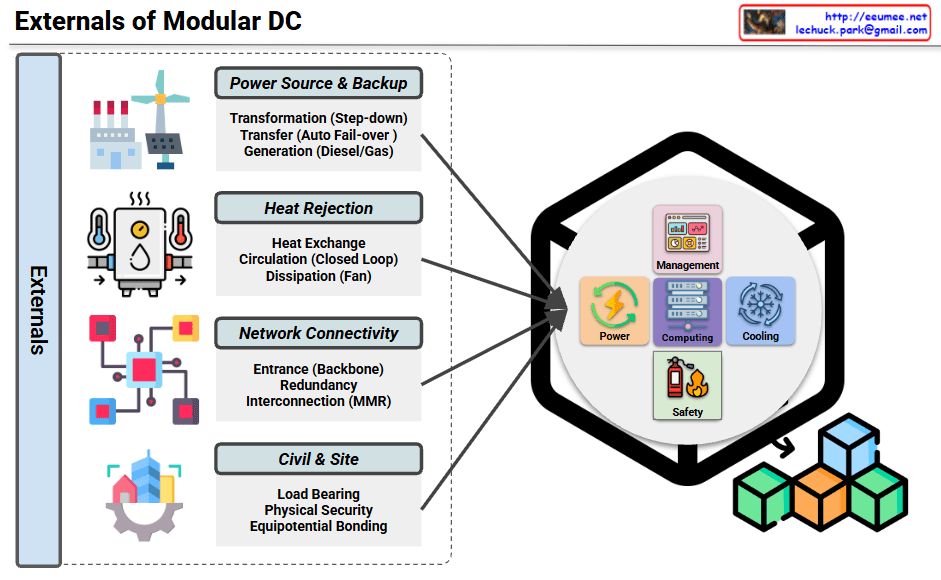
Externals of Modular DC

Externals of Modular DC Infrastructure

This diagram illustrates the external infrastructure systems that support a Modular Data Center (Modular DC).

Main Components

1. Power Source & Backup

  • Transformation (Step-down transformer)
  • Transfer switch (Auto Fail-over)
  • Generation (Diesel/Gas generators)

Ensures stable power supply and emergency backup capabilities.

2. Heat Rejection

  • Heat Exchange equipment
  • Circulation system (Closed Loop)
  • Dissipation system (Fan-based)

Cooling infrastructure that removes heat generated from the data center to the outside environment.

3. Network Connectivity

  • Entrance (Backbone connection)
  • Redundancy configuration
  • Interconnection (MMR – Meet Me Room)

Provides connectivity and telecommunication infrastructure with external networks.

4. Civil & Site

  • Load Bearing structures
  • Physical Security facilities
  • Equipotential Bonding

Handles building foundation and physical security requirements.

Internal Management Systems

The module integrates the following management elements:

  • Management: Integrated control system
  • Power: Power management
  • Computing: Computing resource management
  • Cooling: Cooling system control
  • Safety: Safety management

Summary

Modular data centers require four critical external infrastructure systems: power supply with backup generation, heat rejection for thermal management, network connectivity for communications, and civil/site infrastructure for physical foundation and security. These external systems work together to support the internal management components (power, computing, cooling, and safety) within the modular unit. This architecture enables rapid deployment while maintaining enterprise-grade reliability and scalability.

#ModularDataCenter #DataCenterInfrastructure #DCInfrastructure #EdgeComputing #HybridIT #DataCenterDesign #CriticalInfrastructure #PowerBackup #CoolingSystem #NetworkRedundancy #PhysicalSecurity #ModularDC #DataCenterSolutions #ITInfrastructure #EnterpriseIT

With Claude
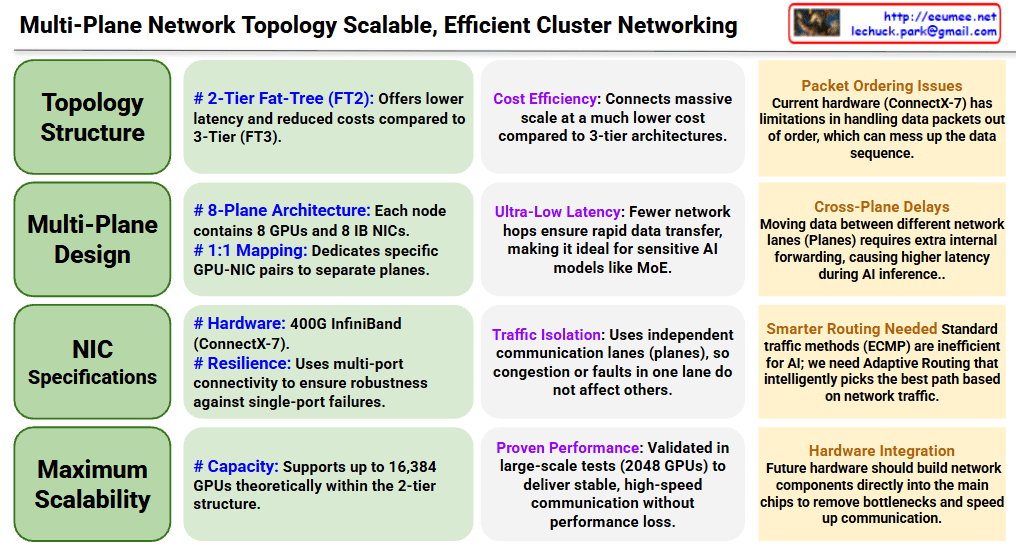
Multi-Plane Network Topology ( deepseek v3)

Multi-Plane Network Topology for Scalable AI Clusters

Core Architecture (Left – Green Sections)

Topology Structure

  • Adopts 2-Tier Fat-Tree (FT2) architecture for reduced latency and cost efficiency compared to 3-Tier
  • Achieves massive scale connections at much lower cost than 3-tier architectures

Multi-Plane Design

  • 8-Plane Architecture: Each node contains 8 GPUs and 8 IB NICs
  • 1:1 Mapping: Dedicates specific GPU-NIC pairs to separate planes

NIC Specifications

  • Hardware: 400G InfiniBand (ConnectX-7)
  • Resilience: Multi-port connectivity ensures robustness against single-port failures

Maximum Scalability

  • Theoretically supports up to 16,384 GPUs within the 2-tier structure

Advantages (Center – Purple Sections)

Cost Efficiency: Connects massive scale at much lower cost compared to 3-tier architectures

Ultra-Low Latency: Fewer network hops ensure rapid data transfer, ideal for latency-sensitive AI models like MoE

Traffic Isolation: Independent communication lanes (planes) prevent congestion or faults in one lane from affecting others

Proven Performance: Validated in large-scale tests with 2048 GPUs, delivering stable and high-speed communication

Challenges (Right – Orange Sections)

Packet Ordering Issues: Current hardware (ConnectX-7) has limitations in handling out-of-order data packets

Cross-Plane Delays: Moving data between different network planes requires extra internal forwarding, causing higher latency during AI inference

Smarter Routing Needed: Standard traffic methods (ECMP) are inefficient for AI; requires Adaptive Routing that intelligently selects the best path based on network traffic

Hardware Integration: Future hardware should build network components directly into main chips to remove bottlenecks and speed up communication


Summary

This document presents a multi-plane network topology using 2-tier Fat-Tree architecture that scales AI clusters up to 16,384 GPUs cost-effectively with ultra-low latency. The 8-plane design with 1:1 GPU-NIC mapping provides traffic isolation and resilience, though challenges remain in packet ordering and cross-plane communication. Future improvements require smarter routing algorithms and deeper hardware-network integration to optimize AI workload performance.

#AIInfrastructure #DataCenterNetworking #HPC #InfiniBand #GPUCluster #NetworkTopology #FatTree #ScalableComputing #MLOps #AIHardware #DistributedComputing #CloudInfrastructure #NetworkArchitecture #DeepLearning #AIatScale

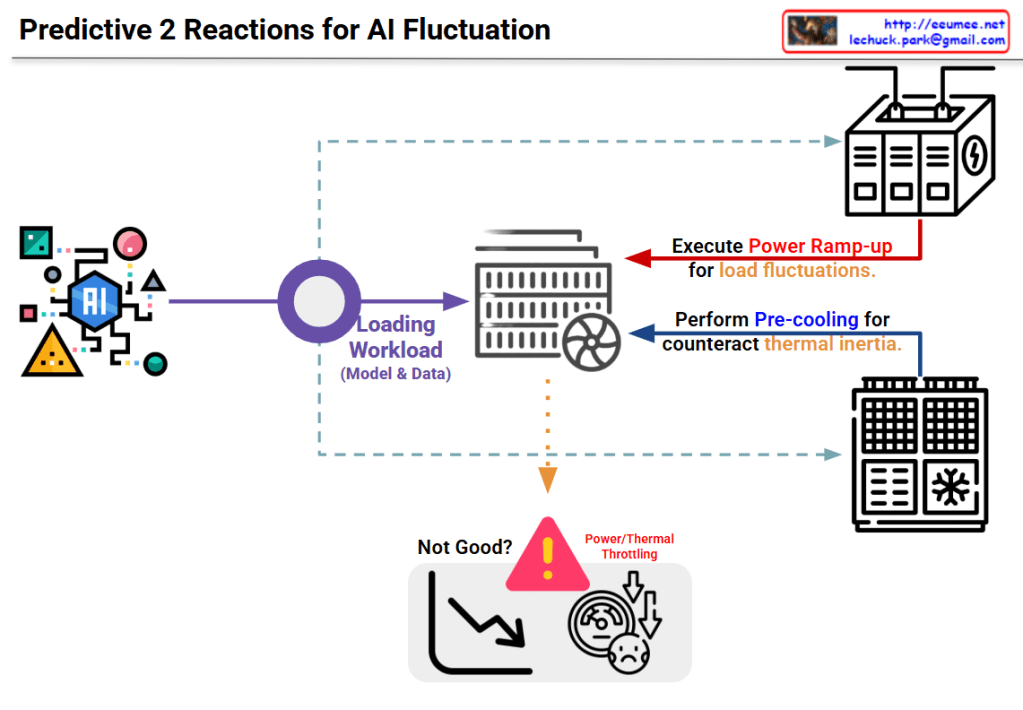
Predictive 2 Reactions for AI HIGH Fluctuation

Image Interpretation: Predictive 2-Stage Reactions for AI Fluctuation

This diagram illustrates a two-stage predictive strategy to address load fluctuation issues in AI systems.

System Architecture

Input Stage:

  • The AI model on the left generates various workloads (model and data)

Processing Stage:

  • Generated workloads are transferred to the central server/computing system

Two-Stage Predictive Reaction Mechanism

Stage 1: Power Ramp-up

  • Purpose: Prepare for load fluctuations
  • Method: The power supply system at the top proactively increases power in advance
  • Preventive measure to secure power before the load increases

Stage 2: Pre-cooling

  • Purpose: Counteract thermal inertia
  • Method: The cooling system at the bottom performs cooling in advance
  • Proactive response to lower system temperature before heat generation

Problem Scenario

The warning area at the bottom center shows problems that occur without these responses:

  • Power/Thermal Throttling
  • Performance degradation (downward curve in the graph)
  • System dissatisfaction state

Key Concept

This system proposes an intelligent infrastructure management approach that predicts rapid fluctuations in AI workloads and proactively adjusts power and cooling before actual loads occur, thereby preventing performance degradation.


Summary

This diagram presents a predictive two-stage reaction system for AI workload management that combines proactive power ramp-up and pre-cooling to prevent thermal throttling. By anticipating load fluctuations before they occur, the system maintains optimal performance without degradation. The approach represents a shift from reactive to predictive infrastructure management in AI computing environments.


#AIInfrastructure #PredictiveComputing #ThermalManagement #PowerManagement #AIWorkload #DataCenterOptimization #ProactiveScaling #AIPerformance #ThermalThrottling #SmartCooling #MLOps #AIEfficiency #ComputeOptimization #InfrastructureAsCode #AIOperations

With Claude

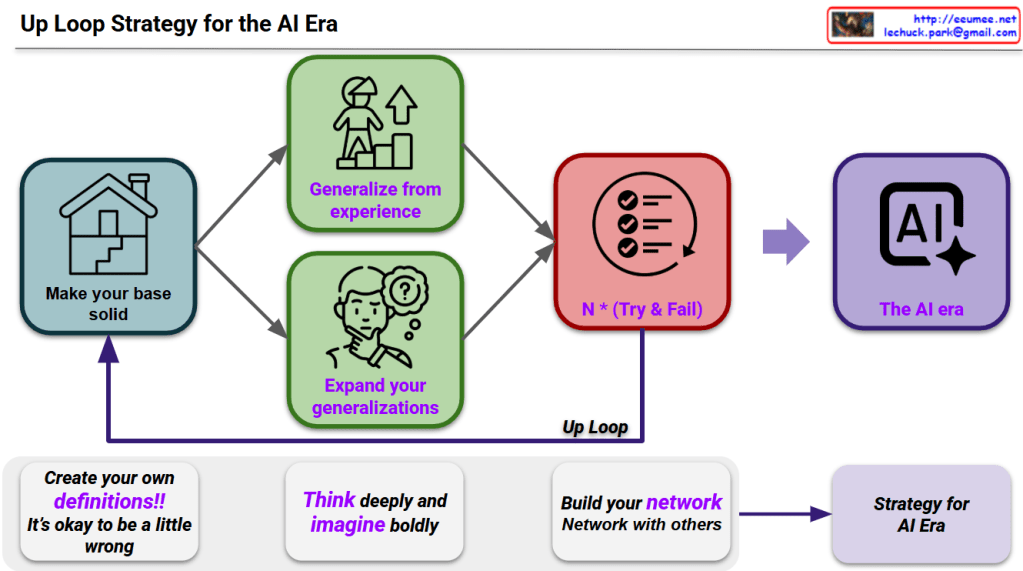
Up Loop Strategy for the AI Era

Up Loop Strategy for the AI Era – Analysis

This diagram presents a learning and growth strategy for preparing for the AI era.

Core循環 Structure (Up Loop)

1. Make your base solid

  • The starting point of everything
  • Building strong fundamentals

2. Two developmental paths

  • Generalize from experience: Extract patterns and principles from your own experiences
  • Expand your generalizations: Extend existing understanding to broader domains

3. N × (Try & Fail)

  • Learning through iterative experimentation and failure
  • This process is the key to actual growth

4. The AI era

  • Ultimate goal: Adapt to and succeed in the AI era

5. Up Loop

  • Return to basics and repeat at a higher level
  • Continuous improvement and growth cycle

Supporting Principles (Bottom Section)

“Create your own definitions!! It’s okay to be a little wrong”

  • Create your own definitions
  • Being slightly wrong is acceptable (escape perfectionism)

“Think deeply and imagine boldly”

  • Think deeply and imagine courageously

“Build your network, Network with others”

  • The importance of building networks

These three elements combine → Strategy for AI Era

Key Message

This strategy emphasizes learning through continuous trial and error rather than perfection, self-directed learning, and networking. It aims to develop the competencies needed for the AI era through iterative improvement.


Summary

This framework advocates for a continuous learning cycle: build solid foundations, generalize and expand your knowledge, then embrace multiple failures as learning opportunities. The strategy rejects perfectionism in favor of bold experimentation, deep thinking, and collaborative networking. Success in the AI era comes from iterative improvement through this “up loop” rather than seeking perfect answers from the start.

#AIStrategy #GrowthMindset #ContinuousLearning #IterativeImprovement #UpLoop #AIEra #LearnFromFailure #NetworkBuilding #LifelongLearning #FutureOfWork #AdaptiveThinking #ExperimentalMindset #AIReadiness #PersonalDevelopment #ProfessionalGrowth

With Claude

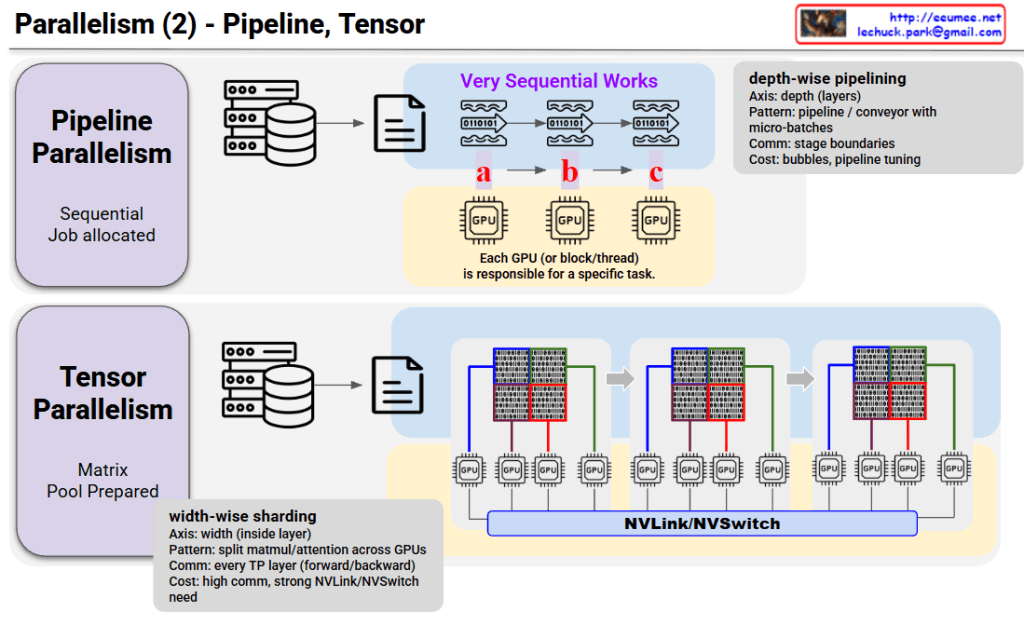
Parallelism (2) – Pipeline, Tensor

Parallelism (2) – Pipeline vs Tensor Parallelism

This image compares two parallel processing techniques: Pipeline Parallelism and Tensor Parallelism.

Pipeline Parallelism

Core Concept:

  • Sequential work is divided into multiple stages
  • Each GPU is responsible for a specific task (a → b → c)

Characteristics:

  • Axis: Depth-wise – splits by layers
  • Pattern: Pipeline/conveyor belt with micro-batches
  • Communication: Only at stage boundaries
  • Cost: Bubbles (idle time), requires pipeline tuning

How it works: Data flows sequentially like waves, with each GPU processing its assigned stage before passing to the next GPU.


Tensor Parallelism

Core Concept:

  • Matrix pool is prepared and split in advance
  • All GPUs simultaneously process different parts of the same data

Characteristics:

  • Axis: Width-wise – splits inside layers
  • Pattern: Width-wise sharding – splits matrix/attention across GPUs
  • Communication: Occurs at every Transformer layer (forward/backward)
  • Cost: High communication overhead, requires strong NVLink/NVSwitch

How it works: Large matrices are divided into chunks, with each GPU processing simultaneously while continuously communicating via NVLink/NVSwitch.


Key Differences

AspectPipelineTensor
Split MethodLayer-wise (vertical)Within-layer (horizontal)
GPU RoleDifferent tasksParts of same task
CommunicationLow (stage boundaries)High (every layer)
Hardware NeedsStandardHigh-speed interconnect required

Summary

Pipeline Parallelism splits models vertically by layers with sequential processing and low communication cost, while Tensor Parallelism splits horizontally within layers for parallel processing but requires high-speed interconnects. These two techniques are often combined in training large-scale AI models to maximize efficiency.

#ParallelComputing #DistributedTraining #DeepLearning #GPUOptimization #MachineLearning #ModelParallelism #AIInfrastructure #NeuralNetworks #ScalableAI #HPC

With Claude